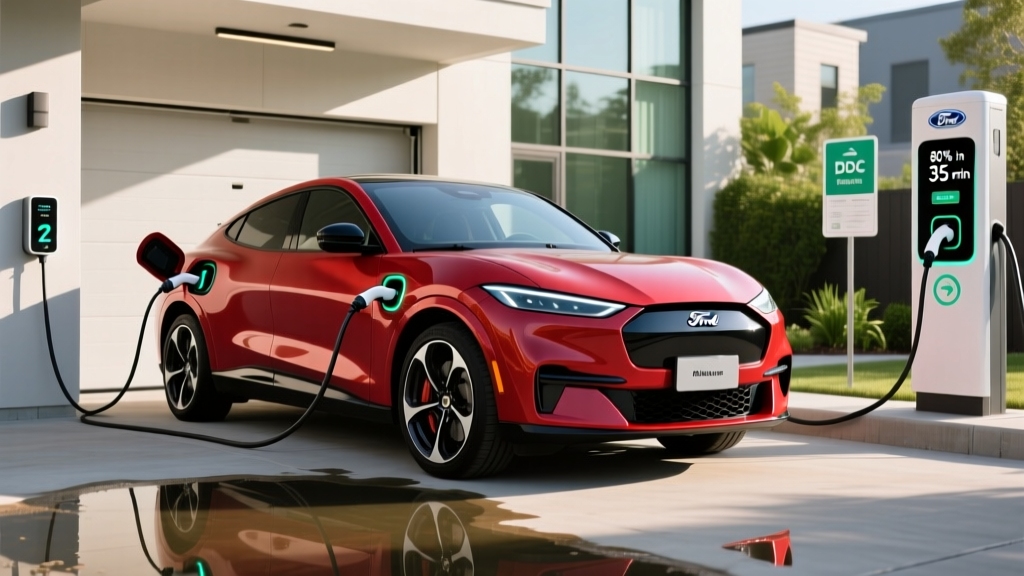
Ford Mustang Mach-E Charging Speeds at Every Level
If you own or are shopping for a Ford Mustang Mach-E, the single most practical question is how long it takes to recharge. The answer depends entirely on which charging level you use. The 2025-2026 Mustang Mach-E is available with two battery packs — a 70 kWh usable Standard Range (LFP chemistry) and a 91 kWh usable Extended Range (NMC chemistry) — and each responds differently to the power you feed it.
Before we get to the numbers, a critical distinction: kW (kilowatts) measures power — the rate at which electricity flows into the battery, like water pressure from a hose. kWh (kilowatt-hours) measures energy — the total amount stored in the battery, like gallons in a tank. A 91 kWh battery charged at 11.5 kW takes roughly 8 hours from empty; that same battery at 150 kW DC fast charging recovers much faster, but only up to its peak acceptance rate.
| Charging Level | Power (kW) | Voltage / Amps | Miles of Range Added per Hour | Best For |
|---|---|---|---|---|
| Level 1 (Standard Outlet) | 1.2–1.4 kW | 120V / 12A | ~3–4 miles/hr | Overnight trickle, PHEVs, emergencies |
| Level 2 (Home / Workplace) | 7.2–11.5 kW | 240V / 32–48A | ~20–32 miles/hr | Daily home charging, destination charging |
| DC Fast Charging | 50–150+ kW | 400–800V DC | ~120–250+ miles/hr (peak) | Road trips, rapid top-ups |
The Mach-E's onboard charger maxes out at 10.5 kW on Level 2 AC (2025-2026 models with the updated dual-phase onboard charger; earlier 2021-2023 models were limited to 10.5 kW single-phase). On DC fast charging, the Extended Range pack peaks at approximately 150 kW, while the Standard Range LFP pack peaks around 115 kW.
Mustang Mach-E Charge Time: 10-80% Breakdown by Method
Ford and most EV makers quote 10-80% charge times because charging slows significantly above 80% to protect battery health. Here's what to expect with each Mach-E battery configuration:
Extended Range (91 kWh, NMC):
- Level 1 (120V): 10-80% in ~50+ hours — not practical as a primary method
- Level 2 (240V, 48A / 11.5 kW): 10-80% in ~6.5 hours
- DC Fast (150 kW peak): 10-80% in ~36 minutes (Ford's published estimate)
Standard Range (70 kWh, LFP):
- Level 1 (120V): 10-80% in ~38 hours
- Level 2 (240V, 48A / 10.5 kW): 10-80% in ~5.5 hours
- DC Fast (115 kW peak): 10-80% in ~40 minutes
Real-world charging curve reality: That 150 kW peak on the Extended Range is sustained only roughly between 15-55% State of Charge (SoC). Above 60%, the rate tapers to ~80 kW, and above 80% it drops below 40 kW. This means a 10-90% session takes considerably longer than a linear calculation would suggest — expect roughly 50-55 minutes total if you push past 80% on a road trip. Plan your stops around the 10-80% window for the best time-to-range ratio.
The Standard Range LFP battery has a flatter charge curve — it holds closer to its peak rate longer, which partially offsets its lower peak kW. In practice, the 10-80% gap between the two packs at a DC fast charger is only about 4-5 minutes.
Home Charger Installation: Electrical Requirements and Costs
The most common and cost-effective way to charge a Mustang Mach-E is a Level 2 home station on a 240V circuit. Here's what's involved electrically:
Circuit requirements: For a 48-amp charger (the sweet spot for the Mach-E's 10.5-11.5 kW onboard charger), the National Electrical Code (NEC) requires the circuit to be rated at 125% of the continuous load — that means a 60-amp breaker on a dedicated circuit. A 40-amp charger requires a 50-amp breaker. Do not share this circuit with other major appliances.
Panel capacity: Most modern homes with 200-amp service can accommodate a 60-amp EV circuit without a panel upgrade. Older homes with 100-amp service or panels already near capacity (electric range, dryer, HVAC, water heater all running) may need a service upgrade to 200 amps or a smart panel load-management device like the Span panel or Emporia smart breaker.
| Cost Component | Typical Range | Notes |
|---|---|---|
| Level 2 Charger (Equipment) | $350–$750 | Smart Wi-Fi chargers, 40-48A, 20-25ft cable |
| Electrician Labor | $400–$1,500 | Depends on run length from panel to garage |
| Permit & Inspection | $50–$250 | Required in most jurisdictions; varies by municipality |
| Electrical Materials (conduit, wire, breaker) | $100–$400 | Longer runs and outdoor routing cost more |
| Panel Upgrade (if needed) | $1,500–$3,500 | 100A → 200A service upgrade; not always required |
| Total (no panel upgrade) | $900–$2,900 | Most homes with 200A service fall in this range |
| Total (with panel upgrade) | $2,400–$6,400 | Older homes, high-load panels |
Federal tax credit for home charging: The IRS §30C Alternative Fuel Vehicle Refueling Property Credit covers 30% of home charger equipment and installation costs, up to $1,000. This is subject to income limits and census-tract eligibility (must be in a non-urban or low-income area). Always verify current-year eligibility on irs.gov and consult a tax professional — rules change and vary by location.
Connector Compatibility: NACS, CCS, and Adapter Realities
The Mustang Mach-E's charge port has evolved. Here's what you need to know depending on model year:
| Model Year | Built-In Connector | Tesla Supercharger Access | Adapter Needed? |
|---|---|---|---|
| 2021–2024 Mach-E | CCS1 (Combo) | Yes (via adapter, Ford-authorized since 2024) | NACS-to-CCS adapter (Ford provides or sells) |
| 2025–2026 Mach-E | NACS (native Tesla port) | Yes, direct plug-in | CCS adapter needed for Electrify America, EVgo CCS stations |
Ford transitioned to the NACS (North American Charging Standard) connector starting with 2025 model-year production. If you're buying a new 2025-2026 Mach-E, you get native Tesla Supercharger compatibility with no adapter. However, you'll need a NACS-to-CCS adapter (roughly $200-$250) to use older CCS-equipped public chargers from Electrify America, EVgo, and some ChargePoint stations.
For 2021-2024 owners, Ford began distributing NACS adapters in 2024 enabling Supercharger access. Check with your dealer or the FordPass app for adapter availability specific to your VIN. The Mach-E does not support CHAdeMO — that legacy standard is limited mostly to the Nissan Leaf and Mitsubishi Outlander PHEV at this point.
Level 2 Home Charger Recommendations for the Mach-E
To maximize the Mach-E's 10.5-11.5 kW onboard charging capability, you want a 48-amp Level 2 station on a 60-amp circuit. Here are proven units matched to the Mach-E's needs:
Ford Charge Station Pro (48A)
Power: 11.5 kW (48A, 240V)
Connector: NACS (2025+ vehicles) / CCS (older models)
Cable: 25 ft
Smart features: Wi-Fi, FordPass integration, scheduled charging, software updates
Price: ~$650–$800
Why it works: Native Ford integration, eligible for §30C credit. Best for owners who want seamless app control and Ford warranty alignment.
ChargePoint Home Flex (up to 50A)
Power: Up to 12 kW (50A, 240V) — adjustable via DIP switch
Connector: NACS or J1772 (with adapter for CCS/NACS depending on config)
Cable: 23 ft
Smart features: Wi-Fi, ChargePoint app, Alexa, load sharing, energy tracking
Price: ~$550–$700
Why it works: Flexible amperage lets you match your circuit exactly. Excellent app and energy reporting. Widely available at Costco and Amazon.
Emporia Vue Level 2 Charger (48A)
Power: 11.5 kW (48A, 240V)
Connector: J1772 (NACS adapter included or sold separately)
Cable: 24 ft
Smart features: Wi-Fi, Emporia app, solar integration, load management, energy monitoring
Price: ~$350–$450
Why it works: Best value in smart chargers. Pairs with the Emporia Vue energy monitor for whole-home load tracking. Ideal if you have solar panels.
Tesla Wall Connector (48A)
Power: 11.5 kW (48A, 240V)
Connector: NACS (native)
Cable: 24 ft
Smart features: Wi-Fi, Tesla app, power sharing between multiple units, OTA updates
Price: ~$420–$475
Why it works: If your 2025-2026 Mach-E has NACS, this works perfectly. Excellent build quality and the lowest price among premium smart chargers. No J1772/CCS output without a separate adapter.
Hardwired vs. plug-in: Chargers at 48A should be hardwired by an electrician (no plug). Units rated 40A or below can use a NEMA 14-50 plug, which offers portability if you move. Hardwired installations are generally more reliable and avoid the known issue of NEMA 14-50 receptacle overheating under continuous EV loads — many electricians now recommend hardwiring regardless of amperage.
Charging Cost Per Mile: Mach-E vs. Gas Vehicle
The Mustang Mach-E Extended Range AWD is rated by the EPA at roughly 98 MPGe combined (varies by trim and wheel size), which translates to about 34 kWh per 100 miles. The Standard Range RWD models achieve closer to 101-105 MPGe, or ~32 kWh/100 mi. Here's what that costs in real scenarios:
| Charging Scenario | Cost per kWh | Cost per 100 Miles (Mach-E ER AWD) | Cost per Mile |
|---|---|---|---|
| Home (national avg. residential) | $0.16/kWh | $5.44 | $0.054 |
| Home (off-peak utility rate) | $0.08/kWh | $2.72 | $0.027 |
| Home (high-cost state, e.g. CA avg.) | $0.30/kWh | $10.20 | $0.102 |
| Public Level 2 (ChargePoint, EVgo) | $0.25–$0.40/kWh | $8.50–$13.60 | $0.085–$0.136 |
| DC Fast (Electrify America, EA Pass) | $0.35–$0.55/kWh | $11.90–$18.70 | $0.119–$0.187 |
| Tesla Supercharger (avg. 2026) | $0.28–$0.40/kWh | $9.52–$13.60 | $0.095–$0.136 |
| Gas equivalent (25 MPG avg. SUV, $3.40/gal) | — | $13.60 | $0.136 |
The bottom line: Home charging — especially on off-peak utility rates — is dramatically cheaper than gas, saving 60-80% per mile. Public DC fast charging at premium rates can approach or even exceed gas cost per mile. The economics of EV ownership hinge on your ability to charge at home. If you're entirely dependent on public DC fast chargers at $0.45+/kWh, the fuel savings shrink significantly.
Many utilities offer time-of-use (TOU) rates that drop electricity to $0.06-$0.10/kWh between 11 PM and 6 AM. The Mach-E's FordPass app and most smart chargers support scheduled charging — plug in when you get home, and the car starts charging at midnight when rates are lowest.
Safety, Code, and Installation Best Practices
EV charging is a continuous high-draw load — your charger will pull maximum current for 6-8 hours straight, which is more demanding than any other household appliance. Proper installation matters for safety and insurance:
- Dedicated circuit: The EV charger must have its own dedicated breaker. Sharing a circuit with a dryer or HVAC unit is a code violation and a fire risk.
- GFCI protection: NEC 2020 and later require GFCI (Ground Fault Circuit Interrupter) protection for outdoor receptacles. Hardwired chargers with built-in ground-fault protection satisfy this without a separate GFCI breaker. Many electricians recommend hardwiring partly to avoid nuisance GFCI trips that plague some NEMA 14-50 installations.
- Outdoor rating: If your charger is installed outside (carport, driveway), ensure the unit is rated NEMA 4 (weatherproof). All the chargers recommended above carry outdoor ratings, but the electrical junction box and conduit connections must also be weather-sealed.
- Permit and inspection: Most jurisdictions require an electrical permit for a new 240V circuit. The inspection verifies wire gauge, breaker sizing, grounding, and conduit. Skipping the permit risks insurance claim denial if an electrical fire occurs. Budget $50-$250 and 1-3 weeks for the permit-to-inspection cycle.
- Wire gauge: A 60-amp circuit requires 6 AWG copper wire (or 4 AWG aluminum). Your electrician will size this based on run length — longer runs may need thicker wire to prevent voltage drop.
Always hire a licensed electrician familiar with EV charger installations. Ask for their experience specifically with 240V/48A+ continuous-load circuits. General electricians who rarely do EV work may undersize the circuit or skip the permit.
Frequently Asked Questions
How much does it cost to install a home EV charger for the Mustang Mach-E?
Most homes with a 200-amp electrical panel will pay between $900 and $2,900 total for a 48-amp Level 2 charger installation, including equipment ($350-$750), electrician labor ($400-$1,500), materials ($100-$400), and permit ($50-$250). Homes needing a panel upgrade from 100A to 200A should budget an additional $1,500-$3,500. The IRS §30C credit can offset up to $1,000 (30%) if you meet income and location requirements.
How fast will each charging level add range to my Mach-E?
Level 1 (120V standard outlet) adds roughly 3-4 miles of range per hour — about 30-40 miles overnight. Level 2 (240V, 48A) adds 20-32 miles per hour, enough to fully replenish a day's driving in 2-3 hours. DC fast charging at 150 kW adds roughly 120-200 miles in 20-30 minutes at peak rate, though this tapers as the battery fills past 60% SoC.
Which connector and charger is compatible with my Mustang Mach-E?
2025-2026 Mach-E models use the NACS connector natively, giving direct access to Tesla Superchargers and all new NACS-equipped public chargers. 2021-2024 models use CCS1 and need a Ford-authorized NACS adapter for Supercharger access. For home Level 2 charging, any NACS or J1772 (with adapter) Level 2 station rated 40-48A will work. The Mach-E does not support CHAdeMO.
How much does charging cost per mile compared to gas?
At home on the national average electricity rate ($0.16/kWh), the Mach-E Extended Range AWD costs approximately $0.054 per mile — roughly 60% less than a comparable gas SUV at 25 MPG and $3.40/gallon ($0.136/mile). On off-peak utility rates ($0.08/kWh), the cost drops to under $0.03/mile. Public DC fast charging at $0.40-$0.55/kWh can cost $0.12-$0.19/mile, approaching gas-equivalent costs.
What electrical upgrades might I need for a home charger?
If your home has a 200-amp panel with available capacity, you likely need no upgrade — just a new 60-amp breaker and a dedicated 240V circuit. If you have a 100-amp panel, an older fuse box, or your panel is already near capacity with existing appliances, you may need a service upgrade to 200 amps ($1,500-$3,500) or a smart load-management system that throttles the charger when other high-draw appliances are running. Your electrician will perform a load calculation to determine this during the initial assessment.
Does the Mustang Mach-E support vehicle-to-home (V2H) or vehicle-to-load (V2L)?
The Mach-E does not currently offer V2H (powering your home during an outage) or V2L (powering external devices from the charge port). Ford has discussed bidirectional charging capability on future platforms, but as of the 2026 model year, the Mach-E cannot export power. If V2H is a priority, the Ford F-150 Lightning with the Charge Station Pro and Home Integration System supports it.
Should I charge my Mach-E to 100% every night?
For the Extended Range (NMC battery), Ford recommends setting a daily charge limit of 80-90% and charging to 100% only before long road trips. NMC chemistry degrades faster at sustained high SoC. For the Standard Range (LFP battery), Ford recommends charging to 100% at least once per week — LFP chemistry tolerates full states of charge well and actually benefits from periodic full charges for battery management system (BMS) calibration. Use the FordPass app to set your target SoC.