The Real Story on MINI Electric Range
If you're researching the MINI Electric range and wondering how charging works in the real world, you've landed in the right place. The 2025 MINI Cooper SE (the current-generation electric MINI available in the US) carries a usable battery capacity of approximately 40.7 kWh and delivers an EPA-estimated range of 114 miles. That number is honest but modest — it's a city-oriented commuter car, not a cross-country cruiser.
Understanding how to charge efficiently — and how much range each charging method adds per hour — is essential to making the most of the MINI Electric's compact battery. Below, we break down every charging level, home installation requirements, connector compatibility, real costs, and the best Level 2 equipment for this specific car.
Charging Levels Explained: kW, Miles Per Hour, and What Each Level Means
Before we get into specifics, let's clear up the single most common confusion in EV ownership: the difference between kW and kWh.
- kW (kilowatts) = power, or the rate at which electricity flows. Think of it like water pressure from a hose.
- kWh (kilowatt-hours) = energy, or the total amount of electricity stored or delivered. Think of it like gallons in a bucket.
Your MINI Cooper SE's battery holds about 40.7 kWh of energy. A charger rated at 11 kW delivers energy at that rate — so in one hour at full power, it would add roughly 11 kWh to your battery (before accounting for charging losses of ~10%).
| Level | Voltage / Amperage | Max Power (kW) | Miles of Range Added Per Hour | Typical Use Case |
|---|---|---|---|---|
| Level 1 (120V) | 120V / 12A | ~1.4 kW | ~3–4 miles/hr | Overnight trickle; emergency top-ups |
| Level 2 (240V) | 240V / 32–48A | 7.7–11.5 kW | ~22–33 miles/hr | Daily home charging; workplace |
| DC Fast Charging | 400V+ DC | Up to 95 kW (peak) | ~150–180 miles/hr (at peak) | Road trips; rapid top-ups |
Key context for MINI owners: The MINI Cooper SE's onboard charger (which governs Level 1 and Level 2 speeds) maxes out at 11 kW on AC power. That means even if you plug into a 48-amp (11.5 kW) Level 2 charger, the car will only accept about 11 kW. You won't damage anything — the car and charger negotiate the safe maximum — but there's no benefit to buying a charger rated above 48 amps for this vehicle.
For DC fast charging, the MINI Cooper SE can accept a peak of approximately 95 kW on a CCS1-equipped charger. However, peak rate is not sustained rate. The charge curve tapers significantly above 80% state of charge (SoC) to protect battery health. A realistic 10–80% DC fast charge session takes approximately 30–36 minutes under ideal conditions (battery preconditioned, ambient temperature 60–80°F).
Home Charger Installation: Electrical Requirements, Costs, and Panel Considerations
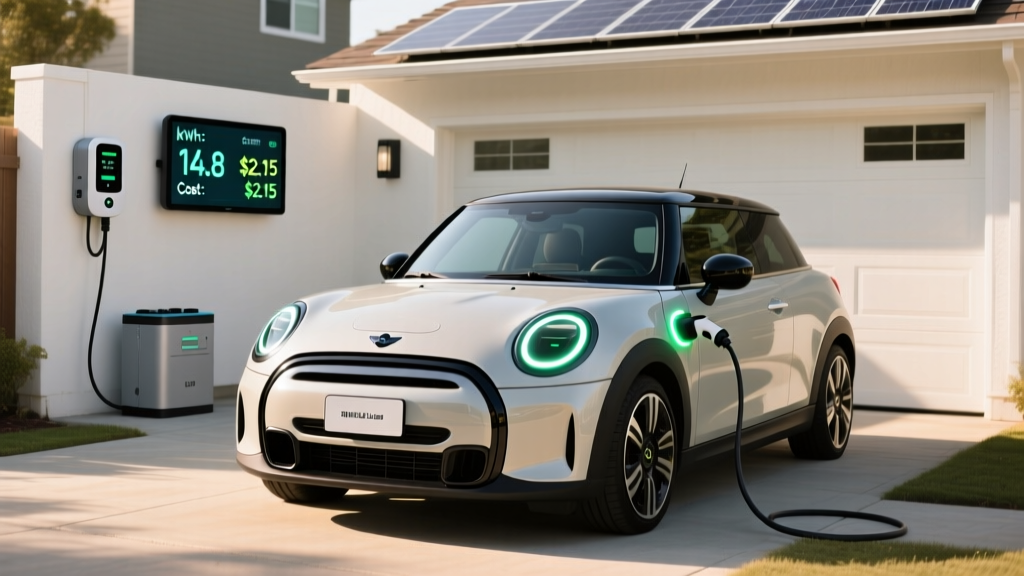
Most MINI Electric owners will want a Level 2 home charger — it's the difference between waking up to a full battery every morning and spending hours on a trickle charge. Here's what a proper Level 2 installation actually requires.
Electrical Requirements
A Level 2 charger for the MINI Cooper SE needs a 240-volt dedicated circuit. The ideal setup is a NEMA 14-50 outlet (50-amp circuit, 40 amps continuous draw) or a hardwired connection on a 60-amp circuit for chargers rated at 48 amps continuous.
- Minimum viable: 240V / 30A circuit (24A continuous) — delivers ~5.8 kW, adding ~17 miles/hr
- Recommended: 240V / 50A circuit (40A continuous) — delivers ~9.6 kW, adding ~28 miles/hr
- Maximum for MINI: 240V / 60A circuit (48A continuous) — delivers ~11.5 kW, but car caps at 11 kW
Do You Need a Panel Upgrade?
This is the question that catches many homeowners off guard. Your electrical panel has a total capacity (typically 100A or 200A in modern homes). A licensed electrician will perform a load calculation to determine whether your panel can handle a new 40A or 50A circuit on top of your existing loads (HVAC, water heater, dryer, oven, etc.).
If you have a 100-amp panel in an older home with electric appliances, a panel upgrade to 200 amps may be necessary. This adds significant cost. Homes with 200-amp panels and gas appliances typically have ample headroom.
Permits and Code
Virtually all jurisdictions require an electrical permit for a new 240V circuit. The permit ensures the work meets the National Electrical Code (NEC) and is inspected for safety. Your electrician typically pulls this permit. Do not skip it — unpermitted work can void home insurance and cause issues at resale.
| Component | Low-End Estimate | High-End Estimate | Notes |
|---|---|---|---|
| Level 2 Charger (Equipment) | $350 | $700 | Quality smart chargers; see recommendations below |
| Electrician Labor | $400 | $1,200 | Depends on run length, conduit, wall type |
| Electrical Permit | $50 | $200 | Varies by municipality |
| Panel Upgrade (if needed) | $1,500 | $3,500 | 100A → 200A; only if load calc requires it |
| Total (no panel upgrade) | $800 | $2,100 | Most common scenario for modern homes |
| Total (with panel upgrade) | $2,300 | $5,600 | Older homes with 100A panels |
Federal incentive note: The Residential Clean Energy Credit (IRC §25D) does not cover EV charger equipment for most taxpayers after 2022. However, the Alternative Fuel Vehicle Refueling Property Credit (IRC §30C) may provide up to $1,000 for home charger installation if you live in an eligible census tract. Check with a tax professional and the IRS for current-year eligibility rules, as these change frequently.
Connector Compatibility: What Plugs Into the MINI Cooper SE?
The MINI Cooper SE sold in the US uses the CCS1 (Combined Charging System) connector for both Level 2 AC charging and DC fast charging. This is the standard shared by most non-Tesla EVs sold in North America through 2024.
| Connector Type | Used For | MINI Cooper SE Compatible? | Adapter Needed? |
|---|---|---|---|
| J1772 (Type 1 AC) | Level 1 & Level 2 AC charging | Yes — native CCS1 includes J1772 inlet | No |
| CCS1 | DC fast charging | Yes — native | No |
| NACS (Tesla) | Tesla Superchargers & NACS chargers | With adapter | Yes — CCS-to-NACS adapter (e.g., Lectron, A2Z) |
| CHAdeMO | Legacy DC fast charging (Nissan Leaf) | No | N/A — CHAdeMO networks are declining |
The NACS transition matters for MINI owners: As of 2025–2026, the North American Charging Standard (NACS), originally developed by Tesla, is being adopted by most major automakers. BMW Group (MINI's parent) has announced that future models will transition to NACS. For current CCS1-equipped MINIs, a CCS-to-NACS adapter (~$150–$250) unlocks access to Tesla Supercharger stations, significantly expanding your public charging options on road trips.
For home Level 2 charging, any J1772-equipped charger will plug directly into the MINI without an adapter. The J1772 portion is the upper section of the CCS1 inlet.
Charging Cost Per Mile: Home vs. Public vs. Gas
One of the strongest ownership arguments for the MINI Electric is its low per-mile energy cost — but only if you're charging strategically. Public DC fast charging can erode the savings advantage quickly.
| Scenario | Rate ($/kWh) | Cost to Charge 40.7 kWh (Full Battery) | Cost Per Mile (at 114 mi range) |
|---|---|---|---|
| Home (off-peak utility rate) | $0.10–$0.14 | $4.07–$5.70 | $0.036–$0.050 |
| Home (standard residential rate) | $0.15–$0.20 | $6.11–$8.14 | $0.054–$0.071 |
| Public Level 2 (workplace, retail) | $0.20–$0.35 | $8.14–$14.25 | $0.071–$0.125 |
| DC Fast Charging (Electrify America, EVgo) | $0.35–$0.55 | $14.25–$22.39 | $0.125–$0.196 |
| Gas car (30 MPG combined, $3.50/gal) | N/A | N/A | $0.117 |
The takeaway: Charging at home on off-peak rates makes the MINI Cooper SE roughly 60–70% cheaper per mile than a 30 MPG gas car. But if you rely exclusively on DC fast charging at $0.45+/kWh, your per-mile cost can actually exceed a gasoline vehicle. This is why home Level 2 charging is practically mandatory for the economic case of any EV — and especially for a compact-battery EV like the MINI, where frequent DC fast charging also accelerates battery wear.
The MINI Cooper SE achieves an EPA-rated 110 MPGe combined (miles per gallon equivalent), meaning it consumes about 30 kWh per 100 miles of driving. You can use this figure to calculate your personal cost: multiply your local electricity rate by 0.30 to get cost per mile.
Best Level 2 Chargers for the MINI Cooper SE: Equipment Recommendations
Since the MINI's onboard charger caps at 11 kW, you don't need the most powerful charger on the market. A 40-amp or 48-amp unit is ideal. Here are three chargers that pair well with this car, based on reliability, smart features, and value.
ChargePoint Home Flex (NEMA 14-50)
- Power Output: Up to 12 kW (50A) — adjustable via dip switches
- Connector: J1772 (plugs directly into MINI's CCS1 inlet)
- Cable Length: 23 feet
- Smart Features: Wi-Fi, app scheduling, Alexa integration, energy tracking
- Price: ~$550–$650
- Why for MINI: Amperage flexibility means you can set it to 40A if your circuit is 50A, or lower if needed. Excellent app for scheduling off-peak charges.
Emporia Vue Level 2 Charger
- Power Output: Up to 11.5 kW (48A hardwired) or 9.6 kW (40A plug-in)
- Connector: J1772
- Cable Length: 24 feet
- Smart Features: Wi-Fi, detailed energy monitoring, solar integration, time-of-use scheduling
- Price: ~$350–$450
- Why for MINI: Best value smart charger. Energy monitoring pairs well with solar owners. 48A hardwired version matches the MINI's 11 kW onboard cap perfectly.
Grizzl-E Smart (United Chargers)
- Power Output: Up to 10 kW (40A) — adjustable
- Connector: J1772
- Cable Length: 24 feet
- Smart Features: Wi-Fi, OCPP-compatible, adjustable amperage, outdoor-rated (NEMA 4)
- Price: ~$450–$550
- Why for MINI: Built for harsh outdoor conditions. Canadian-made, rugged aluminum enclosure. 40A output is well within the MINI's acceptance rate.
What to avoid: Ultra-cheap, no-name chargers from online marketplaces that lack UL certification or ETL listing. A charger is a high-amperage device running for hours — it must meet safety standards. Look for UL 2594 or UL 2202 listing on the product label.
Charging Times: How Long to Fill the MINI's 40.7 kWh Battery
Here's what you can expect for common charging scenarios with the MINI Cooper SE's 40.7 kWh battery:
- Level 1 (120V, 1.4 kW): 0–100% in approximately 30–33 hours. Practical only for overnight top-ups of 20–30 miles.
- Level 2 (240V, 9.6 kW / 40A): 0–100% in approximately 5 hours. A typical 20–80% daily charge takes about 2.5 hours.
- Level 2 (240V, 11 kW / 48A): 0–100% in approximately 4.2 hours. This matches the MINI's maximum onboard acceptance rate.
- DC Fast Charging (95 kW peak): 10–80% in approximately 30–36 minutes under ideal conditions. Expect 40–50 minutes in cold weather or without battery preconditioning.
Charge curve reality: DC fast charging does not deliver peak kW for the entire session. The MINI Cooper SE peaks near 95 kW at low SoC (~10–30%) and progressively tapers — dropping to roughly 50 kW by 60% SoC and below 25 kW above 80%. This is why the industry standard metric is 10–80% time rather than 0–100%. Charging above 80% on DC fast is painfully slow and should only be done when absolutely necessary for trip range.
Safety, Code, and Best Practices for Home Charging
A Level 2 charger draws significant current for extended periods. Proper installation and ongoing safety practices matter.
- Dedicated circuit: Your charger must be on its own dedicated breaker — never shared with other appliances. The NEC requires that continuous loads (defined as running 3+ hours) use only 80% of the circuit's rated capacity. A 50A breaker supports 40A continuous; a 60A breaker supports 48A continuous.
- GFCI protection: The 2020 NEC and later require GFCI (Ground Fault Circuit Interrupter) protection for outdoor EV charging outlets. Hardwired indoor installations may not require a GFCI breaker, but your local inspector will determine this. Note: many quality chargers include built-in ground fault detection.
- Outdoor rating: If your charger is mounted outside, it must carry at minimum a NEMA 3R rating (rain-resistant). NEMA 4 (watertight) is preferred. All three chargers recommended above meet outdoor requirements.
- Cable management: A 24-foot cable is sufficient for most garages and driveways. Avoid extension cords — they introduce resistance, heat, and code violations.
- Preconditioning: The MINI Cooper SE supports battery preconditioning when you set a departure time in the vehicle or app. This warms the battery to optimal temperature before charging or driving, improving both charge speed and range — especially in cold climates.
Frequently Asked Questions
How much does it cost to install a home EV charger for the MINI Cooper SE?
Expect $800–$2,100 for a standard Level 2 installation (equipment, electrician labor, and permit) in a home with a 200-amp panel. If your home has an older 100-amp panel that requires an upgrade, total costs can reach $2,300–$5,600. Always get a load calculation from a licensed electrician before committing.
How fast will each charging level add range to my MINI Electric?
Level 1 (120V) adds roughly 3–4 miles per hour. Level 2 (240V at 40A) adds about 28 miles per hour. DC fast charging can add up to 150–180 miles per hour at peak rate, but only for short bursts at low state of charge. For the MINI's 114-mile EPA range, a Level 2 charger replenishes the full battery in about 4–5 hours.
Which connector and charger is compatible with my MINI Cooper SE?
The MINI Cooper SE uses the CCS1 connector natively. For Level 2 home charging, any J1772-equipped charger works directly. For Tesla Supercharger access, you'll need a CCS-to-NACS adapter (~$150–$250). CHAdeMO chargers are not compatible.
How much does charging cost per mile compared to gas?
At home on off-peak rates ($0.12/kWh), the MINI Cooper SE costs about $0.04 per mile — roughly 65% less than a 30 MPG gas car at $3.50/gallon ($0.12/mile). However, DC fast charging at $0.45/kWh pushes the cost to $0.14/mile, which is more expensive than gas. Home charging is essential to the economic advantage.
What electrical upgrades might I need for a Level 2 charger?
Most homes with a 200-amp panel need only a new 240V dedicated circuit (50A or 60A breaker). Homes with 100-amp panels, especially those with electric HVAC, water heaters, and dryers, may need a panel upgrade to 200 amps ($1,500–$3,500). A licensed electrician will perform a load calculation to determine this before any work begins.
Will DC fast charging damage my MINI's battery?
Occasional DC fast charging is fine and expected. However, frequent use (multiple times per week) accelerates battery degradation compared to Level 2 charging. The MINI's battery management system includes thermal management to mitigate this, but for daily charging, Level 2 at home is always preferable for long-term battery health. BMW provides a battery warranty of 8 years or 100,000 miles, covering capacity loss below 70% of original.
Does the MINI Cooper SE qualify for the federal EV tax credit?
The federal EV tax credit under IRC §30D has complex eligibility rules including MSRP caps, buyer income limits, and battery component/critical mineral sourcing requirements. The MINI Cooper SE's eligibility varies by model year and sourcing changes. As of 2025, check the latest IRS guidance and MINI's official information, as battery supply chain changes can shift eligibility mid-year. Point-of-sale transfer is available if eligible, reducing your purchase price directly at the dealer.