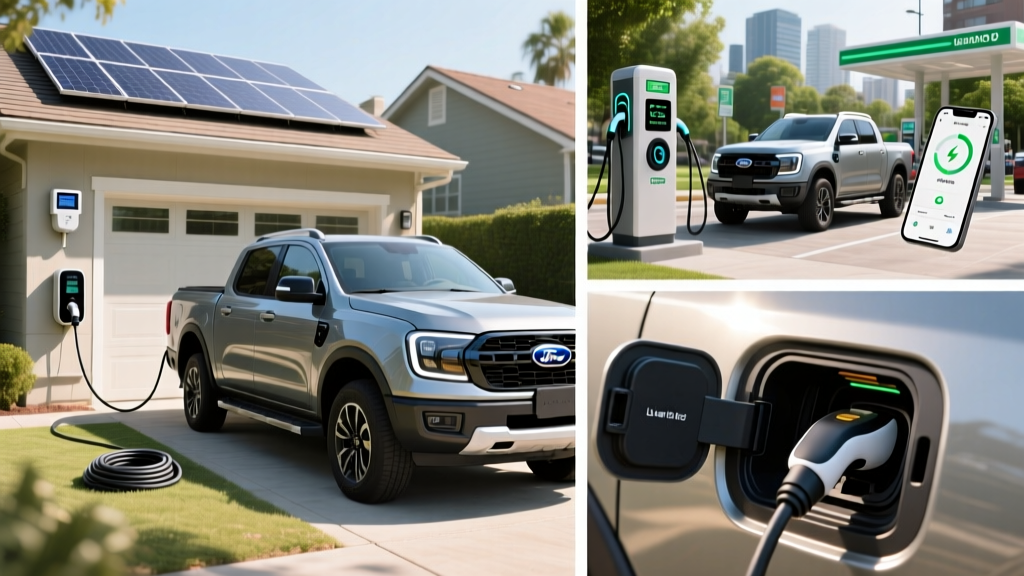
The 2025 Ford Ranger Hybrid pairs a turbocharged gasoline engine with a modest electric motor and a compact lithium-ion battery pack. Unlike a full battery-electric vehicle (BEV), this hybrid architecture means your charging needs are fundamentally different — and far simpler — than those of a pure EV owner. Still, understanding exactly how the system charges, what equipment you actually need, and what it costs per mile is critical before you plug in or call an electrician.
This guide breaks down every charging scenario for the 2025 Ford Ranger Hybrid, from the onboard charger's kilowatt (kW) capacity to real-world cost-per-mile math against a gas-only Ranger. We will also clarify a common point of confusion: this truck is a self-charging hybrid (HEV) in most global markets, with a plug-in hybrid (PHEV) variant sold in select regions. Your charging setup depends entirely on which version you drive.
Understanding the 2025 Ford Ranger Hybrid Powertrain and Battery
Before discussing chargers, we need to establish what is actually being charged. The 2025 Ford Ranger Hybrid (global HEV variant) uses a 2.3-liter EcoBoost engine paired with an electric motor integrated into the transmission. The battery pack is a compact unit — approximately 1.5 to 2.0 kWh of usable capacity — designed for short electric-only assists, regenerative braking capture, and start-stop optimization, not for extended electric-only driving.
kW (kilowatts) = the rate of power flow — think of it as how fast water comes out of a hose.
kWh (kilowatt-hours) = the total energy stored or consumed — think of it as the size of the bucket being filled.
The Ranger Hybrid's small battery (measured in kWh) fills quickly because it holds very little energy. The charger's power output (measured in kW) determines how fast that filling happens.
For the PHEV variant (available in markets like Europe and Australia, and anticipated for the U.S. market), the battery pack is significantly larger — typically in the 13–18 kWh range — enabling 25–40 miles of electric-only range per EPA or WLTP estimates. This is the version that benefits from a dedicated home charging setup. The HEV variant, by contrast, charges exclusively through regenerative braking and the gasoline engine; it has no plug.
Charging Levels Explained: Speeds, kW, and Miles Per Hour
EV and PHEV charging falls into three standardized tiers. Here is how each applies to a midsize truck battery pack like the Ranger PHEV's:
| Level | Voltage / Amps | Power (kW) | Miles of Range Per Hour | 10–80% Time (15 kWh Battery) |
|---|---|---|---|---|
| Level 1 | 120V / 12A | ~1.4 kW | 3–5 mi/hr | ~7–8 hours |
| Level 2 | 240V / 32–48A | 7.7–11.5 kW | 20–35 mi/hr | ~1.5–2 hours |
| DC Fast Charging | 400–800V DC | 50–350 kW | 150–300+ mi/hr | ~20–30 min* |
*Note: Most PHEVs, including the Ranger PHEV, have limited DC fast-charge acceptance rates (often 50 kW or less) due to smaller battery packs. The battery management system (BMS) tapers charge speed aggressively above 80% state of charge (SoC) to protect cell longevity. A "peak 50 kW" rating may only sustain for minutes before tapering to 20–25 kW.
For the HEV (non-plug) Ranger Hybrid, none of these charging levels apply. The battery is replenished solely by the onboard engine-generator and regenerative braking during deceleration. There is no charge port.
Home Charger Installation: Electrical Requirements and Costs
If you own or plan to purchase the PHEV variant, a home Level 2 charger is the single most impactful upgrade for daily usability. Here is what the installation actually entails.
Electrical Requirements
A Level 2 home charger requires a dedicated 240-volt circuit, typically rated at 40 amps (for a 32A continuous charger) or 60 amps (for a 48A continuous charger). The National Electrical Code (NEC) requires that continuous loads not exceed 80% of the circuit breaker rating — so a 40A breaker supports up to 32A of continuous draw, delivering approximately 7.7 kW.
The charger must be installed on a circuit with no other major appliances sharing the line. Your electrician will verify that your main electrical panel has sufficient spare capacity. Most modern 200-amp panels can accommodate a 40A or 60A EV circuit without issue, but older 100-amp panels often require an upgrade.
Panel Upgrade: The Hidden Cost
If your home has a 100-amp service panel, or if your existing panel is near capacity, you will likely need a panel upgrade to 200 amps. This is the single largest variable in home charger installation cost and can add $1,500–$3,500 to the project. Signs you may need an upgrade:
- Your panel is 100A or less
- You have fewer than two open breaker slots
- Your panel is a known-defective brand (e.g., Federal Pacific, Zinsco)
- You already run multiple high-draw appliances (electric range, dryer, HVAC) near panel capacity
Installation Cost Breakdown
| Component | Typical Cost Range | Notes |
|---|---|---|
| Level 2 Charger (hardware) | $300–$700 | Varies by brand, power, smart features |
| Electrician labor (standard install) | $400–$1,200 | Depends on run length from panel to garage |
| Electrical permit | $50–$250 | Municipality-dependent |
| Panel upgrade (if needed) | $1,500–$3,500 | 100A → 200A service upgrade |
| Conduit, wiring, junction boxes | $100–$400 | Longer runs cost more |
| Total (no panel upgrade) | $850–$2,550 | Most homes with 200A panels |
| Total (with panel upgrade) | $2,350–$6,050 | Older homes with 100A service |
According to the U.S. Department of Energy, the national average for a basic Level 2 home installation (without panel upgrade) falls between $1,000 and $2,000 including equipment.
Connector Compatibility: Which Plug Fits the Ranger Hybrid?
Connector standards are shifting rapidly in North America. Here is where the Ranger PHEV fits in the current landscape:
| Connector | Description | Ford Ranger PHEV Compatibility |
|---|---|---|
| J1772 | Standard North American Level 1/Level 2 AC connector | Native — all Ford PHEVs use J1772 for AC charging |
| CCS1 (Combo) | J1772 + two DC pins; legacy DC fast standard | Likely native for DC fast charging on PHEV variant |
| NACS (Tesla) | North American Charging Standard; adopted by Ford for BEVs starting 2025 | Adapter required — Ford provides or sells CCS-to-NACS adapters |
| CHAdeMO | Legacy Japanese DC standard; being phased out | Not compatible — no adapter commonly available |
Ford has committed to the NACS standard for its battery-electric lineup (F-150 Lightning, Mustang Mach-E), providing adapters for access to Tesla Superchargers. However, PHEV models have historically retained the J1772/CCS1 configuration. Confirm your specific model year and trim's charge port before purchasing home equipment.
For home Level 2 charging, a J1772 connector is all you need. Virtually every non-Tesla Level 2 home charger on the market ships with a J1772 plug, making this the simplest part of the setup.
Charging Cost Per Mile: Ranger Hybrid vs Gas-Only Ranger
This is where the hybrid value proposition gets concrete. Let us compare operating costs using real energy prices and EPA efficiency data.
| Scenario | Energy Cost | Cost Per Mile | Annual Cost (12,000 mi) |
|---|---|---|---|
| Gas Ranger (22 MPG combined, $3.40/gal) | $3.40/gallon | $0.155/mi | $1,860 |
| Ranger PHEV — home charging (off-peak, $0.13/kWh) | $0.13/kWh | $0.039–$0.052/mi (electric portion) | $468–$624 (if mostly electric) |
| Ranger PHEV — public Level 2 ($0.30/kWh) | $0.30/kWh | $0.09–$0.12/mi (electric portion) | $1,080–$1,440 |
| Ranger PHEV — DC fast charging ($0.45/kWh) | $0.45/kWh | $0.135–$0.18/mi (electric portion) | $1,620–$2,160 |
| Ranger HEV (hybrid, no plug, ~27 MPG combined) | $3.40/gallon | $0.126/mi | $1,512 |
The math is clear: home charging at off-peak rates delivers the lowest per-mile cost by a wide margin. A Ranger PHEV owner who charges at home and drives primarily within electric range (25–40 miles daily) can cut fuel costs by 65–75% compared to the gas-only Ranger. However, relying exclusively on DC fast charging erases most of that advantage — the per-mile cost approaches or exceeds gasoline.
The HEV (non-plug) variant saves roughly 18–20% on fuel versus the conventional Ranger through regenerative braking and engine optimization, with no charging infrastructure needed.
Recommended Home Charging Equipment for the Ranger PHEV
For PHEV owners, a quality Level 2 charger is a long-term investment. These are our top picks based on reliability, features, and value:
Emporia Level 2 Smart Charger
- Power Output: 48A / 11.5 kW (hardwired) or 40A / 9.6 kW (NEMA 14-50 plug)
- Connector: J1772
- Cable Length: 24 feet
- Smart Features: Wi-Fi, app scheduling, energy monitoring, solar integration
- Price: ~$399
Best for: Budget-conscious buyers who want smart features and energy tracking.
ChargePoint Home Flex
- Power Output: Up to 50A / 12 kW (adjustable via dip switches)
- Connector: J1772
- Cable Length: 23 feet
- Smart Features: Wi-Fi, Alexa integration, scheduling, detailed app analytics
- Price: ~$649
Best for: Flexibility — adjustable amperage works with any panel capacity.
Ford Connected Charge Station
- Power Output: 48A / 11.5 kW
- Connector: J1772
- Cable Length: 25 feet
- Smart Features: FordPass app integration, scheduled charging, departure preconditioning
- Price: ~$799 (often bundled or discounted with Ford EV/PHEV purchase)
Best for: Seamless Ford ecosystem integration and app-based vehicle management.
All three chargers are UL-listed, support outdoor installation (NEMA 4 rated enclosures), and include GFCI (Ground Fault Circuit Interrupter) protection as required by NEC 2020 and later for EV charging circuits.
Safety, Code Compliance, and Installation Best Practices
Home EV charging is safe when installed to code. Here are the non-negotiable requirements your electrician should follow, per the National Electrical Code (NEC Article 625):
- Dedicated circuit: The charger must have its own breaker — no shared circuits with laundry, kitchen, or HVAC equipment.
- GFCI protection: Required for all receptacles used for EV charging (NEC 625.54). Hardwired units may have built-in ground-fault protection.
- Outdoor rating: If installing outdoors or in an open carport, the charger enclosure must be rated NEMA 3R or NEMA 4 (weather-resistant).
- Cable management: The charging cable should not stretch across walkways or driveways where it creates a trip hazard. Wall-mounted cable organizers or retractable reels solve this.
- Strain relief: The connector holster should support the cable weight to prevent stress on the vehicle's charge port.
Public Charging: When and Where to Use It
For the Ranger PHEV, public charging serves as a supplement, not a primary strategy. Here is how to use it effectively:
Level 2 public stations (ChargePoint, EVgo, Blink) at 6.6–7.7 kW can fully replenish a PHEV battery in 2–3 hours. These are practical at workplaces, shopping centers, or anywhere you park for an extended period. Cost typically ranges from $0.25–$0.49/kWh or $1.00–$2.00/hour session fees.
DC fast chargers (Electrify America, EVgo, Tesla Superchargers with adapter) are generally overkill for a PHEV's small battery. The charge acceptance rate is limited, and the per-kWh cost ($0.35–$0.55) often exceeds the cost of simply running the gasoline engine. Reserve DC fast charging for road trips where you need to extend electric range quickly — but understand that a Ranger PHEV will revert to hybrid (gas + electric) operation seamlessly once the battery depletes.
Use apps like PlugShare or the FordPass app to locate compatible stations, check real-time availability, and view pricing before you arrive.
Frequently Asked Questions
How much does it cost to install a home EV charger for the Ford Ranger Hybrid?
For a Level 2 home charger, expect $850–$2,550 if your home has a 200-amp electrical panel with available capacity. This includes the charger ($300–$700), electrician labor ($400–$1,200), permits ($50–$250), and wiring materials. If your home needs a panel upgrade from 100A to 200A, add $1,500–$3,500, bringing the total to $2,350–$6,050. Always get at least two quotes from licensed electricians.
How fast will each charging level add range to the Ranger PHEV?
Level 1 (120V standard outlet) adds approximately 3–5 miles of electric range per hour — adequate for overnight replenishment of a PHEV's 25–40 mile battery. Level 2 (240V) adds 20–35 miles per hour, fully charging the PHEV battery in roughly 1.5–2 hours. DC fast charging can reach 80% in 20–30 minutes, though PHEV batteries accept DC power at lower rates (typically 30–50 kW peak) than full BEVs.
Which connector and charger is compatible with the 2025 Ford Ranger Hybrid?
The PHEV variant uses a standard J1772 connector for Level 1 and Level 2 AC charging — the universal North American standard for non-Tesla vehicles. For DC fast charging, expect a CCS1 (Combo) port. If you need to use Tesla Superchargers or NACS-equipped stations, a Ford-approved CCS-to-NACS adapter will be required. The HEV (non-plug) variant has no charge port at all.
How much does charging cost per mile compared to gasoline?
Home charging at off-peak rates (~$0.13/kWh) costs approximately $0.04–$0.05 per mile on electric power — roughly one-third the cost of the gas-only Ranger at $0.155/mile. Public Level 2 charging ($0.30/kWh) costs $0.09–$0.12/mile, and DC fast charging ($0.45/kWh) costs $0.14–$0.18/mile, which approaches or exceeds gasoline cost. The HEV hybrid variant saves about 18–20% on fuel versus the conventional Ranger with no charging needed.
What electrical upgrades might I need for a home charger?
The most common upgrade is a panel capacity increase from 100A to 200A service, required if your existing panel cannot safely support a new 40A or 60A dedicated circuit. You may also need additional breaker slots, a new conduit run from the panel to the garage or driveway, and in some cases a utility service drop upgrade. A licensed electrician can perform a load calculation during an initial consultation — many offer this for free or a nominal fee.
Does the 2025 Ford Ranger Hybrid qualify for the federal EV tax credit?
The HEV (non-plug) Ranger Hybrid does not qualify for the IRS §30D Clean Vehicle Credit, which requires plug-in capability and a minimum 7 kWh battery. The PHEV variant may qualify for up to $7,500 depending on battery sourcing, critical mineral content, MSRP caps ($80,000 for trucks), and buyer income limits ($300,000 joint / $150,000 single). Point-of-sale transfer is available for 2025. Always verify current-year eligibility on irs.gov or with a tax professional before purchasing.