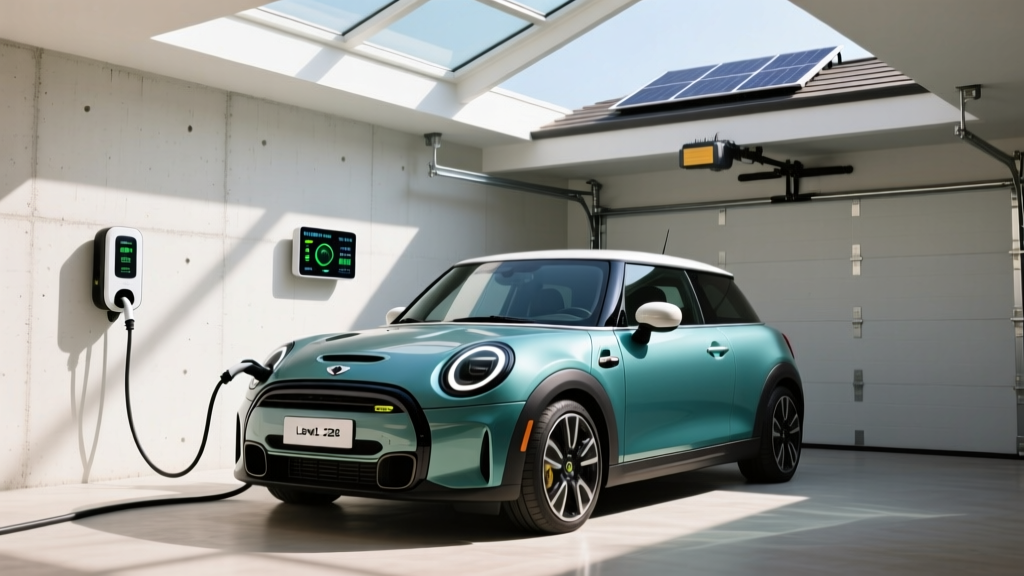
The 2026 Mini Cooper SE delivers an EPA-estimated 240 miles of range — a meaningful jump from earlier generations — but how you charge at home directly impacts how much of that range you can actually use day-to-day. A properly sized Level 2 home charger ensures the Cooper SE's 54.2 kWh battery (usable capacity) wakes up full every morning, ready for real-world driving that typically nets 200–220 miles on mixed highway and city routes.
This guide walks through the charging infrastructure you need to support the electric Mini Cooper range, from electrical requirements to equipment selection, with exact costs and specifications.
EPA estimate: 240 miles (2026 Cooper SE). Real-world expectations: ~200–220 miles combined driving; ~170–190 miles sustained highway at 70+ mph; ~150–170 miles in sub-30°F cold weather. The Cooper SE uses an NMC lithium-ion pack with active thermal management, which helps preserve range and charging speed in temperature extremes compared to passively cooled packs.
Charging Levels Explained: How Fast Each Adds Range
Understanding the three charging tiers is essential before spending money on equipment. Power is measured in kilowatts (kW) — the rate of energy delivery — while battery capacity is measured in kilowatt-hours (kWh), the total energy stored. The Cooper SE's 54.2 kWh usable battery determines how long each level takes.
| Level | Voltage | Max Power (kW) | Miles Added/Hour | Cooper SE 10–80% Time |
|---|---|---|---|---|
| Level 1 (120V outlet) | 120V | 1.4–1.9 kW | 4–6 mi/hr | ~30+ hours |
| Level 2 (240V home/public) | 240V | 7.2–19.2 kW | 22–58 mi/hr | ~3.5–7 hours |
| DC Fast Charging | 400V+ | Up to 95 kW (peak) | ~180+ mi/hr (peak) | ~28–32 min |
For daily driving, Level 2 is the practical baseline. A 40-amp Level 2 charger delivering 9.6 kW adds roughly 30 miles of range per hour of charging — enough to fully replenish the Cooper SE overnight. Level 1 works only as a trickle supplement; plugging into a standard 120V outlet overnight yields perhaps 30–40 miles of recovered range, insufficient for most commutes.
On DC fast charging, the Cooper SE peaks at approximately 95 kW. However, that peak is sustained only between roughly 10–50% state of charge. Above 60%, the charge curve tapers significantly — expect 40–50 kW from 60–80%, which is typical for NMC chemistry managed conservatively for longevity. Plan road-trip stops around 10–80% charges rather than topping to 100%.
Home Charger Installation: Electrical Requirements & Costs
Installing a Level 2 charger at home for the Mini Cooper SE requires a dedicated 240V circuit, typically 40 or 50 amps. The exact amperage depends on your chosen charger's maximum output and your electrical panel's available capacity.
A 40A circuit supports up to 9.6 kW continuous output (chargers are derated to 80% of breaker capacity per NEC code — a 40A breaker yields 32A continuous). A 50A circuit supports up to 12 kW, though the Cooper SE's onboard charger maxes out at approximately 11 kW, meaning a 48A charger on a 60A circuit captures the car's full Level 2 capability.
What Electrical Upgrades Might You Need?
Most modern homes with 200-amp electrical panels have sufficient capacity for a 40A or 50A EV circuit. However, homes with 100-amp panels, older wiring, or high existing loads (electric heat, dual ovens, hot tubs) may require a panel upgrade to 200A — a significant added cost. A licensed electrician should perform a load calculation before installation.
| Component | Typical Cost Range | Notes |
|---|---|---|
| Level 2 Charger (hardwired) | $400–$750 | Smart chargers with Wi-Fi at upper end |
| Level 2 Charger (NEMA 14-50 plug) | $350–$700 | Allows portability; requires 50A outlet |
| Electrician labor (standard install) | $500–$1,500 | Varies by run length from panel to garage |
| Electrical permit | $50–$200 | Required in most jurisdictions |
| Panel upgrade (if needed) | $1,500–$3,500 | 100A to 200A upgrade; not always required |
| Total (no panel upgrade) | $950–$2,450 | Most common scenario |
| Total (with panel upgrade) | $2,450–$5,950 | Older homes with 100A service |
The federal Residential Clean Energy Credit (IRS §25D) does not cover EV chargers as of 2026. However, the Alternative Fuel Vehicle Refueling Property Credit (§30C) may provide up to $1,000 for home charger equipment and installation, subject to census-tract eligibility and income requirements. Check with a tax professional before claiming.
Connector Compatibility: What Fits the Mini Cooper SE?
The 2026 Mini Cooper SE sold in North America uses the CCS1 (Combined Charging System) connector for both Level 2 AC charging and DC fast charging. Mini has not adopted the Tesla NACS connector as of the current model year, though adapters are available for Supercharger access.
| Connector | Used By | Cooper SE Compatible? | Adapter Needed? |
|---|---|---|---|
| CCS1 | Mini, VW, Hyundai, GM, Ford (legacy) | Yes — native | No |
| NACS (Tesla) | Tesla, Ford, GM, Rivian, Volvo (2025+) | With adapter | Yes — CCS-to-NACS (~$200–$250) |
| CHAdeMO | Nissan Leaf (legacy) | No | N/A — network declining |
| J1772 | All EVs (Level 2 only) | Yes — native (upper portion of CCS) | No |
For home Level 2 charging, any J1772-connector charger works with the Cooper SE. For public DC fast charging, CCS1 stalls at Electrify America, EVgo, and ChargePoint networks are directly compatible. If you want access to Tesla Superchargers (the largest and most reliable DC network), you'll need a CCS-to-NACS adapter — verify Mini's official position on adapter compatibility before purchasing, as some vehicles require firmware support.
Charging Cost Per Mile: Home vs. Public vs. Gas
One of the strongest ownership arguments for the Cooper SE is fuel cost. Electricity prices vary significantly by region and time of use, but home charging on off-peak rates consistently undercuts gasoline.
| Scenario | Rate | Cost for Full Charge (54.2 kWh) | Cost Per Mile (240 mi range) |
|---|---|---|---|
| Home off-peak (national avg) | $0.12/kWh | $6.50 | $0.027/mi |
| Home peak / standard rate | $0.18/kWh | $9.76 | $0.041/mi |
| Public Level 2 (ChargePoint, etc.) | $0.30/kWh | $16.26 | $0.068/mi |
| DC Fast Charging (Electrify America) | $0.48/kWh | $26.02 | $0.108/mi |
| Gasoline equivalent (30 MPG, $3.40/gal) | — | $27.20 | $0.113/mi |
At national average off-peak residential rates, the Cooper SE costs roughly $0.03 per mile to drive — about one-quarter the per-mile cost of a 30 MPG gas car at $3.40/gallon. Even public DC fast charging at premium rates roughly matches gasoline per-mile costs. The savings compound: a driver covering 12,000 miles annually saves approximately $900–$1,100 per year charging primarily at home versus fueling a comparable gas vehicle, per fueleconomy.gov data.
The key to maximizing savings is time-of-use (TOU) scheduling. Most smart Level 2 chargers let you set charging windows — program the Cooper SE to charge between midnight and 6 AM when utility rates drop to their lowest tier.
Best Home Chargers for the Mini Cooper SE
The Cooper SE's 11 kW onboard AC charger means you benefit from a 48-amp (11.5 kW) Level 2 unit, though a 40-amp (9.6 kW) charger still delivers a full overnight charge in roughly 6 hours. Here are three proven options:
ChargePoint Home Flex
- Power: Up to 12 kW (50A) — configurable 16A–50A
- Connector: J1772 (native fit for Cooper SE Level 2)
- Cable length: 23 feet
- Smart features: Wi-Fi, app scheduling, TOU optimization, Alexa integration
- Price: ~$550–$650
- Install type: Hardwired or NEMA 14-50 plug
Verdict: Best all-around pick. Amperage flexibility means you can match it to your panel's capacity without overspending on electrical work.
Emporia Vue Level 2 Charger
- Power: Up to 11.5 kW (48A)
- Connector: J1772
- Cable length: 24 feet
- Smart features: Wi-Fi, energy monitoring, solar integration, app scheduling
- Price: ~$400–$500
- Install type: Hardwired or NEMA 14-50
Verdict: Best value. Pairs well with home solar systems and provides detailed energy-use breakdowns. Lower price point with full smart features.
Grizzl-E Smart
- Power: Up to 10 kW (40A)
- Connector: J1772
- Cable length: 24 feet
- Smart features: Wi-Fi, OCPP support, adjustable amperage
- Price: ~$450–$550
- Install type: Hardwired or NEMA 14-50
Verdict: Best for cold climates. Built in Canada with a -40°F operating rating and a rugged aluminum enclosure. Ideal for unheated garages or outdoor mounting.
Any of these chargers will fully replenish the Cooper SE's 54.2 kWh battery overnight. Prioritize a unit with adjustable amperage so your electrician can match it to your available circuit capacity without unnecessary panel work.
Safety, Code, and Installation Best Practices
EV charging places a sustained high-amperage load on your home's electrical system — unlike a dryer or oven that cycles on and off, a Level 2 charger draws maximum current continuously for hours. This makes code compliance and proper installation non-negotiable.
- Dedicated circuit: The charger must have its own dedicated breaker — never share a circuit with other appliances.
- GFCI protection: NEC 2020 and later require GFCI protection for all EV charging outlets. Hardwired installations may have different GFCI requirements depending on jurisdiction.
- Outdoor rating: If installing outside, ensure the charger carries a NEMA 4 (weatherproof) rating and that the connector holster protects the plug from moisture and debris.
- Wire gauge: A 50A circuit requires 6 AWG copper wire; a 40A circuit requires 8 AWG. Your electrician will size wire to the breaker and run length.
- Permit and inspection: Most municipalities require an electrical permit and post-installation inspection. Skipping this can void homeowner's insurance coverage for electrical fires.
Always hire a licensed electrician familiar with EV charger installations. The NHTSA and your vehicle manufacturer both recommend professional installation over DIY for high-amperage circuits.
Frequently Asked Questions
How much does it cost to install a home EV charger for the Mini Cooper SE?
Expect $950–$2,450 total for a standard installation (charger, electrician labor, permit) if your panel has adequate capacity. If a panel upgrade from 100A to 200A is required, add $1,500–$3,500. The federal §30C credit may offset up to $1,000 for eligible taxpayers in qualifying census tracts.
How fast will each charging level add range to the Cooper SE?
Level 1 (120V) adds roughly 4–6 miles per hour. Level 2 at 9.6 kW (40A) adds about 30 miles per hour. Level 2 at 11.5 kW (48A) adds about 36 miles per hour. DC fast charging at peak 95 kW adds roughly 3 miles per minute, tapering above 60% SoC.
Which connector does the Mini Cooper SE use?
The 2026 Cooper SE uses CCS1 for DC fast charging and J1772 (the upper portion of the CCS1 connector) for Level 2 AC charging. A CCS-to-NACS adapter is required for Tesla Supercharger access.
How much does charging the Cooper SE cost per mile vs. gas?
At $0.12/kWh (home off-peak), the Cooper SE costs approximately $0.027 per mile. A 30 MPG gas car at $3.40/gallon costs $0.113 per mile — roughly 4x more. Even public DC fast charging at $0.48/kWh costs about $0.108 per mile, essentially matching gasoline.
What electrical upgrades might I need for a Level 2 charger?
You need a dedicated 240V circuit (40A or 50A). Homes with 100A panels may need a panel upgrade to 200A ($1,500–$3,500). Homes with 200A panels and available breaker slots typically need only the new circuit run. An electrician will perform a load calculation to confirm.
Can I charge the Cooper SE on a regular 120V outlet?
Yes, but Level 1 charging adds only 4–6 miles per hour — a full 10–80% charge takes over 30 hours. It's suitable only as a backup or for very low daily mileage (under 30 miles/day). For practical daily use, Level 2 is strongly recommended.