Why EV Ford Ranger Charging Demands a Plan
The all-electric Ford Ranger — Ford's midsize truck entry into the EV space — carries a battery pack large enough to require thoughtful charging infrastructure. Whether you're eyeing the announced electric Ranger for worksite duty, weekend towing, or daily commuting, understanding how to feed its battery efficiently will determine whether ownership feels effortless or frustrating.
Unlike smaller commuter EVs with 60 kWh packs, a midsize electric truck typically requires a battery in the 85–100+ kWh usable range to deliver competitive payload, towing, and range. That larger battery means longer charge times at lower power levels — making your home charging setup and public network knowledge essential before delivery day.
This guide covers every charging scenario for an electric Ford Ranger: home installation requirements and costs, public charging speeds, connector standards, equipment recommendations, and real cost-per-mile math versus a gas-powered Ranger.
Charging Levels Explained: Speeds and Range Recovery
EV charging falls into three tiers. The critical distinction: kW (kilowatts) measures power — how fast energy flows into the battery. kWh (kilowatt-hours) measures energy — the battery's total capacity. Think of kW as the hose diameter and kWh as the tank size.
| Level | Voltage | Power (kW) | Miles of Range Per Hour | Best Use Case |
|---|---|---|---|---|
| Level 1 | 120V AC | 1.0–1.4 kW | 3–5 mi/hr | Overnight top-off, emergency backup |
| Level 2 | 240V AC | 7.2–19.2 kW | 25–65 mi/hr | Daily home charging, workplace |
| DC Fast Charge | 400–800V DC | 50–350 kW | 150–800+ mi/hr (peak) | Road trips, rapid top-up |
Real-world context for a ~90 kWh truck battery:
- Level 1 (1.4 kW): A full 0–100% charge would take roughly 64+ hours. Useful only for maintaining charge or adding ~40 miles overnight.
- Level 2 at 11.5 kW (48A): 0–100% in approximately 8 hours — ideal for overnight charging on a dedicated 60A circuit.
- Level 2 at 19.2 kW (80A): 0–100% in roughly 5 hours — requires a 100A circuit and compatible onboard charger.
- DC Fast Charge at 150+ kW peak: 10–80% in an estimated 25–35 minutes, depending on the pack's charge curve and thermal management. Expect the rate to taper significantly above 80% SoC to protect battery health.
Home Level 2 Installation: Requirements, Costs, and Panel Upgrades
For an electric Ford Ranger with a large battery, a Level 2 home charger is essentially mandatory. Level 1 trickle charging won't replenish a depleted truck pack in any practical timeframe.
Electrical Requirements
Most high-quality Level 2 chargers for trucks run at 48 amps continuous, which requires a dedicated 60-amp, 240-volt circuit (the National Electrical Code requires circuits rated at 125% of continuous load: 48A × 1.25 = 60A). Higher-power 80A chargers need a 100A circuit.
Key installation considerations:
- Dedicated circuit: The charger must have its own breaker — no sharing with dryers, HVAC, or other heavy loads.
- Wire gauge: 6 AWG copper for 60A circuits; 4 AWG or larger for 100A circuits over typical residential distances.
- GFCI protection: NEC 2020 and later require GFCI breakers for EV receptacles in garages and outdoor locations.
- Outdoor rating: If installing outside, the charger must carry a NEMA 4 or IP65 weather rating, and the circuit must be in conduit rated for wet locations.
Panel Upgrade: The Hidden Cost
Many homes built before 2010 have 100A or 150A main electrical panels. Adding a 60A EV circuit to a panel already near capacity may require a panel upgrade to 200A — or even a service upgrade from the utility. A licensed electrician will perform a load calculation (NEC Article 220) to determine if your panel can handle the added draw.
Installation Cost Breakdown
| Component | Low End | High End | Notes |
|---|---|---|---|
| Level 2 Charger (hardware) | $350 | $800 | 48A smart charger, NACS or J1772 |
| Electrician labor | $500 | $1,500 | Varies by wire run length, wall type |
| Electrical materials (wire, conduit, breaker) | $150 | $500 | Longer runs and outdoor conduit cost more |
| Permit and inspection | $50 | $300 | Required in most jurisdictions |
| Panel upgrade (if needed) | $1,500 | $4,500 | 200A service upgrade; not always required |
| Total (no panel upgrade) | $1,050 | $3,100 | Typical garage install with nearby panel |
| Total (with panel upgrade) | $2,550 | $7,600 | Older homes needing 200A service |
The federal Alternative Fuel Vehicle Refueling Property Credit (IRS Form 8911) may cover up to 30% of home charging equipment and installation costs (capped at $1,000), subject to census-tract eligibility. Check the latest IRS guidance for qualifying areas.
Connector Compatibility: NACS, CCS, and the Ford Ecosystem
Ford made a pivotal move by adopting the North American Charging Standard (NACS) — the Tesla-designed connector — for its electric vehicles starting with the F-150 Lightning and extending to subsequent EV models including the electric Ranger platform.
| Connector | Type | Native Ford EV Compatibility | Notes |
|---|---|---|---|
| NACS (J3400) | AC + DC | Yes — native on new Ford EVs | Smaller, lighter; direct Tesla Supercharger access |
| CCS1 | AC + DC | Adapter required | Used by Electrify America, EVgo legacy stations |
| CHAdeMO | DC only | Not compatible | Legacy Nissan/Mitsubishi standard; phasing out |
| J1772 (Type 1) | AC only | Adapter included (NACS-to-J1772) | Older public Level 2 stations |
What this means in practice: A NACS-equipped electric Ranger can plug directly into Tesla Superchargers (now open to Ford EVs via the NACS agreement) and any new NACS-native public charger. For CCS1 stations — which still make up a significant portion of Electrify America and other networks — Ford provides or sells a CCS-to-NACS adapter. Keep this adapter in the truck for road trips.
For home Level 2 charging, most new chargers now ship with NACS connectors. If you purchase a J1772 charger, the adapter that comes with the vehicle will handle it.
Cost to Charge: Electric Ranger vs. Gas Ranger Per Mile
The economic case for an electric truck hinges on fuel savings. Here's how charging costs stack up against gasoline for a midsize truck.
| Scenario | Rate | Cost Per Mile | Annual (15,000 mi) |
|---|---|---|---|
| Home charging (off-peak utility rate) | $0.11/kWh | $0.033 | $495 |
| Home charging (avg US residential) | $0.17/kWh | $0.051 | $765 |
| Public Level 2 (network pricing) | $0.30/kWh | $0.090 | $1,350 |
| DC Fast Charging (road trip) | $0.45/kWh | $0.135 | $2,025 |
| Gas Ranger (22 MPG combined, $3.50/gal) | — | $0.159 | $2,385 |
Key assumptions: Electric truck efficiency estimated at ~3.0–3.3 kWh/mile (realistic for a midsize AWD truck with moderate payload). Gas Ranger EPA combined at 22 MPG. Actual costs vary by driving style, terrain, climate, and local utility rates.
Best Level 2 Chargers for an Electric Truck (2026 Picks)
Not all Level 2 chargers are equal. For a large-battery truck, prioritize amperage (48A minimum for reasonable overnight speeds), cable length (25 feet for garage flexibility), and smart scheduling (to leverage off-peak rates).
ChargePoint Home Flex (NACS)
- Power Output: Up to 12 kW (50A) on a 60A circuit; adjustable down to 16A
- Connector: NACS native (2025+ models); J1772 also available
- Cable Length: 24 feet
- Smart Features: Wi-Fi, app scheduling, Alexa integration, energy tracking
- Price: ~$550–$650
- Best For: Flexible amperage adjustment if your panel can't support a full 60A circuit
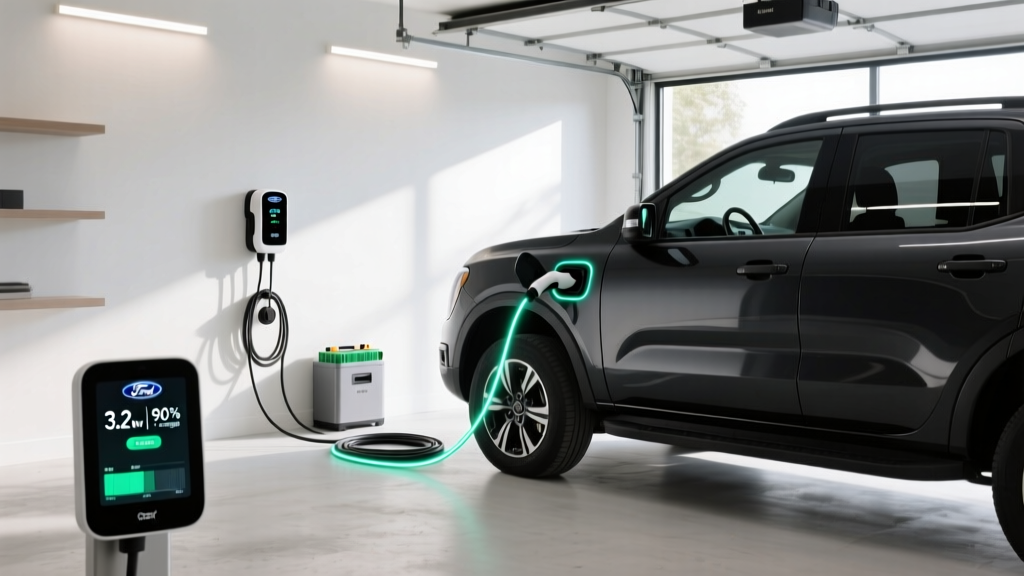
Ford Charge Station Pro (NACS)
- Power Output: Up to 19.2 kW (80A) on a 100A circuit
- Connector: NACS
- Cable Length: 25 feet
- Smart Features: FordPass app integration, scheduled charging, bidirectional V2H capable (with compatible Ford EVs and home integration system)
- Price: ~$800–$1,000
- Best For: Ford ecosystem integration and maximum Level 2 speed if your electrical panel supports 100A
Wallbox Pulsar Plus (NACS)
- Power Output: Up to 11.5 kW (48A) on a 60A circuit
- Connector: NACS (2025+); J1772 available
- Cable Length: 25 feet
- Smart Features: Wi-Fi + Bluetooth, Power Sharing (daisy-chain two units on one circuit), eco-solar mode
- Price: ~$450–$550
- Best For: Budget-conscious buyers wanting a compact, reliable 48A charger
All three chargers carry UL certification, NEMA 4 outdoor ratings, and are eligible for the federal installation credit where applicable. For a large-battery truck, the 48A Wallbox or 50A ChargePoint will add roughly 30–35 miles of range per hour — enough to fully replenish overnight from a typical daily drive.
Safety, Code, and Installation Best Practices
EV charging draws sustained high current for hours — unlike a dryer that cycles on and off. This makes proper installation non-negotiable:
- Always use a licensed electrician. DIY EV charger wiring on 240V circuits is dangerous and may void homeowner's insurance in the event of a fire.
- Permit and inspection are required in virtually all US jurisdictions. Your electrician should pull the permit before work begins.
- Hardwire vs. plug: Hardwired chargers (directly connected to the circuit) are preferred for 48A+ installations — they avoid the heat buildup and wear associated with NEMA 14-50 receptacles under continuous load. If using a receptacle, specify a commercial-grade (industrial) NEMA 14-50 outlet, not a residential-grade unit.
- GFCI breaker: NEC 2020+ requires ground-fault protection on EV receptacles. Some hardwired chargers have built-in GFCI, which may allow a standard breaker — your electrician will determine this.
- Outdoor installations: Require NEMA 4/IP65-rated chargers, weatherproof conduit, and in some jurisdictions, a protective bollard or mounting post to prevent vehicle impact damage.
Frequently Asked Questions
How much does it cost to install a home EV charger for an electric Ford Ranger?
Expect $1,050–$3,100 for a standard Level 2 installation (charger, electrician labor, materials, and permit) if your existing electrical panel has capacity. If a panel upgrade to 200A service is needed, add $1,500–$4,500. The federal refueling property credit may offset up to $1,000 of these costs in qualifying census tracts.
How fast will each charging level add range to an electric Ranger?
Level 1 (120V) adds roughly 3–5 miles per hour — impractical for a large truck battery. Level 2 at 48A (11.5 kW) adds approximately 30–35 miles per hour, fully recharging overnight. DC fast charging at 150+ kW can add 150+ miles in 15–20 minutes at peak rate, though expect tapering above 80% SoC.
Which connector is compatible with the electric Ford Ranger?
The electric Ranger uses the NACS (J3400) connector natively, giving it direct access to Tesla Superchargers and new NACS public stations. A CCS-to-NACS adapter (provided or sold by Ford) enables compatibility with Electrify America and other CCS networks. CHAdeMO is not compatible.
How much does charging an electric Ranger cost per mile vs. gas?
At home off-peak rates (~$0.11/kWh), expect roughly $0.03/mile — about 80% cheaper than a gas Ranger at $0.16/mile (22 MPG, $3.50/gallon). Even at the national average residential rate of $0.17/kWh, home charging costs roughly $0.05/mile. Public DC fast charging at $0.45/kWh narrows the gap to ~$0.14/mile.
What electrical upgrades might I need for a Level 2 charger?
If your home has a 200A panel with available capacity, you likely need only a new 60A breaker and wire run. Homes with 100A or 150A panels — common in pre-2010 construction — may require a panel upgrade to 200A or even a full service upgrade from the utility. A licensed electrician will perform an NEC Article 220 load calculation to determine this before any work begins.
Should I hardwire my charger or use a NEMA 14-50 outlet?
For 48A+ continuous charging, hardwiring is the preferred approach — it eliminates the receptacle as a heat and failure point. If you want portability or have a lower-amperage charger (32A or below), a commercial-grade NEMA 14-50 receptacle is acceptable. Never use a cheap residential-grade receptacle for sustained EV charging loads.