Mercedes-Benz EQE 350: Real-World Range Meets Charging Reality
The Mercedes-Benz EQE 350+ sedan pairs a 90.6 kWh usable battery (NMC chemistry) with a single rear motor producing 288 horsepower. The EPA rates the EQE 350+ at 260 miles of combined range. But if you're researching the EQE 350 range for a purchase decision, that sticker number is only the starting point.
EPA Combined: 260 miles
Highway (70-75 mph sustained): ~220-235 miles
Cold weather (below 32°F, highway): ~185-210 miles
City / moderate climate: ~260-280 miles (regen-friendly)
The EQE 350's aerodynamic sedan body helps highway efficiency compared to SUV rivals, but its 90.6 kWh pack is modest for a vehicle weighing over 5,300 lbs. Expect roughly 3.0-3.3 kWh/mile (30-33 kWh/100mi) in mixed driving, which is less efficient than a Tesla Model S or Lucid Air. That efficiency figure directly determines your charging cost per mile — and how much infrastructure you need at home.
| Spec | EQE 350+ Sedan |
|---|---|
| Battery (usable) | 90.6 kWh, NMC |
| EPA Range | 260 miles |
| Efficiency | ~31 kWh/100mi |
| Motor | Single rear, 288 hp / 406 lb-ft |
| 0-60 mph | 6.2 seconds |
| Max DC Charge Rate | 170 kW (peak) |
| 10-80% DC Fast | ~32 minutes |
| Level 2 Onboard Charger | 9.6 kW (optional 11 kW) |
| Connector | CCS1 (NACS adapter available) |
| Base MSRP (2025) | ~$74,900 |
| Battery Warranty | 10 yr / 155,000 mi |
Charging Levels Explained: How Fast Does Each Add Range?
Understanding charging speed starts with separating kW (power — how fast energy flows) from kWh (energy — how much the battery holds). The EQE 350's 90.6 kWh battery is the tank size. The charger's kW rating is the hose diameter. A bigger hose fills the tank faster — but only up to the car's acceptance rate.
| Level | Voltage / Amps | Power (kW) | Miles Added/Hour | Best For |
|---|---|---|---|---|
| Level 1 | 120V / 12A | ~1.4 kW | ~3-4 mi/hr | Overnight trickle, emergencies |
| Level 2 | 240V / 40A | 9.6 kW | ~28-32 mi/hr | Daily home charging |
| Level 2 (48A) | 240V / 48A | 11.5 kW | ~34-38 mi/hr | Heavy daily drivers |
| DC Fast | 400V+ DC | 50-170 kW | ~150-500+ mi/hr | Road trips, quick top-ups |
For the EQE 350, a Level 1 outlet adds roughly 35-40 miles overnight (10 hours). That's barely enough for most commutes. A 40A Level 2 charger replenishes the full 90.6 kWh pack in about 9.5 hours — perfect for overnight charging. A 48A unit shaves that to ~8 hours. On DC fast charging, the EQE 350 peaks at 170 kW but tapers significantly above 80% State of Charge (SoC), which is why manufacturers quote 10-80% times rather than full charges.
Home Charger Installation: Electrical Requirements & Cost Breakdown
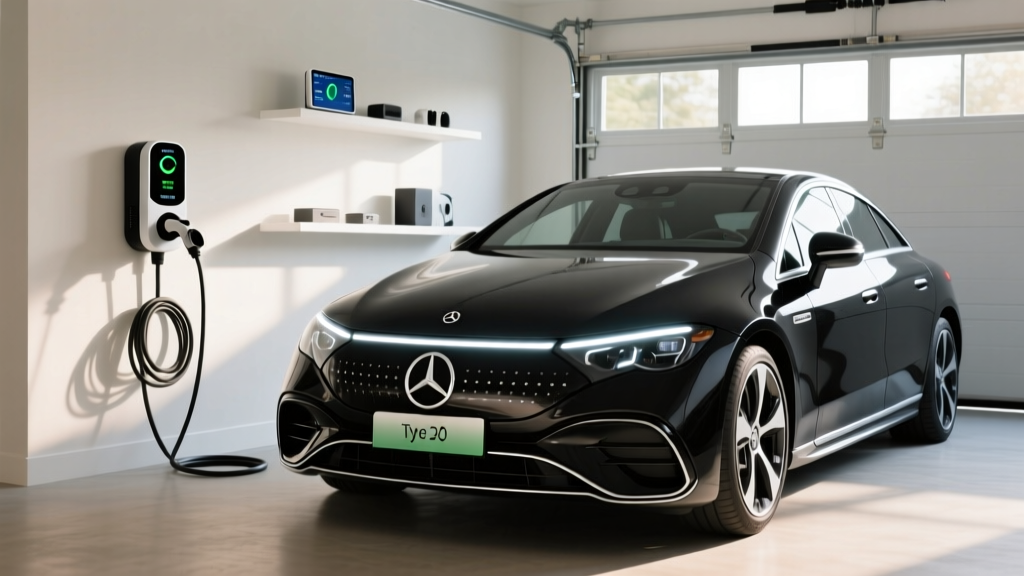
Installing a Level 2 home charger for the EQE 350 means running a dedicated 240V circuit. Here's what that involves electrically and financially.
Electrical requirements: A 40A charger needs a 50A breaker (National Electrical Code requires circuits rated at 125% of continuous load). A 48A charger needs a 60A breaker. Both require 240V split-phase power, the same voltage as your electric dryer or oven.
Panel capacity: Most modern homes have 200A electrical service. If your panel is already near capacity (common in older homes with electric heat, water heaters, and dryers), you may need a panel upgrade to 200A or even 400A, or a smart load-management device like the Span panel or Emporia smart breaker that shares capacity between the EV charger and other loads.
| Component | Typical Cost Range | Notes |
|---|---|---|
| Level 2 Charger (hardwired) | $400 - $750 | 40A-48A smart chargers |
| Electrician labor (standard install) | $500 - $1,500 | Depends on panel-to-garage distance |
| Electrical permit | $50 - $200 | Varies by municipality |
| Panel upgrade (if needed) | $1,500 - $4,000 | 200A to 400A; older homes only |
| Conduit/wiring (long runs) | $200 - $800 | If panel is far from garage |
| Total (no panel upgrade) | $950 - $2,450 | Most newer homes |
| Total (with panel upgrade) | $2,450 - $6,450 | Older homes, high-load panels |
Safety and code considerations: Your installation must include a dedicated circuit (not shared with other appliances), proper wire gauge (6 AWG copper for 50A, 4 AWG for 60A), and GFCI protection if the outlet is outdoors or in a garage per NEC 2020+ requirements. For outdoor installations, use a NEMA 4-rated charger enclosure. Hardwired installations (no plug) are preferred for 48A units because NEMA 14-50 receptacles are rated for intermittent, not continuous, 40A+ draw — many electricians report melted receptacles from sustained EV charging at high amperage.
Connector Compatibility: NACS, CCS1, and Adapter Needs
The Mercedes-Benz EQE 350 ships with a CCS1 (Combined Charging System) port in North America. This is the standard connector used by Electrify America, EVgo, and most non-Tesla DC fast networks. However, Tesla's NACS (North American Charging Standard) has been adopted by most automakers, and Mercedes-Benz now offers a NACS adapter for EQE owners.
| Connector | Network Access | EQE 350 Compatibility |
|---|---|---|
| CCS1 | Electrify America, EVgo, ChargePoint, Ionity | Native — no adapter needed |
| NACS (Tesla) | Tesla Supercharger network (17,000+ stalls) | Via Mercedes NACS adapter or aftermarket |
| CHAdeMO | Limited legacy stations | Not supported — avoid |
| J1772 (Level 2) | All public Level 2 stations | Native — same inlet as CCS1 upper portion |
The NACS adapter unlocks Tesla Supercharger access, which is the most reliable DC fast charging network in the US. For EQE 350 owners, carrying a NACS adapter on road trips is strongly recommended — Supercharger stalls outnumber CCS stations roughly 3-to-1 on major highway corridors. At home, Level 2 charging uses the J1772 portion of the CCS connector, so any standard Level 2 home charger will work without adapters.
Cost to Charge: Home vs. Public vs. Gas Comparison
The EQE 350's ~31 kWh/100mi efficiency determines your per-mile cost. Here's how that translates across charging scenarios compared to a gas sedan averaging 28 MPG combined.
| Scenario | Rate ($/kWh) | Cost per 100 mi | Cost per Mile |
|---|---|---|---|
| Home (off-peak utility rate) | $0.12 | $3.72 | $0.037 |
| Home (average US residential) | $0.17 | $5.27 | $0.053 |
| Public Level 2 (network pricing) | $0.30 | $9.30 | $0.093 |
| DC Fast (Electrify America) | $0.48 | $14.88 | $0.149 |
| DC Fast (Tesla Supercharger) | $0.35 | $10.85 | $0.109 |
| Gas sedan (28 MPG, $3.40/gal) | — | $12.14 | $0.121 |
Home charging at off-peak rates saves roughly 70% compared to gasoline. Even DC fast charging at Electrify America is only slightly more expensive per mile than gas. The key takeaway: home charging is where EV economics win. If you rely exclusively on public DC fast charging, the EQE 350's per-mile cost approaches or exceeds gasoline, and you lose the ownership-cost advantage.
For a full 10-80% DC fast charge on the EQE 350 (roughly 63 kWh added), expect to pay $18-30 at public stations. At home, that same charge costs $7.50-$11 depending on your utility rate.
Recommended Home Chargers for the EQE 350
ChargePoint Home Flex (48A)
Power: Up to 11.5 kW (48A) on a 60A circuit
Connector: J1772 (works natively with EQE 350)
Cable length: 23 feet
Smart features: Wi-Fi, app scheduling, utility integration, Alexa
Price: ~$550-$650
Verdict: Best all-around pick. Adjustable amperage (16A-48A) lets you match your circuit. UL-listed, NEMA 4 outdoor rated.
Emporia Vue Level 2 Charger (48A)
Power: Up to 11.5 kW (48A) on a 60A circuit
Connector: J1772
Cable length: 24 feet
Smart features: Wi-Fi, energy monitoring, solar integration, load management
Price: ~$400-$500
Verdict: Best value. Excellent app with real-time energy tracking. Pairs well with Emporia whole-home monitor for load balancing.
Wallbox Pulsar Plus (40A)
Power: Up to 9.6 kW (40A) on a 50A circuit
Connector: J1772
Cable length: 25 feet
Smart features: Wi-Fi + Bluetooth, app control, Power Sharing for multi-charger setups
Price: ~$450-$550
Verdict: Compact, reliable, and well-suited for 50A circuits. Good for tight garage spaces.
Grizzl-E Smart (40A)
Power: Up to 9.6 kW (40A) on a 50A circuit
Connector: J1772
Cable length: 24 feet
Smart features: Wi-Fi, OCPP-compatible, extreme cold rated (-40°F)
Price: ~$450-$550
Verdict: Built in Canada for harsh climates. Heavy-duty aluminum case. Best for unheated garages and outdoor mounts in cold regions.
For the EQE 350's 90.6 kWh battery, a 48A charger adds roughly 34-38 miles of range per hour, meaning a full overnight session (8-9 hours) replenishes the pack from near-empty. If your electrical panel can only support a 50A breaker (40A charger), you'll add ~28-32 miles per hour — still sufficient for most daily needs since the average American drives 37 miles per day according to FHWA data.
DC Fast Charging Times for the EQE 350
The EQE 350's 170 kW peak DC charge rate sounds competitive, but sustained charging speed matters more than peak. The charge curve tapers progressively above 50% SoC and drops sharply past 80% to protect the NMC battery chemistry.
| SoC Range | Avg. Power | Time | Miles Added |
|---|---|---|---|
| 10-50% | ~150-170 kW | ~12 min | ~105 miles |
| 50-80% | ~90-110 kW | ~20 min | ~80 miles |
| 10-80% total | ~120 kW avg | ~32 min | ~185 miles |
| 80-100% | ~20-40 kW | ~45 min | ~50 miles |
The taper above 80% is why you should plan road-trip stops around 10-80% charges rather than filling to 100%. Charging from 80-100% takes longer than 10-80% on the EQE 350. On a 300-mile trip, two 20-minute stops (10-60% each) are faster than one 50-minute stop (10-100%).
Preconditioning matters: if you navigate to a DC fast charger using the EQE's built-in navigation, the battery thermal management system pre-warms or pre-cools the pack for optimal charge acceptance. Without preconditioning (e.g., arriving at a charger not via nav), cold-soaked batteries may accept only 50-80 kW initially, adding 5-10 minutes to your stop.
Frequently Asked Questions
How much does it cost to install a home EV charger for the EQE 350?
Most homeowners pay $950-$2,450 for a complete Level 2 installation (charger + electrician + permit) when no panel upgrade is needed. If your home has an older 100A panel or is already near capacity, a panel upgrade adds $1,500-$4,000. Get at least two quotes from licensed electricians — pricing varies significantly by region and install complexity.
How fast will each charging level add range to the EQE 350?
Level 1 (120V) adds roughly 3-4 miles per hour — about 35-40 miles overnight. Level 2 at 40A (240V) adds 28-32 miles per hour. Level 2 at 48A adds 34-38 miles per hour. DC fast charging at 170 kW peak adds roughly 150+ miles in 15 minutes during the 10-50% SoC window, tapering significantly above 80%.
Which connector and charger is compatible with the EQE 350?
The EQE 350 uses CCS1 natively, which covers Electrify America, EVgo, and most public DC fast stations. For Level 2 home and public charging, it uses the J1772 connector (the upper portion of the CCS1 inlet). A Mercedes NACS adapter unlocks Tesla Supercharger access. Any J1772 Level 2 home charger (ChargePoint, Emporia, Wallbox, Grizzl-E) will work without adapters.
How much does charging the EQE 350 cost per mile compared to gas?
At home on off-peak electricity ($0.12/kWh), the EQE 350 costs about $0.037 per mile — roughly 70% less than a 28 MPG gas sedan at $3.40/gallon ($0.121/mile). On public DC fast chargers at $0.35-$0.48/kWh, costs range from $0.109-$0.149 per mile, which is comparable to or slightly above gasoline. The economic case for the EQE 350 depends heavily on reliable home charging access.
What electrical upgrades might I need for a home charger?
You need a dedicated 240V circuit: 50A breaker for a 40A charger, 60A breaker for a 48A charger. If your panel is at or near capacity (common in homes with electric heat, water heaters, and dryers), you may need a panel upgrade to 200A or 400A, or a smart load-management system that dynamically shares power between the charger and other circuits. Your electrician should perform a load calculation per NEC Article 220 before recommending a solution. Homes built after 2000 with 200A service typically have sufficient headroom.
Does the EQE 350 qualify for the federal EV tax credit?
The federal §30D clean vehicle credit offers up to $7,500, but eligibility depends on MSRP caps ($55,000 for sedans — the EQE 350 at ~$74,900 exceeds this), buyer income limits, and battery critical-mineral sourcing requirements. The EQE 350 sedan does not qualify for the new-vehicle credit due to its MSRP. However, it may qualify for the used-EV credit (up to $4,000) once it enters the secondary market at or below $25,000. Consult a tax professional for your specific situation.