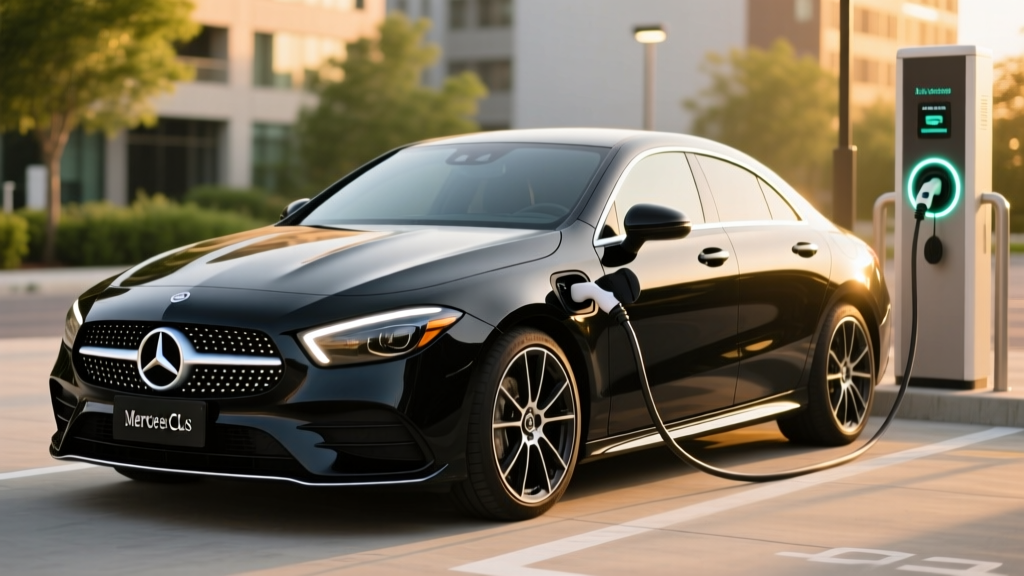
The 2026 Mercedes-Benz CLA EV arrives on the new MMA (Mercedes Modular Architecture) platform with an 85 kWh usable battery, an EPA-estimated range north of 350 miles, and an 800-volt electrical architecture that enables some of the fastest DC charging in the luxury compact segment. But EPA stickers only tell part of the story. In this guide, we break down the Mercedes CLA EV real-world range you can actually expect across highway, city, and cold-weather driving — then cover everything you need to charge it at home or on the road, from panel upgrades to cost-per-mile math.
Mercedes CLA EV Real-World Range vs. EPA Estimates
Mercedes targets an EPA range of approximately 350 miles for the rear-wheel-drive CLA 250 EV, with the all-wheel-drive CLA 350 EV expected around 320 miles. Those are strong numbers, but real-world results depend heavily on speed, temperature, and terrain.
EPA Estimate: ~350 mi (RWD) / ~320 mi (AWD)
Real-World Highway (70 mph): ~290–320 mi
Real-World Mixed Driving: ~310–340 mi
Cold Weather (below 32°F): ~250–290 mi (expect 15–25% reduction)
Battery: 85 kWh usable, NMC chemistry
Efficiency: ~3.6–4.0 mi/kWh (estimated 120+ MPGe combined)
The CLA EV's efficiency benefits from Mercedes' heat pump (standard on US models), which recovers waste heat from the drivetrain to warm the cabin — a critical advantage in winter that preserves range compared to resistive heating. On a 300-mile highway run at 75 mph in 65°F weather, expect to consume roughly 90–95 kWh, leaving a small buffer. In stop-and-go city traffic with regenerative braking engaged, you may actually exceed the EPA figure slightly, as EVs are most efficient at lower speeds.
Charging Levels Explained: kW, Speeds, and Miles Added Per Hour
Understanding charging requires distinguishing kW (kilowatts) — the rate of power delivery — from kWh (kilowatt-hours) — the total energy stored in the battery. Think of kW as how fast water flows from a hose, and kWh as the size of the bucket. The CLA EV's 85 kWh battery needs to be filled at varying rates depending on your charger.
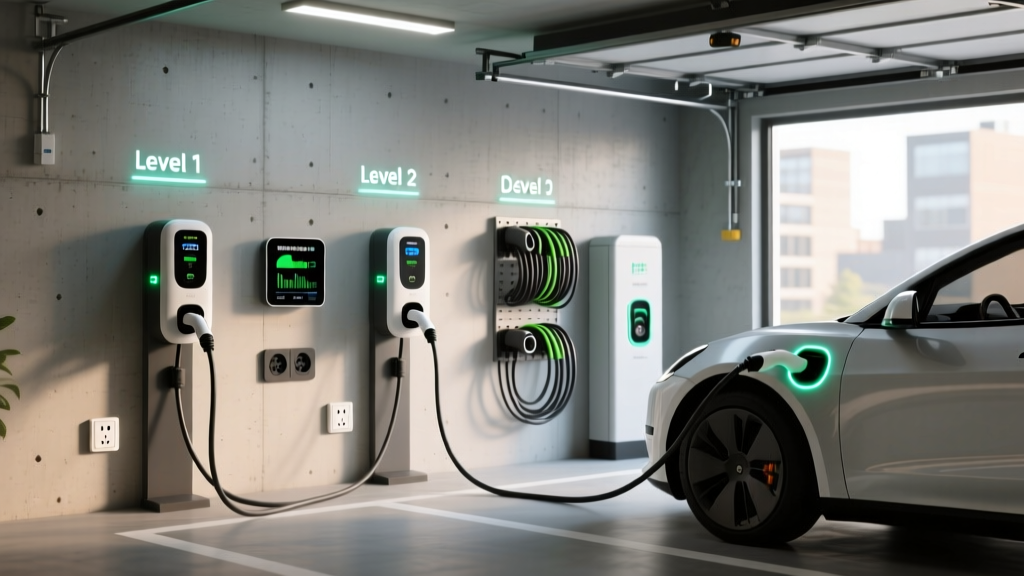
| Level | Voltage / Amps | Power (kW) | Miles Added / Hour | 0–100% Time | Best Use |
|---|---|---|---|---|---|
| Level 1 | 120V / 12A | 1.4 kW | ~4–5 mi/hr | ~60+ hours | Emergency / overnight trickle |
| Level 2 | 240V / 32–48A | 7.7–11.5 kW | ~25–40 mi/hr | ~8–11 hours | Daily home charging |
| DC Fast | 400–800V DC | Up to 250 kW (peak) | ~180+ mi in 10 min | 10–80% in ~15 min | Road trips, quick top-ups |
The CLA EV's onboard AC charger is rated at 11 kW (single-phase) or up to 22 kW (three-phase, where available). In the US, most residential Level 2 setups deliver single-phase power, meaning you'll see a maximum of 11 kW — adding roughly 38–40 miles of range per hour of charging.
On DC fast charging, the 800-volt architecture allows the CLA EV to accept up to 250 kW at compatible stations. Mercedes states a 10–80% charge time of approximately 15 minutes under ideal conditions. In practice, expect 15–18 minutes depending on battery temperature, state of charge when you arrive, and whether the station can sustain peak output. The EPA's fueleconomy.gov database provides official efficiency ratings once the model is fully certified.
Home Charger Installation: Costs, Electrical Requirements, and Panel Upgrades
Installing a Level 2 home charger for the CLA EV requires a dedicated 240-volt circuit. The most common setup is a NEMA 14-50 outlet (50A circuit, delivering up to 40A continuous to the vehicle) or a hardwired connection at 48A or 60A for faster charging.
| Item | Low Estimate | High Estimate | Notes |
|---|---|---|---|
| Level 2 Charger (hardware) | $400 | $800 | Smart Wi-Fi chargers, 32–48A |
| Electrician labor | $500 | $1,500 | Varies by run length and complexity |
| Permit & inspection | $50 | $250 | Required in most jurisdictions |
| Electrical panel upgrade (if needed) | $1,500 | $4,000 | 100A→200A service upgrade for older homes |
| Total (no panel upgrade) | $950 | $2,550 | Typical modern home with 200A panel |
| Total (with panel upgrade) | $2,450 | $6,550 | Older homes with 100A or maxed-out panels |
Panel upgrade reality: If your home has a 100-amp electrical service or your panel is already near capacity (running electric heat, a dryer, an oven, and AC), you may need a service upgrade to 200A before adding a 40–50A EV circuit. A licensed electrician will perform a load calculation per NEC Article 220 to determine if your existing panel can handle the additional draw. Don't skip this step — an overloaded panel is a fire hazard.
Safety and code requirements: The National Electrical Code (NEC) requires a dedicated circuit for EV charging — you cannot share the circuit with other appliances. For outdoor installations, the charger must carry a NEMA 4 or NEMA 4X weather-resistance rating. GFCI (Ground Fault Circuit Interrupter) protection is required for outdoor receptacles. All work must be permitted and inspected; unpermitted installations can void home insurance claims and create resale issues.
Connector Compatibility: NACS, CCS1, and Adapter Needs
The 2026 Mercedes-Benz CLA EV ships in the US with the NACS (North American Charging Standard) connector — the Tesla-style plug now adopted by Mercedes-Benz, Ford, GM, Rivian, and most major automakers. This means native access to Tesla Superchargers (now open to non-Tesla EVs) as well as the growing network of NACS-equipped Electrify America, EVgo, and ChargePoint stations.
| Connector | CLA EV Native? | Network Access | Adapter Needed? |
|---|---|---|---|
| NACS | ✅ Yes (standard) | Tesla Supercharger, EA, EVgo, ChargePoint (new stalls) | None |
| CCS1 | ❌ No (legacy) | Older Electrify America, EVgo, ChargePoint stalls | NACS-to-CCS adapter (~$200–$300) |
| CHAdeMO | ❌ No | Limited legacy stations (mostly discontinued) | Not recommended — network shrinking |
| J1772 (Level 2) | ✅ via included adapter | All public Level 2 stations, home chargers | NACS-to-J1772 adapter (often included) |
For home Level 2 charging, most new chargers now ship with a NACS connector, but if you already own a J1772 charger from a previous EV, a simple NACS-to-J1772 adapter (typically $100–$150) lets you use it with the CLA EV. For road trips into areas where CCS1-only DC fast chargers remain, carrying a NACS-to-CCS adapter provides insurance against stranded scenarios — though this is becoming less necessary as networks convert to NACS.
Cost to Charge: Home vs. Public vs. Gas Comparison
One of the strongest ownership arguments for the CLA EV is fuel cost savings, but the math depends entirely on where you charge. Home charging on an off-peak utility rate is dramatically cheaper than DC fast charging or gasoline.
| Scenario | Rate | Cost / Full Charge | Cost / Mile | Cost / 12,000 mi/yr |
|---|---|---|---|---|
| Home (off-peak utility) | $0.12/kWh | ~$10.20 | $0.029 | $348 |
| Home (standard rate) | $0.18/kWh | ~$15.30 | $0.044 | $528 |
| Public Level 2 | $0.30/kWh | ~$25.50 | $0.073 | $876 |
| DC Fast Charging | $0.45/kWh | ~$38.25 | $0.109 | $1,308 |
| Gas equivalent (30 MPG, $3.50/gal) | $3.50/gallon | — | $0.117 | $1,400 |
| Annual savings (home off-peak vs gas) | ~$1,052/yr |
At the CLA EV's estimated efficiency of 3.6 mi/kWh, you consume roughly 28 kWh per 100 miles. If you charge primarily at home on a time-of-use (TOU) rate plan — available from most major utilities — overnight charging between 10 PM and 6 AM typically costs $0.10–$0.14/kWh. This makes the CLA EV roughly 4x cheaper to "fuel" per mile than a 30 MPG gasoline car at $3.50/gallon. Even exclusive DC fast charging is slightly cheaper than gas, but you lose the cost advantage.
Recommended Home Chargers for the Mercedes CLA EV
The CLA EV's 11 kW onboard charger means you won't benefit from chargers rated above 48A (11.5 kW). Here are three proven options matched to the CLA EV's capabilities:
ChargePoint Home Flex (NACS)
Power: Up to 11.5 kW (48A)
Connector: NACS native
Cable: 23 ft
Smart features: Wi-Fi, app scheduling, TOU integration, Alexa
Price: ~$599
Verdict: Best overall value for CLA EV owners. Adjustable amperage (16–48A) lets you match your circuit capacity.
Tesla Wall Connector (NACS)
Power: Up to 11.5 kW (48A)
Connector: NACS native
Cable: 24 ft
Smart features: Wi-Fi, OTA updates, power sharing (multi-unit), access control
Price: ~$450
Verdict: Excellent hardware at a competitive price. Works seamlessly with NACS-equipped non-Tesla EVs like the CLA EV.
Emporia Vue Level 2
Power: Up to 11.5 kW (48A)
Connector: NACS or J1772
Cable: 24 ft
Smart features: Energy monitoring, solar integration, grid-aware scheduling
Price: ~$499
Verdict: Ideal if you have or plan solar panels — integrates with Emporia's whole-home energy monitor.
DC Fast Charging Curve: What 10–80% Really Looks Like
Mercedes advertises a 10–80% DC fast charge time of approximately 15 minutes for the CLA EV. This is possible thanks to the 800-volt architecture, which allows higher power delivery at lower current — reducing heat and enabling sustained fast charging. However, peak kW is not sustained kW.
Here's what a realistic charging curve looks like at a 350 kW-capable station (like an Electrify America 350 kW stall):
- 10–30% SoC: Peaks near 250 kW (~5–6 minutes)
- 30–60% SoC: Sustains 180–220 kW (~7–8 minutes)
- 60–80% SoC: Tapers to 100–150 kW (~4–5 minutes)
- 80–100% SoC: Drops sharply to under 50 kW — avoid charging past 80% on road trips unless necessary
Total 10–80% time: approximately 15–18 minutes. The taper above 80% is a battery-protection feature — lithium-ion cells accept charge more slowly as they approach full capacity to prevent lithium plating and thermal stress. This is why we always quote 10–80% times rather than 0–100%.
Preconditioning matters: The CLA EV's navigation system will automatically precondition (warm or cool) the battery when a DC fast charger is set as your destination. Arriving with a cold battery can cut peak charging power by 30–50%, turning a 15-minute stop into a 25-minute stop. Always navigate to the charger rather than just driving there.
Federal Tax Credit & Home Charging Incentives
The CLA EV may qualify for the federal §30D Clean Vehicle Credit of up to $7,500, but eligibility depends on multiple factors that change annually. As of 2026, IRS rules require:
- MSRP cap: Vehicle must be under $55,000 (sedans) — the CLA EV base price is expected near $47,000–$50,000, likely qualifying
- Buyer income cap: AGI must not exceed $150,000 (single) / $300,000 (joint)
- Battery sourcing: Critical minerals and battery components must meet escalating domestic/free-trade-agreement thresholds
- Point-of-sale transfer: You can apply the credit as a down-payment reduction at the dealer (new for 2024+)
Additionally, the Alternative Fuel Vehicle Refueling Property Credit (§30C) covers 30% of home charger equipment and installation costs, up to $1,000, if you live in a qualifying census tract. Check IRS.gov or consult a tax professional for your specific situation.
Frequently Asked Questions
How much does it cost to install a home EV charger for the Mercedes CLA EV?
Expect $950–$2,550 for a standard installation in a home with an adequate 200A electrical panel. This includes the charger ($400–$800), electrician labor ($500–$1,500), and permit ($50–$250). If your home needs a panel upgrade from 100A to 200A service, add $1,500–$4,000. Always get a load calculation from a licensed electrician before committing.
How fast will each charging level add range to the CLA EV?
Level 1 (120V) adds roughly 4–5 miles per hour — only useful for emergencies. Level 2 (240V, 48A) adds 35–40 miles per hour, fully replenishing the 85 kWh battery overnight in about 8–9 hours. DC fast charging at 250 kW can add approximately 180 miles in 10 minutes, with a 10–80% charge in 15–18 minutes.
Which connector and charger is compatible with the CLA EV?
The 2026 CLA EV uses the NACS connector natively, giving it direct access to Tesla Superchargers and new NACS-equipped public stations. For older CCS1 stations, you'll need a NACS-to-CCS adapter (~$200–$300). For home Level 2, any NACS-equipped charger at 40–48A will work — the ChargePoint Home Flex and Tesla Wall Connector are top picks.
How much does charging the CLA EV cost per mile compared to gas?
At a national average home electricity rate of $0.15/kWh and the CLA EV's ~3.6 mi/kWh efficiency, home charging costs approximately $0.042 per mile — about 64% less than a 30 MPG gasoline car at $3.50/gallon ($0.117/mile). Over 12,000 miles annually, that's roughly $500 in electricity vs. $1,400 in gasoline. DC fast charging at $0.45/kWh costs about $0.125/mile, roughly matching gas.
What electrical upgrades might I need for a home charger?
The most common upgrade is a panel capacity increase from 100A to 200A service, needed in older homes or those with many high-draw appliances (electric heat, dryer, oven, AC). Your electrician will perform a NEC Article 220 load calculation. Other potential upgrades include running a new 240V circuit from the panel to your garage or parking spot (cost varies with distance), installing a GFCI breaker for outdoor outlets, and upgrading aluminum wiring to copper in older homes.
Does the CLA EV battery degrade, and what's the warranty?
Mercedes provides an 8-year/100,000-mile high-voltage battery warranty guaranteeing at least 70% capacity retention. The 85 kWh NMC battery uses advanced thermal management to minimize degradation. Based on industry data for similar NMC packs, expect approximately 5–8% capacity loss over the first 100,000 miles under normal use — meaning your 350-mile range might become 320–330 miles after several years. LFP chemistry is not used in the CLA EV, as Mercedes prioritized energy density for range targets.