Understanding the Mercedes Charging Network Ecosystem
The Mercedes charging network represents the brand's strategic entry into premium EV charging infrastructure, designed specifically to address the needs of Mercedes-Benz EQ vehicle owners while remaining accessible to all electric vehicle drivers. Unlike Tesla's proprietary Supercharger network that dominated the early EV era, Mercedes has taken a collaborative approach, partnering with established charging networks like Electrify America, EVgo, and ChargePoint to create a seamless charging experience.
For Mercedes EQ owners—whether you drive the EQE sedan, EQS luxury flagship, EQB compact SUV, or the upcoming electric G-Class—understanding how the Mercedes charging network integrates with home charging, public infrastructure, and your vehicle's specific capabilities is essential for maximizing convenience and minimizing charging costs.
This guide breaks down everything you need to know: charging speeds at each level, real-world installation costs for home chargers, connector compatibility across the Mercedes EQ lineup, per-mile charging costs compared to gasoline, and the best equipment choices for 2026.
Charging Levels Explained: Speed, Power, and Range Added
Electric vehicle charging operates across three primary levels, each delivering different power outputs measured in kilowatts (kW). Remember: kW measures the rate of energy flow (like water pressure from a hose), while kilowatt-hours (kWh) measure the total energy stored in your battery (like the size of the tank). This distinction is critical—when Mercedes advertises "200 kW DC fast charging," they're describing the peak power delivery rate, not the battery capacity.
| Charging Level | Power Output | Voltage/Amperage | Miles of Range Added Per Hour | Typical Use Case |
|---|---|---|---|---|
| Level 1 | 1.4 - 1.9 kW | 120V / 12-16A | 3-5 miles | Overnight trickle charging, emergency backup |
| Level 2 | 7.2 - 19.2 kW | 240V / 30-80A | 20-60 miles | Home charging, workplace, shopping centers |
| DC Fast Charging | 50 - 350 kW | 400-800V DC | 150-1,000+ miles (theoretical) | Road trips, rapid top-ups, Mercedes High-Power stations |
For a Mercedes EQS 450+ with its 107.8 kWh battery pack (102 kWh usable), here's what charging times look like in practice:
- Level 1 (1.9 kW): 0-100% in approximately 54 hours — impractical for daily use
- Level 2 (11.5 kW): 0-100% in about 9 hours — ideal overnight home charging
- DC Fast (200 kW peak): 10-80% in 31 minutes (per Mercedes specs), though real-world charging curves show sustained rates closer to 150-170 kW after the initial peak
The Mercedes charging network's High-Power Charging stations deliver up to 350 kW, though your vehicle's onboard charger and battery management system determine the actual acceptance rate. The EQS and EQE can accept up to 200 kW, while the EQB maxes out around 100 kW on DC fast charging.
Mercedes High-Power Charging Stations: What Sets Them Apart
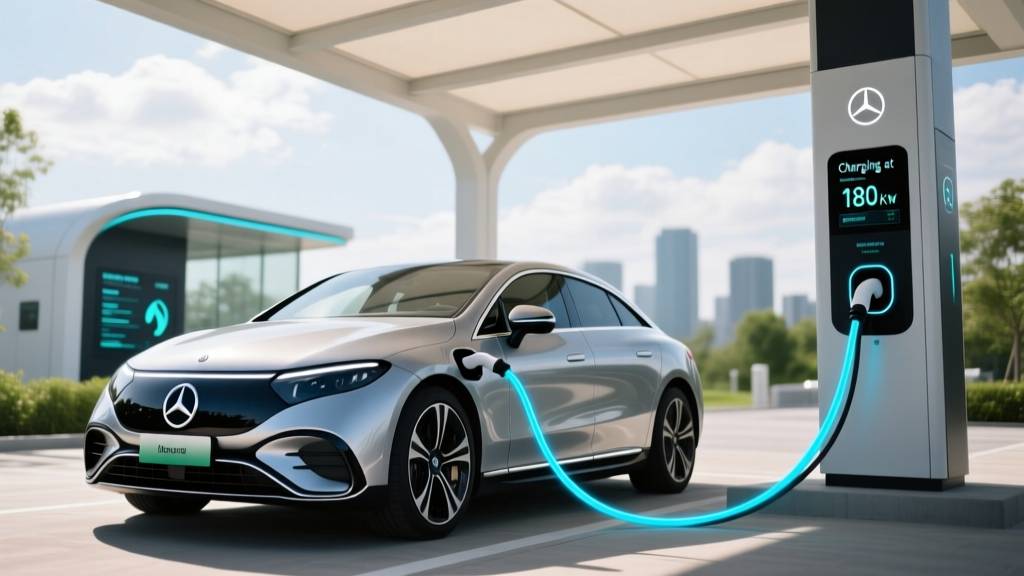
Mercedes-Benz has deployed branded High-Power Charging stations across major US corridors, featuring several premium amenities that distinguish them from generic public chargers:
- Plug & Charge capability: No app or RFID card needed — your Mercedes EQ vehicle authenticates automatically when plugged in, and billing happens through your Mercedes me connect account
- Integrated navigation: Your vehicle's MBUX system routes you to available Mercedes network stations, preconditions the battery for optimal charging speed, and shows real-time stall availability
- Premium amenities: Many locations feature covered charging bays, lounges with Wi-Fi, restrooms, and refreshments — addressing a common pain point at typical public charging stations
- CCS1 and NACS connectors: Stations support both standards, ensuring compatibility with current Mercedes EQ models (CCS1) and future vehicles adopting the North American Charging Standard
As of 2026, Mercedes has activated over 2,500 High-Power charging ports across 400+ stations in the United States, with concentrations in California, Texas, Florida, and major interstate corridors. The network continues expanding through partnerships with Electrify America and independent site hosts.
Home EV Charger Installation: Electrical Requirements and Costs
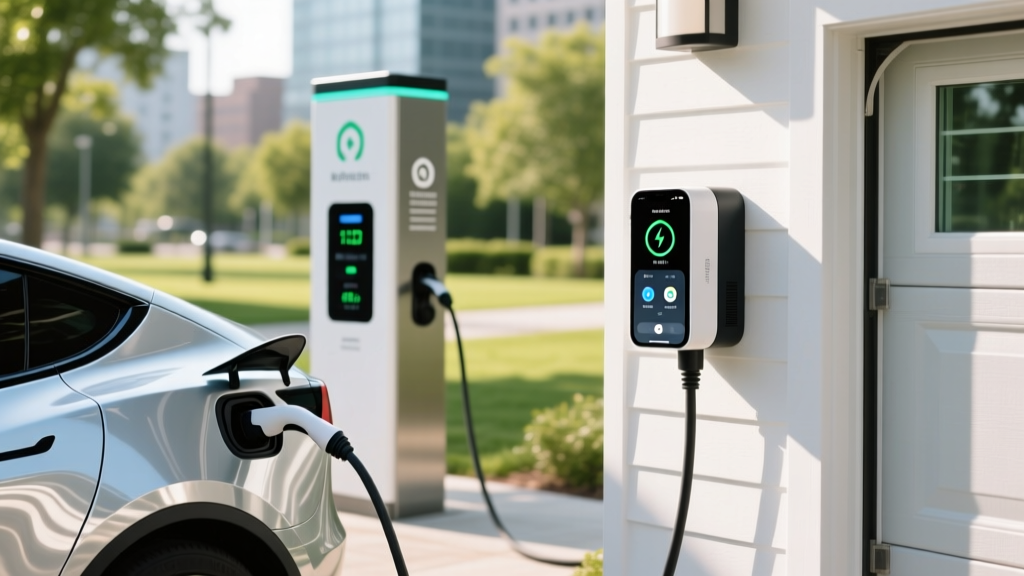
Installing a Level 2 home charger is the single most impactful upgrade for EV ownership convenience. For Mercedes EQ owners, a properly sized home charger means waking up every morning with a full battery, eliminating range anxiety for daily driving.
Electrical Requirements for Mercedes EQ Vehicles
Most Mercedes EQ vehicles come with an 11.5 kW onboard charger (some EQB variants have 7.2 kW). To maximize charging speed, you'll need:
- 240V dedicated circuit (like an electric dryer or oven outlet)
- 40-60 amp breaker for a 9.6-11.5 kW charger (NEC code requires circuits rated 125% above continuous load, so an 11.5 kW charger drawing 48A needs a 60A breaker)
- 6-gauge copper wire for runs up to 50 feet; 4-gauge for longer runs to prevent voltage drop
- NEMA 14-50 outlet (for portable chargers) or hardwired connection (for wall-mounted units — often required for 48A+ chargers)
Panel Upgrade Considerations
Many homes built before 2000 have 100-amp or 150-amp main electrical panels. Adding a 60A EV circuit may exceed your panel's capacity, especially if you already have electric appliances (oven, dryer, HVAC). Signs you may need a panel upgrade:
- Main panel is 100A or 150A
- Few open breaker slots remaining
- Existing high-draw appliances (electric heat, hot tub, workshop equipment)
- Utility service drop is undersized for modern loads
A panel upgrade to 200A typically costs $1,500-$3,500, while upgrading to 400A (for homes with multiple EVs or future solar/battery plans) runs $3,000-$6,000.
Home Charger Installation Cost Breakdown (2026)
| Component | Cost Range | Notes |
|---|---|---|
| Level 2 Charger Equipment | $400 - $800 | Smart WiFi-enabled chargers (ChargePoint, Emporia, Wallbox) |
| Electrical Permit | $50 - $250 | Varies by municipality; some areas waive for EV installations |
| Electrician Labor (standard install) | $600 - $1,500 | Assumes panel within 30 feet of garage, no upgrades needed |
| Wire and Conduit Materials | $150 - $400 | 6-gauge copper, PVC conduit, junction boxes |
| Panel Upgrade (if needed) | $1,500 - $3,500 | 100A/150A to 200A upgrade |
| Total (no panel upgrade) | $1,200 - $2,950 | Typical scenario for newer homes |
| Total (with panel upgrade) | $2,700 - $6,450 | Older homes needing service upgrade |
Always hire a licensed electrician familiar with NEC Article 625 (EV charging equipment). Permits and inspections protect you from fire hazards and insurance claim denials. Some utilities offer rebates of $250-$1,000 for home charger installations — check with your provider before starting work.
Connector Compatibility: NACS, CCS1, and Adapter Requirements
The connector landscape has shifted dramatically since Tesla opened its Supercharger network and the industry coalesced around the North American Charging Standard (NACS). Here's how this affects Mercedes EQ owners in 2026:
| Connector Type | Mercedes Models (2026) | Charging Networks Supported | Adapter Needed? |
|---|---|---|---|
| CCS1 (Combo) | EQS, EQE, EQB, EQC (2022-2025 models) | Electrify America, EVgo, ChargePoint, Mercedes High-Power | None (native) |
| NACS (Tesla-style) | 2026+ EQS, EQE, EQB, EQG (new production) | Tesla Supercharger, Mercedes High-Power, Electrify America (expanding) | None (native on 2026+ models) |
| CHAdeMO | Not supported | Nissan Leaf, older Japanese EVs | N/A — avoid CHAdeMO-only stations |
For 2022-2025 Mercedes EQ owners with CCS1: Mercedes offers an official CCS1-to-NACS adapter ($200-$250) enabling access to Tesla Superchargers. This is essential for road trips through regions where Tesla's network has better coverage than CCS-based networks.
For 2026+ Mercedes EQ models: New vehicles ship with native NACS ports, providing seamless access to 25,000+ Tesla Superchargers plus the growing NACS-equipped public network. No adapter needed.
Charging Costs: Home vs. Public vs. Gasoline Comparison
One of the strongest financial arguments for EV ownership is lower fueling costs, but the savings vary dramatically based on where and when you charge. Let's break down real costs for a Mercedes EQS 450+ (EPA-estimated 350 miles range, 102 kWh usable battery, ~3.0 miles/kWh efficiency):
Cost Per Mile: Mercedes EQS vs. Gasoline Equivalent
| Charging Scenario | Cost per kWh | Cost for Full Charge (102 kWh) | Cost Per Mile | Annual Fuel Cost (12,000 mi) |
|---|---|---|---|---|
| Home Charging (off-peak rate) | $0.13 | $13.26 | $0.044 | $528 |
| Home Charging (standard rate) | $0.18 | $18.36 | $0.061 | $732 |
| Public Level 2 (shopping centers, workplaces) | $0.25 - $0.35 | $25.50 - $35.70 | $0.085 - $0.119 | $1,020 - $1,428 |
| DC Fast Charging (Mercedes High-Power, Electrify America) | $0.35 - $0.48 | $35.70 - $48.96 | $0.119 - $0.163 | $1,428 - $1,956 |
| Gasoline Equivalent (25 MPG, $3.50/gal) | N/A | N/A | $0.140 | $1,680 |
Key takeaways:
- Home charging with off-peak rates saves $1,150+ annually vs. gasoline
- Exclusive reliance on DC fast charging can exceed gasoline costs — home charging is essential for economic benefits
- Mercedes me connect subscribers often receive complimentary or discounted charging at partner networks (typically 2-3 years of included DC fast charging with new EQ purchases)
- Time-of-use utility plans can cut home charging costs by 30-50% — schedule charging for 10 PM - 6 AM when rates are lowest
For detailed utility rate comparisons and time-of-use plan availability in your area, check the Department of Energy's EV charging resources.
Recommended Home Charging Equipment for Mercedes EQ Vehicles
Not all Level 2 chargers are equal. For Mercedes EQ owners, you need equipment that matches your vehicle's 11.5 kW onboard charger capability, offers smart features for cost optimization, and provides reliable daily operation. Here are top-performing options for 2026:
ChargePoint Home Flex
- Power Output: Up to 12 kW (50A) — matches Mercedes EQ onboard charger
- Connector: J1772 (CCS1-compatible); NACS adapter available
- Cable Length: 23 feet
- Smart Features: WiFi connectivity, scheduled charging, energy tracking, Alexa integration, load sharing for multi-charger setups
- Price: $699 (charger only); $799 with NACS adapter
- Best For: Mercedes owners wanting detailed app control and utility demand-response program participation
Emporia Vue Smart Home EV Charger
- Power Output: Up to 11.5 kW (48A)
- Connector: J1772 (CCS1-compatible)
- Cable Length: 24 feet
- Smart Features: Real-time energy monitoring, solar integration (prioritize excess solar for EV charging), circuit-level load management
- Price: $599
- Best For: Homes with solar panels or those wanting granular energy usage data
Wallbox Pulsar Plus
- Power Output: Up to 11.5 kW (48A)
- Connector: J1772 or NACS (select at purchase)
- Cable Length: 20 feet
- Smart Features: Compact design, WiFi + Bluetooth, Power Sharing for dual installations, eco mode for renewable energy prioritization
- Price: $649
- Best For: Tight garage spaces and two-EV households
Mercedes-Benz Wallbox (Official)
- Power Output: Up to 11.5 kW (48A)
- Connector: Integrated cable with CCS1 or NACS (model-year dependent)
- Cable Length: 19.7 feet
- Smart Features: Mercedes me connect integration, RFID authentication, green LED status ring, premium build quality
- Price: $895
- Best For: Brand-loyal owners wanting seamless Mercedes ecosystem integration
All recommended chargers are UL-listed (critical for safety and insurance), NEMA 4-rated for outdoor installation, and compatible with Mercedes EQ vehicles. Avoid uncertified "budget" chargers from unknown brands — they lack safety features like ground fault protection and may void your vehicle's charging system warranty.
Safety, Electrical Code, and Installation Best Practices
EV charging involves sustained high-current electrical loads — cutting corners on safety creates fire and shock hazards. Follow these non-negotiable requirements:
NEC Code Compliance (Article 625)
- Dedicated circuit: Your EV charger must have its own breaker — never share a circuit with other appliances
- GFCI protection: Required for outdoor installations and recommended for garages (2023 NEC update)
- Proper wire gauge: 6-gauge copper minimum for 48A chargers; 4-gauge for 60A or runs over 50 feet
- Ventilation: Indoor chargers don't require special ventilation, but ensure adequate airflow around the unit
Outdoor Installation Considerations
- Use NEMA 4-rated (weatherproof) chargers — all recommended models above qualify
- Install at 48-60 inches height for ergonomic access and flood protection
- Use conduit for exposed wiring runs (UV-resistant PVC or metal)
- Consider a locking charger cover if installed in public-access areas
Smart Load Management
If your electrical panel is near capacity, consider chargers with load-sharing features (ChargePoint Home Flex, Wallbox Pulsar Plus). These devices communicate with a current sensor on your main panel and automatically reduce charging power when other appliances draw heavy loads, preventing breaker trips without requiring a panel upgrade.
Mercedes me connect: Optimizing Your Charging Experience
The Mercedes me connect app and in-vehicle MBUX system provide powerful tools for managing charging across home and public networks:
- Preconditioning: Set departure times, and your Mercedes will warm or cool the battery to optimal temperature for maximum charging speed when you arrive at a DC fast charger
- Charging profiles: Create location-specific settings (home: charge to 80% overnight; road trip: charge to 100% before departure)
- Route planning: MBUX automatically includes charging stops on long trips, selecting Mercedes High-Power stations when available and pre-routing battery temperature
- Payment integration: Link a credit card once — Plug & Charge at Mercedes network stations bills automatically without apps or RFID cards
- Charging history: Track energy usage, costs, and CO2 savings over time
For Mercedes EQ owners, the combination of the Mercedes charging network, home Level 2 charging, and intelligent vehicle software creates a charging experience that's genuinely more convenient than gasoline refueling for daily driving — you simply plug in at home and wake up with a full "tank" every morning.
Frequently Asked Questions
How much does it cost to install a home EV charger for my Mercedes?
Expect $1,200-$2,950 for a standard installation (equipment + electrician + permit) in homes with adequate electrical capacity. If your home needs a panel upgrade from 100A/150A to 200A, add $1,500-$3,500, bringing the total to $2,700-$6,450. Always get 2-3 quotes from licensed electricians and verify they have EV charging installation experience.
How fast will each charging level add range to my Mercedes EQ?
Level 1 (120V) adds 3-5 miles per hour — impractical for daily use. Level 2 (240V, 11.5 kW) adds 30-40 miles per hour, fully recharging an EQS overnight in 9 hours. DC fast charging at 200 kW adds 150-200 miles in 15-20 minutes, though charging speed tapers above 80% state of charge to protect battery health.
Which connector does my Mercedes EQ use, and do I need an adapter?
2022-2025 Mercedes EQ models use CCS1 connectors and work natively with Electrify America, EVgo, and Mercedes High-Power stations. To access Tesla Superchargers, you'll need a CCS1-to-NACS adapter ($200-$250). 2026+ Mercedes EQ models ship with native NACS ports, requiring no adapters for Tesla or NACS-equipped public chargers.
How much does charging a Mercedes EQ cost per mile compared to gasoline?
Home charging with off-peak electricity ($0.13/kWh) costs about $0.044 per mile — 68% cheaper than gasoline at $3.50/gallon in a 25 MPG vehicle ($0.14/mile). However, exclusive reliance on DC fast charging ($0.35-$0.48/kWh) can exceed gasoline costs. Home charging is essential for realizing EV fuel savings.
What electrical upgrades might I need for a home charger?
Homes with 200A electrical service and open breaker slots typically need no upgrades. Older homes with 100A/150A panels, electric heating, or few remaining breaker slots may require a panel upgrade ($1,500-$3,500). A licensed electrician can assess your panel's capacity during a pre-installation consultation — many offer this service free with a quote.
Can I use the Mercedes charging network if I don't own a Mercedes?
Yes. Mercedes High-Power Charging stations are open to all EV drivers with CCS1 or NACS connectors. However, Mercedes me connect subscribers receive benefits like Plug & Charge authentication, discounted rates, and integrated navigation that non-Mercedes owners won't access.
Does fast charging damage my Mercedes EQ battery?
Occasional DC fast charging has minimal impact on battery health. Mercedes engineers battery management systems to limit peak charging rates and manage thermal loads. However, frequent daily fast charging (especially to 100% state of charge) accelerates degradation. For daily use, charge at home on Level 2 to 80% — reserve fast charging for road trips. Mercedes warranties EQ batteries for 8 years/100,000 miles with a guaranteed 70% capacity retention threshold.
How do I find Mercedes High-Power Charging stations?
Use the Mercedes me connect app, your vehicle's MBUX navigation system, or visit the Mercedes-Benz USA electric vehicle page. The network is also listed on aggregator apps like PlugShare and ChargePoint, though real-time availability is most accurate through Mercedes' own systems.
Final Considerations for Mercedes EQ Owners
The Mercedes charging network, combined with strategic home charging setup, delivers a premium EV ownership experience that justifies the investment in a Mercedes EQ vehicle. Key action items:
- Install a Level 2 home charger — the single most important step for daily convenience and cost savings
- Enroll in your utility's time-of-use plan — cut charging costs by 30-50% with off-peak scheduling
- Purchase a CCS1-to-NACS adapter (if you own a 2022-2025 model) — unlocks Tesla Supercharger access for road trips
- Use Mercedes me connect features — preconditioning, route planning, and Plug & Charge streamline the charging process
- Reserve DC fast charging for road trips — home Level 2 charging is cheaper, gentler on the battery, and more convenient for daily use
For the latest information on Mercedes EQ models, charging specifications, and network expansion, visit the EPA's Fuel Economy website or your local Mercedes-Benz dealer. The EV charging landscape evolves rapidly — staying informed ensures you maximize the value and convenience of your electric Mercedes.