If you own or are considering a Mercedes-Benz EQE, EQS, EQB, or any other model from the Stuttgart automaker's electric lineup, you've likely encountered the Mercedes-Benz Wallbox charger — the brand's official home Level 2 charging solution. But is the OEM wallbox the best choice for your garage, or are third-party alternatives a smarter buy? This guide covers the Wallbox Home's specs, installation requirements, real-world charging times, total cost, and how it stacks up against competitors like the ChargePoint Home Flex and Emporia Vue.
What Is the Mercedes-Benz Wallbox Home Charger?
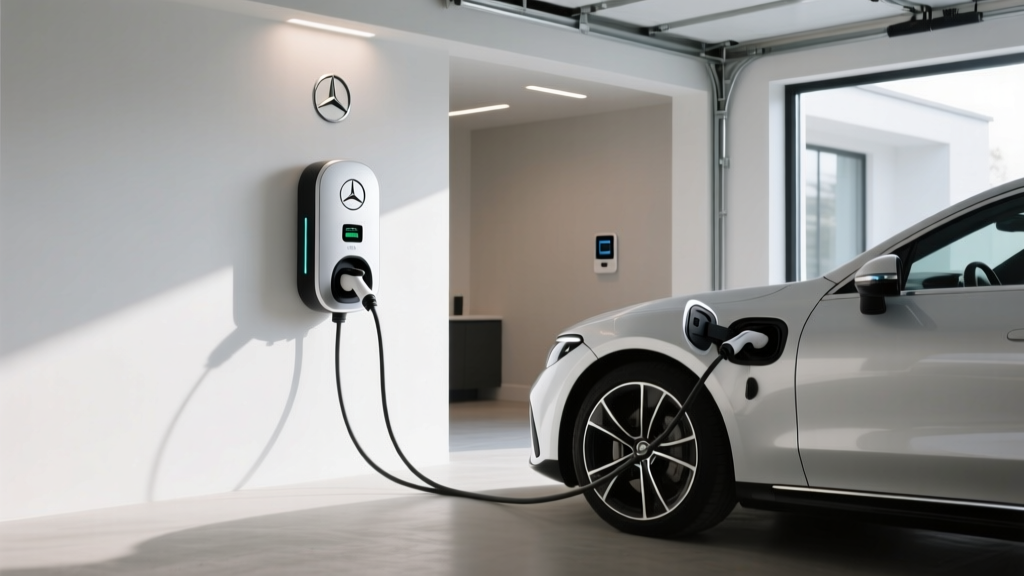
The Mercedes-Benz Wallbox Home is a hardwired Level 2 AC charger rated for up to 11.5 kW (48 amps) on a 240-volt dedicated circuit. It ships with a ~25-foot cable and is available in both the legacy CCS1 connector (J1772-based) and, for 2025+ models, the North American Charging Standard (NACS) plug that Tesla pioneered and most automakers have now adopted.
Mercedes-Benz positions the Wallbox as a premium, design-matched accessory for EQ owners. The unit features an integrated cable management holster, LED status ring, RFID authorization (to prevent unauthorized use in shared garages), and Wi-Fi connectivity via the Mercedes me Charge app for scheduling, session history, and solar-integration triggers if you have a home PV system.
Max Power Output: 11.5 kW (48A) / configurable down to 32A or 40A
Voltage: 240V AC, single-phase
Cable Length: 25 ft (7.5 m)
Connector: NACS (2025+) or CCS1 (legacy)
Weatherproofing: NEMA 4 (indoor/outdoor rated)
Smart Features: Wi-Fi, Mercedes me app, RFID lock, solar scheduling
MSRP: ~$695 (charger unit only, before installation)
Charging Levels Explained: How Fast Will Each Add Range?
Before evaluating the Wallbox specifically, it helps to understand the three EV charging tiers and how they translate to miles added per hour. Power is measured in kW (kilowatts — the rate of energy flow), while battery capacity is measured in kWh (kilowatt-hours — the total energy stored). Think of kW as the width of a hose and kWh as the size of the bucket.
| Level | Voltage | Max Power (kW) | Miles of Range Added per Hour | Typical Use Case |
|---|---|---|---|---|
| Level 1 | 120V AC | 1.4 kW | 3–5 mi/hr | Overnight trickle; PHEVs or low-mileage drivers |
| Level 2 (Home) | 240V AC | 7.2–11.5 kW | 20–44 mi/hr | Daily home charging; full overnight recharge |
| DC Fast Charge | 400–800V DC | 50–350 kW | 150–1,000+ mi/hr | Road trips; 10–80% in 15–30 minutes |
For an EQS 450+ with its 108.4 kWh (usable) battery and EPA-estimated 390-mile range, the Mercedes-Benz Wallbox at 11.5 kW adds roughly 37–42 miles of range per hour. A full 10–80% charge takes approximately 7.5 hours — ideal for overnight replenishment while you sleep. By contrast, Level 1 on a standard 120V outlet would take over 70 hours for the same 10–80% fill, making it impractical as a primary charging method for large-battery EVs.
Installation Requirements & Real Cost Breakdown
The single biggest variable in home charging isn't the charger itself — it's the electrical work. The Mercedes-Benz Wallbox Home is a hardwired unit (no plug), which means a licensed electrician must run a dedicated 240V circuit from your electrical panel to the charger location and terminate it directly. Here's what that entails and what it costs.
Electrical Requirements
- Circuit: Dedicated 60-amp breaker (to support 48A continuous draw, per NEC 80% rule)
- Wire: 6 AWG copper (or 4 AWG aluminum) THHN in conduit
- Panel capacity: Your main panel must have at least 60 amps of spare capacity. A 200-amp panel serving a modern home with electric HVAC, dryer, and range may be near its limit.
- GFCI protection: NEC 2023 (and adopted in most jurisdictions by 2026) requires GFCI protection for EV charging circuits — the Wallbox has built-in ground-fault protection, but your electrician will verify compliance.
- Permit: Required in virtually all US jurisdictions for new 240V circuits. Inspection ensures the work meets code.
Panel Upgrade: The Hidden Cost
If your home has a 100-amp main panel (common in pre-1990 construction) or your existing 200-amp panel is already heavily loaded, you may need a panel upgrade to 200A or even 400A. This is the single most expensive variable in EV charger installation. A 200A upgrade typically runs $1,500–$3,000; a 400A service upgrade (for homes adding EV charging plus heat pumps and solar) can reach $3,500–$5,500. Always get a load calculation from your electrician before committing.
| Component | Low Estimate | High Estimate | Notes |
|---|---|---|---|
| Wallbox unit (11.5 kW) | $695 | $695 | Fixed MSRP from Mercedes-Benz dealer or online |
| Electrician labor (short run, <30 ft) | $400 | $800 | Panel adjacent to garage; easy conduit path |
| Electrician labor (long run, >50 ft) | $800 | $1,500 | Panel on opposite side of house; attic/crawlspace routing |
| Materials (wire, conduit, breaker) | $100 | $300 | Varies with run length and local copper pricing |
| Permit & inspection | $50 | $250 | Varies by municipality |
| Total (no panel upgrade) | $1,245 | $3,545 | Most homes fall in $1,500–$2,200 range |
| Panel upgrade (if needed) | $1,500 | $5,500 | 200A to 400A service upgrade |
| Total (with panel upgrade) | $2,745 | $9,045 | Older homes or heavy-load households |
The IRS §30D federal tax credit does not cover home charging equipment directly (that was the now-expired §30C Alternative Fuel Infrastructure credit for most residential installations). However, some states and utilities offer rebates of $250–$1,000 for Level 2 charger installation — check your local utility's EV program page.
Connector Compatibility: NACS vs. CCS1 for Mercedes-Benz EVs
Mercedes-Benz began transitioning its US-market EVs to the NACS (North American Charging Standard) connector starting with the 2025 model year. If you own a 2024 or earlier EQE, EQS, EQB, or EQC, your vehicle has a CCS1 port. If you've purchased a 2025+ model, it likely has NACS.
| Model | Model Years | Port Type | Wallbox Config Needed | Adapter Required? |
|---|---|---|---|---|
| EQS Sedan/SUV | 2022–2024 | CCS1 | CCS1 Wallbox | None (or NACS-to-CCS for Tesla Superchargers) |
| EQS Sedan/SUV | 2025+ | NACS | NACS Wallbox | CCS1 adapter for older public stations |
| EQE Sedan/SUV | 2023–2024 | CCS1 | CCS1 Wallbox | None |
| EQE Sedan/SUV | 2025+ | NACS | NACS Wallbox | CCS1 adapter for older public stations |
| EQB | 2022–2024 | CCS1 | CCS1 Wallbox | None |
| EQB | 2025+ | NACS | NACS Wallbox | CCS1 adapter for older public stations |
| eSprinter | 2024+ | CCS1 | CCS1 Wallbox | None |
If you're buying the Mercedes-Benz Wallbox today, order the connector that matches your vehicle's port. Mercedes-Benz dealers can confirm your VIN's connector type. If you plan to keep the charger through a future vehicle swap, NACS is the safer long-term bet given the industry-wide migration — and a CCS1-to-NACS adapter (from Tesla or third-party makers like Lectron, ~$200) handles legacy vehicles.
Charging Time Examples: Mercedes-Benz EV Models on the Wallbox
Here's how long a 10–80% charge takes on the 11.5 kW Wallbox for current Mercedes-Benz EV models, using their usable battery capacities and accounting for the charge-curve taper that occurs as the battery approaches higher states of charge. (Note: Level 2 AC charging is relatively linear compared to DC fast charging, where taper above 80% SoC is dramatic.)
| Model | Usable Battery (kWh) | EPA Range (mi) | 10–80% Time (hrs) | Mi Added per Hour |
|---|---|---|---|---|
| EQS 450+ Sedan | 108.4 | 390 | ~7.5 | ~37 |
| EQS 580 4MATIC | 108.4 | 371 | ~7.5 | ~35 |
| EQS SUV 450+ | 108.4 | 305 | ~7.5 | ~29 |
| EQE 350+ Sedan | 90.6 | 308 | ~6.3 | ~35 |
| EQE 350 4MATIC SUV | 90.6 | 279 | ~6.3 | ~31 |
| EQB 300 4MATIC | 66.5 | 243 | ~4.6 | ~37 |
How Much Does Charging Cost Per Mile vs. Gas?
One of the strongest economic arguments for home EV charging is the per-mile fuel cost. Let's compare an EQS 450+ (EPA combined efficiency of 97 MPGe, or roughly 34 kWh per 100 miles) against a comparable gas vehicle — the S 500 4MATIC, which returns about 24 MPG combined on premium unleaded.
| Scenario | Energy Cost | Cost per 100 Miles | Cost per Mile |
|---|---|---|---|
| Home charging (national avg. electricity, $0.16/kWh) | $0.16/kWh | $5.44 | $0.054 |
| Home charging (off-peak TOU rate, $0.09/kWh) | $0.09/kWh | $3.06 | $0.031 |
| Public Level 2 (avg. $0.35/kWh) | $0.35/kWh | $11.90 | $0.119 |
| DC Fast Charging (avg. $0.48/kWh) | $0.48/kWh | $16.32 | $0.163 |
| S 500 Gasoline (premium $4.20/gal, 24 MPG) | $4.20/gal | $17.50 | $0.175 |
At home off-peak rates, the EQS costs roughly $0.03 per mile to fuel — about 83% less than the gas S 500 at $0.175/mile. Even at DC fast-charging prices, the EV is marginally cheaper. The key takeaway: home charging is where the economics work best. If you rely primarily on public DC fast chargers, the per-mile cost approaches parity with gasoline, and the time cost is significantly higher than plugging in at home overnight.
Mercedes-Benz Wallbox vs. Competitors: Which Charger Should You Buy?
The Mercedes-Benz Wallbox Home is a solid, premium charger — but it's not the only option, and depending on your needs, a third-party unit might offer more flexibility or a lower price. Here's how it compares to the leading alternatives.
Power: 11.5 kW (48A)
Connector: NACS or CCS1
Cable: 25 ft
Smart: Wi-Fi, Mercedes me app, RFID
Price: ~$695
Best for: EQ owners who want OEM integration and app ecosystem consistency.
Power: Up to 12 kW (50A)
Connector: NACS or J1772
Cable: 23 ft
Smart: Wi-Fi, ChargePoint app, Alexa
Price: ~$649
Best for: Multi-EV households; works with every brand via app-agnostic platform.
Power: Up to 11.5 kW (48A)
Connector: NACS or J1772
Cable: 24 ft
Smart: Wi-Fi, Emporia app, solar integration
Price: ~$399
Best for: Budget-conscious buyers and solar-panel owners who want energy monitoring.
The Wallbox's main advantage is the Mercedes me integration — scheduled charging that syncs with your vehicle's departure-time preconditioning, solar charging triggers, and RFID anti-theft lock. If you drive only Mercedes EVs and value a unified app experience, it's worth the premium. If you have a mixed-brand garage or want to save $200–$300, the ChargePoint Home Flex or Emporia are excellent alternatives that will charge any Mercedes EV just as fast.
Safety, Code, and Outdoor Installation Considerations
EV chargers draw sustained high current for hours — this is one of the most demanding continuous loads in a residential electrical system. Proper installation isn't optional; it's a safety requirement.
- Dedicated circuit: The Wallbox must be on its own dedicated breaker. Sharing a circuit with other appliances is a code violation and a fire risk.
- NEMA 4 rating: The Wallbox Home carries a NEMA 4 (weatherproof) rating, making it suitable for outdoor installation on a garage exterior wall or carport. If you install outdoors, ensure the conduit entry point is sealed and the unit is mounted at least 18 inches above grade per most local codes.
- GFCI: The Wallbox includes integrated ground-fault protection. Your electrician will verify this satisfies NEC 2023 Section 625.54 requirements (which mandate personnel protection for EV supply equipment).
- Wire gauge: For a 60A breaker / 48A continuous load, 6 AWG copper is standard. Runs exceeding 100 feet may require upsizing to 4 AWG to limit voltage drop below 3%.
- Permit and inspection: Do not skip this. A permitted, inspected installation protects you in the event of an insurance claim and ensures the work meets the National Electrical Code (NEC) standards adopted by your jurisdiction.
- Load management: If your panel is near capacity but you want to avoid a full upgrade, consider a load-management device like the Emporia Smart Panel or a Tesla Gateway that dynamically throttles charger amperage based on real-time household draw. This can reduce the circuit requirement from 60A to 40A or 30A while still providing adequate overnight charging.
Frequently Asked Questions
How much does it cost to install the Mercedes-Benz Wallbox charger at home?
Expect $1,245–$3,545 total (charger + electrician + materials + permit) for a standard installation with no panel upgrade. If your home requires a 200A or 400A electrical service upgrade, add $1,500–$5,500. Most homeowners with a 200A panel and a garage-adjacent breaker panel land in the $1,500–$2,200 range.
How fast will the Mercedes-Benz Wallbox charge my EQS or EQE?
At its maximum 11.5 kW output, the Wallbox adds approximately 30–42 miles of range per hour depending on the model's efficiency. A 10–80% charge for the EQS 450+ (108.4 kWh usable battery) takes about 7.5 hours — comfortably completing overnight. The smaller EQB (66.5 kWh) reaches 80% in roughly 4.6 hours.
Is the Mercedes-Benz Wallbox compatible with non-Mercedes EVs?
Yes. The NACS version will charge any NACS-equipped vehicle (Tesla Model 3/Y/S/X, Ford F-150 Lightning, Rivian, etc.). The CCS1 version charges any CCS1 vehicle. It's a standard Level 2 AC charger — the Mercedes me smart features are bonus functionality, but the charging protocol is universal.
Do I need a NACS or CCS1 Wallbox?
Match the connector to your vehicle's charge port. 2025+ Mercedes-Benz EVs use NACS; 2022–2024 models use CCS1. If you plan to upgrade to a newer Mercedes within a few years, buying the NACS version now and using a CCS1 adapter for your current vehicle is a reasonable strategy.
Can I install the Mercedes-Benz Wallbox myself?
No. The Wallbox Home is a hardwired unit requiring a dedicated 240V/60A circuit. The National Electrical Code requires this work to be performed by a licensed electrician and inspected by your local building authority. DIY installation of a 48-amp continuous load is a serious fire and electrocution hazard and will void both the charger warranty and potentially your homeowner's insurance coverage.
How does charging cost compare between home and public chargers?
Home charging at off-peak utility rates (~$0.09/kWh) costs about $0.03/mile for an EQS 450+. Public DC fast charging at ~$0.48/kWh costs about $0.16/mile — roughly 5x more. For the best economics, charge at home whenever possible and reserve public DC fast charging for road trips.
Will the Wallbox work with solar panels?
Yes. The Mercedes me Charge app supports solar-integration scheduling, allowing you to set charging windows that align with peak PV production hours. Pairing the Wallbox with a home solar system and a time-of-use utility plan can push your effective per-mile fuel cost toward zero during sunny months.