The State of CCS EV Charging in 2026
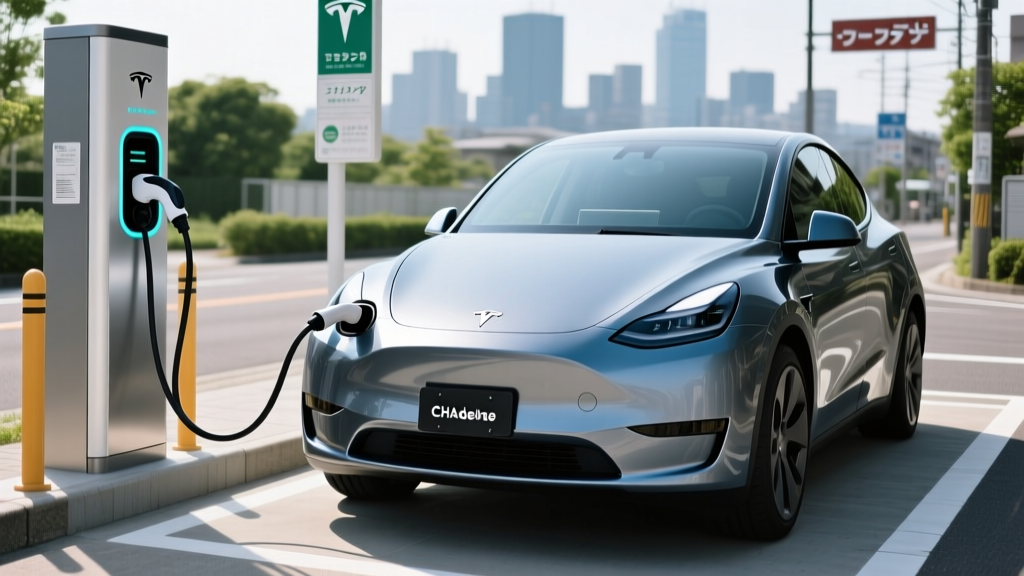
Combined Charging System (CCS) remains the original standardized DC fast-charging connector for most non-Tesla EVs sold in North America. If you own a Hyundai Ioniq 5, Ford Mustang Mach-E, BMW i4, Volkswagen ID.4, or any pre-2025 General Motors EV, your vehicle charges natively via CCS1. But the landscape is shifting: nearly every major automaker has adopted the North American Charging Standard (NACS) for 2025+ models, and networks like Electrify America and EVgo now deploy dual-standard stalls.
This guide covers everything you need to know about CCS EV charging — from home Level 2 installation costs and electrical requirements to public DC fast-charging speeds, connector adapters, and what it actually costs per mile versus gasoline.
Understanding CCS vs NACS: What Connector Does Your EV Use?
Before buying a charger or planning a road trip, you need to know which connector your EV requires. The physical plug and communication protocol differ, and using the wrong one means you won't charge at all.
| Connector | Native Vehicles | Adapter Required For | Max DC Rate |
|---|---|---|---|
| CCS1 | Hyundai/Kia (pre-2025), VW ID.4, Ford Mach-E (pre-2025), BMW i4/iX, Rivian R1T/R1S (pre-2025), most pre-2025 GM EVs | NACS-equipped Superchargers (CCS→NACS adapter, ~$150–$250) | Up to 350 kW (vehicle-dependent) |
| NACS | All Tesla vehicles, 2025+ GM (Cadillac, Chevrolet, GMC), 2025+ Ford, 2025+ Rivian, 2025+ Hyundai/Kia, 2025+ BMW, Volvo, Polestar, Mercedes-Benz, Lucid, Fisker | CCS public chargers (NACS→CCS adapter, ~$150–$200) | Up to 250 kW (Tesla Supercharger V3); V4 supports higher |
| CHAdeMO | Nissan Leaf (all years), Mitsubishi Outlander PHEV (older) | No viable adapter to CCS or NACS for DC | Up to 100 kW (most vehicles capped at 50–62 kW) |
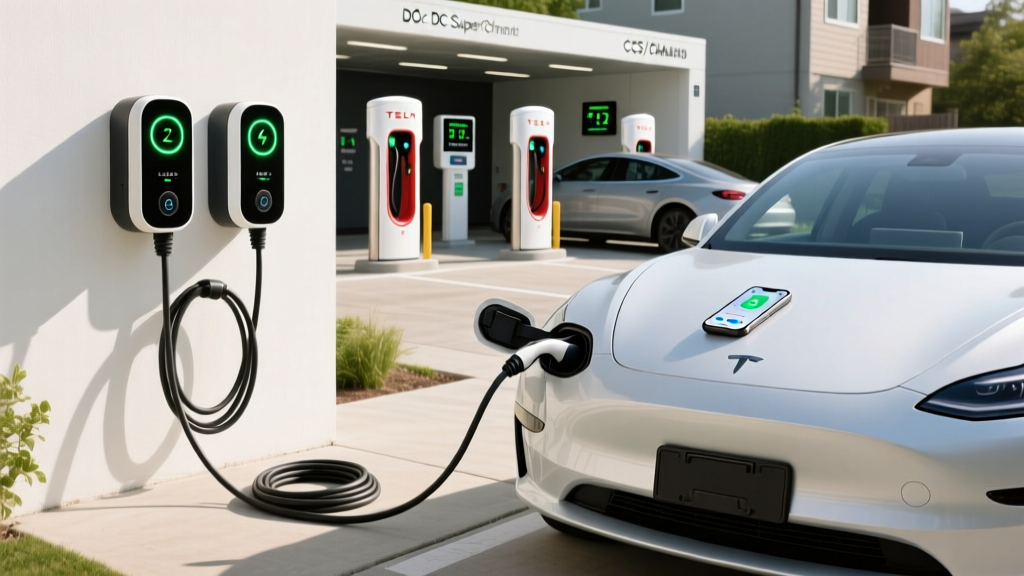
Key insight: If you drive a CCS-equipped EV in 2026, you can access Tesla Superchargers using a CCS-to-NACS adapter. Tesla, Lectron, and A2Z sell adapters rated for up to 250 kW DC. Conversely, if you drive a NACS-equipped 2025+ vehicle, you'll need a NACS-to-CCS adapter to use Electrify America or older EVgo CCS-only stalls.
For Level 2 AC charging at home, the standard J1772 connector works on all CCS and CHAdeMO vehicles. Tesla uses a proprietary connector but includes a J1772 adapter in every vehicle. NACS vehicles also accept J1772 via adapter for Level 2.
Charging Levels Explained: Speeds, Power, and Range Added
A critical distinction every EV owner must understand: kW (kilowatts) measures power — the rate at which energy flows into your battery. kWh (kilowatt-hours) measures energy — the total capacity stored in your battery. A 77 kWh battery charged at 11 kW takes roughly 7 hours; charged at 150 kW (DC), it takes about 30 minutes to 80%.
| Level | Voltage | Power (kW) | Miles of Range Per Hour | Best For |
|---|---|---|---|---|
| Level 1 | 120V AC | 1.0–1.4 kW | 3–5 miles/hr | Overnight trickle for PHEVs or low-mileage commuters |
| Level 2 | 240V AC | 3.3–19.2 kW | 12–75 miles/hr | Daily home charging, workplace, shopping centers |
| DC Fast (Level 3) | 400–800V DC | 50–350 kW | 150–400+ miles/hr (peak) | Road trips, rapid top-ups; not for daily use |
Real-world charging time examples (10–80% SoC):
- Hyundai Ioniq 5 (77.4 kWh battery, 800V architecture): Peaks at ~240 kW on a 350 kW CCS charger. 10–80% in approximately 18 minutes. Sustained rate averages ~170 kW due to charge-curve taper above 60%.
- Ford Mustang Mach-E Extended Range (91 kWh usable): Peaks at ~150 kW on CCS. 10–80% in approximately 38–42 minutes. Charge curve tapers significantly past 80%.
- Volkswagen ID.4 (82 kWh battery): Peaks at ~170 kW on newer models (2024+). 10–80% in approximately 28–30 minutes.
- BMW i4 eDrive40 (81.5 kWh): Peaks at ~200 kW. 10–80% in approximately 28–31 minutes.
Charge-curve reality check: Advertised peak kW is never sustained across the entire session. A vehicle rated for 250 kW peak may only hold that rate between 10–30% SoC before tapering. Average charging power across a 10–80% session is typically 60–75% of the peak rate. Always evaluate chargers and vehicles by their 10–80% time, not peak kW alone.
Home Level 2 Charger Installation: Electrical Requirements and Costs
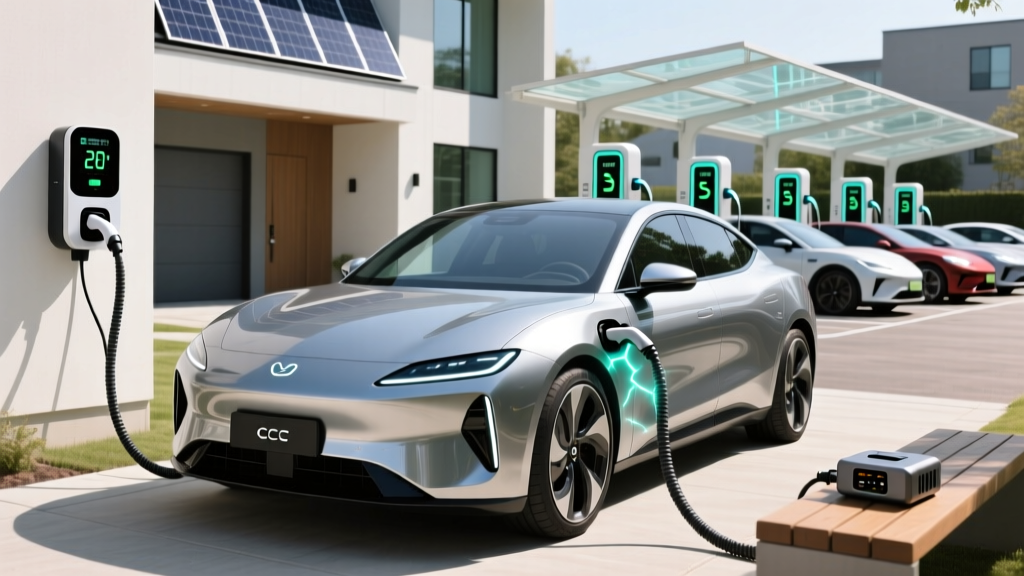
Most CCS-equipped EV owners charge at home using a Level 2 wall-mounted unit on a dedicated 240V circuit. Here's what the electrical work involves and what you should budget.
Electrical Panel and Circuit Requirements
A standard Level 2 home charger requires a dedicated 240V circuit at 40A, 48A, or 60A depending on the charger's maximum output. The National Electrical Code (NEC) requires circuits to be rated at 125% of the continuous load — meaning a 48A charger needs a 60A breaker, and a 40A charger needs a 50A breaker.
- 200-amp electrical panel: Most modern homes can accommodate a 40A–60A EV circuit without a panel upgrade, provided spare capacity exists after existing loads (HVAC, water heater, dryer, range).
- 100-amp panel: Common in homes built before 2000. A 60A EV circuit may push total calculated load past the panel's rating, requiring a panel upgrade to 200A ($1,500–$3,500) or a smart load-management device like the Emporia Smart Load Center (~$400) that throttles the charger when other loads spike.
- Wire gauge: 6 AWG copper for 48A–60A circuits; 8 AWG for 40A circuits. Longer wire runs (50+ feet from panel to garage) increase material cost significantly.
| Component | Low End | High End | Notes |
|---|---|---|---|
| Level 2 charger (hardware) | $350 | $750 | 40A–48A Wi-Fi-enabled units |
| Electrician labor (standard install) | $400 | $1,200 | Short run, panel adjacent to garage |
| Electrical permit | $50 | $200 | Varies by municipality |
| Wire and conduit (50 ft run) | $100 | $300 | 6 AWG copper in EMT or PVC |
| Subtotal — standard install | $900 | $2,450 | No panel upgrade needed |
| Panel upgrade (100A → 200A) | $1,500 | $3,500 | Required for older homes with limited capacity |
| Total — with panel upgrade | $2,400 | $5,950 | Worst-case older home scenario |
Many utilities offer rebates of $200–$500 for Level 2 charger installation, and some states provide additional incentives. Check your local utility's EV program page before scheduling the electrician.
Safety and Code Considerations
- Dedicated circuit: The EV charger must be on its own breaker — never shared with other appliances.
- GFCI protection: NEC 2020 and later require GFCI protection for all 240V receptacles in garages. Hardwired chargers may be exempt depending on local code interpretation, but GFCI breakers (~$40–$80) add a safety margin.
- NEMA 14-50 receptacle vs. hardwired: A NEMA 14-50 outlet allows you to unplug the charger and take it when you move, but the receptacle itself must be GFCI-protected in most jurisdictions post-2020. Hardwired installations avoid the GFCI receptacle requirement and reduce the risk of overheating at the plug connection over years of use.
- Outdoor rating: If your charger mounts outside, confirm it carries a NEMA 4 (weather-resistant) or IP56+ rating. Units like the ChargePoint Home Flex and Emporia Vue are rated for outdoor installation.
Recommended Home Chargers for CCS-Equipped EVs
Every CCS vehicle charges on Level 2 AC using the standard J1772 connector. The chargers below all feature J1772 output (or include a J1772 adapter) and are compatible with CCS, NACS (via adapter), and CHAdeMO vehicles.
ChargePoint Home Flex
- Power output: Up to 12 kW (50A) on a 60A circuit; configurable down to 16A
- Connector: J1772 (25-foot cable)
- Smart features: Wi-Fi, app-based scheduling, utility demand-response integration, Alexa
- Price: ~$550 (hardware only)
- Best for: Reliable daily charging with flexible amperage for older panels
Emporia Level 2 EV Charger
- Power output: Up to 11.5 kW (48A) on a 60A circuit
- Connector: J1772 (24-foot cable)
- Smart features: Wi-Fi, energy monitoring via Emporia Vue panel integration, solar-aware scheduling
- Price: ~$400 (hardware only)
- Best for: Budget-conscious buyers who want energy monitoring and solar integration
Wallbox Pulsar Plus
- Power output: Up to 11.5 kW (48A) on a 60A circuit
- Connector: J1772 (25-foot cable)
- Smart features: Wi-Fi + Bluetooth, Power Sharing (daisy-chain two units on one circuit), compact form factor
- Price: ~$500 (hardware only)
- Best for: Two-EV households or tight garage spaces
Grizzl-E Smart
- Power output: Up to 10 kW (40A) on a 50A circuit
- Connector: J1772 (24-foot cable)
- Smart features: OCPP-compatible, basic app scheduling, built in Canada for extreme cold (-40°C rated)
- Price: ~$450 (hardware only)
- Best for: Cold-climate durability and outdoor installations
Public CCS DC Fast Charging: Networks, Pricing, and Reliability
For road trips, CCS-equipped EVs rely on public DC fast-charging networks. Here are the major U.S. providers with native CCS stalls in 2026:
- Electrify America: The largest open CCS network, with 1,000+ stations. Offers up to 350 kW chargers. Pricing averages $0.43–$0.56/kWh depending on location and membership tier (Pass+ membership at $4/month reduces rates).
- EVgo: 1,100+ stations, many with CCS connectors at 50–350 kW. Pricing averages $0.39–$0.52/kWh. EVgo Plus+ membership (~$5/month) lowers per-kWh cost.
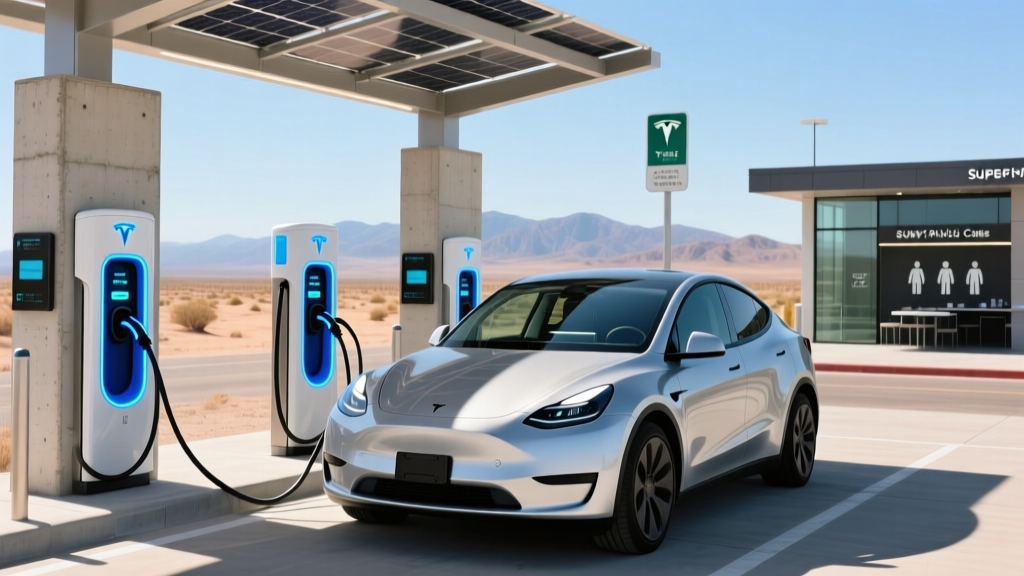
- Tesla Supercharger (with adapter): CCS vehicles can access Supercharger stalls equipped with the Magic Dock (built-in CCS adapter) or by using a purchased CCS-to-NACS adapter. Pricing averages $0.25–$0.35/kWh — significantly cheaper than most non-Tesla networks.
- Ionity (Europe) / Petro-Canada (Canada): Relevant for cross-border travel.
Reliability note: Public CCS charger uptime has improved but remains inconsistent. A J.D. Power 2025 EVX Public Charging Study found customer satisfaction with public DC fast charging averaged 654 out of 1,000 points, with broken screens, payment failures, and connector errors as top complaints. Tesla Superchargers consistently score highest in reliability.
Cost to Charge: $/kWh and Cost Per Mile vs. Gasoline
Charging cost varies enormously depending on where and when you plug in. Here are realistic 2026 scenarios:
| Scenario | Cost Per kWh | Efficiency | Cost Per Mile | Notes |
|---|---|---|---|---|
| Home Level 2 (off-peak utility rate) | $0.08–$0.14 | 3.0 mi/kWh (avg EV) | $0.03–$0.05 | Cheapest option; schedule overnight charging |
| Home Level 2 (standard rate, no TOU) | $0.14–$0.20 | 3.0 mi/kWh | $0.05–$0.07 | Still 60–70% cheaper than gas |
| Public Level 2 (workplace, shopping) | $0.15–$0.30 | 3.0 mi/kWh | $0.05–$0.10 | Some workplaces offer free charging |
| DC fast (Electrify America, EVgo) | $0.40–$0.56 | 3.0 mi/kWh | $0.13–$0.19 | Approaches gas cost; use sparingly |
| DC fast (Tesla Supercharger w/ adapter) | $0.25–$0.35 | 3.0 mi/kWh | $0.08–$0.12 | Best-value DC fast option for CCS vehicles |
| Gasoline comparison (25 MPG avg) | $3.20/gal | 25 mi/gal | $0.13 | National avg regular unleaded, 2026 |
The takeaway: Home charging at off-peak rates costs roughly $0.03–$0.05 per mile — about one-quarter the cost of gasoline at $3.20/gal and 25 MPG. Even expensive DC fast charging at $0.50/kWh costs $0.17/mile, which is comparable to or slightly above gasoline. The economic case for EVs depends heavily on consistent home charging access.
According to fueleconomy.gov, most modern EVs achieve 3.0–4.0 miles per kWh (roughly 100–130 MPGe combined). Cold weather reduces this to 2.2–2.8 mi/kWh due to battery heating demands and reduced regenerative braking efficiency.
Frequently Asked Questions About CCS EV Charging
How much does it cost to install a home EV charger?
A standard Level 2 home charger installation with a dedicated 240V/48A–60A circuit costs $900–$2,450 when no panel upgrade is needed (charger hardware + electrician labor + permit + wire). If your home has a 100A panel that needs upgrading to 200A, add $1,500–$3,500. Utility rebates of $200–$500 often offset part of this cost.
How fast will each charging level add range?
Level 1 (120V) adds 3–5 miles per hour. Level 2 (240V, 48A) adds roughly 30–40 miles per hour depending on vehicle efficiency. DC fast charging adds 150–400+ miles per hour at peak, but the rate tapers as the battery fills — a typical 10–80% session takes 18–42 minutes depending on the vehicle's charge curve and battery size.
Which connector and charger is compatible with my CCS-equipped EV?
All CCS vehicles use the J1772 connector for Level 1 and Level 2 AC charging, and the CCS1 connector for DC fast charging. Any J1772 home charger works. For public DC fast charging, look for CCS1 stalls — or use a CCS-to-NACS adapter ($150–$250) to access Tesla Superchargers with Magic Dock capability.
How much does charging cost per mile compared to gasoline?
Home charging at off-peak rates costs $0.03–$0.05 per mile, roughly 70% less than gasoline at $3.20/gal and 25 MPG ($0.13/mile). Public DC fast charging at $0.40–$0.56/kWh costs $0.13–$0.19 per mile — comparable to or slightly more than gas. Maximize home charging for the best economics.
What electrical upgrades might I need for a home charger?
If your home has a 200A electrical panel with sufficient spare capacity, you likely need only a dedicated 50A–60A breaker and a wire run to the garage. Homes with 100A panels may need a panel upgrade ($1,500–$3,500) or a smart load-management device that shares capacity between the EV charger and other high-draw appliances like HVAC or electric ranges. Always have a licensed electrician perform a load calculation before installation.
Can I use a Tesla Supercharger with my CCS vehicle?
Yes, with limitations. Tesla has opened select Supercharger stalls to non-Tesla EVs via the built-in Magic Dock adapter (CCS-to-NACS). Alternatively, purchase a third-party CCS-to-NACS adapter (Lectron, A2Z, or Tesla's official adapter for approved vehicles) to use any NACS-equipped Supercharger stall. Not all Supercharger locations support non-Tesla vehicles — check the Tesla app for station compatibility.
Is CCS being phased out in favor of NACS?
CCS is not being eliminated, but NACS is becoming the dominant standard for new vehicles sold in North America starting with 2025 model years. Existing CCS vehicles will continue to work on CCS chargers, and public networks are adding NACS connectors alongside CCS rather than replacing them. CCS vehicles will need adapters to access the growing NACS infrastructure over time, but the transition will be gradual and backward-compatible.