Quick Verdict: Is the Mercedes-Benz Power Charger Worth It?
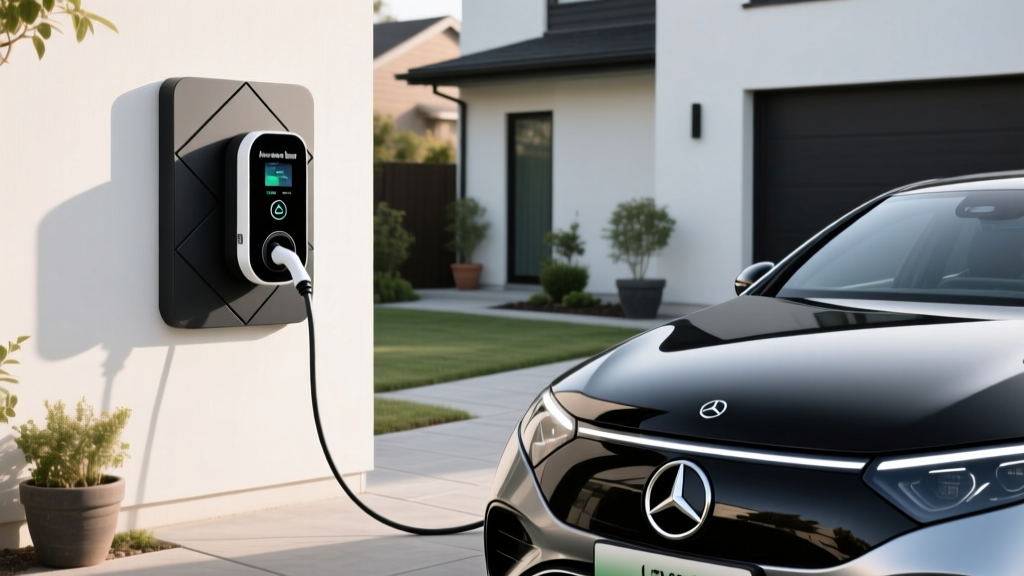
The Mercedes-Benz Power Charger (often referred to as the Mercedes-Benz Home Charging System or Wallbox) is a Level 2 home charging solution designed to deliver up to 11.5 kW of power on a 240V/48A circuit. For Mercedes EQ owners — from the EQB and EQE to the EQS and EQS SUV — it provides reliable overnight charging that replenishes most battery packs from 10% to 80% in roughly 6 to 8 hours depending on battery size. However, the hardware itself is essentially a rebranded Wallbox Pulsar Plus with Mercedes-specific branding and integration, which raises a practical question: should you pay the Mercedes premium, or buy a comparable third-party charger for less?
This guide breaks down everything you need to know about the Mercedes-Benz Power Charger, including electrical requirements, installation costs, connector compatibility, and how it compares to alternatives — all grounded in real numbers, not marketing copy.
Charging Levels Explained: What Speed Are You Actually Getting?
Before evaluating any specific charger, you need to understand the three tiers of EV charging and how they translate to real-world range recovery. The most critical distinction in EV charging is between kW (kilowatts — the rate of power delivery, like water pressure from a hose) and kWh (kilowatt-hours — the total energy stored in your battery, like the size of the tank). A charger rated at 11.5 kW doesn't put 11.5 kWh into your car per hour in practice; efficiency losses, thermal management, and the vehicle's onboard charger acceptance rate all affect actual throughput.
| Charging Level | Voltage | Max Power (kW) | Miles of Range Per Hour | Typical Use Case |
|---|---|---|---|---|
| Level 1 | 120V AC | 1.4 – 1.9 kW | 3 – 5 mi/hr | Emergency / trickle charging from standard outlet |
| Level 2 (Home) | 240V AC | 7.2 – 11.5 kW | 20 – 44 mi/hr | Daily home charging, overnight replenishment |
| DC Fast Charging | 400V–800V DC | 50 – 350 kW | 150 – 1,000+ mi/hr (peak) | Road trips, rapid top-ups at public stations |
The Mercedes-Benz Power Charger operates at Level 2. For context, a Mercedes EQS 450+ with its 107.8 kWh usable battery (EPA range 350 miles) gains roughly 35–40 miles of range per hour of charging at 11.5 kW. That means a full overnight session of 8 hours adds approximately 280–320 miles — more than enough for most daily driving patterns.
Mercedes-Benz Power Charger: Hardware Specs and What's Inside
The Mercedes-Benz branded home charger is manufactured in partnership with Wallbox, a Barcelona-based EV charging company. Here are the exact specifications you're working with:
| Specification | Detail |
|---|---|
| Max Power Output | 11.5 kW (at 48A / 240V) |
| Adjustable Amperage | 16A – 48A (configurable via app) |
| Connector | SAE J1772 (standard for non-Tesla North American EVs) |
| Cable Length | 25 feet (standard) |
| Wi-Fi / Connectivity | Wi-Fi + Bluetooth; app-based scheduling and monitoring |
| Indoor/Outdoor Rating | NEMA 4 (suitable for outdoor installation) |
| Weight | ~3.5 lbs (wall-mounted unit) |
| Smart Features | Load balancing, solar integration, energy reporting, scheduled charging |
| Estimated Hardware Price | $599 – $749 (varies by dealer and promotions) |
For 2025–2026 Mercedes EQ models, the J1772 connector is native. Mercedes-Benz has confirmed that future models will adopt the NACS (North American Charging Standard) connector — aligning with Tesla's plug — but current EQ vehicles still use CCS1/J1772 for AC charging. If you purchase the Mercedes-Benz Power Charger today, it will include a J1772 plug that works natively with all current EQ models.
Connector Compatibility for Mercedes-Benz EQ Models
| Model | AC Charging Connector | DC Fast Charging Connector | Max AC Acceptance |
|---|---|---|---|
| EQB 300 / 350 | J1772 | CCS1 | 11 kW |
| EQE 350 / 350+ | J1772 | CCS1 | 11 kW |
| EQE SUV | J1772 | CCS1 | 11 kW |
| EQS 450+ / 580 | J1772 | CCS1 | 11 kW |
| EQS SUV | J1772 | CCS1 | 11 kW |
| Future models (announced) | NACS (expected) | NACS (expected) | TBD |
Note: Current EQ owners do not need a NACS adapter for home Level 2 charging. The J1772 connector is the North American standard for AC charging. For DC fast charging at Tesla Superchargers, Mercedes has announced NACS adapter availability for current EQ models — check your dealer for the latest adapter program details.
Home Installation: Electrical Requirements and Real Costs
Installing the Mercedes-Benz Power Charger isn't a plug-and-play affair. It requires a dedicated 240V circuit, typically rated at 60A to safely support the charger's 48A continuous draw (the National Electrical Code requires circuits to be rated at 125% of continuous load, so 48A × 1.25 = 60A breaker).
What Electrical Upgrades Might I Need?
Your home's electrical panel is the starting point. Here's what determines your installation complexity:
- Panel capacity: Most modern homes have a 200A main panel. If your panel is already near capacity (running electric HVAC, dryer, oven, water heater), adding a 60A EV circuit may require a panel upgrade to 300A or 400A, or the addition of a sub-panel.
- Available breaker spaces: You need two adjacent slots for a 240V double-pole breaker. Older panels may be full.
- Distance from panel to charger location: Longer wire runs (especially 50+ feet) require heavier-gauge copper wire (typically 6 AWG for 60A), increasing material costs.
- Conduit requirements: Some jurisdictions require conduit for exposed wiring runs, adding labor and material.
Typical Home Charger Installation Cost Breakdown
| Component | Low Estimate | High Estimate | Notes |
|---|---|---|---|
| Mercedes-Benz Power Charger (hardware) | $599 | $749 | Price varies by dealer; occasionally bundled with vehicle purchase |
| Electrical permit | $50 | $250 | Varies by municipality; required in most jurisdictions |
| Electrician labor (standard install, <30ft run) | $500 | $1,200 | 2–4 hours at $100–$150/hr for a licensed electrician |
| Wire, conduit, breaker, materials | $150 | $500 | 6 AWG copper; longer runs cost more |
| Panel upgrade (if needed) | $1,500 | $4,000+ | Only if existing panel can't support a 60A circuit; 200A→300A upgrade |
| Total (no panel upgrade) | $1,300 | $2,700 | Most homeowners fall in this range |
| Total (with panel upgrade) | $2,800 | $6,700+ | Older homes or high-load panels |
Source: National average estimates. Always get 2–3 quotes from licensed electricians in your area. Some utilities offer rebates of $250–$1,000 for home charger installation — check with your local provider. The IRS Residential Clean Energy Credit (25C) may cover up to 30% of charger hardware and installation costs, capped at $1,000, through 2032.
Safety and Code Considerations
Don't cut corners on electrical safety. Key code requirements include:
- Dedicated circuit: The charger must have its own dedicated 60A breaker — never shared with other appliances.
- GFCI protection: The 2023 NEC update requires GFCI protection for EV charging outlets in garages. Hardwired installations (which the Mercedes-Benz Power Charger supports) may be exempt in some jurisdictions, but a GFCI breaker adds a layer of safety.
- NEMA 4 rating: If installing outdoors, confirm the unit's NEMA 4 weather resistance rating. The Mercedes-Benz Power Charger meets this standard.
- Proper grounding: Your electrician should verify the grounding electrode system meets code, especially in older homes.
- Load management: If your panel is tight on capacity, the Wallbox platform supports load balancing — a feature that dynamically reduces charging power when other high-draw appliances activate, preventing breaker trips without a panel upgrade.
Real-World Charging Times: What to Expect with Mercedes EQ Batteries
Here's where the rubber meets the road. The table below shows estimated 10–80% Level 2 charging times for current Mercedes-Benz EQ models using the Power Charger at its full 11.5 kW output. These assume the vehicle's onboard charger can accept the full 11 kW (which all current EQ models can) and account for typical charging efficiency losses of 10–15%.
| Model | Battery (usable kWh) | EPA Range | 10–80% at 11.5 kW | Miles Added in 8 Hours |
|---|---|---|---|---|
| EQB 300 4MATIC | 66.5 kWh | 245 mi | ~4.5 hours | ~235 mi (full charge) |
| EQE 350+ Sedan | 90.6 kWh | 305 mi | ~6.5 hours | ~280 mi |
| EQE 350 SUV | 90.6 kWh | 279 mi | ~6.5 hours | ~255 mi |
| EQS 450+ Sedan | 107.8 kWh | 350 mi | ~7.5 hours | ~310 mi |
| EQS 580 SUV | 108.4 kWh | 305 mi | ~7.5 hours | ~275 mi |
Real-World Range vs. EPA Estimates
EPA range figures assume a mix of city and highway driving at moderate temperatures. In practice, expect:
- Highway driving (70+ mph): 10–15% below EPA range due to aerodynamic drag
- Cold weather (below 32°F): 15–30% range reduction due to battery resistance and cabin heating (the EQS and EQE include heat pumps to mitigate this, but losses remain)
- Combined real-world expectation: Most EQ owners report 80–90% of EPA range in mixed driving, dropping to 65–75% in winter highway conditions
This makes overnight Level 2 charging critical: even with range loss, an 8-hour charge at 11.5 kW restores enough range for 200+ miles of real-world driving in most conditions.
Cost to Charge: Home Electricity vs. Public vs. Gas
One of the strongest arguments for home Level 2 charging is cost. Here's how the numbers break down for a Mercedes EQE 350+ (90.6 kWh battery, 305 mi EPA range) in different scenarios:
| Charging Scenario | Rate ($/kWh) | Cost for Full Charge | Cost Per Mile | Annual Cost (12,000 mi) |
|---|---|---|---|---|
| Home (national avg, off-peak) | $0.13 | $11.78 | $0.039 | $464 |
| Home (California avg) | $0.27 | $24.46 | $0.080 | $963 |
| Home (time-of-use, overnight) | $0.08 | $7.25 | $0.024 | $286 |
| Public Level 2 (e.g., ChargePoint) | $0.25 – $0.49 | $22.65 – $44.39 | $0.074 – $0.146 | $890 – $1,747 |
| DC Fast (Electrify America, etc.) | $0.35 – $0.56 | $31.71 – $50.74 | $0.104 – $0.166 | $1,247 – $1,997 |
| Gas equivalent (30 MPG, $3.40/gal) | — | — | $0.113 | $1,360 |
Source: fueleconomy.gov and U.S. EIA electricity rate data. Gas prices based on national average as of early 2026. Actual rates vary by utility, state, and time-of-use plan enrollment.
The takeaway: home charging at off-peak rates is roughly 65–79% cheaper per mile than gasoline. Even in high-cost states like California, home charging beats gas on a per-mile basis. Public DC fast charging, however, can approach or exceed gas costs — which is why home Level 2 charging is the economic sweet spot for EQ owners.
Equipment Alternatives: How Does the Mercedes-Benz Power Charger Compare?
Since the Mercedes-Benz Power Charger is essentially a rebranded Wallbox Pulsar Plus, you have options. Here's how it stacks up against the leading Level 2 chargers on the market:
| Charger | Max Power | Amperage | Cable Length | Smart Features | Connector | Price |
|---|---|---|---|---|---|---|
| Mercedes-Benz Power Charger (Wallbox) | 11.5 kW | 48A | 25 ft | App, scheduling, load balancing, solar integration | J1772 | $599–$749 |
| Wallbox Pulsar Plus (direct) | 11.5 kW | 48A | 25 ft | Identical platform (same app, same features) | J1772 or NACS | $449–$599 |
| ChargePoint Home Flex | 12 kW | 50A | 23 ft | App, Alexa, scheduling, energy reports | J1772 (NACS adapter available) | $549–$699 |
| Tesla Wall Connector | 11.5 kW | 48A | 24 ft | App, scheduling, load sharing (Tesla ecosystem) | NACS native (J1772 adapter included) | $475 |
| Emporia Level 2 Smart Charger | 11.5 kW | 48A | 24 ft | App, energy monitoring, solar integration, very detailed data | J1772 | $399 |
Key insight: The Wallbox Pulsar Plus — the hardware underpinning the Mercedes-Benz Power Charger — is available directly from Wallbox for $449–$599 with identical functionality. The Mercedes-Benz branding adds a premium of roughly $100–$200. If brand alignment and potential dealer-bundle convenience matter to you, the Mercedes-branded unit is fine. If you're optimizing for value, the direct Wallbox Pulsar Plus, ChargePoint Home Flex, or Emporia charger deliver equivalent or better performance at lower cost.
One advantage of the Tesla Wall Connector: it now ships with NACS native and includes a J1772 adapter, making it future-proof for the upcoming NACS transition. If you plan to keep your EQ for many years and eventually switch to a NACS-equipped Mercedes, the Tesla unit offers more connector flexibility today.
Tax Credits and Incentives for Home Charger Installation
The IRS Residential Clean Energy Credit (Section 25C) provides a tax credit of up to 30% of the cost of home EV charging equipment and installation, capped at $1,000 per year. This credit is available through 2032.
- Eligible costs: Charger hardware + electrician labor + permit fees
- Credit amount: 30% of total, up to $1,000 maximum
- Income limits: No income cap for 25C (unlike the §30D vehicle credit)
- Residence requirement: Must be installed at your primary residence in the United States
- Filing: Claim on IRS Form 5695 with your federal tax return
- State/utility rebates: Many states and utilities offer additional rebates ($250–$1,000+) that can stack with the federal credit — check AFDC.energy.gov for your area
Important: Tax credit rules can change. Always consult a tax professional and reference the latest IRS guidance before making purchase decisions based on incentive eligibility.
Frequently Asked Questions
How much does it cost to install a Mercedes-Benz Power Charger at home?
Expect $1,300–$2,700 for a standard installation (charger hardware + electrician + permit + materials) if your electrical panel has sufficient capacity. If your home needs a panel upgrade from 200A to 300A or 400A, add $1,500–$4,000+ to that total. The federal 25C tax credit can offset up to $1,000 of this cost.
How fast will the Mercedes-Benz Power Charger add range?
At its maximum 11.5 kW output, the charger adds approximately 35–44 miles of range per hour depending on the vehicle's efficiency. An EQS 450+ gains roughly 38 mi/hr, while a more efficient EQE 350+ gains around 35 mi/hr. A full overnight session (8 hours) restores 250–320 miles of EPA-rated range.
Which connector does the Mercedes-Benz Power Charger use, and is it compatible with my EV?
The current Mercedes-Benz Power Charger uses a J1772 connector, which is the standard AC charging plug for all non-Tesla EVs sold in North America. It is natively compatible with all current Mercedes EQ models (EQB, EQE, EQS, and their SUV variants). For future models adopting NACS, a J1772-to-NACS adapter will be needed, or you can opt for a charger that ships with NACS natively.
How much does charging cost per mile compared to gas?
Home charging at the national average rate of $0.13/kWh costs roughly $0.039 per mile in a Mercedes EQE 350+. A comparable gas vehicle at 30 MPG with $3.40/gallon fuel costs $0.113 per mile. That's a savings of approximately $0.074 per mile, or about $886 per year for a driver covering 12,000 miles. In states with time-of-use plans offering $0.08/kWh overnight rates, savings increase to roughly $1,070 per year.
What electrical upgrades might my home need for a Level 2 charger?
The most common upgrade is a panel capacity increase if your existing 200A service is already heavily loaded. You need two adjacent breaker slots for a 60A double-pole breaker and sufficient remaining capacity for the continuous 48A draw. Homes built before 2000 with 100A or 150A panels almost always need an upgrade. Your electrician will perform a load calculation to determine this during the initial assessment. A less expensive alternative is the Wallbox load-balancing feature, which can reduce charging amperage dynamically to stay within your panel's capacity — potentially avoiding a panel upgrade entirely.
Can I use a cheaper third-party charger with my Mercedes EQ?
Yes. Any Level 2 charger with a J1772 connector will work with current Mercedes EQ models. The vehicle doesn't require the Mercedes-branded hardware to charge. Third-party options like the ChargePoint Home Flex, Emporia charger, or direct-purchase Wallbox Pulsar Plus offer equivalent or superior features at lower prices. The Mercedes-branded charger is a convenience and brand-alignment choice, not a technical requirement.
Is the Mercedes-Benz Power Charger eligible for the federal tax credit?
Yes. Under the IRS Section 25C Residential Clean Energy Credit, you can claim 30% of the combined cost of the charger hardware and professional installation, up to a maximum credit of $1,000. This is separate from the §30D new vehicle credit. File IRS Form 5695 with your tax return and retain your receipts.