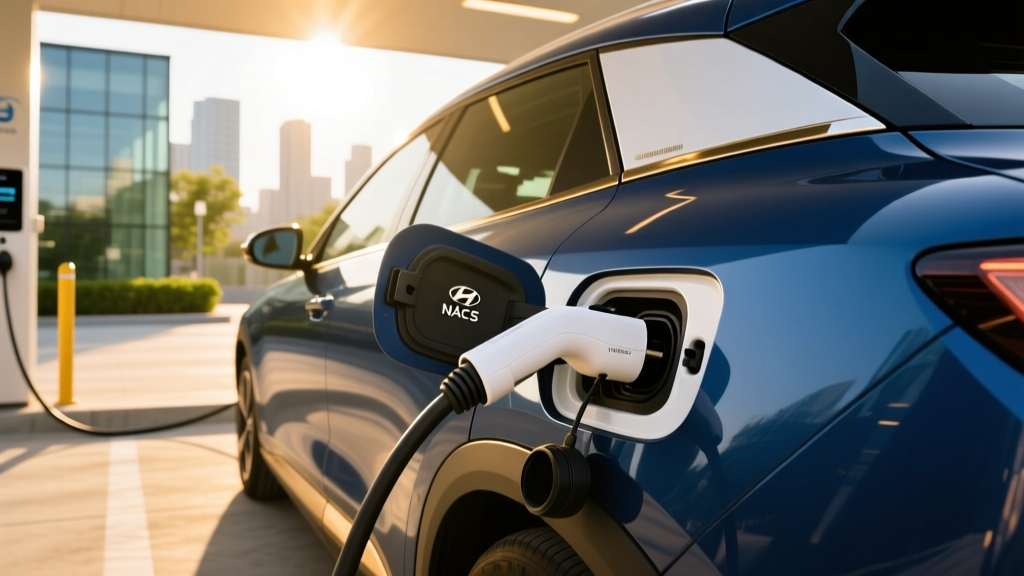
If you drive a Hyundai Ioniq 5, Ioniq 6, or Kona Electric, you've likely noticed a shift in the charging landscape. Hyundai's transition to the North American Charging Standard (NACS) port began with the 2025 Ioniq 9, but the vast majority of Hyundai EVs on the road in 2026 still use the CCS1 connector. That means a NACS adapter for Hyundai vehicles is the key to unlocking Tesla's Supercharger network — the largest and most reliable DC fast-charging network in North America.
This guide covers everything you need to know: which adapter to use, how fast each charging level will replenish your Hyundai's battery, what home installation actually costs, and how charging economics compare to gas. We'll use the 2024–2026 Ioniq 5 (84 kWh usable battery, NMC chemistry) and the 2024–2026 Kona Electric (64.8 kWh usable, NMC) as reference points throughout.
Charging Levels Explained: Speeds, kW, and Miles Per Hour
Before plugging in anywhere, it's essential to understand the three charging levels and what they mean for your Hyundai. Power is measured in kW (kilowatts) — the rate of energy flow — while your battery capacity is measured in kWh (kilowatt-hours) — the total energy stored. Confusing these is the most common EV mistake.
| Level | Voltage | Power (kW) | Miles of Range Added Per Hour | 10–80% Time (Ioniq 5, 84 kWh) | 10–80% Time (Kona Electric, 64.8 kWh) |
|---|---|---|---|---|---|
| Level 1 (120V household outlet) | 120V | ~1.4 kW | ~4–5 mi/hr | ~40+ hours | ~30+ hours |
| Level 2 (240V home/public) | 240V | 7.2–11.5 kW | ~25–42 mi/hr | ~6–9 hours | ~5–7 hours |
| DC Fast Charging (CCS1) | 400–800V | Up to 240 kW (Ioniq 5) | ~600+ mi/hr (peak) | ~18 min (10–80%) | ~43 min (10–80%, peak 100 kW) |
| DC Fast Charging (NACS via Tesla Supercharger V3/V4) | 400–800V | Up to 150–250 kW (adapter-dependent) | ~500+ mi/hr (peak) | ~22–28 min (10–80%) | ~35–45 min (10–80%) |
Real-world note on DC fast charging: Peak kW is not sustained kW. The Ioniq 5's 800V architecture allows it to peak at 240 kW on a compatible 350 kW CCS charger (like Electrify America), but the charge curve tapers significantly above 55% State of Charge (SoC). On a Tesla V3 Supercharger (250 kW max, CCS communication via adapter), expect the Ioniq 5 to pull around 150–180 kW at peak before tapering. A 10–80% session typically takes 22–28 minutes depending on battery temperature and charger output.
NACS Adapter for Hyundai: Connector Compatibility & Tesla Supercharger Access
Hyundai's existing EV lineup — the Ioniq 5, Ioniq 6, and Kona Electric — ships with a CCS1 charge port. Tesla's Supercharger network uses NACS. As of late 2024, Tesla opened its network to non-Tesla EVs equipped with a CCS-to-NACS adapter, and Hyundai owners gained access to thousands of additional V3 and V4 Supercharger stalls across the U.S.
| Connector | Hyundai EV Port | Adapter Needed? | Network Access |
|---|---|---|---|
| CCS1 | Native (Ioniq 5, Ioniq 6, Kona Electric) | No | Electrify America, EVgo, ChargePoint DC, most non-Tesla networks |
| NACS (Tesla) | Not native (except 2025+ Ioniq 9) | Yes — CCS-to-NACS adapter | Tesla Supercharger network (V3/V4 stalls opened to non-Tesla EVs) |
| CHAdeMO | Not supported | N/A | Largely legacy; not recommended for Hyundai owners |
| J1772 (Level 2 AC) | Native (same port as CCS1 upper section) | No | Home chargers, public Level 2 stations |
Which NACS Adapter Should Hyundai Owners Use?
Not all CCS-to-NACS adapters are created equal. Here's what to look for and what's available:
- Tesla CCS Adapter (OEM): Tesla sells a CCS1-to-NACS adapter (part number varies by region) rated for up to 250 kW DC fast charging. Priced around $175–$250, it's the most widely tested option for Supercharger access. Hyundai has also offered a branded version through dealerships at similar pricing.
- Third-party adapters (Lectron, A2Z, etc.): Available for $100–$200, typically rated for 200–250 kW. Verify UL certification and maximum current rating (look for 500A+ rating for full V3 Supercharger compatibility). Some third-party adapters have firmware compatibility issues with specific Supercharger stalls.
- Hyundai-provided adapter: Hyundai began including or offering a CCS-to-NACS adapter for Ioniq 5 and Ioniq 6 owners in late 2024 as part of its Supercharger access agreement. Check with your dealer — you may already be eligible for a free or discounted unit.
Home EV Charger Installation: Electrical Requirements & Costs
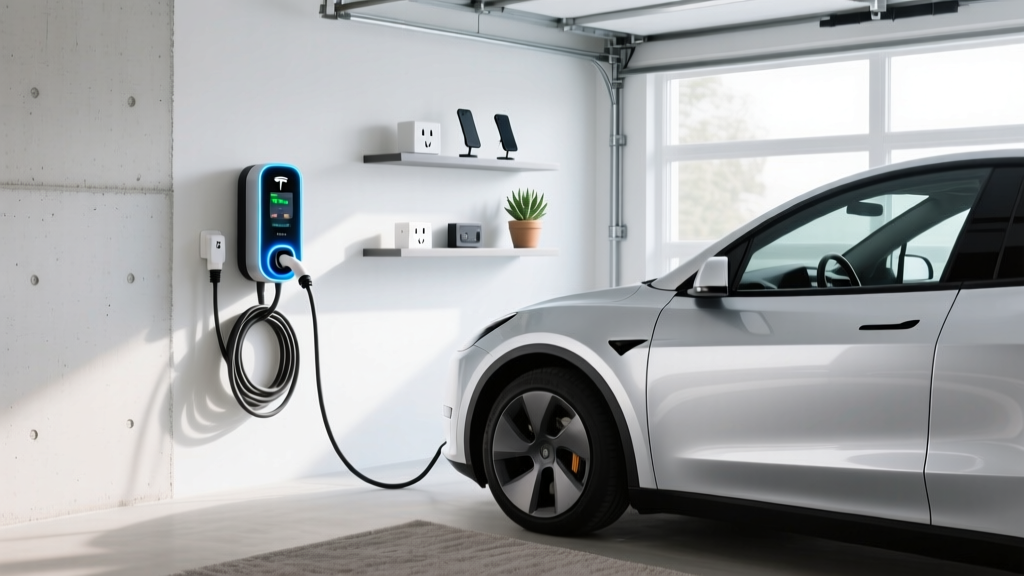
Level 2 home charging is the backbone of practical EV ownership. For a Hyundai Ioniq 5 or Kona Electric, a properly installed Level 2 charger will fully replenish your battery overnight — typically 6–9 hours for the Ioniq 5 and 5–7 hours for the Kona Electric from a low state of charge.
Electrical Requirements
Most Level 2 home chargers require a 240V dedicated circuit, similar to what an electric dryer or oven uses. Here are the common configurations:
- 40-amp circuit (32A continuous charge): Delivers ~7.7 kW. Sufficient for overnight charging of most Hyundai EVs. Uses 6 AWG copper wire.
- 50-amp circuit (40A continuous charge): Delivers ~9.6 kW. Recommended for the Ioniq 5's larger 84 kWh battery. Uses 6 AWG copper wire.
- 60-amp circuit (48A continuous charge): Delivers ~11.5 kW. Maximum AC charge rate for the Ioniq 5 (10.9 kW onboard charger). Uses 4 AWG copper wire.
Panel upgrade reality: Most homes built after 1990 have a 200-amp electrical panel with sufficient spare capacity for a 40–60A EV circuit. However, older homes with 100-amp service, or homes already running multiple high-draw appliances (electric heat, hot tub, double oven), may need a panel upgrade to 200A. This adds $1,500–$3,500 to your project and should be assessed by a licensed electrician during a load calculation.
| Component | Cost Range | Notes |
|---|---|---|
| Level 2 Charger (hardware) | $350–$750 | Varies by brand, power output, smart features |
| Electrical permit | $50–$250 | Required in most jurisdictions; varies by city/county |
| Electrician labor (standard install) | $500–$1,500 | Assumes panel is nearby, short wire run (~25 ft), no panel upgrade |
| Electrician labor (complex install) | $1,500–$3,000 | Long wire runs, conduit, panel relocation, or trenching |
| Panel upgrade (if needed) | $1,500–$3,500 | 100A to 200A upgrade; not needed in most modern homes |
| Total (typical install, no panel upgrade) | $900–$2,500 | Most common scenario for homes with 200A service |
| Total (with panel upgrade) | $2,400–$6,000+ | Older homes or high-load panels |
According to the U.S. Department of Energy, the national average for a standard Level 2 home installation (without panel upgrade) falls between $1,000 and $2,000 including equipment. Always get at least two quotes from licensed electricians and verify they pull the required permit — unpermitted work can void your homeowner's insurance coverage for electrical fires.
Cost to Charge: Home vs. Public vs. Gas Comparison
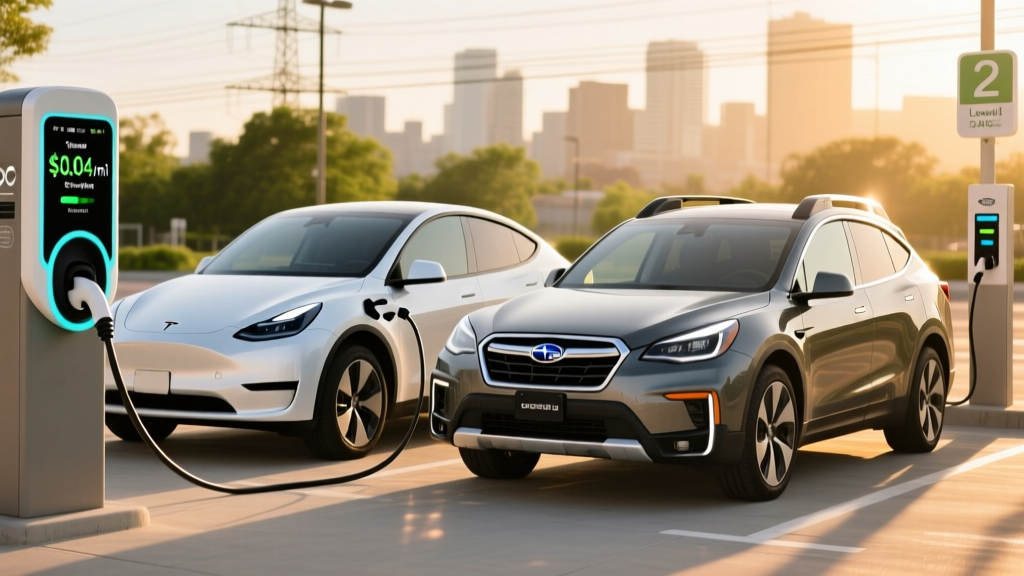
One of the strongest arguments for EV ownership is the per-mile fuel cost advantage. Here's how charging a Hyundai Ioniq 5 compares to fueling a similarly sized gas vehicle (we'll use the 2026 Hyundai Tucson 2.5L AWD at 28 MPG combined as the baseline).
| Charging/Fueling Scenario | Rate | Cost Per Mile (Ioniq 5, 3.5 mi/kWh) | Cost Per Mile (Tucson Gas, 28 MPG) |
|---|---|---|---|
| Home Level 2 (off-peak utility rate) | $0.09–$0.13/kWh | $0.026–$0.037 | — |
| Home Level 2 (standard utility rate) | $0.14–$0.18/kWh | $0.040–$0.051 | — |
| Public Level 2 (ChargePoint, etc.) | $0.25–$0.49/kWh | $0.071–$0.140 | — |
| DC Fast Charging (Electrify America) | $0.38–$0.56/kWh | $0.109–$0.160 | — |
| Tesla Supercharger (NACS adapter) | $0.28–$0.45/kWh | $0.080–$0.129 | — |
| Gasoline ($3.50/gal national avg.) | $3.50/gal | — | $0.125 |
| Gasoline ($4.25/gal — high-cost state) | $4.25/gal | — | $0.152 |
Bottom line: Home charging on an off-peak rate delivers fuel savings of 70–75% compared to gasoline. Even at public DC fast-charging rates, the Ioniq 5 is typically cheaper per mile than a 28 MPG gas vehicle. However, frequent reliance on premium-priced public chargers ($0.45+/kWh) can erode much of the cost advantage — home charging access is the single biggest factor in EV ownership economics.
For detailed utility rate data and time-of-use plan information, check fueleconomy.gov's EV comparison tools, which break down annual fuel costs by ZIP code and utility provider.
Recommended Home Chargers for Hyundai EVs
Based on power output, reliability, connector type, and value, here are the Level 2 chargers we recommend for Hyundai Ioniq 5, Ioniq 6, and Kona Electric owners in 2026:
ChargePoint Home Flex
- Power: Up to 11.5 kW (48A) on a 60A circuit; configurable down to 16A
- Connector: J1772 (native for Hyundai Level 2)
- Cable length: 23 ft
- Smart features: Wi-Fi, app scheduling, utility TOU integration, Alexa
- Price: ~$550–$650
- Best for: Hyundai owners wanting max AC speed and smart scheduling
Tesla Wall Connector (with J1772 adapter)
- Power: Up to 11.5 kW (48A) on a 60A circuit
- Connector: NACS native; Tesla sells a J1772 adapter (~$45) for non-Tesla EVs
- Cable length: 24 ft
- Smart features: Wi-Fi, OTA updates, power sharing (multiple units)
- Price: ~$425 + $45 adapter = ~$470
- Best for: Multi-EV households with both Tesla and Hyundai vehicles
Emporia Level 2 EV Charger
- Power: Up to 11.5 kW (48A) on a 60A circuit
- Connector: J1772
- Cable length: 24 ft
- Smart features: Wi-Fi, app control, energy monitoring, solar integration
- Price: ~$350–$400
- Best for: Budget-conscious buyers who still want full smart features
All three chargers are UL-listed, support outdoor installation (NEMA 4 rated enclosures), and include GFCI protection as required by NEC Article 625. The ChargePoint and Emporia units come with J1772 connectors natively, which plug directly into your Hyundai's CCS1 port (the upper J1772 section handles AC charging). The Tesla Wall Connector requires the separate J1772 adapter for Hyundai compatibility.
Safety, Code, and Permit Considerations
EV charger installation is governed by NEC Article 625 (National Electrical Code) and local amendments. Here's what your electrician must address:
- Dedicated circuit: Your Level 2 charger must be on its own dedicated breaker — no sharing with other outlets or appliances. A 50A or 60A double-pole breaker is standard for 40A/48A chargers.
- GFCI protection: NEC 2020 and later requires GFCI (Ground Fault Circuit Interrupter) protection for all EV charging outlets. Hardwired chargers have built-in GFCI; plug-in units (NEMA 14-50 receptacle) require a GFCI breaker, which adds $40–$80 to the panel cost.
- Outdoor rating: If your charger is installed outdoors or in an unconditioned garage, it must carry a NEMA 4 (or IP65+) weather rating. All three chargers recommended above meet this standard.
- Wire gauge: 6 AWG copper for 40–50A circuits; 4 AWG copper for 60A circuits. Aluminum wire is cheaper but requires larger gauge and is not always accepted by local inspectors for EV circuits.
- Permit and inspection: Most jurisdictions require an electrical permit ($50–$250) and a post-installation inspection. Skipping this step risks insurance denial in the event of an electrical fire and may cause issues when selling your home.
Using Your NACS Adapter at Tesla Superchargers: What to Expect
Once you have your CCS-to-NACS adapter, accessing Tesla Superchargers with your Hyundai follows a straightforward process:
- Download the Tesla app or use a Supercharger stall with a built-in payment screen (newer V4 stalls).
- Add your vehicle and payment method in the Tesla app. You'll identify your vehicle by its charge port location and VIN.
- Plug in: Attach the NACS end of the adapter to the Supercharger cable, then plug the CCS1 end into your Hyundai's charge port.
- Start the session via the app or stall screen. Charging begins after a brief handshake (10–30 seconds).
Charging speed reality at Superchargers: Tesla V3 Superchargers peak at 250 kW, but your Hyundai Ioniq 5 — despite its 800V architecture capable of 240 kW on CCS — will typically see peak rates of 150–180 kW through the adapter due to communication protocol overhead and the adapter's current limits. The Ioniq 5's charge curve still tapers above 55% SoC, so expect a 10–80% session to take approximately 22–28 minutes, compared to ~18 minutes on a 350 kW Electrify America CCS stall.
For the Kona Electric (400V architecture, 100 kW peak DC rate), the difference is smaller: expect ~35–45 minutes for 10–80% on both Supercharger and CCS networks, as the vehicle's onboard limit is the bottleneck, not the charger.
Frequently Asked Questions
How much does it cost to install a home EV charger?
A standard Level 2 home charger installation costs $900–$2,500 total (equipment, permit, and electrician labor) for homes with a 200A panel and a short wire run. If your home needs a panel upgrade from 100A to 200A, add $1,500–$3,500, bringing the total to $2,400–$6,000+. Always get a professional load calculation before committing.
How fast will each charging level add range to my Hyundai?
Level 1 (120V) adds about 4–5 miles of range per hour — essentially a trickle. Level 2 (240V) adds 25–42 miles per hour depending on your charger's amperage and your Hyundai's onboard charger capacity (10.9 kW for the Ioniq 5, 7.2 kW for the Kona Electric). DC fast charging adds hundreds of miles per hour at peak, with the Ioniq 5 achieving 10–80% in ~18 minutes on a 350 kW CCS charger or ~22–28 minutes on a Tesla V3 Supercharger via NACS adapter.
Which connector and charger is compatible with my Hyundai EV?
All current Hyundai EVs (Ioniq 5, Ioniq 6, Kona Electric) use a CCS1 port, which natively accepts CCS1 DC plugs and J1772 AC plugs. For Tesla Supercharger access, you need a CCS-to-NACS adapter. For home Level 2 charging, any J1772 charger works directly — no adapter needed.
How much does charging cost per mile vs. gas?
At home on off-peak rates ($0.09–$0.13/kWh), a Hyundai Ioniq 5 costs roughly $0.03–$0.04 per mile to charge. A comparable 28 MPG gas vehicle at $3.50/gallon costs about $0.125 per mile. That's a 68–76% savings. Even public DC fast charging at $0.40/kWh works out to ~$0.114/mile — still competitive with gasoline in most states.
What electrical upgrades might I need for a home charger?
Most homes with 200A electrical service need no upgrade beyond a dedicated 40–60A double-pole breaker and a wire run to the charger location. Homes with 100A service, or panels already near capacity from electric heating, hot tubs, or other high-draw loads, may require a panel upgrade to 200A ($1,500–$3,500). Your electrician will perform a NEC-compliant load calculation to determine this.
Does Hyundai provide a free NACS adapter?
Hyundai began offering complimentary or discounted CCS-to-NACS adapters to qualifying Ioniq 5 and Ioniq 6 owners in late 2024 as part of its Supercharger network access agreement. Availability and terms vary by model year and region — contact your local Hyundai dealer or check the Hyundai Electrified portal for current offers.