Why Your Charging Strategy Directly Controls Your Real-World Range
The EPA range sticker on your EV's window is a starting point, not a guarantee. Real-world range depends heavily on how you charge, when you charge, and what equipment you use. A driver who charges at home on a Level 2 station, preconditions their battery, and manages state of charge (SoC) habits can routinely extract 90-95% of their EPA-rated range. A driver relying solely on DC fast charging, skipping preconditioning, and charging to 100% every night may see that figure drop to 75-80% over time due to accelerated battery degradation.
Before we map out the strategy, let's establish the foundational distinction that trips up most new EV owners: kW (kilowatts) measures power — the rate at which energy flows into your car. kWh (kilowatt-hours) measures energy — the total capacity of your battery. A 75 kWh battery charged at 11 kW takes roughly 7 hours. That same battery at a 150 kW DC fast charger can reach 80% in about 25 minutes. Confusing these two units is the single most common EV literacy gap.
Charging Levels Explained: Speed, Power, and Range Added Per Hour
Every EV owner interacts with three charging tiers. Understanding the math behind each one is essential to building a range-maximizing routine.
| Level | Voltage | Power (kW) | Miles of Range Added Per Hour | Typical Use Case |
|---|---|---|---|---|
| Level 1 | 120V AC | 1.0–1.4 kW | 3–5 miles | Overnight top-up, PHEVs, emergency backup |
| Level 2 | 240V AC | 7.2–19.2 kW | 25–75 miles | Daily home charging, workplace, destination |
| DC Fast Charging | 400–800V DC | 50–350 kW | 150–1,000+ miles (peak rate) | Road trips, quick top-ups, fleet operations |
For range maximization, Level 2 home charging is the sweet spot. It's fast enough to fully replenish any consumer EV overnight, gentle enough on the battery to minimize long-term degradation, and dramatically cheaper than public DC fast charging. According to fueleconomy.gov, home Level 2 charging also allows the vehicle's battery management system (BMS) to perform cell-balancing during the final hours of a slow charge — something DC fast charging skips entirely, which can reduce usable capacity over hundreds of cycles.
How to Maximize the Range of an Electric Car: 7 Charging Habits That Work
Range isn't just about driving efficiently — it's about how energy enters and leaves your battery. These seven practices, grounded in battery chemistry and thermal management physics, consistently deliver more usable miles per charge.
1. Charge to 80% Daily, 100% Only When Needed
Most EVs use NMC (nickel manganese cobalt) or NCA (nickel cobalt aluminum) battery chemistry. These cells experience the least stress between 20% and 80% SoC. Charging to 100% and holding there — especially in warm weather — accelerates capacity loss. Set your car's charge limit to 80% for daily driving. Reserve 100% charges for road trips where you'll depart immediately. LFP (lithium iron phosphate) batteries, found in the Tesla Model 3 Standard Range and some BYD models, tolerate 100% SoC better and actually benefit from periodic full charges for BMS calibration.
2. Precondition Before Fast Charging
Preconditioning warms the battery pack to its optimal charging temperature (typically 85-95°F / 30-35°C) before you arrive at a DC fast charger. Without it, a cold battery on a 350 kW charger might accept only 50-80 kW for the first 10-15 minutes, adding 20+ minutes to your stop. Most EVs precondition automatically when you navigate to a charger in the car's built-in nav. If you're using a third-party app like PlugShare, initiate preconditioning manually 15-20 minutes before arrival.
3. Understand the Charge Curve — Peak kW Is Not Sustained kW
When a manufacturer advertises "250 kW peak charging," that rate typically holds only from roughly 10% to 30-40% SoC. Above 50%, the rate tapers significantly. Above 80%, it drops to a trickle (often under 30 kW) to protect the cells. This is why 10-80% charge times are the industry benchmark — charging from 80% to 100% can take as long as 10% to 80%. Plan road-trip stops to arrive at 10-15% SoC and depart at 80%, not 100%.
4. Use Timed Charging to Hit Off-Peak Electricity Rates
Many utilities offer time-of-use (TOU) rates where electricity drops to $0.06-$0.10/kWh between 10 PM and 6 AM, compared to $0.18-$0.30/kWh during peak hours. Set your EV or home charger to begin charging at 11 PM. You'll wake up to a full battery at roughly one-third the cost — and the slower overnight charge is gentler on the battery. Over a year, this can save $300-$600 depending on your local utility and mileage.
5. Park in Shade or a Garage When Possible
Battery degradation accelerates at sustained high temperatures. A car parked in direct sun in Phoenix with SoC at 90% is under significant thermal stress. Garage parking or shaded spots reduce pack temperature by 15-25°F, directly preserving long-term capacity — and therefore range. If you must park outside in heat, set your charge limit to 60-70% until you're ready to drive.
6. Use Regenerative Braking Strategically
Maximize regen in stop-and-go city driving to recapture kinetic energy. On the highway, coasting is sometimes more efficient than heavy regen followed by re-acceleration. Most EVs offer adjustable regen levels — use the highest setting in traffic and a moderate setting on open roads.
7. Monitor State of Health (SoH) Regularly
Your car's battery doesn't hold 75 kWh forever. After 100,000 miles, expect 88-94% of original capacity depending on chemistry and habits. Some EVs (Tesla, Hyundai/Kia) display SoH in the infotainment system. Third-party apps like Tessie or Recurrent can track degradation over time. If SoH drops below the warranty threshold (typically 70% capacity retention over 8 years/100,000 miles), you may qualify for a warranty battery replacement.
Home Charger Installation: Electrical Requirements, Costs, and What to Expect
A Level 2 home charger is the single most impactful upgrade for maximizing your EV's range and minimizing cost per mile. Here's what installation actually involves.
Electrical Requirements
A typical Level 2 home charger requires a 240V dedicated circuit, similar to a clothes dryer or electric oven. The most common configurations:
- 40-amp circuit / 32-amp continuous draw — delivers 7.7 kW, sufficient for most EVs overnight (adds ~30 miles/hour)
- 50-amp circuit / 40-amp continuous draw — delivers 9.6 kW, ideal for larger batteries like the F-150 Lightning's 131 kWh pack
- 60-amp circuit / 48-amp continuous draw — delivers 11.5 kW, the fastest residential AC option; requires robust panel capacity
The National Electrical Code (NEC) requires EV chargers to be on a dedicated circuit rated at 125% of the charger's continuous draw. A 48-amp charger therefore needs a 60-amp breaker.
Will You Need a Panel Upgrade?
This is the wildcard cost that catches homeowners off guard. Most homes built after 2000 have a 200-amp electrical panel, which usually accommodates a 40-50 amp EV circuit. Homes with 100-amp panels — common in houses built before the 1990s — often need a panel upgrade to 200 amps before adding a high-power EV charger. A panel upgrade typically costs $1,500-$3,000. A licensed electrician can assess your panel's available capacity during a site visit.
Installation Cost Breakdown
| Component | Low Estimate | High Estimate | Notes |
|---|---|---|---|
| Level 2 Charger (Equipment) | $350 | $750 | 32A–48A smart chargers; Tesla Wall Connector, ChargePoint, Emporia |
| Electrician Labor | $500 | $2,000 | Depends on run length from panel to garage/driveway |
| Electrical Permit | $50 | $300 | Varies by municipality; some jurisdictions waive for EV installs |
| Panel Upgrade (if needed) | $1,500 | $3,000 | Required for 100A panels or insufficient capacity |
| Conduit, Wiring, Miscellaneous | $100 | $500 | Longer runs, outdoor conduit, junction boxes |
| Total (No Panel Upgrade) | $1,000 | $3,550 | Most installations fall in the $1,200–$2,200 range |
| Total (With Panel Upgrade) | $2,500 | $6,550 | Older homes; consider future-proofing with 200A+ panel |
The IRS §25C Residential Clean Energy Credit may cover 30% of home charger equipment and installation costs, up to $1,000 annually, through 2032. Eligibility depends on your tax liability and whether you live in a qualifying census tract for certain provisions. Consult a tax professional for your specific situation.
Charging Time Examples: 10-80% for Common Battery Sizes
Charging speed depends on both the charger's output and the vehicle's onboard charger (for AC) or DC fast-charge acceptance rate. Here's how common EVs perform:
| Vehicle (Battery Size) | Level 2 at 11.5 kW (48A) | DC Fast at Peak kW | Peak DC Rate |
|---|---|---|---|
| Tesla Model 3 LR (75 kWh usable, NMC) | ~4.5 hours | ~25 minutes | 250 kW |
| Hyundai Ioniq 5 (77.4 kWh, NMC) | ~5 hours | ~18 minutes | 240 kW (800V architecture) |
| Ford F-150 Lightning Ext. Range (131 kWh, NMC) | ~8 hours | ~41 minutes | 150 kW |
| Chevrolet Equinox EV (85 kWh, NMC) | ~5.5 hours | ~30 minutes | 150 kW |
| BMW i4 eDrive40 (81.5 kWh, NMC) | ~5.5 hours | ~31 minutes | 200 kW |
Note: DC fast-charge times assume preconditioned battery and optimal conditions. Cold batteries (below 50°F / 10°C) can increase these times by 30-50% without preconditioning. The Hyundai Ioniq 5's 800V architecture is an outlier — its ability to sustain near-peak charging rates longer makes it one of the fastest-charging consumer EVs available.
Connector Compatibility: NACS, CCS1, and CHAdeMO in 2026
The connector landscape has consolidated dramatically. Here's where things stand for the 2026 model year:
| Connector | Brands Using It (Native) | Adapter Needed For | Notes |
|---|---|---|---|
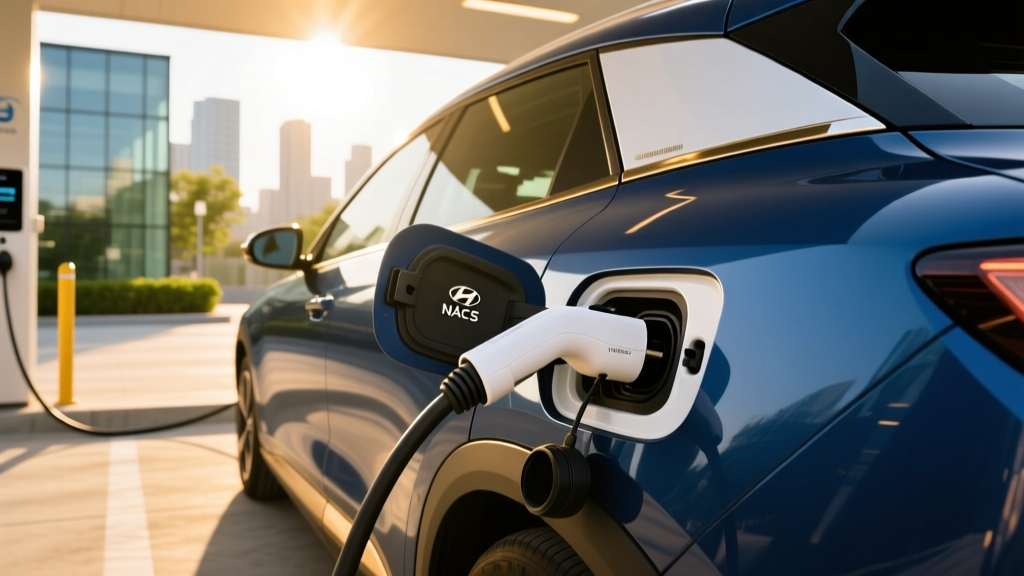
| NACS (North American Charging Standard / Tesla) | Tesla, Ford, GM, Rivian, Volvo, Polestar, Mercedes-Benz, BMW, Hyundai/Kia (select 2026 models) | CCS vehicles via adapter ($100-$200) | Now the dominant standard; most new 2026 models ship with NACS |
| CCS1 (Combined Charging System) | Volkswagen ID.4 (remaining inventory), some 2025 carryover models | NACS vehicles via adapter | Rapidly declining on new vehicles; still common on 2022-2025 used EVs |
| CHAdeMO | Nissan Leaf (legacy) | Not adaptable to NACS/CCS | Effectively discontinued; only relevant for used Leaf buyers |
If you're buying a new EV in 2026, it almost certainly has a NACS port — or will have one by model-year refresh. If you own a 2023-2025 CCS vehicle, adapters from Tesla, Lectron, or A2Z allow access to the Tesla Supercharger network. For home Level 2 charging, all vehicles use the J1772 connector (or NACS, which supports J1772 AC signaling), so any Level 2 home charger will work with any EV.
Cost to Charge: Home vs. Public vs. Gas — The Per-Mile Math
Charging cost is where EVs deliver their most compelling ownership advantage — but only if you charge smart. Here's the real math:
| Scenario | Rate ($/kWh) | Vehicle Efficiency | Cost Per Mile |
|---|---|---|---|
| Home Level 2 — Off-Peak TOU Rate | $0.08 | 3.5 mi/kWh (e.g., Tesla Model 3) | $0.023 |
| Home Level 2 — Standard Residential Rate | $0.16 | 3.5 mi/kWh | $0.046 |
| Public Level 2 (ChargePoint, EVgo) | $0.25–$0.40 | 3.5 mi/kWh | $0.071–$0.114 |
| DC Fast Charging (Electrify America, Tesla Supercharger) | $0.35–$0.55 | 3.0 mi/kWh (highway) | $0.117–$0.183 |
| Gasoline Vehicle (30 MPG combined, $3.40/gal) | — | 30 MPG | $0.113 |
| Gasoline Vehicle (22 MPG combined, $3.40/gal) | — | 22 MPG | $0.155 |
At home off-peak rates, an EV costs roughly $0.02-$0.05 per mile — one-quarter to one-half the cost of a gas car. Even at DC fast-charging rates, a highly efficient EV like the Model 3 or Hyundai Ioniq 6 can match or beat a 30 MPG gas car. The cost advantage evaporates only when you exclusively use expensive public DC chargers with an inefficient, heavy EV like a full-size truck.
Over 15,000 miles/year, home-charged EV owners typically spend $350-$700 annually on electricity vs. $1,500-$2,100 on gasoline — a savings of $1,000-$1,500 per year, or $5,000-$7,500 over five years.
Recommended Home Chargers: Power, Features, and Pricing
Not all Level 2 chargers are equal. Here are top picks based on reliability, power output, smart features, and value:
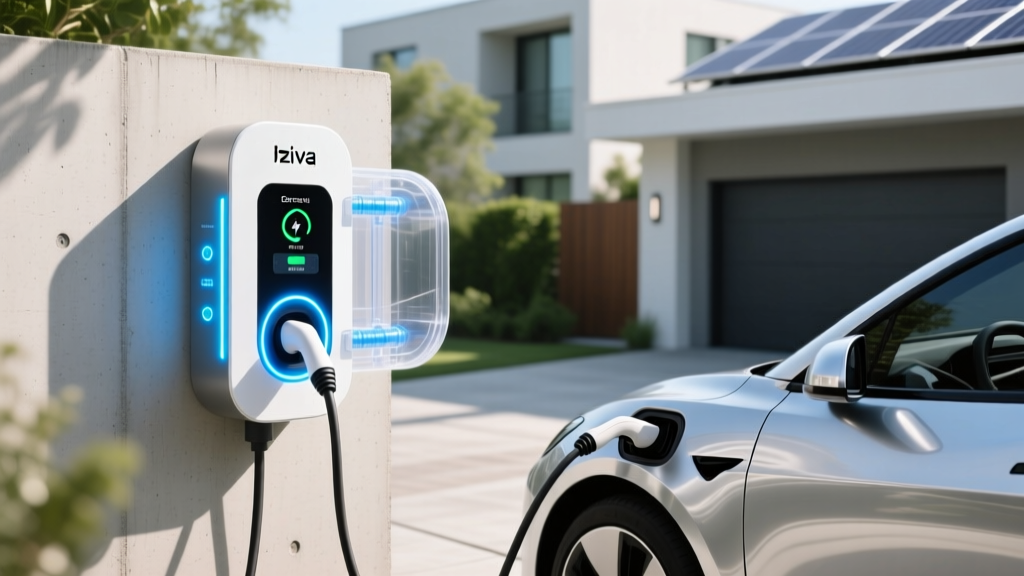
Emporia Vue Level 2 Charger
- Power Output: 48A (11.5 kW on 60A circuit)
- Connector: J1772 (NACS adapter included)
- Cable Length: 24 feet
- Smart Features: Wi-Fi, app scheduling, energy monitoring, solar integration, load management
- Price: ~$399
- Best For: Budget-conscious buyers who want full smart features and high amperage
Tesla Wall Connector (Gen 4)
- Power Output: 48A (11.5 kW on 60A circuit)
- Connector: NACS native
- Cable Length: 24 feet
- Smart Features: Wi-Fi, OTA updates, power sharing (multiple units on one circuit), access control
- Price: ~$475
- Best For: Tesla owners and NACS-equipped EVs; multi-EV households
ChargePoint Home Flex
- Power Output: Up to 50A (12 kW on 60A circuit); adjustable 16A–50A via DIP switch
- Connector: J1772 (NACS adapter available)
- Cable Length: 23 feet
- Smart Features: Wi-Fi, Alexa/Google Home, app scheduling, detailed energy reports
- Price: ~$599
- Best For: Flexibility across panel capacities; excellent app and ecosystem
Safety, Code, and Installation Best Practices
A home EV charger is a high-draw, continuously operating electrical appliance. Cutting corners on installation risks fire, voided warranties, and insurance claim denials. Here's what code and common sense require:
- Dedicated circuit: Your EV charger must be on its own breaker — never shared with other appliances. The NEC requires the circuit to be rated at 125% of the charger's maximum continuous draw.
- GFCI protection: Outdoor installations and garages in many jurisdictions require a GFCI (Ground Fault Circuit Interrupter) breaker. Some chargers have built-in GFCI; confirm with your electrician to avoid nuisance tripping from double-GFCI setups.
- Outdoor rating: If your charger is mounted outside, it must carry a NEMA 4 (weatherproof) rating. All major chargers listed above meet this standard, but verify the specific model's IP rating.
- Permit and inspection: Most municipalities require an electrical permit for EV charger installation. The permit ensures a city or county inspector verifies the work — protecting you from liability and insurance issues. Permit costs range from $50-$300.
- Cable management: Use a holster or cable reel to keep the cord off the ground. Dragging a 24-foot cable across a concrete floor degrades the insulation over time and creates a trip hazard.
- Future-proofing: If you're running new conduit, consider installing a 60-amp circuit even if your current charger only needs 40 amps. Upgrading later means another electrician visit, another permit, and more drywall work.
Frequently Asked Questions
How much does it cost to install a home EV charger?
A typical Level 2 home charger installation costs between $1,200 and $2,200 when no panel upgrade is needed. This includes the charger ($350-$750), electrician labor ($500-$2,000 depending on wiring run length), and permit ($50-$300). If your home has a 100-amp panel that needs upgrading to 200 amps, add $1,500-$3,000, bringing the total to $2,500-$6,500.
How fast will each charging level add range?
Level 1 (120V) adds 3-5 miles of range per hour. Level 2 (240V, 48A) adds 30-40 miles per hour for most EVs. DC fast charging at 150+ kW can add 150-250 miles in 20-25 minutes at peak rate, though this tapers significantly above 80% SoC.
Which connector/charger is compatible with my EV?
For 2026 model-year vehicles, NACS is the dominant standard — Tesla, Ford, GM, Rivian, and most major brands now use it natively. Older CCS vehicles (2022-2025) can use NACS Superchargers with an adapter ($100-$200). For home Level 2 charging, all EVs are compatible with any J1772 or NACS charger — AC charging uses a universal protocol.
How much does charging cost per mile vs. gas?
Home charging at off-peak rates costs roughly $0.02-$0.05 per mile — about 75% less than a 25 MPG gas car at $3.40/gallon ($0.136/mile). Even at public DC fast-charging rates ($0.35-$0.55/kWh), efficient EVs match or beat gas cars on cost per mile.
What electrical upgrades might I need?
If your home has a 200-amp panel (most homes built after 2000), you likely have sufficient capacity for a 40-60 amp EV circuit with no upgrade. Homes with 100-amp panels typically need a panel upgrade to 200 amps ($1,500-$3,000). An electrician can assess your panel's available amperage during a site visit — many offer free or low-cost evaluations.
Does fast charging degrade my battery faster?
DC fast charging does generate more heat than Level 2, which marginally accelerates degradation. However, modern battery thermal management systems mitigate most of this effect. Studies from NREL and real-world fleet data from Recurrent show that vehicles using DC fast charging 1-2 times per week lose only 1-3% more capacity over 100,000 miles compared to exclusive Level 2 users. The bigger degradation risk is repeatedly charging to 100% and letting the car sit in hot weather.
Can I charge my EV with solar panels?
Yes — and it's one of the cheapest "fuels" available. A typical home solar array producing 8-10 kW can fully power a Level 2 charger during daylight hours. Pair solar with timed charging (schedule your EV to charge between 10 AM and 3 PM when solar production peaks) for near-zero marginal fuel cost. Smart chargers like the Emporia Vue can automatically adjust charging rate to match real-time solar production.