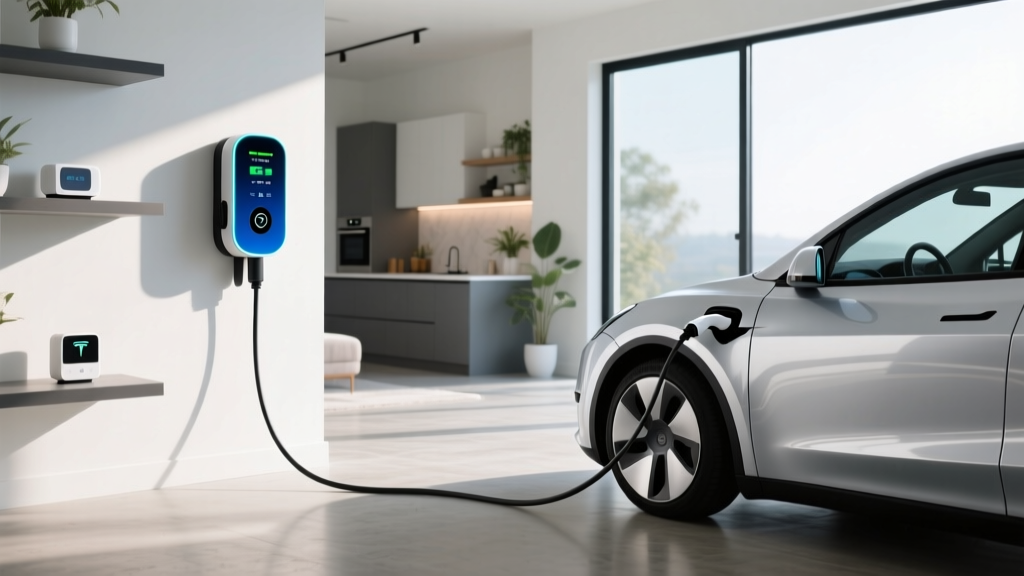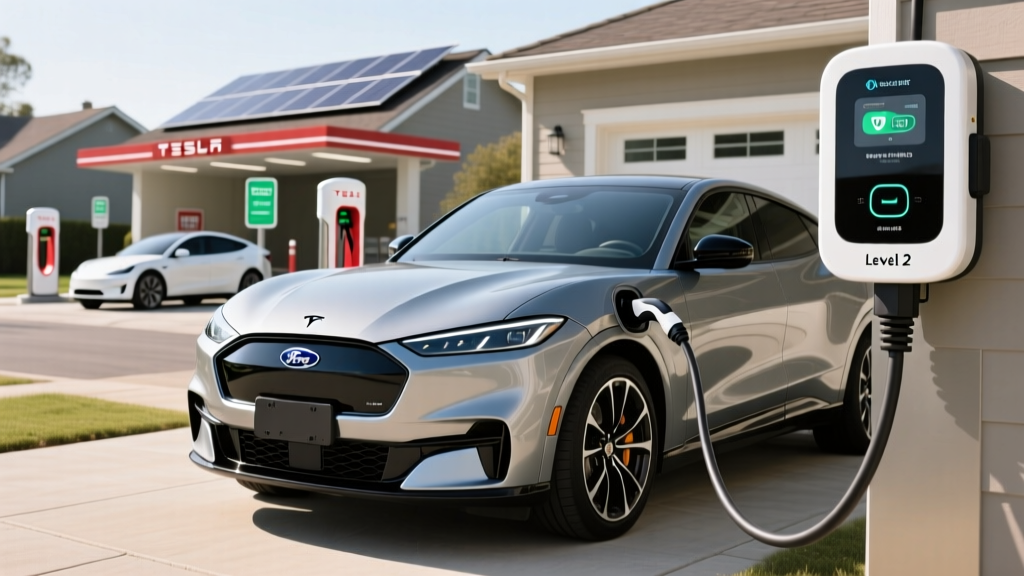
If you own a Ford Mustang Mach-E, you've likely noticed something frustrating: the Tesla Supercharger network has nearly twice as many locations as any CCS-based public charging provider in the U.S. As of 2026, Tesla operates over 6,500 Supercharger stalls across North America, while Electrify America sits at roughly 4,000. For Mach-E owners, a Mach-E Tesla adapter — officially the Ford-provided NACS-to-CCS adapter — unlocks that entire network, transforming your road-trip charging options overnight.
But the adapter is just one piece of a broader charging strategy. This guide covers everything Mach-E owners need to know: how fast you'll charge at home, what a Level 2 installation actually costs, which connectors work where, and how your per-mile fuel cost compares to a gas car. We'll use real numbers from the 2025–2026 Mach-E lineup to ground every recommendation.
How the Mach-E Tesla Adapter Works (and Where You Can Use It)
Ford was the first legacy automaker to sign an agreement with Tesla granting access to the Supercharger network. Starting with the 2024 model year, Ford began shipping a NACS (North American Charging Standard) adapter to Mach-E owners. This adapter converts the Mach-E's native CCS1 charge port to Tesla's NACS connector, enabling DC fast charging at Supercharger V3 and V4 stalls.
Here's what you need to know:
- DC Fast Charging: The adapter supports up to 150 kW at Supercharger V3 stalls. The Mach-E Extended Range (91 kWh usable battery, NMC chemistry) can accept up to ~150 kW peak, so you won't bottleneck the stall — but you also won't see the 250 kW that a Tesla Model Y can pull.
- Level 2 AC Charging: The adapter also works at Tesla Wall Connectors and Tesla Destination Chargers, delivering up to 10.5 kW (48A) to the Mach-E's onboard charger.
- Navigation Integration: Ford's SYNC 4A system now routes through Tesla Superchargers in the FordPass app, preconditioning the battery before arrival for optimal charge speed.
If you bought a 2024 or newer Mach-E, the adapter was included or available for order through your dealer. For 2021–2023 models, Ford offered the adapter free of charge through a mail-in program. Check Ford's official EV charging page for current availability.
Charging Levels Explained: Speeds, kW, and Range Per Hour
Before we discuss installation, let's establish the critical distinction: kW (kilowatts) measures power — the rate of charging. kWh (kilowatt-hours) measures energy — the battery's total capacity. Think of kW as the width of a hose and kWh as the size of the bucket. A wider hose fills the bucket faster.
| Level | Voltage / Amps | Power (kW) | Miles of Range Per Hour | Typical Use Case |
|---|---|---|---|---|
| Level 1 | 120V / 12A | ~1.4 kW | 3–5 mi/hr | Overnight trickle; PHEVs and emergencies |
| Level 2 (Home/Public) | 240V / 32–48A | 7.7–11.5 kW | 22–35 mi/hr | Daily home charging; workplace; shopping centers |
| DC Fast Charging | 400–800V DC | 50–350 kW | 150–600+ mi/hr (peak) | Road trips; highway corridors; Superchargers |
For the Mach-E Extended Range AWD (EPA-estimated 305 miles, 91 kWh usable battery), here are realistic charge times from 10% to 80% State of Charge:
- Level 1 (120V): ~60+ hours — impractical for full charges; best for maintaining SoC
- Level 2 (240V, 48A / 11.5 kW): ~8–9 hours — perfect for overnight charging
- DC Fast (150 kW at Supercharger): ~38–45 minutes (10–80%)
- DC Fast (50 kW CCS public stall): ~90–100 minutes (10–80%)
Real-world caveat: DC fast charging rarely sustains peak power. The Mach-E's charge curve peaks around 150 kW up to ~40% SoC, then tapers progressively. From 80–100%, speeds drop below 30 kW. This is normal battery management — lithium cells accept charge more slowly as they approach full to prevent degradation.
Home Charger Installation: Electrical Requirements and Real Costs
Most Mach-E owners install a Level 2 home charger — it's the single biggest quality-of-life upgrade in EV ownership. But installation costs vary dramatically based on your electrical panel's capacity and the distance from panel to charger location.
Electrical Requirements for Level 2
- Circuit: A dedicated 240V circuit rated for 40A–60A. A 48A charger requires a 60A breaker (NEC code mandates 125% overhead for continuous loads).
- Wire: 6 AWG copper for 48A circuits; 4 AWG for 60A runs over longer distances.
- Panel Capacity: Your home's main panel must have spare capacity. A 200A panel with existing heavy loads (electric range, dryer, HVAC) may need a load calculation. A 100A panel in an older home almost certainly requires an upgrade.
| Component | Typical Cost Range | Notes |
|---|---|---|
| Level 2 Charger (hardware) | $350 – $750 | Smart Wi-Fi chargers with NACS or CCS cable |
| Electrician labor (standard install) | $500 – $1,500 | Short run from panel to garage; drywall patching |
| Electrician labor (complex run) | $1,500 – $3,000 | Long conduit runs, trenching, attic crawls |
| Electrical permit | $50 – $200 | Varies by municipality; some waive for EV installs |
| Panel upgrade (100A → 200A) | $2,000 – $4,500 | Required in older homes with insufficient capacity |
| Total (no panel upgrade) | $900 – $2,500 | Most common scenario for modern homes |
| Total (with panel upgrade) | $3,500 – $7,000 | Older homes pre-2000 |
Panel upgrade reality check: Homes built before 2000 often have 100A or even 60A main panels. Adding a 48A EV circuit on top of an electric oven, dryer, and central AC can overload these panels. A licensed electrician will perform a load calculation (NEC Article 220) to determine whether your panel can handle the addition. Don't skip this step — an overloaded panel is a fire hazard, and your homeowner's insurance may deny a claim if unpermitted work caused damage.
Safety and Code Considerations
- GFCI Protection: NEC 2023 and later require GFCI (Ground Fault Circuit Interrupter) protection on all EV charging circuits. Most quality Level 2 chargers have built-in GFCI, but your electrician may also install a GFCI breaker.
- Outdoor Rating: If your charger mounts outside (driveway, carport), it must carry a NEMA 4 or IP55 weather rating. All chargers recommended below meet this standard.
- Dedicated Circuit: Never share the EV circuit with other appliances. Continuous loads over 3 hours (which EV charging qualifies as) require dedicated, properly sized breakers.
- Permit: Most jurisdictions require an electrical permit for new 240V circuits. The permit triggers a post-installation inspection, which protects you and is often required for utility rebates.
Connector Compatibility: NACS, CCS1, and Adapter Needs
The connector landscape in 2026 has largely consolidated around NACS, but CCS1 infrastructure remains widespread. Here's how the Mach-E fits in:
| Connector | Mach-E Native? | Adapter Needed? | Where You'll Find It |
|---|---|---|---|
| CCS1 (J1772 + DC pins) | Yes — native port | No | Electrify America, EVgo, ChargePoint, most public DC stalls |
| NACS (Tesla) | No | Yes — Ford NACS adapter | Tesla Superchargers, Tesla Destination Chargers, newer third-party NACS stalls |
| J1772 (AC only) | Yes — via CCS inlet | No (CCS inlet accepts J1772) | Public Level 2 stations, older home chargers |
| CHAdeMO | No | Not available for Mach-E | Nissan Leaf legacy stations; being phased out |
2026 outlook: Nearly every major automaker has adopted NACS for new vehicles starting with the 2025 model year. Electrify America, EVgo, and ChargePoint are retrofitting existing stations with NACS cables. By late 2026, most new public DC fast chargers will offer both NACS and CCS1 connectors natively. If you buy a 2026 Mach-E, it may ship with a NACS port directly — check your specific build configuration.
Recommended Home Chargers for the Mach-E
The Mach-E's onboard charger accepts up to 10.5 kW (48A at 240V). Installing a charger that exceeds this won't damage the car — the vehicle simply draws what it can. But there's no benefit to overspending on an 80A charger when 48A is your ceiling.
ChargePoint Home Flex (NACS or CCS)
- Power Output: Up to 12 kW / 50A (adjustable down)
- Connector: Available in NACS or CCS1 — order the NACS version if you have the adapter
- Cable Length: 23 feet
- Smart Features: Wi-Fi, app scheduling, utility rate integration, Alexa
- Price: ~$550 (NACS) / ~$500 (CCS1)
- Best For: Mach-E owners who want utility TOU scheduling and future-proofing
Emporia Vue Level 2 Charger
- Power Output: Up to 11.5 kW / 48A
- Connector: J1772 (compatible with Mach-E CCS inlet); NACS version available
- Cable Length: 24 feet
- Smart Features: Integrates with Emporia energy monitor for whole-home load management — can auto-throttle charge rate if panel nears capacity
- Price: ~$400
- Best For: Homes on the edge of panel capacity; budget-conscious buyers
Tesla Wall Connector (with NACS adapter use)
- Power Output: Up to 11.5 kW / 48A
- Connector: NACS native — plug directly into Mach-E using your Ford adapter
- Cable Length: 24 feet
- Smart Features: Wi-Fi, firmware updates, power sharing between two Wall Connectors on one circuit
- Price: ~$475
- Best For: Multi-EV households (one Tesla, one Mach-E) sharing a single circuit
Ford Connected Charge Station
- Power Output: Up to 11.5 kW / 48A
- Connector: CCS1 native (no adapter needed at home)
- Cable Length: 25 feet
- Smart Features: FordPass integration, scheduled charging, energy usage reports
- Price: ~$600 (often included or discounted with new Mach-E purchase)
- Best For: Ford-loyal owners who want seamless app integration; no adapter fumbling
Our pick: The ChargePoint Home Flex in NACS configuration offers the best balance of smart features, cable length, and price. If your household includes a Tesla, the Tesla Wall Connector with power-sharing is the pragmatic choice.
Charging Cost Per Mile: Home vs. Public vs. Gas
The Mach-E Extended Range AWD averages roughly 3.0 miles per kWh (97 MPGe combined per fueleconomy.gov). Using that efficiency, here's what charging actually costs:
| Charging Scenario | Cost per kWh | Cost per Mile | Annual Cost (12,000 mi) |
|---|---|---|---|
| Home — Off-Peak (utility TOU rate) | $0.08 – $0.12 | $0.027 – $0.040 | $320 – $480 |
| Home — Standard Residential Rate | $0.14 – $0.18 | $0.047 – $0.060 | $560 – $720 |
| Public Level 2 (ChargePoint, etc.) | $0.25 – $0.40 | $0.083 – $0.133 | $1,000 – $1,600 |
| DC Fast — Supercharger (NACS adapter) | $0.28 – $0.36 | $0.093 – $0.120 | $1,120 – $1,440 |
| DC Fast — Electrify America (CCS) | $0.35 – $0.48 | $0.117 – $0.160 | $1,400 – $1,920 |
| Gas Equivalent (25 MPG avg, $3.40/gal) | — | $0.136 | $1,632 |
The takeaway: Home charging at off-peak rates costs roughly one-quarter to one-third what gasoline costs per mile. Even DC fast charging at Tesla Superchargers (using your Mach-E Tesla adapter) undercuts gasoline on a per-mile basis in most states. The economics only flip if you rely exclusively on premium-priced public DC chargers — which is why home charging access remains the single most important factor in EV ownership satisfaction.
Federal and Utility Incentives for Home Charging
The federal Alternative Fuel Vehicle Refueling Property Credit (IRC §30C) offers up to $1,000 (30% of equipment and installation costs, capped at $1,000 for residential) for home EV charger installation. Key requirements:
- The charger must be installed at your primary residence
- The property must be located in an eligible census tract (generally low-income or non-urban areas — check IRS eligibility maps)
- The credit is non-refundable (you must owe taxes to claim it)
- Equipment and labor both qualify
Additionally, many utilities offer direct rebates for Level 2 charger purchases or installation. Common examples include $250–$500 rebates from providers like PG&E, ConEdison, and Xcel Energy. Check your local utility's EV program page before purchasing hardware.
Real-World Charging Strategy for Mach-E Owners
After extensive real-world use, here's the charging strategy we recommend for Mach-E owners:
- Daily driving (under 60 miles): Charge at home on Level 2 overnight. Set your charger to 80% State of Charge to minimize NMC battery degradation. This covers 90%+ of driving needs.
- Road trips: Use the Ford NACS adapter at Tesla Superchargers for the fastest, most reliable DC charging experience. Precondition the battery via SYNC 4A navigation before arrival. Expect 10–80% in roughly 38–45 minutes at V3 stalls.
- Winter charging: In sub-40°F temperatures, expect DC charge speeds to drop 20–30% due to cold battery chemistry. Always precondition. Cold weather also reduces range by 20–35% (EPA 305 mi → expect ~210–245 mi in freezing highway driving).
- Battery longevity: The Mach-E's NMC battery is warranted for 8 years / 100,000 miles with a minimum 70% capacity retention threshold. Avoid routinely charging to 100% on Level 2; reserve full charges for road trips.
Frequently Asked Questions
How much does it cost to install a home EV charger for my Mach-E?
A standard Level 2 installation (48A charger, short conduit run from a 200A panel) typically costs $900–$2,500 all-in, including equipment, electrician labor, and permit. If your home has an older 100A panel that needs upgrading, add $2,000–$4,500 for the panel work, bringing the total to $3,500–$7,000. Always get a load calculation from a licensed electrician before committing.
How fast will each charging level add range to the Mach-E?
Level 1 (120V) adds 3–5 miles per hour. Level 2 (240V, 48A) adds roughly 30–35 miles per hour. DC fast charging at a 150 kW Supercharger adds 150+ miles in approximately 15–20 minutes at peak rate, though the charge curve tapers significantly above 80% SoC.
Which connector and charger is compatible with my Mach-E?
The Mach-E has a native CCS1 charge port that also accepts J1772 (AC only). With the Ford NACS adapter, you can charge at Tesla Superchargers and NACS-equipped Level 2 stations. At home, any Level 2 charger with a J1772, CCS1, or NACS connector will work — the CCS inlet physically accepts J1772 plugs for AC charging without an adapter.
How much does charging cost per mile compared to gas?
Home charging at off-peak rates costs approximately $0.03–$0.04 per mile. Public DC fast charging costs $0.09–$0.16 per mile. A comparable gas vehicle at 25 MPG with $3.40/gallon fuel costs about $0.14 per mile. Home charging is consistently the cheapest option — roughly one-quarter the cost of gasoline.
What electrical upgrades might I need for a home charger?
The most common upgrade is a panel capacity increase from 100A to 200A, needed in homes built before ~2000. You may also need a dedicated 60A breaker slot, new conduit runs, or a sub-panel if your main panel is full. A licensed electrician performs a NEC Article 220 load calculation to determine exactly what's required. Never install an EV charger on an existing shared circuit.
Does the Mach-E Tesla adapter affect charging speed?
The adapter itself introduces negligible resistance. Your Mach-E's peak DC charge rate is ~150 kW regardless of whether you're using a CCS1 stall or a Supercharger with the NACS adapter. The limiting factor is the vehicle's onboard charge management, not the adapter. At Level 2, the adapter passes through the full 10.5 kW the Mach-E can accept.
Can I charge my Mach-E at a Tesla Supercharger without the adapter?
No. The Mach-E's native CCS1 port is physically incompatible with Tesla's NACS connector. The Ford NACS adapter is required for Supercharger access. Without it, you're limited to CCS1 networks (Electrify America, EVgo, ChargePoint) and J1772 Level 2 stations.