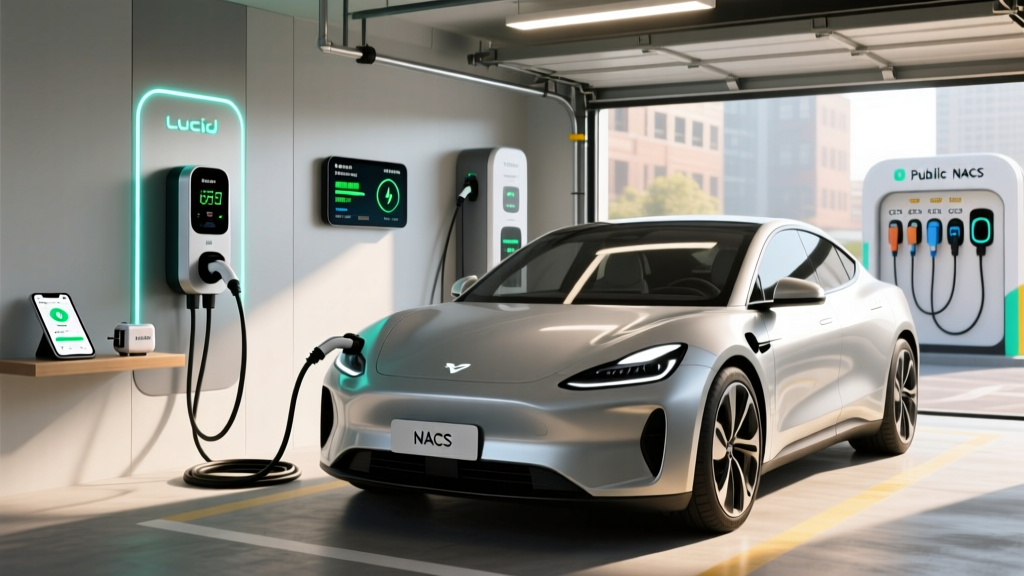
Lucid Motors made a pivotal charging decision when it adopted the North American Charging Standard (NACS) for its vehicles, starting with the 2025 Lucid Air and extending to the Lucid Gravity SUV. If you're shopping for a Lucid or have just taken delivery, understanding how NACS affects your home charging setup, public charging access, and equipment choices is essential. This guide covers every practical detail — from electrical panel requirements to real-world charging costs — so you can plan with confidence.
Why Lucid's Move to NACS Matters for Owners
Lucid originally launched the Air with a CCS1 charge port. Following the industry-wide shift toward Tesla's open NACS connector — now adopted by Ford, GM, Rivian, Hyundai, BMW, and most major automakers — Lucid transitioned to NACS beginning with the 2025 model year. The Lucid Gravity launched with NACS from the start.
This matters because NACS grants direct access to Tesla's Supercharger network, the largest and most reliable DC fast-charging network in North America, without needing an adapter. For 2025+ Lucid owners, this means more seamless road-trip charging and a single-connector ecosystem for both home and public use.
If you own a 2022–2024 Lucid Air with a CCS1 port, Lucid offers an official CCS-to-NACS adapter, and the Supercharger network is accessible via that adapter. Always verify adapter compatibility with Lucid directly, as firmware updates can affect handshake protocols between the vehicle and the charger.
Charging Levels Explained: Speeds, Power, and Range Added
Before evaluating equipment, you need to understand the three charging levels and what each delivers. Note the critical distinction: kW (kilowatts) measures power — the rate of energy transfer. kWh (kilowatt-hours) measures energy — the total capacity stored in the battery. A 112 kWh battery charged at 19.2 kW will take longer than one charged at 48 kW, even though both draw from the same energy pool.
| Level | Voltage / Amperage | Max Power (kW) | Miles of Range per Hour | Typical Use Case |
|---|---|---|---|---|
| Level 1 | 120V / 12A | ~1.4 kW | ~3–5 mi/hr | Emergency top-off, overnight trickle |
| Level 2 (Home) | 240V / 48A | ~11.5 kW | ~30–40 mi/hr | |
| Level 2 (Home, max) | 240V / 80A | ~19.2 kW | ~50–65 mi/hr | |
| DC Fast Charging | 400V+ / up to 300A | ~250 kW (peak) | ~200 mi in ~15 min (10–80%) |
The Lucid Air Grand Touring carries a 112 kWh usable battery pack. At a 48-amp Level 2 home charger (11.5 kW), a full charge from 10% to 100% takes roughly 10 hours. At 80 amps (19.2 kW), that drops to about 6 hours. For daily driving — where most owners charge from 30% to 80% — a 48A charger replenishes roughly 300 miles of EPA-rated range overnight, which covers nearly all daily needs.
On DC fast charging, the Lucid Air can accept up to approximately 250 kW at peak, though the charge curve tapers significantly above 80% state of charge. Expect a 10–80% session in roughly 15–20 minutes at a Tesla V3 Supercharger (250 kW) or Electrify America station, with real-world speeds depending on battery temperature, preconditioning, and ambient conditions.
Home Charger Installation: Electrical Requirements and Costs
Installing a Level 2 home charger is the single most impactful upgrade for Lucid ownership. Here's what the electrical side requires.
Circuit and Amperage Requirements
A 48-amp Level 2 charger requires a dedicated 60-amp circuit (the National Electrical Code requires circuits to be rated at 125% of continuous load). An 80-amp charger requires a 100-amp circuit. Most modern homes with 200-amp electrical panels can accommodate a 60-amp circuit, but older homes with 100-amp service may need a panel upgrade.
Panel Upgrade Considerations
If your panel is near capacity — common in homes with electric ranges, dryers, and HVAC — adding a 60-amp EV circuit could exceed the panel's rated load. A licensed electrician will perform a load calculation per NEC Article 220. If an upgrade is needed, expect a 200-amp panel upgrade to cost between $1,500 and $3,500, depending on your utility's requirements and local labor rates.
Installation Cost Breakdown
| Component | Low Estimate | High Estimate | Notes |
|---|---|---|---|
| Level 2 Charger (Equipment) | $400 | $750 | 48A–80A NACS hardwired or plug-in |
| Electrician Labor | $500 | $2,000 | Depends on run length, wall type, conduit |
| Permit & Inspection | $50 | $250 | Varies by municipality |
| Panel Upgrade (if needed) | $1,500 | $3,500 | Only if existing panel is undersized |
| Total (no panel upgrade) | $950 | $3,000 | Most common scenario |
| Total (with panel upgrade) | $2,450 | $6,500 | Older homes or high-load panels |
Some utilities offer rebates for Level 2 charger installation — check with your local provider. Additionally, the federal Alternative Fuel Vehicle Refueling Property Credit (IRS Form 8911) may cover up to 30% of installation costs (capped at $1,000 for residential), subject to income limits and census-tract eligibility. Consult a tax professional and review current rules on irs.gov.
Connector Compatibility: NACS, CCS1, and Adapters
With the industry converging on NACS, connector compatibility has become simpler for new buyers but more complex for owners of earlier-model vehicles. Here's where Lucid fits.
| Vehicle | Native Port | Tesla Supercharger | CCS Public Stations | Adapter Needed? |
|---|---|---|---|---|
| 2025+ Lucid Air | NACS | Direct (native) | CCS-to-NACS adapter | CCS adapter for non-Tesla DCFC |
| Lucid Gravity (all years) | NACS | Direct (native) | CCS-to-NACS adapter | CCS adapter for non-Tesla DCFC |
| 2022–2024 Lucid Air | CCS1 | NACS adapter | Direct (native) | NACS adapter for Superchargers |
For 2025+ NACS-equipped Lucid owners, you'll want a CCS-to-NACS adapter for the remaining Electrify America, EVgo, and ChargePoint DC fast chargers that still use CCS1 connectors. Tesla sells a CCS-to-NACS adapter, and several third-party options are available. Expect to pay $150–$250 for a quality adapter. Always confirm that the adapter supports the full amperage your vehicle can accept — a low-amperage adapter will bottleneck your charging speed.
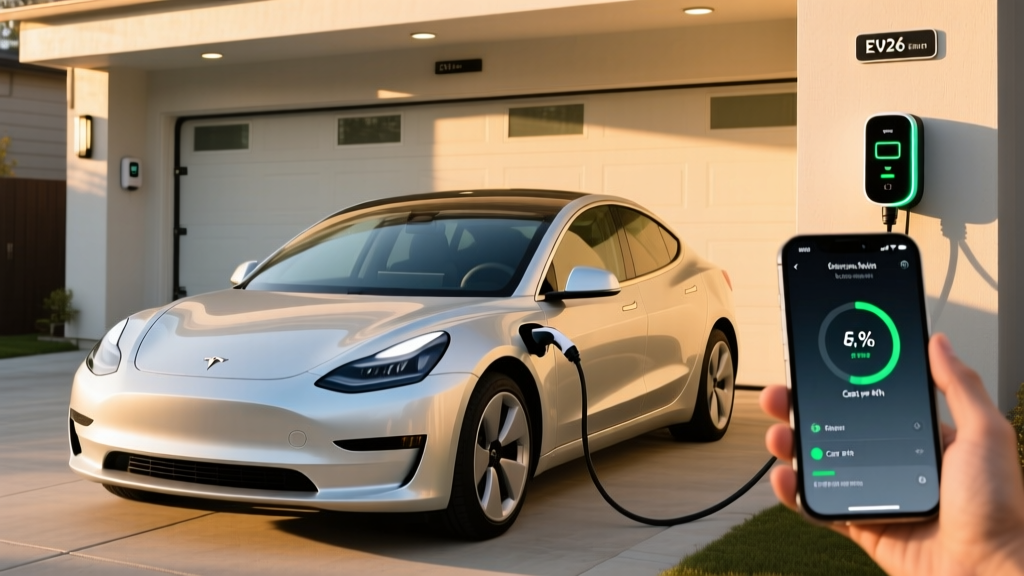
For home Level 2 charging, NACS is the native connector on 2025+ Lucid vehicles, so any NACS-equipped wall connector will plug in directly with no adapter.
Charging Cost: Home vs. Public vs. Gas Comparison
One of the strongest ownership arguments for the Lucid Air is its exceptional efficiency. The Air Grand Touring achieves approximately 4.0 miles per kWh (142 MPGe combined per the EPA), making it one of the most efficient luxury EVs available. That efficiency translates directly into lower per-mile costs.
| Scenario | Rate | Lucid Air Cost/Mile | Gas Sedan (30 MPG) Cost/Mile |
|---|---|---|---|
| Home charging (off-peak) | $0.13/kWh | $0.033 | — |
| Home charging (peak) | $0.25/kWh | $0.063 | — |
| Public Level 2 | $0.35/kWh | $0.088 | — |
| DC Fast Charging | $0.48/kWh | $0.120 | — |
| Gasoline ($3.50/gal, 30 MPG) | — | — | $0.117 |
At off-peak residential rates, the Lucid Air costs roughly 3.3 cents per mile to drive — about a quarter of what a comparable 30 MPG gas sedan costs at $3.50 per gallon. Even at public DC fast-charging rates, the Air's efficiency keeps per-mile costs competitive with gasoline. Over 15,000 miles per year, home charging at $0.13/kWh costs approximately $488, compared to $1,750 for gasoline.
Lucid's efficiency advantage comes from its high-voltage architecture, low drag coefficient (0.197 Cd for the Air), and advanced thermal management. This is where the Air outpaces heavier, less aerodynamic EVs that may consume 3.0 or fewer miles per kWh.
Recommended Home Charging Equipment for Lucid NACS
Below are our top picks for NACS-equipped Level 2 home chargers that pair well with Lucid vehicles. All recommendations are hardwired or NACS plug-in units rated for continuous indoor/outdoor use.
Tesla Wall Connector (NACS)
- Power Output: Up to 48A (11.5 kW) on a 60A circuit
- Connector: Native NACS — plugs directly into 2025+ Lucid Air and Gravity
- Cable Length: 24 feet
- Smart Features: Wi-Fi connectivity, OTA firmware updates, power sharing between two units, access control
- Price: ~$425
- Best For: Budget-conscious Lucid owners who want native NACS without an adapter
ChargePoint Home Flex (NACS)
- Power Output: Up to 80A (19.2 kW) on a 100A circuit; adjustable down to 16A
- Connector: Available with NACS connector
- Cable Length: 23 feet
- Smart Features: App-based scheduling, Alexa integration, energy-use tracking, flexible amperage settings
- Price: ~$650
- Best For: Lucid owners who want maximum Level 2 speed and smart-home integration
Emporia Level 2 EV Charger (NACS)
- Power Output: Up to 48A (11.5 kW) on a 60A circuit
- Connector: NACS
- Cable Length: 24 feet
- Smart Features: Real-time energy monitoring, solar-integration scheduling, app control
- Price: ~$400
- Best For: Solar-panel owners who want to optimize EV charging against home generation
For Lucid Air owners with the 112 kWh battery, a 48A charger is usually sufficient — it adds approximately 300+ miles of range in a typical 8–10 hour overnight session. The 80A option (like the ChargePoint Home Flex at full amperage) makes sense if you regularly deplete the battery and need faster turnaround, or if you plan to charge a second EV simultaneously.
Safety, Electrical Code, and Installation Best Practices
EV charging places a sustained, high-amperage load on your home's electrical system. This is not a DIY project. Here's what proper installation requires:
- Dedicated circuit: Your Level 2 charger must be on its own dedicated breaker — not shared with any other appliance or outlet.
- GFCI protection: The NEC (2023 edition, Article 625) requires ground-fault circuit interrupter protection for EV charging circuits. Hardwired installations may use a GFCI breaker; plug-in installations require a GFCI-protected receptacle.
- Outdoor rating: If installing outside, ensure the charger carries a NEMA 4 or IP65 rating for weather resistance. All recommended units above are outdoor-rated.
- Wire gauge: A 60-amp circuit typically requires 6 AWG copper wire; a 100-amp circuit requires 3 AWG or larger. Your electrician will size wire per NEC Table 310.16 and adjust for ambient temperature and conduit fill.
- Permit and inspection: Most jurisdictions require an electrical permit for EV charger installation. A post-installation inspection ensures code compliance and protects your home insurance coverage.
Never use an extension cord or adapter to plug a Level 2 charger into a standard dryer or range outlet. Sustained EV charging loads differ from intermittent appliance loads, and improper connections are a fire risk.
Public Charging with Lucid NACS: Superchargers and Beyond
With a native NACS port, 2025+ Lucid vehicles can use Tesla Superchargers directly. Tesla's V3 Superchargers deliver up to 250 kW, and V4 cabinets are rolling out with higher power capability. Use the Lucid's built-in navigation to route to Superchargers — the vehicle will precondition the battery for optimal charge speed upon approach.
For non-Tesla DC fast chargers (Electrify America, EVgo, ChargePoint), you'll need a CCS-to-NACS adapter. Electrify America stations commonly offer 150 kW and 350 kW stalls. The Lucid Air's peak acceptance rate of ~250 kW means you'll benefit from the higher-speed stalls, but expect the charge curve to taper above 80% SoC to protect battery longevity.
Preconditioning is essential for fast-charging speed. If you navigate to a charger using the car's built-in routing, the Lucid's thermal management system will warm or cool the battery to the optimal temperature window before you arrive. Arriving at a DC fast charger without preconditioning — especially in cold weather — can reduce peak charge rates by 30–50%.
Frequently Asked Questions
How much does it cost to install a home EV charger for a Lucid?
Expect $950 to $3,000 for a standard installation (equipment, electrician labor, and permit) without a panel upgrade. If your home needs a 200-amp panel upgrade, total costs can reach $2,450 to $6,500. The federal refueling property credit may offset up to $1,000 of installation costs, subject to eligibility requirements.
How fast will each charging level add range to my Lucid Air?
Level 1 (120V) adds approximately 3–5 miles per hour — practical only for emergencies. Level 2 at 48 amps adds roughly 30–40 miles per hour, enough for overnight replenishment. Level 2 at 80 amps adds approximately 50–65 miles per hour. DC fast charging at 250 kW can add roughly 200 miles in about 15 minutes under optimal conditions.
Which connector is compatible with my Lucid?
2025 and newer Lucid Air models and all Lucid Gravity models use the NACS connector natively. 2022–2024 Lucid Air models use CCS1 and require a NACS adapter for Tesla Superchargers. For home charging, any NACS-equipped Level 2 wall connector works directly with 2025+ models.
How much does charging cost per mile compared to gas?
At typical off-peak residential rates ($0.13/kWh), the Lucid Air costs about $0.033 per mile — roughly 72% less than a 30 MPG gas sedan at $3.50/gallon ($0.117/mile). Even at public DC fast-charging rates ($0.48/kWh), the Air's exceptional efficiency of ~4.0 mi/kWh keeps costs at approximately $0.12 per mile, comparable to gasoline.
What electrical upgrades might I need for a home charger?
If your home has a 200-amp electrical panel with available capacity, a 60-amp circuit for a 48A charger is usually straightforward. Older homes with 100-amp panels, or homes with high existing electrical loads (electric heat, hot tubs, multiple EVs), may require a panel upgrade to 200A or higher. A licensed electrician's load calculation is the definitive answer.
Do I need an adapter to charge my NACS Lucid at non-Tesla stations?
Yes. For DC fast chargers using CCS1 connectors (Electrify America, EVgo, some ChargePoint stations), you'll need a CCS-to-NACS adapter. For Level 2 public chargers with J1772 connectors, you'll need a J1772-to-NACS adapter. Tesla sells both, and third-party options are widely available.
For the latest Lucid charging specifications and software updates, consult Lucid's official Air page. For federal tax credit and incentive details, refer to IRS.gov and verify current-year rules with a tax professional.