Why the Lucid Connected Home Charging Station Matters for Air Owners
The Lucid Air lineup — from the Pure to the Sapphire — packs some of the largest battery packs in any production sedan, ranging from 88 kWh usable (Pure) to 118 kWh (Grand Touring). That massive energy capacity delivers EPA ranges up to 516 miles (Grand Touring with 19-inch wheels), but it also means Level 2 home charging can take significantly longer than smaller-battery EVs unless you have the right hardware.
The Lucid Connected Home Charging Station is Lucid's own branded Level 2 wall unit, engineered specifically to maximize charge speeds for the Air's onboard charger architecture. But is it the right pick for your garage, and what will it cost to install? This guide breaks down the unit's specs, real-world install requirements, charging math for every Air trim, and whether a third-party charger might serve you better.
Charging Levels Explained: What Speeds Actually Look Like
Before evaluating any home charger, you need to understand the three charging tiers available to Lucid Air owners and how much range each adds per hour of charging.
| Level | Voltage / Power | Miles of Range Added per Hour | Best Use Case |
|---|---|---|---|
| Level 1 | 120V / 1.4–1.9 kW | 3–5 miles/hr | Overnight trickle; emergency backup |
| Level 2 | 240V / 7.7–19.2 kW | 18–62 miles/hr | Daily home and workplace charging |
| DC Fast Charging | 400–900V / 50–300+ kW | 200–900+ miles/hr (peak) | Road trips; public fast-charging stations |
The Lucid Air Grand Touring can accept up to 19.2 kW on Level 2 AC — one of the highest onboard charger capacities of any production EV. This means it can absorb the full output of a 240V/80A circuit, which is exactly what the Lucid Connected Home Charging Station delivers. Most competing EVs cap Level 2 acceptance at 11.5 kW (48A), so Lucid owners have a real advantage here — if their electrical panel supports it.
On DC fast charging, the Air Grand Touring peaks at approximately 250 kW on compatible CCS stations (and up to 300+ kW on NACS-equipped Superchargers via adapter with the latest 2025+ models). A 10–80% DC fast charge takes roughly 20–25 minutes under ideal conditions, though the charge curve tapers significantly above 80% SoC to protect battery longevity. Expect 80–100% to add another 20+ minutes.
Lucid Connected Home Charging Station: Specs and Features
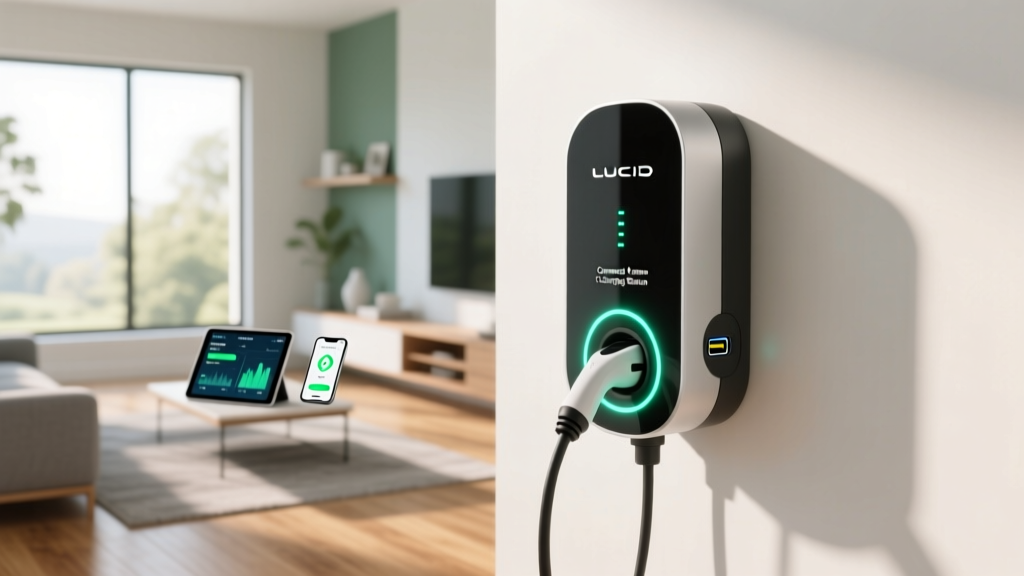
The Lucid Connected Home Charging Station is a hardwired, Wi-Fi-enabled Level 2 unit manufactured for Lucid by a Tier 1 supplier. Here are the key specifications:
- Max power output: 19.2 kW (240V / 80A)
- Connector: NACS (North American Charging Standard) — native Tesla-style plug on 2025+ units; earlier units shipped with J1772 and included a NACS adapter
- Cable length: 24 feet
- Smart features: Wi-Fi connectivity, Lucid app integration, scheduled charging, energy-use tracking, OTA firmware updates
- Enclosure rating: NEMA 4 (indoor/outdoor rated, weather-resistant)
- Estimated price: ~$1,200–$1,500 (equipment only; check Lucid's official accessories page for current pricing)
The primary advantage of this unit is its 80A output. Most residential Level 2 chargers top out at 48A (11.5 kW), which would add only about 37 miles of range per hour to a Grand Touring. At 80A / 19.2 kW, you get roughly 62 miles of range per hour — meaning a full overnight session easily replenishes even the 118 kWh pack from 20% to full in about 6–7 hours.
How Much Does It Cost to Install a Home EV Charger?
Installation cost is where many EV buyers get surprised. The charger hardware is only part of the equation — electrical labor, permitting, and potential panel upgrades often exceed the equipment cost.
| Component | Typical Cost Range | Notes |
|---|---|---|
| Charger equipment (Lucid station or equivalent) | $700 – $1,500 | 80A units cost more than 48A |
| Electrician labor (run 240V circuit, mount unit) | $600 – $2,500 | Depends on distance from panel to garage; longer wire runs = higher cost |
| Electrical permit | $50 – $300 | Varies by municipality; required for code compliance |
| Panel upgrade (100A → 200A service) | $1,500 – $4,000 | Needed in older homes; 80A charger requires significant spare capacity |
| Total (no panel upgrade) | $1,350 – $4,300 | Most homes with 200A service |
| Total (with panel upgrade) | $2,850 – $8,300 | Homes with 100A or maxed-out 150A panels |
The 80A gotcha: The Lucid Connected Home Charging Station requires a dedicated 100A breaker (NEC code mandates that continuous loads use only 80% of a circuit's rated capacity, so 80A continuous draw needs a 100A breaker). That means your electrical panel must have at least 100A of spare capacity beyond your home's existing loads. Homes with 200A total service that are already running central AC, electric oven, and a dryer may not have enough headroom. A licensed electrician should perform a load calculation before you commit to an 80A unit.
If your panel can't support 100A spare, you have two options: upgrade your panel, or install a 48A or 60A charger instead (which still provides 30–45 miles of range per hour for the Air — plenty for most daily driving).
Real-World Charging Times for Every Lucid Air Trim
Charging time depends on battery size, onboard charger acceptance rate, and the charger's power output. Here's what Lucid Air owners can expect at home on the Lucid Connected Home Charging Station at its full 19.2 kW output:
| Trim | Battery (kWh usable) | EPA Range | 20–80% at 19.2 kW | 20–80% at 11.5 kW (48A) |
|---|---|---|---|---|
| Air Pure | 88 kWh | 419 mi | ~2.75 hours | ~4.6 hours |
| Air Touring | 112 kWh | 425 mi | ~3.5 hours | ~5.8 hours |
| Air Grand Touring | 118 kWh | 516 mi | ~3.7 hours | ~6.2 hours |
| Air Sapphire | 118 kWh | 427 mi | ~3.7 hours | ~6.2 hours |
Connector Compatibility: NACS, CCS, and Adapter Needs
The charging connector landscape has shifted dramatically. As of 2025, nearly all major automakers — including Lucid — have adopted or committed to NACS (North American Charging Standard), the connector originally developed by Tesla. Here's what Lucid Air owners need to know:
| Connector | Lucid Air (2025+) | Lucid Air (2022–2024) | Where You'll Find It |
|---|---|---|---|
| NACS | Native port | Via adapter (included or aftermarket) | Tesla Superchargers, new Lucid home station, growing public networks |
| CCS1 | Via adapter | Native port | Electrify America, EVgo, most non-Tesla DC fast networks |
| CHAdeMO | Not supported | Not supported | Legacy Nissan Leaf infrastructure; effectively obsolete |
| J1772 (Level 2 AC) | Via adapter | Native port | Older public Level 2 stations, some home chargers |
If you own a 2022–2024 Air with a CCS port and purchase the latest Lucid Connected Home Charging Station with a NACS plug, you'll need a CCS-to-NACS adapter for home use — or opt for a J1772/CCS-compatible third-party charger instead. Lucid has provided adapters to many existing owners; check your Lucid app or contact support for availability.
Top Alternative Home Chargers for Lucid Air
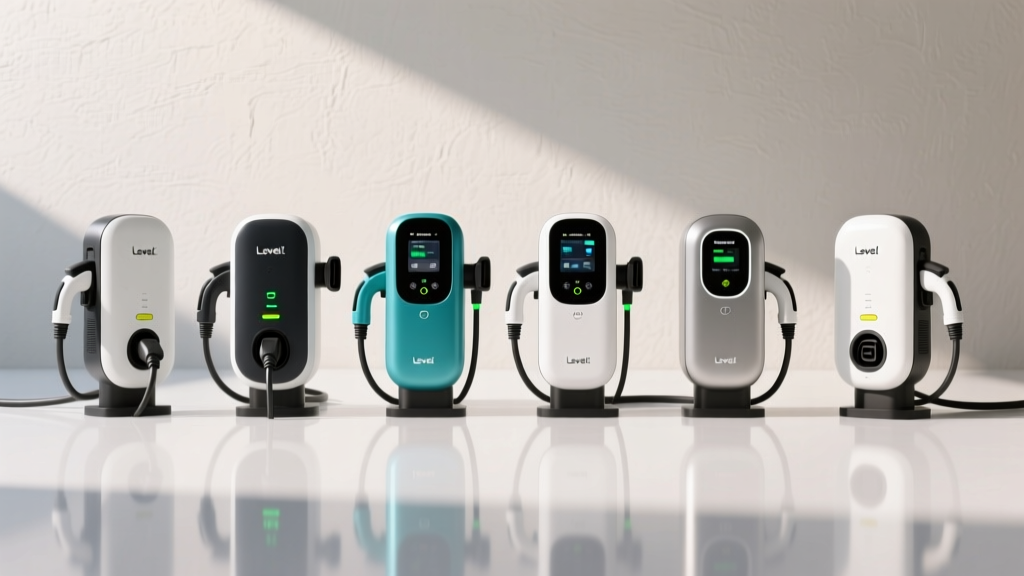
The Lucid Connected Home Charging Station isn't your only option. Here are three high-quality alternatives that support the Air's charging architecture, with a comparison of their key specs:
ChargePro Home 80A
- Power: 19.2 kW / 80A (matches Lucid station)
- Connector: NACS native
- Cable: 25 ft
- Smart features: Wi-Fi, app scheduling, load management, energy dashboard
- Price: ~$900–$1,100
- Best for: Lucid owners wanting 80A at a lower price point
Emporia Vue Smart Charger 48A
- Power: 11.5 kW / 48A
- Connector: J1772 (NACS adapter available)
- Cable: 24 ft
- Smart features: Wi-Fi, solar integration, real-time energy monitoring, automatic load shedding
- Price: ~$400–$550
- Best for: Homes with solar panels or limited panel capacity
Tesla Wall Connector (Gen 3)
- Power: 11.5 kW / 48A
- Connector: NACS native
- Cable: 24 ft
- Smart features: Wi-Fi, OTA updates, power sharing between multiple units, load management
- Price: ~$425–$475
- Best for: Multi-EV households with both Tesla and Lucid (2025+ NACS port)
If your electrical panel can't support a 100A breaker for 80A continuous charging, a 48A unit like the Tesla Wall Connector or Emporia is a practical and significantly cheaper alternative. You'll sacrifice some charging speed — roughly 37 vs. 62 miles of range per hour — but for overnight charging, most Air owners won't notice the difference.
Charging Cost Per Mile: Home vs. Public vs. Gas
One of the strongest ownership arguments for the Lucid Air is fuel cost savings. Here's a breakdown of what you'll actually pay per mile under different scenarios, using the Air Grand Touring's efficiency of approximately 3.6 miles/kWh (130 MPGe combined per fueleconomy.gov):
| Scenario | Cost per kWh | Cost per Mile | Cost for 516-mi Tank |
|---|---|---|---|
| Home (off-peak utility rate) | $0.10–$0.14 | $0.028–$0.039 | $14.45–$20.10 |
| Home (average US rate) | $0.16–$0.18 | $0.044–$0.050 | $22.70–$25.80 |
| Public Level 2 (ChargePoint, etc.) | $0.25–$0.40 | $0.069–$0.111 | $35.60–$57.30 |
| DC Fast Charging (Electrify America, Tesla) | $0.35–$0.55 | $0.097–$0.153 | $50.10–$78.90 |
| Gas car (28 MPG combined, $3.40/gal) | — | $0.121 | $62.50 (equiv.) |
At home off-peak rates, charging a Lucid Air Grand Touring costs roughly 3–4 cents per mile — about one-quarter the cost of a 28 MPG gas car at $3.40/gallon. Even at average residential rates, you're saving 50–70% per mile. The savings shrink at public DC fast chargers, which is why home charging is the economic sweet spot.
Safety, Code, and Electrical Requirements
Installing an 80A EV charger is a significant electrical project. Here's what the National Electrical Code (NEC) and best practices require:
- Dedicated circuit: The charger must be on its own dedicated breaker — no sharing with other appliances.
- Breaker sizing: 80A continuous load requires a 100A breaker per NEC 210.20(A) (125% rule for continuous loads).
- Wire gauge: Typically 3 AWG copper or 1 AWG aluminum for an 80A circuit, though exact gauge depends on run length and local code.
- GFCI protection: NEC 2020 and later requires GFCI protection for EV charging outlets in garages. Hardwired installations may be exempt depending on jurisdiction — your electrician will confirm.
- Outdoor rating: If mounted outside, the unit must carry a NEMA 4 (or better) weather-resistance rating. The Lucid Connected Home Charging Station meets this requirement.
- Permit and inspection: Virtually all jurisdictions require a permit for new 240V circuits. Skipping this risks insurance claim denial if a fire originates from unpermitted work.
Always hire a licensed electrician familiar with EV charger installations. Get at least two quotes, and ask specifically whether they've installed 80A/100A circuits before — many residential electricians primarily work with 40A–50A dryer and range circuits.
Frequently Asked Questions
How much does it cost to install the Lucid Connected Home Charging Station?
Expect $1,350–$4,300 total if your home already has 200A electrical service with sufficient spare capacity. If you need a panel upgrade from 100A to 200A, add $1,500–$4,000. The 80A circuit requirement makes this one of the more demanding residential EV installs — always get a professional load calculation first.
How fast will each charging level add range to my Lucid Air?
Level 1 (120V): about 3–5 miles per hour. Level 2 at 48A (11.5 kW): about 37 miles per hour. Level 2 at 80A (19.2 kW, the Lucid station's output): about 62 miles per hour. DC fast charging: 200–900+ miles per hour at peak, but only for short bursts during the 10–80% window.
Which connector does the Lucid Connected Home Charging Station use?
The latest version uses a native NACS connector. If you have a 2022–2024 Lucid Air with a CCS port, you'll need a CCS-to-NACS adapter for home charging with this unit. Lucid has distributed adapters to many existing owners.
How much does charging cost per mile compared to gas?
At home off-peak rates ($0.10–$0.14/kWh), the Lucid Air costs roughly 3–4 cents per mile. A comparable gas sedan at 28 MPG and $3.40/gallon costs about 12 cents per mile. Home charging saves 65–75% per mile. Public DC fast charging narrows the gap to 10–25% savings.
What electrical upgrades might I need for an 80A charger?
The biggest potential upgrade is your electrical panel. An 80A continuous charger needs a 100A dedicated breaker, which requires significant spare panel capacity. Homes with older 100A or 150A total service will likely need a panel upgrade to 200A ($1,500–$4,000). Homes with modern 200A service and moderate existing loads usually have enough headroom.
Can I use a third-party charger instead of the Lucid Connected Home Charging Station?
Yes. Any Level 2 charger with a compatible connector (NACS for 2025+ models, CCS/J1772 for earlier models) will charge your Air. Third-party 48A chargers cost less and are easier to install but charge slower. If you want the full 19.2 kW speed, you'll need either the Lucid station or a third-party 80A unit like the ChargePro Home 80A.
Does the Lucid Connected Home Charging Station qualify for a tax credit?
The federal Alternative Fuel Vehicle Refueling Property Credit (IRS Form 8911) covers up to 30% of home charger equipment and installation costs, capped at $1,000. Eligibility depends on your census tract meeting certain income or rural criteria. Consult a tax professional to confirm your qualification.