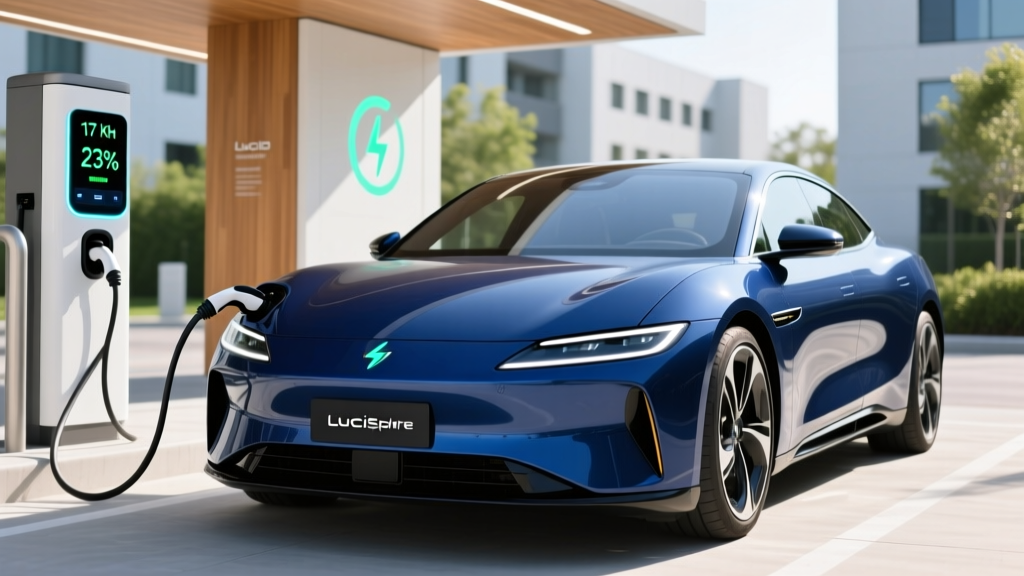
The Lucid Air Sapphire is an engineering marvel. With its tri-motor powertrain producing 1,234 horsepower and a massive 117 kWh battery pack, it delivers an EPA-estimated 427 miles of range. But extracting every mile from that battery — and replenishing it efficiently when depleted — requires understanding the charging ecosystem around a vehicle this capable. This guide breaks down exactly how to charge the Air Sapphire at home and on the road, what it costs, and what equipment you need.
The Lucid Air Sapphire Range: EPA vs. Reality
EPA Range: 427 miles (2025/2026 model year)
Real-World Expectation: 340–380 miles at sustained highway speeds (70–80 mph); 300–340 miles in freezing temperatures with cabin heat. The Sapphire's performance-tuned drivetrain and wider tires sacrifice roughly 10–15% efficiency versus the Air Grand Touring's 516-mile EPA rating.
The Sapphire uses a 117 kWh usable lithium-ion battery pack (NMC chemistry) operating on a 900V+ architecture. This high-voltage platform is the key to its exceptional DC fast-charging capability. Lucid's Wunderbox onboard charger and integrated charge system enable the car to accept peak charge rates up to 300 kW at compatible DC fast chargers, meaning you can recover significant range in short stops.
Efficiency matters when calculating real range. The Sapphire returns approximately 130 MPGe combined (roughly 26 kWh/100 mi) per fueleconomy.gov. Aggressive driving, cold weather, and high speeds push consumption toward 30–35 kWh/100 mi, compressing real-world range accordingly.
| Specification | Value |
|---|---|
| Battery Capacity (Usable) | 117 kWh (NMC) |
| EPA Range | 427 miles |
| Efficiency (Combined) | ~130 MPGe / ~26 kWh/100 mi |
| Max DC Fast Charge Rate | ~300 kW (peak) |
| 10–80% DC Fast Charge Time | ~25 minutes (at 300 kW-capable station) |
| Onboard AC Charger (Level 2) | 19.2 kW (Wunderbox) |
| Charge Port | CCS1 (NACS via adapter) |
| 0–60 mph | 1.89 seconds |
| Horsepower | 1,234 hp |
| Base MSRP | $250,500 (incl. destination) |
| Federal §30D Tax Credit | Not eligible (exceeds $55,000 sedan MSRP cap) |
| Battery Warranty | 8 years / 100,000 miles |
Charging Levels Explained: Speeds That Matter for 117 kWh
Understanding the difference between kW (kilowatts — the rate of power delivery) and kWh (kilowatt-hours — the energy stored in the battery) is essential. A 300 kW charger delivers energy at a rate that could theoretically fill a 1 kWh battery in 1/300th of an hour. The Air Sapphire's 117 kWh battery needs sustained high kW delivery to charge quickly.
| Charging Level | Voltage / Amperage | Max Power (kW) | Miles of Range Added per Hour | Best For |
|---|---|---|---|---|
| Level 1 (120V AC) | 120V / 12A | ~1.4 kW | ~3–4 miles | Emergency top-ups only |
| Level 2 (240V AC) | 240V / 48–80A | 11.5–19.2 kW | ~30–56 miles | Daily home charging |
| DC Fast Charging | 400–900V+ DC | 50–350 kW | ~150–700+ miles (equivalent) | Road trips, rapid replenishment |
Level 1 is essentially useless for a 117 kWh pack. Charging from 10% to 80% (~82 kWh needed) at 1.4 kW would take over 58 hours of continuous plugging. Use it only in emergencies.
Level 2 is where Sapphire owners will do 90%+ of their charging. Lucid's Wunderbox onboard charger accepts up to 19.2 kW on AC power — among the highest in the industry. At 19.2 kW, you add roughly 56 miles of range per hour, and a 10–80% charge completes in about 4.5 hours. Most home chargers deliver 11.5 kW (48A), yielding ~34 miles per hour and a 10–80% time around 7 hours — still easily accomplished overnight.
DC Fast Charging leverages the Sapphire's 900V architecture. At a 350 kW-capable Electrify America or Ionity station, the Sapphire peaks near 300 kW and sustains high rates through roughly 50% SoC before tapering. Expect 10–80% in approximately 25 minutes under ideal conditions. At older 50–150 kW stations, that stretches to 45–80 minutes.
Charge Curve Reality Check
No EV sustains its peak charge rate for the entire session. The Air Sapphire's charge curve holds above 200 kW from roughly 10–45% SoC, then steps down progressively. Charging from 80–100% on DC fast charging is painfully slow — the car protects the battery by throttling to under 30 kW. Plan road-trip stops around 10–80% sessions and top off the last 20% at home on Level 2.
Home Charging Installation: Requirements and Costs
Charging a 117 kWh battery overnight requires a properly sized Level 2 home station. Here's what the electrical infrastructure looks like for a Sapphire-optimized setup.
Electrical Requirements
- Circuit: Dedicated 60A or 100A breaker (240V) for 48A or 80A continuous charging, respectively
- Wire gauge: 4 AWG copper for 60A circuits; 2 AWG for 100A circuits (varies by run length and local code)
- Panel capacity: Minimum 200A main service panel recommended; older homes with 100A or 150A panels will likely need a panel upgrade
- Outlet vs. hardwired: Hardwired installation is preferred for 80A circuits (NEMA 14-50 outlets are rated for 50A max continuous)
Panel Upgrade Warning: If your home has a 100A or 150A service panel — common in homes built before 1990 — adding a 60A or 100A EV circuit may exceed your panel's capacity. A licensed electrician must perform a load calculation. Panel upgrades to 200A typically cost $1,500–$3,500; upgrades to 400A (needed for simultaneous high-draw appliances + 80A EV charging) can reach $3,000–$5,000+.
| Cost Component | Typical Range | Notes |
|---|---|---|
| Level 2 Charger (Equipment) | $400–$1,200 | Depends on brand, amperage, smart features |
| Electrician Labor | $500–$2,500 | Varies by wire run length, wall material, attic/crawlspace access |
| Electrical Permit | $50–$300 | Required in most jurisdictions; inspected post-install |
| Panel Upgrade (if needed) | $1,500–$5,000 | 200A upgrade most common; 400A for heavy-load homes |
| Total (no panel upgrade) | $950–$4,000 | Most homeowners fall in $1,200–$2,200 range |
| Total (with panel upgrade) | $2,450–$9,000 | Higher end includes 400A service + long wire runs |
For the Air Sapphire's 19.2 kW onboard charger capability, an 80A hardwired station (like the ChargePoint Home Flex configured to 80A or the Lucid-recommended Connected Home charging station) extracts the fastest Level 2 speeds. However, a 48A / 11.5 kW setup on a 60A circuit covers overnight charging needs for most owners at significantly lower install cost.
Connector Compatibility: CCS1, NACS, and Adapters
The Lucid Air Sapphire ships with a CCS1 (Combined Charging System) charge port. As of 2026, Lucid provides a NACS adapter enabling access to Tesla's Supercharger network (V3 and V4 stalls), though DC fast-charging speeds through the adapter are capped lower than native CCS1 connections — expect approximately 150–200 kW peak via adapter versus the native 300 kW on compatible CCS stations.
| Connector Standard | Networks / Stations | Air Sapphire Compatibility | Max Charge Rate |
|---|---|---|---|
| CCS1 (Native) | Electrify America, EVgo, ChargePoint DC, Ionity (EU) | ✅ Native port | Up to ~300 kW |
| NACS (Tesla) | Tesla Supercharger V3/V4 | ✅ Via Lucid NACS adapter | ~150–200 kW (adapter-limited) |
| CHAdeMO | Limited legacy stations | ❌ Not compatible (no adapter available) | N/A |
| J1772 (Level 2 AC) | Public Level 2, home chargers | ✅ Via included J1772-to-CCS adapter or direct plug | Up to 19.2 kW |
For home Level 2 charging, any J1772-connector wall unit works natively with the Air's charge port. For DC fast charging on road trips, prioritize Electrify America 350 kW stations for maximum charge speed, and use Tesla Superchargers for network coverage convenience — accepting the speed trade-off.
Charging Cost Per Mile: Home vs. Public vs. Gas
The Sapphire's 117 kWh battery makes charging cost a meaningful ownership variable. Here's what you'll actually pay.
| Charging Scenario | Rate ($/kWh) | Cost for 10–80% (~82 kWh) | Cost per Mile (est.) |
|---|---|---|---|
| Home Off-Peak (utility time-of-use) | $0.08–$0.14 | $6.56–$11.48 | $0.02–$0.03/mi |
| Home Standard Rate | $0.13–$0.20 | $10.66–$16.40 | $0.03–$0.05/mi |
| Public Level 2 (ChargePoint, etc.) | $0.25–$0.49 | $20.50–$40.18 | $0.06–$0.11/mi |
| DC Fast Charging (EA, EVgo) | $0.35–$0.65 | $28.70–$53.30 | $0.08–$0.15/mi |
| Tesla Supercharger | $0.28–$0.48 | $22.96–$39.36 | $0.06–$0.11/mi |
Gas comparison: A performance sedan averaging 18 MPG combined at $3.50/gallon costs roughly $0.19 per mile. Even at the most expensive public DC fast-charging rates, the Air Sapphire undercuts gasoline on a per-mile basis. At home off-peak rates, it costs roughly one-sixth to one-eighth as much per mile as a comparable gas performance sedan.
Over 12,000 miles annually, a Sapphire owner charging primarily at home ($0.04/mi average) spends approximately $480/year on electricity. A gas equivalent at $0.19/mi spends $2,280/year — a $1,800 annual fuel savings.
Recommended Home Charging Equipment
Given the Sapphire's 19.2 kW onboard charger, investing in a high-amperage Level 2 station unlocks its full AC charging potential. Here are top picks for 2026:
ChargePoint Home Flex (80A Config)
- Power Output: Up to 19.2 kW (80A / 240V, hardwired)
- Connector: J1772 (compatible with all EVs)
- Cable Length: 23 feet
- Smart Features: Wi-Fi, app scheduling, utility TOU integration, energy tracking
- Price: ~$699 (unit only)
- Best For: Sapphire owners wanting full 19.2 kW AC speed
Lucid Connected Home Charging Station
- Power Output: Up to 19.2 kW (80A / 240V, hardwired)
- Connector: J1772
- Cable Length: 24 feet
- Smart Features: Lucid app integration, scheduled charging, OTA updates
- Price: ~$1,200 (often included or discounted with vehicle purchase)
- Best For: Seamless Lucid ecosystem integration
Grizzl-E Smart (48A)
- Power Output: Up to 11.5 kW (48A / 240V, NEMA 14-50 or hardwired)
- Connector: J1772
- Cable Length: 24 feet
- Smart Features: Wi-Fi, OCPP compatibility, load sharing
- Price: ~$499
- Best For: Budget-conscious install on a 60A circuit; still adds ~34 mi/hr
Tesla Wall Connector (48A)
- Power Output: Up to 11.5 kW (48A / 240V)
- Connector: NACS (requires CCS-to-NACS adapter for Air Sapphire) or J1772 version
- Cable Length: 24 feet
- Smart Features: Wi-Fi, power sharing with second unit, firmware updates
- Price: ~$475
- Best For: Multi-EV households with both Tesla and Lucid vehicles
Safety, Code, and Installation Best Practices
Charging a 117 kWh battery at high amperage for hours demands correct installation. Key safety considerations per the National Electrical Code (NEC) and typical local requirements:
- Dedicated circuit: Your EV charger must have its own dedicated breaker — no shared circuits with dryers, ovens, or HVAC
- GFCI protection: NEC 2020+ requires GFCI breakers for outdoor receptacles; hardwired installations may be exempt depending on jurisdiction
- Outdoor rating: If your charger is mounted outside or in an unconditioned garage, ensure the unit carries a NEMA 4 (weatherproof) rating — all recommended units above meet this standard
- Wire sizing: Undersized wire causes voltage drop and fire risk. Your electrician must size wire per NEC Table 310.15(B)(16) accounting for ambient temperature and conduit fill
- Permit and inspection: Required in virtually all US jurisdictions. The inspection verifies correct wire gauge, breaker sizing, grounding, and GFCI compliance. Never skip this step — unpermitted work can void homeowner's insurance
- Load management: If your panel is near capacity, consider a smart load-management device (like the Emporia VUE or Span smart panel) that dynamically throttles EV charging when other high-draw appliances activate
Frequently Asked Questions
How much does it cost to install a home EV charger for the Lucid Air Sapphire?
For a 60A circuit with a 48A charger, expect $1,200–$2,200 total (equipment + electrician + permit) in most homes with a modern 200A panel. For an 80A hardwired setup to unlock the Sapphire's full 19.2 kW AC charging, budget $1,800–$3,500. If your home needs a panel upgrade from 100A/150A to 200A, add $1,500–$3,500.
How fast will each charging level add range to the Air Sapphire?
Level 1 (120V): approximately 3–4 miles per hour — impractical for a 117 kWh battery. Level 2 (240V/48A): roughly 34 miles per hour. Level 2 (240V/80A): roughly 56 miles per hour. DC Fast Charging (300 kW peak): up to 200+ miles in 15 minutes at a compatible 350 kW station, though the charge curve tapers significantly above 60% SoC.
Which connector and charger are compatible with the Air Sapphire?
The Sapphire uses a CCS1 charge port natively. For Level 2 home charging, any J1772-connector station works directly. For DC fast charging, CCS1 stations (Electrify America, EVgo) provide maximum charge speed. A Lucid-supplied NACS adapter enables Tesla Supercharger access at reduced peak rates (~150–200 kW). CHAdeMO is not compatible.
How much does charging the Air Sapphire cost per mile versus gas?
At home off-peak rates ($0.10/kWh), the Sapphire costs roughly $0.025 per mile. At public DC fast-charging rates ($0.48/kWh average), it costs about $0.12 per mile. A comparable gas performance sedan at 18 MPG and $3.50/gallon costs $0.19 per mile. Home charging saves approximately $1,800 per year over gas at 12,000 miles driven annually.
What electrical upgrades might I need for a home charger?
Homes with a 200A or larger main panel and available breaker slots typically need no upgrades beyond the dedicated EV circuit. Homes with 100A or 150A panels, or those with no available breaker spaces, may need a panel upgrade ($1,500–$5,000). Homes with long wire runs from the panel to the garage (100+ feet) will see higher material costs due to thicker gauge wire requirements. A licensed electrician's load calculation is the definitive answer — request one before purchasing equipment.
Does the Lucid Air Sapphire qualify for the federal EV tax credit?
No. Under current IRS §30D rules, the federal clean vehicle credit has a $55,000 MSRP cap for sedans. The Air Sapphire's $250,500 base price far exceeds this threshold. Additionally, buyer income caps ($150,000 single / $300,000 joint) apply. State-level incentives may still be available — check your local DMV or energy office for current programs.
Can I charge the Air Sapphire on a regular 120V household outlet?
Technically yes, using the mobile charger that ships with the vehicle. However, at roughly 1.4 kW, you'll add only 3–4 miles of range per hour. Fully charging the 117 kWh battery from empty would take over 80 hours. Level 1 is viable only as an emergency trickle or for vehicles driven under 20 miles per day with overnight access.
For additional details on Lucid Air specifications and efficiency ratings, consult fueleconomy.gov or the official Lucid Motors Air Sapphire page.