You've researched the longest range electric car of 2025 — maybe it's the Lucid Air Grand Touring with its EPA-estimated 516 miles, the Tesla Model S at 402 miles, or the Chevrolet Silverado EV 4WT with 492 miles. But owning a long-range EV is only half the equation. The other half is how you'll keep that massive battery full: what charger to install at home, what it costs, which connector your car needs, and how public DC fast charging actually works when you're on a road trip.
This guide walks through the exact numbers — kilowatts, installation costs, connector standards, and per-mile charging economics — so you can pair your high-range EV purchase with a charging setup that actually makes sense.
Why Long-Range EVs Demand a Smart Charging Strategy
Long-range EVs carry large battery packs — typically 100 kWh to 131 kWh of usable capacity. That's great for highway trips, but it also means Level 1 charging (a standard 120V household outlet) is functionally useless as a primary strategy. Plugging a 131 kWh Lucid Air into a 120V outlet adds roughly 3 to 4 miles of range per hour. Fully replenishing from empty would take over 4 days.
For any EV with more than 300 miles of EPA range, a Level 2 home charger is not optional — it's essential infrastructure. And for road trips, knowing which DC fast-charging networks support your car's connector and peak charge rate determines whether a 400-mile journey takes 5 hours or 8.
Charging Levels Explained: Speeds, Power, and Range Added
Understanding the difference between kW (kilowatts — the rate of power delivery) and kWh (kilowatt-hours — the total energy stored in your battery) is the single most important piece of EV literacy. Think of kW as how fast water flows from a hose, and kWh as the size of the bucket. Your charger's kW rating determines how quickly it fills your battery's kWh capacity.
| Level | Voltage | Power (kW) | Miles of Range Added/Hour | Best For |
|---|---|---|---|---|
| Level 1 | 120V AC | 1.0–1.4 kW | 3–5 mi/hr | Overnight top-up, PHEVs, emergencies |
| Level 2 | 240V AC | 3.3–19.2 kW | 12–75 mi/hr | Daily home charging — the standard |
| DC Fast Charge | 200–900V DC | 50–350 kW | 150–1,200+ mi/hr (peak) | Road trips, highway corridors |
For context, a Tesla Model S (100 kWh battery, 402 mi EPA) charging on a 48-amp Level 2 home charger at 11.5 kW will go from 10% to 80% in roughly 7.5 hours — perfect for overnight replenishment. That same car on a 250 kW Supercharger can hit 10–80% in about 30 minutes, adding roughly 200 miles in 15 minutes at peak rate.
Home Charger Installation: Electrical Requirements and Real Costs
A Level 2 home charger requires a dedicated 240V circuit — the same voltage your electric dryer or oven uses. The most common residential setup is a 60-amp breaker feeding a 48-amp continuous charger (electrical code requires circuits to be rated 125% above continuous load). This delivers up to 11.5 kW of charging power.
If your home's electrical panel is already near capacity — common in homes built before 2000 with 100-amp or 150-amp service — you may need a panel upgrade to 200 amps before adding an EV circuit. This is the single biggest variable in installation cost.
| Item | Typical Cost Range | Notes |
|---|---|---|
| Level 2 Charger (Equipment) | $350–$750 | 40A–48A smart Wi-Fi charger |
| Electrician Labor | $400–$1,500 | Varies by run length, conduit, wall type |
| Permit & Inspection | $50–$250 | Required in most jurisdictions |
| Panel Upgrade (if needed) | $1,500–$4,000 | 100A → 200A service upgrade |
| Total (no panel upgrade) | $800–$2,500 | Most typical scenario |
| Total (with panel upgrade) | $2,300–$6,500 | Older homes with limited capacity |
Always hire a licensed electrician and pull a permit. Unpermitted EV charger installations can void homeowner's insurance claims and create fire hazards. The National Electrical Contractors Association maintains a directory of certified EV charger installers.
Connector Compatibility: NACS, CCS, and CHAdeMO in 2025–2026
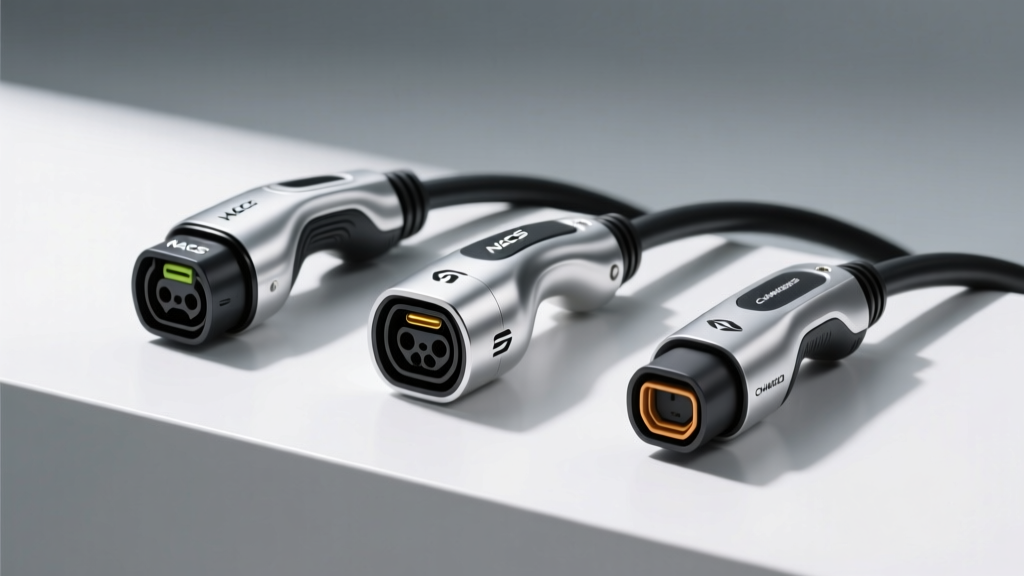
The connector landscape has consolidated significantly. As of the 2025 model year, the Tesla North American Charging Standard (NACS) has become the dominant connector, with Ford, GM, Rivian, Hyundai, Kia, and most major automakers adopting it for new vehicles. CCS1 (Combined Charging System) remains on many 2024–2025 models, and CHAdeMO is effectively legacy (Nissan Leaf only).
| Connector | 2025 Vehicles Using It | Tesla Supercharger Access | Adapter Needed? |
|---|---|---|---|
| NACS (Tesla) | Tesla (all), Ford F-150 Lightning, GM Ultium models, Rivian R1T/R1S (2025+), Hyundai Ioniq 5/6 (2025+) | Native access | None for Tesla Superchargers |
| CCS1 | VW ID.4, BMW iX, some 2024 carryover models, Porsche Taycan | Via NACS adapter (provided by many OEMs) | CCS-to-NACS adapter (~$200–$250) |
| CHAdeMO | Nissan Leaf (legacy) | No | Limited adapter options |
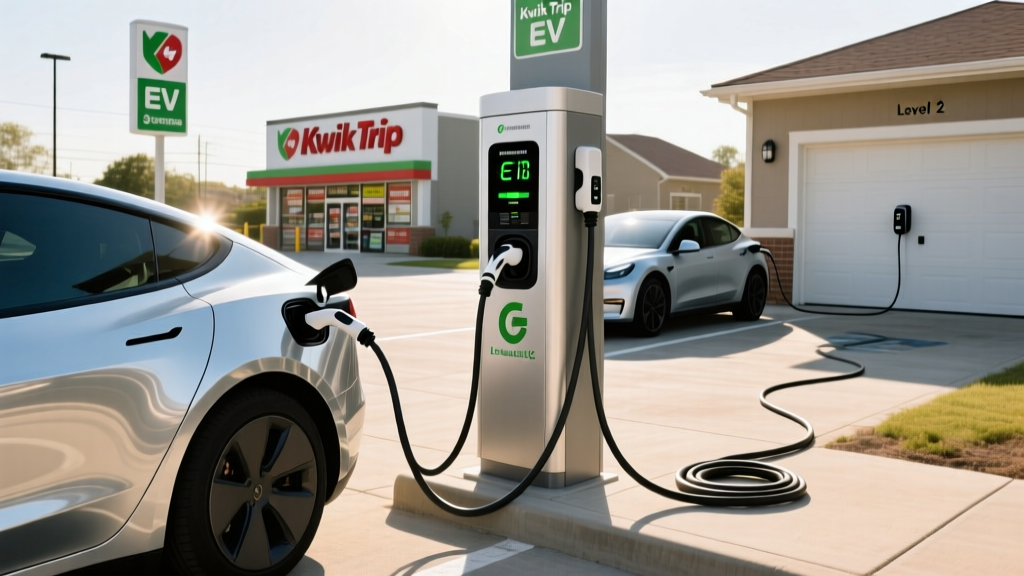
For home Level 2 charging, virtually all non-Tesla chargers use a J1772 connector, and all EVs (including Teslas) come with a J1772 adapter or native inlet. Tesla's Wall Connector includes both NACS and J1772 connectors in its latest version.
Equipment Recommendations: Best Home Chargers for Long-Range EVs
With a large battery (100+ kWh), you want at minimum a 48-amp charger on a 60-amp circuit to achieve ~11.5 kW. Here are three proven options:
Tesla Wall Connector
Power: Up to 11.5 kW (48A)
Connector: NACS (native) + J1772 adapter included
Cable: 24 ft
Smart Features: Wi-Fi, OTA updates, load sharing between units, access control
Price: ~$475
Best for: Tesla owners and NACS-equipped 2025 EVs
ChargePoint Home Flex
Power: Up to 12 kW (50A, configurable 16A–50A)
Connector: J1772 (NACS adapter available separately)
Cable: 23 ft
Smart Features: Wi-Fi, app scheduling, Alexa integration, ENERGY STAR certified
Price: ~$550–$650
Best for: CCS/J1772 vehicles, flexible amperage for older panels
Emporia Vue Level 2
Power: Up to 11.5 kW (48A)
Connector: J1772
Cable: 24 ft
Smart Features: Wi-Fi, energy monitoring, solar integration, scheduling
Price: ~$350–$400
Best for: Budget-conscious buyers with solar panels
Cost to Charge: Home vs. Public vs. Gas — Per-Mile Economics
Long-range EVs shine economically when charged at home on off-peak electricity rates. Here's how the numbers compare across charging scenarios for a typical 400-mile-range EV with 3.0 miles per kWh efficiency (roughly 112 MPGe):
| Scenario | Rate | Cost per kWh | Cost per Mile | Full "Tank" (400 mi) |
|---|---|---|---|---|
| Home (off-peak TOU) | Residential TOU | $0.08–$0.14 | $0.027–$0.047 | $11–$19 |
| Home (standard rate) | Flat residential | $0.15–$0.20 | $0.050–$0.067 | $20–$27 |
| Public Level 2 | Network pricing | $0.25–$0.49 | $0.083–$0.163 | $33–$65 |
| DC Fast Charging | EA / EVgo / Supercharger | $0.32–$0.56 | $0.107–$0.187 | $43–$75 |
| Gasoline (25 MPG avg) | $3.40/gal | — | $0.136 | $54 |
The takeaway: home-charged electricity at off-peak rates costs roughly one-quarter to one-third of gasoline per mile. Even DC fast charging is cost-competitive with gas on a per-mile basis, though it's more expensive than home charging by a factor of 3–4x. For owners of the longest range electric cars of 2025, the ability to charge at home overnight means most daily driving costs $0.03–$0.05 per mile.
Charging Times for Long-Range EV Batteries: What to Expect
Large batteries take longer to charge, but peak DC fast-charge rates have scaled up to match. Note that charging speed is not linear — batteries charge fastest between 10–50% State of Charge (SoC), then taper significantly above 80% to protect battery health. The "10–80%" metric is the industry standard because charging past 80% can double total session time.
Charging Time Examples: 10% to 80% SoC
- Lucid Air Grand Touring (131 kWh battery): ~25 min on a 300 kW DC charger (peak 250+ kW); ~12 hrs on 11.5 kW Level 2
- Tesla Model S Long Range (100 kWh battery): ~25 min on a 250 kW Supercharger; ~9 hrs on 11.5 kW Level 2
- Chevrolet Silverado EV 4WT (200+ kWh battery): ~40 min on a 350 kW DC charger (peak ~350 kW); ~18+ hrs on 11.5 kW Level 2
- Hyundai Ioniq 5 N (84 kWh battery): ~18 min on a 350 kW charger (800V architecture, peak ~240 kW); ~7.5 hrs on 11.5 kW Level 2
Safety, Electrical Code, and Installation Best Practices
EV charging is a continuous high-draw load — your charger may run at full power for 8+ hours straight. This demands proper installation:
- Dedicated circuit: Your EV charger must have its own breaker — never share a circuit with other appliances.
- GFCI protection: The 2020 NEC requires GFCI protection for outdoor receptacles; hardwired chargers may not require a GFCI breaker (check local code), but many electricians include one for safety.
- Outdoor rating: If mounting outside, ensure the charger carries a NEMA 4 or NEMA 4X rating for weather resistance.
- Cable management: A 24-foot cable draped across a driveway is a trip hazard and code violation in some areas. Consider a cable retractor or mount the charger close to your parking spot.
- Smart load management: If your panel is tight on capacity, chargers like the Emporia Vue or Tesla Wall Connector support software-based load limiting — you can set a lower amperage (e.g., 32A instead of 48A) without replacing the breaker.
For more on electrical safety standards, the National Fire Protection Association's NEC guidelines govern EV charger installation requirements in the United States.
Frequently Asked Questions
How much does it cost to install a home EV charger?
A typical Level 2 home charger installation costs $800–$2,500 including equipment ($350–$750), electrician labor ($400–$1,500), and permits ($50–$250). If your home needs a panel upgrade from 100A to 200A service, add $1,500–$4,000. Most homes built after 2000 with 200A panels won't need an upgrade.
How fast will each charging level add range?
Level 1 (120V) adds 3–5 miles per hour — impractical for long-range EVs. Level 2 (240V, 48A) adds 30–40 miles per hour, sufficient to fully replenish most EVs overnight. DC fast charging adds 150–1,200+ miles per hour at peak, though sessions typically last 20–40 minutes (10–80% SoC) due to taper above 80%.
Which connector/charger is compatible with my EV?
Check your vehicle's charge port. 2025 Teslas, Fords, GMs, Rivians, and Hyundais use NACS. Many 2024 carryover models (VW, BMW, Porsche) still use CCS1. For home Level 2, all EVs accept J1772 (Teslas via included adapter). If your car has CCS1 and you want Tesla Supercharger access, you'll need a CCS-to-NACS adapter (~$200–$250), often provided free by the automaker.
How much does charging cost per mile vs gas?
Home charging at off-peak rates costs $0.03–$0.05 per mile — roughly one-quarter the cost of gasoline at $3.40/gal in a 25 MPG vehicle ($0.136/mile). Public DC fast charging ranges $0.11–$0.19 per mile, still competitive with gas. The U.S. Department of Energy's fueleconomy.gov provides a ZIP-code-based electricity cost calculator for precise local estimates.
What electrical upgrades might I need?
The most common upgrade is a panel capacity increase from 100A or 150A to 200A service ($1,500–$4,000). You may also need a new conduit run if your parking spot is far from the panel, or a sub-panel if your main panel is full. Some utilities offer rebates or time-of-use (TOU) rate plans specifically for EV owners — check with your provider before installation.
Can I charge a 2025 long-range EV on a standard outlet?
Technically yes, but practically no. A 120V Level 1 outlet delivers ~1.4 kW, adding about 4 miles of range per hour. Fully charging a 131 kWh Lucid Air from empty would take over 90 hours. Level 1 is acceptable only as an emergency backup or for PHEVs with small batteries under 20 kWh.