If you're shopping for the longest electric car range in 2026, you're looking at batteries pushing 100 kWh or more — the Lucid Air Grand Touring (516 miles EPA, ~118 kWh usable), Chevrolet Silverado EV 4WT (460 miles, ~200 kWh), and Tesla Model S Long Range (402 miles, ~100 kWh). But a massive battery only solves half the equation. Without the right charging infrastructure, a 120+ kWh pack becomes a liability: Level 1 trickle charging can take over 100 hours from empty, and undersized Level 2 equipment leaves you waiting overnight and still waking up short.
This guide breaks down exactly what charging hardware, electrical upgrades, and connectors you need to support long-range EVs — with real numbers for install costs, charge times, and cost per mile.
Charging Levels Explained: How Fast Each Adds Range
Understanding charging speed starts with a critical distinction: kW (kilowatts) measures power — the rate at which energy flows into your car. kWh (kilowatt-hours) measures energy — the total capacity of your battery. A 100 kWh battery charged at 10 kW takes roughly 10 hours. At 1 kW, it takes 100 hours. For long-range EVs with large packs, this math dictates your entire charging strategy.
| Level | Voltage | Power (kW) | Miles of Range Per Hour | Best For |
|---|---|---|---|---|
| Level 1 | 120V | 1.0–1.4 kW | 3–5 mi/hr | Emergency top-up, PHEVs |
| Level 2 (24A) | 240V | 5.8 kW | 17–23 mi/hr | Minimum viable for large packs |
| Level 2 (48A) | 240V | 11.5 kW | 34–46 mi/hr | Recommended for 100+ kWh EVs |
| DC Fast (150 kW) | 400V+ | 150 kW peak | ~500+ mi/hr (peak) | Road trips, quick stops |
| DC Fast (350 kW) | 800V | 350 kW peak | ~1,000+ mi/hr (peak) | Lucid Air, 800V-architecture EVs |
10–80% Charging Times for Long-Range EV Batteries
Long-range EVs carry big batteries, and that directly impacts how long you're tethered to a charger. Here's what to expect for 2026's range leaders across common charging scenarios:
| Vehicle | Usable Battery | 48A Level 2 (11.5 kW) | 150 kW DCFC | 350 kW DCFC |
|---|---|---|---|---|
| Lucid Air Grand Touring | 118 kWh | ~7.2 hours | ~48 min | ~22 min (peak 300 kW) |
| Chevy Silverado EV 4WT | ~200 kWh | ~12.2 hours | ~75 min | ~40 min (800V arch.) |
| Tesla Model S LR | ~100 kWh | ~6.1 hours | ~40 min | N/A (400V arch.) |
| Rivian R1T Max Pack | ~149 kWh | ~9.1 hours | ~58 min | ~35 min |
| Mercedes EQS 450+ | ~108 kWh | ~6.6 hours | ~44 min | ~31 min (200 kW peak) |
The takeaway: if you buy a 200 kWh Silverado EV, a 48A Level 2 home charger is mandatory for overnight charging. A 24A unit won't refill the pack in a single night even with 12 hours plugged in. And for road trips, prioritize 350 kW-capable stations (Electrify America, select Tesla Superchargers with Magic Dock) to keep stops under 30 minutes.
Home Charger Installation: Electrical Requirements and Costs
Installing a Level 2 home charger for a long-range EV isn't just plugging into a dryer outlet. Here's what the electrical work actually involves — and what it costs.
Electrical Requirements for 48A Charging
A 48A Level 2 charger requires a dedicated 60-amp circuit on a 240V line (the National Electrical Code requires circuits be rated 125% above continuous load, so 48A × 1.25 = 60A minimum). The wiring is typically 6 AWG copper, and the breaker is a 2-pole 60A in your main panel.
Your electrical panel must have both the physical space (two adjacent breaker slots) and the amperage headroom. A 200A service panel running near capacity may need an upgrade to 300A or 400A — common in older homes built before EV-era electrical loads.
Installation Cost Breakdown
| Component | Low End | Typical | High End |
|---|---|---|---|
| Level 2 Charger (48A, hardwired) | $450 | $600 | $800 |
| Electrician labor (standard run, <30 ft) | $500 | $900 | $1,500 |
| Permit and inspection | $50 | $150 | $400 |
| Panel upgrade (if needed, 200A→300A) | $1,500 | $2,500 | $4,500 |
| Conduit/wiring (long runs, >50 ft) | $200 | $500 | $1,200 |
| Total (no panel upgrade) | $1,200 | $2,150 | $3,900 |
| Total (with panel upgrade) | $2,700 | $4,650 | $8,400 |
According to data compiled by the U.S. Department of Energy, most homeowners spend between $1,000 and $2,500 for a standard Level 2 install without a panel upgrade. If your home was built before 2000 and still has a 100A or 150A service, budget for the upgrade — it's the single biggest variable.
Do You Need a Panel Upgrade?
A licensed electrician will perform a load calculation (NEC Article 220) to determine whether your existing panel can handle a 60A EV circuit. Common scenarios that trigger an upgrade:
- Your panel is 100A or 150A total service
- You already have high-draw appliances (electric range, dryer, HVAC, hot tub) consuming most of your panel's capacity
- Your panel has no adjacent open slots for a 2-pole breaker
- You're adding solar, a heat pump, or battery storage simultaneously
Some utility companies offer rebates of $200–$500 toward panel upgrades when paired with EV charger installations. Check with your local utility before proceeding.
Connector Compatibility: NACS, CCS1, and CHAdeMO
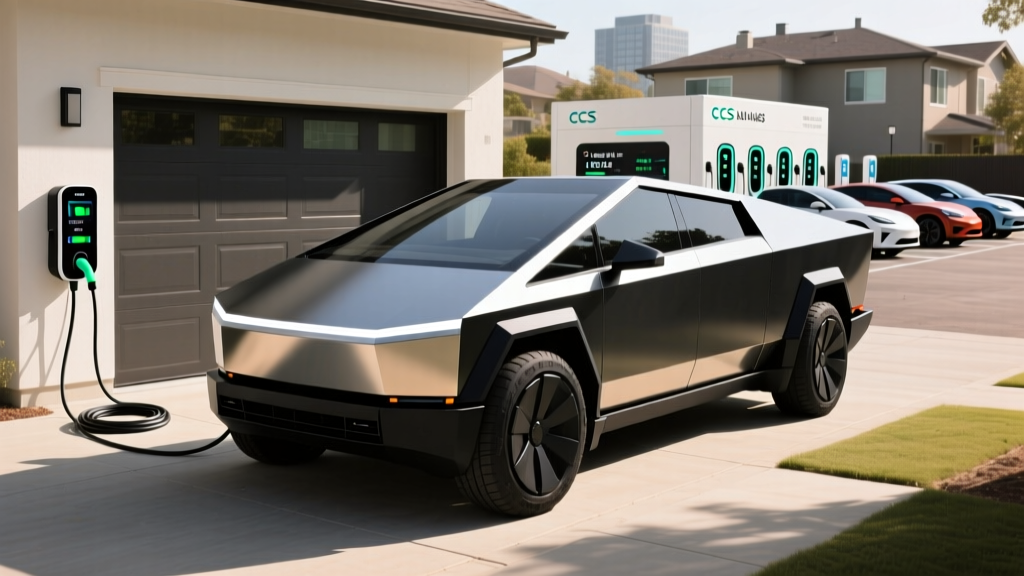
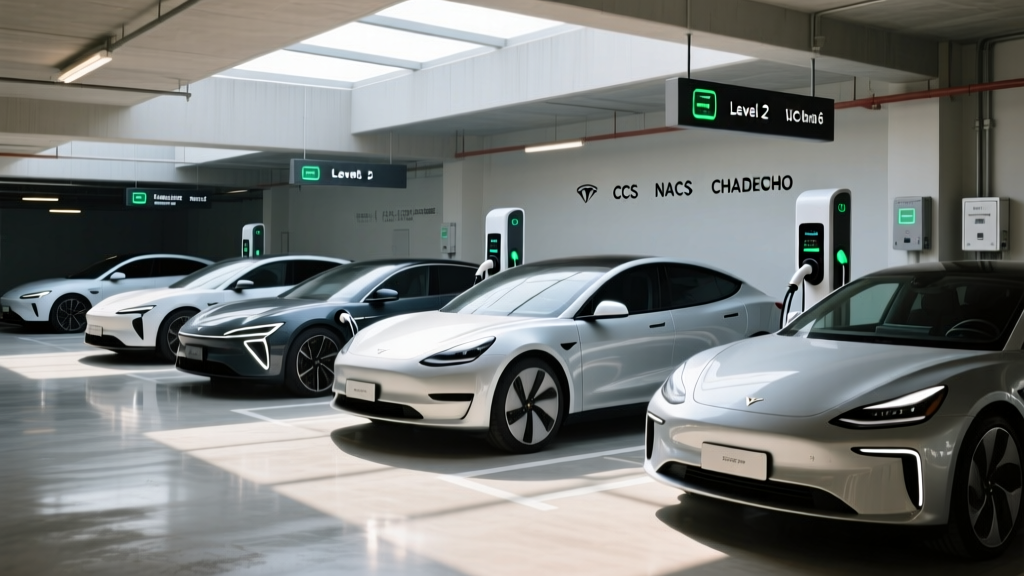
The connector landscape in 2026 has largely consolidated around NACS (North American Charging Standard), originally developed by Tesla and now adopted by nearly every major automaker. But if you own a long-range EV purchased in 2024 or earlier, you may still have CCS1 or CHAdeMO. Here's what fits what:
| Connector | Brands Using It (2026) | DC Fast Charge Availability |
|---|---|---|
| NACS (native) | Tesla, Ford, GM, Rivian, Volvo, Polestar, Mercedes, BMW, Hyundai, Kia, Lucid | Tesla Supercharger network + NACS-equipped public stations |
| CCS1 | Older VW ID.4, Audi e-tron (pre-2025), some Stellantis models | Electrify America, EVgo, ChargePoint (declining availability) |
| CHAdeMO | Nissan Ariah (legacy), Mitsubishi (discontinued in US) | Very limited; adapters available |
Adapter needs: If you drive a CCS1-equipped EV (e.g., a 2024 VW ID.4), you'll need a CCS1-to-NACS adapter (~$150–$200) to access Tesla Superchargers, which now represent the largest and most reliable DC fast-charging network in North America. Tesla offers a CCS adapter for non-Tesla vehicles, and third-party options from Lectron and A2Z are widely available. NACS-native vehicles need no adapter for Tesla stations.
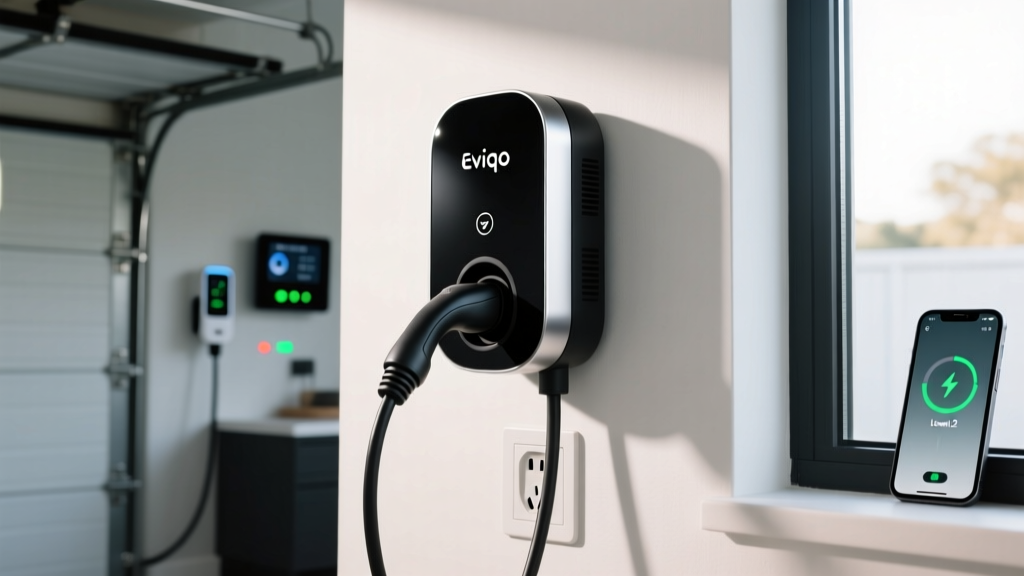
For home Level 2 charging, all modern chargers ship with either a J1772 connector (universal standard for Level 2) or a NACS connector. Most NACS-equipped EVs accept J1772 via a compact adapter included with the vehicle.
Recommended Home Chargers for Long-Range EVs
For EVs with 100+ kWh batteries, a 48A hardwired charger is the minimum practical setup. Here are top-rated 2026 options based on power output, build quality, smart features, and real-world reliability:
ChargePoint Home Flex (NACS)
- Power: Up to 48A / 11.5 kW (240V)
- Connector: NACS (also available in J1772)
- Cable length: 23 ft
- Smart features: Wi-Fi, scheduling, energy dashboard, Alexa
- Price: ~$650
- Best for: Tesla, Ford, GM, Rivian owners wanting app control
Wall Connector (Tesla, 3rd Gen)
- Power: Up to 48A / 11.5 kW (240V)
- Connector: NACS native
- Cable length: 24 ft
- Smart features: Wi-Fi, OTA updates, power sharing (multiple units)
- Price: ~$475
- Best for: Tesla owners; best value in 48A chargers
Emporia Vue Level 2 Charger
- Power: Up to 48A / 11.5 kW (240V)
- Connector: J1772 (NACS adapter included)
- Cable length: 24 ft
- Smart features: Energy monitoring, solar integration, scheduling
- Price: ~$400
- Best for: Budget-conscious buyers with solar panels
Grizzl-E Smart (United Chargers)
- Power: Up to 40A / 9.6 kW (240V)
- Connector: J1772 or NACS
- Cable length: 24 ft
- Smart features: Wi-Fi, OCPP support, adjustable amperage
- Price: ~$550
- Best for: Cold-climate durability (rated to -40°F), outdoor installs
For a Lucid Air or Silverado EV, prioritize the ChargePoint Home Flex or Tesla Wall Connector at full 48A. The Grizzl-E maxes out at 40A (9.6 kW), adding roughly 20% more charging time — a meaningful difference when refilling a 150–200 kWh pack.
Charging Cost Per Mile: EV vs. Gasoline
Long-range EVs are heavy and carry big batteries, but their per-mile energy cost still undercuts gasoline in almost every scenario. Here's how costs break down across common charging situations, using the Lucid Air Grand Touring (EPA combined: 130 MPGe, ~3.0 miles/kWh) as a representative long-range vehicle:
| Scenario | Rate ($/kWh) | Cost Per Mile | Cost for 400 Miles |
|---|---|---|---|
| Home Level 2 (off-peak TOU rate) | $0.08–$0.12 | $0.03–$0.04 | $12–$16 |
| Home Level 2 (standard rate) | $0.15–$0.20 | $0.05–$0.07 | $20–$28 |
| Public Level 2 (ChargePoint, EVgo) | $0.25–$0.40 | $0.08–$0.13 | $32–$52 |
| DC Fast (Tesla Supercharger) | $0.28–$0.36 | $0.09–$0.12 | $36–$48 |
| DC Fast (Electrify America) | $0.35–$0.55 | $0.12–$0.18 | $48–$72 |
| Gasoline equivalent (25 MPG, $3.40/gal) | — | $0.14 | $56 |
The economics are clearest when you charge at home on a time-of-use plan. A full 0–100% charge on the Lucid Air's 118 kWh battery costs roughly $9–$14 off-peak — for 516 miles of EPA-rated range. That same distance in a 25 MPG gas car at $3.40/gallon costs $70. Even public DC fast charging is competitive with gasoline on a per-mile basis in most states.
According to fueleconomy.gov, the Lucid Air Grand Touring achieves a combined 130 MPGe, making it one of the most efficient long-range EVs available — which amplifies the cost advantage at every charging tier.
Safety, Code, and Outdoor Installation Considerations
EV chargers draw sustained high current for hours — a fundamentally different load profile than most household appliances. The National Electrical Code (NEC) addresses this with specific requirements:
- Dedicated circuit: Your EV charger must have its own breaker — no sharing with other outlets or appliances.
- GFCI protection: NEC 2023 (and adopted 2026 codes in most jurisdictions) requires GFCI protection for all outdoor receptacles. Hardwired chargers may be exempt in some jurisdictions, but GFCI breakers are recommended regardless.
- Outdoor rating: If your charger is mounted outside or in an unconditioned garage, it must carry a NEMA 4 or NEMA 4X rating (weatherproof, UV-resistant). All chargers listed above meet this standard.
- Cable management: The NEC prohibits charging cables from running across walkways or driveways where they create a trip hazard. Wall-mounted retractors or cord reels solve this.
- Load management: Some smart chargers (ChargePoint, Emporia) offer dynamic load balancing — they monitor your home's total electrical draw and reduce charging speed if other appliances spike, preventing breaker trips without a panel upgrade.
Always pull a permit for EV charger installation. Unpermitted work can void your homeowner's insurance in the event of an electrical fire and may cause issues during a home sale inspection.
Frequently Asked Questions
How much does it cost to install a home EV charger for a long-range EV?
For a 48A hardwired Level 2 charger on an existing 200A panel, expect $1,200–$2,500 total (charger + electrician + permit). If your panel needs upgrading to 300A or 400A, add $1,500–$4,500. The total range is $1,200 to $7,000 depending on your home's electrical infrastructure.
How fast will each charging level add range to a 100+ kWh EV?
Level 1 (120V) adds 3–5 miles per hour — essentially unusable for large packs. Level 2 at 48A (240V) adds 34–46 miles per hour, fully replenishing a 100 kWh battery in about 6–7 hours. DC fast charging at 150–350 kW adds hundreds of miles per hour at peak, but tapers significantly above 80% SoC.
Which connector and charger is compatible with my long-range EV?
For 2026 models, nearly all new EVs use NACS natively — including Tesla, Ford, GM, Rivian, Hyundai, Kia, BMW, Mercedes, and Lucid. Older models (pre-2025) may use CCS1; adapters are available for ~$150–$200 to access Tesla Superchargers. For home Level 2, all EVs accept J1772 or NACS connectors.
How much does charging cost per mile compared to gas?
Home charging on an off-peak rate ($0.10/kWh) costs $0.03–$0.04 per mile in a long-range EV like the Lucid Air — roughly 75% less than a 25 MPG gas car at $3.40/gallon ($0.14/mile). Even public DC fast charging at $0.35/kWh costs $0.12/mile, still below gasoline.
What electrical upgrades might I need for a 48A home charger?
A 48A charger requires a dedicated 60A, 240V circuit. If your panel is 100A or 150A, or if existing loads consume most of your panel's capacity, you'll need a service upgrade to 200A, 300A, or 400A. Your electrician will perform an NEC Article 220 load calculation to determine this. Budget $1,500–$4,500 for a panel upgrade if required.
Can I use a smart charger to avoid a panel upgrade?
Yes, in some cases. Chargers with dynamic load management (Emporia Vue, ChargePoint Home Flex with load-sharing) can monitor your panel's real-time draw and reduce charging amperage when other appliances are running. This lets you install a 48A charger on a panel that would otherwise fail the load calculation — though peak charging speed will be reduced during high-demand periods.
Do long-range EVs qualify for the federal tax credit to offset charging costs?
The IRS §30D Clean Vehicle Credit provides up to $7,500 for qualifying new EVs and up to $1,000 for home charger installation (Alternative Fuel Vehicle Refueling Property Credit, §30C). Eligibility depends on MSRP caps ($55,000 for sedans, $80,000 for trucks/SUVs), buyer income limits ($150K single / $300K joint), and battery critical-mineral sourcing requirements. The Lucid Air Grand Touring exceeds the MSRP cap; the Silverado EV and Model S may qualify depending on trim and buyer income. Consult a tax professional and verify current-year rules at irs.gov.