Quick Verdict: Who the Eviqo Level 2 Charger Actually Fits
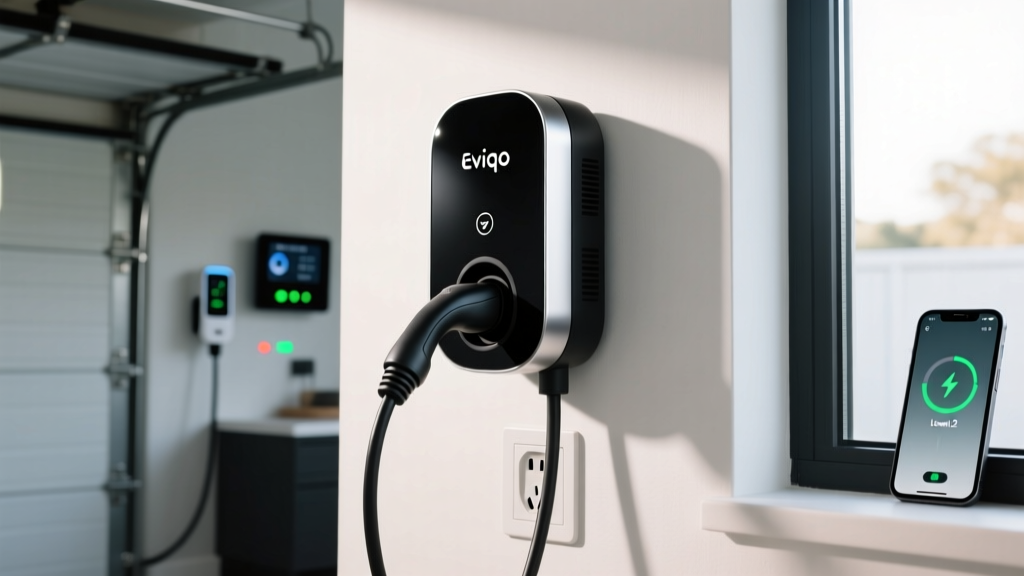
The Eviqo Level 2 charger targets EV owners who want a no-frills, hardwired 48-amp wall unit at a sub-$400 price point. It delivers up to 11.5 kW on a 240V/60A dedicated circuit — enough to replenish most EV batteries overnight. It lacks Wi-Fi, app scheduling, and load-sharing, which makes it a pure "plug in and charge" device. For drivers who don't need smart features and want maximum charging speed per dollar, it's a strong pick. For those who want utility-rate optimization, remote monitoring, or multi-charger load balancing, look elsewhere.
| Spec | Value |
|---|---|
| Max Output Current | 48 amps |
| Max Power Output | 11.5 kW (at 240V) |
| Required Circuit | 60A dedicated breaker (240V) |
| Connector Options | J1772 (standard), NACS (Tesla-native variant) |
| Cable Length | 25 feet |
| Installation Type | Hardwired only (no NEMA plug) |
| Wi-Fi / App | None |
| Energy Metering | None (requires external panel meter or EV telematics) |
| Outdoor Rating | NEMA 4 (rain/splash rated) |
| Warranty | 3 years |
| Typical Price (2026) | $349–$399 MSRP |
| UL Listed | Yes (UL 2594) |
Charging Levels Explained: Where Level 2 Fits
Before sizing a home charger, it helps to understand the three charging tiers. The distinction between kW (power — how fast energy flows) and kWh (energy — how much the battery holds) matters here. A 48A charger delivering 11.5 kW adds energy to a 75 kWh battery at a predictable rate: roughly 15% of that battery per hour under ideal conditions.
| Level | Voltage | Typical kW | Miles of Range per Hour | Best Use |
|---|---|---|---|---|
| Level 1 (120V outlet) | 120V / 12A | ~1.4 kW | 3–5 mi/hr | Overnight top-ups, PHEVs, emergencies |
| Level 2 (240V home) | 240V / 16–48A | 3.8–11.5 kW | 14–46 mi/hr | Daily home charging, full BEV replenishment |
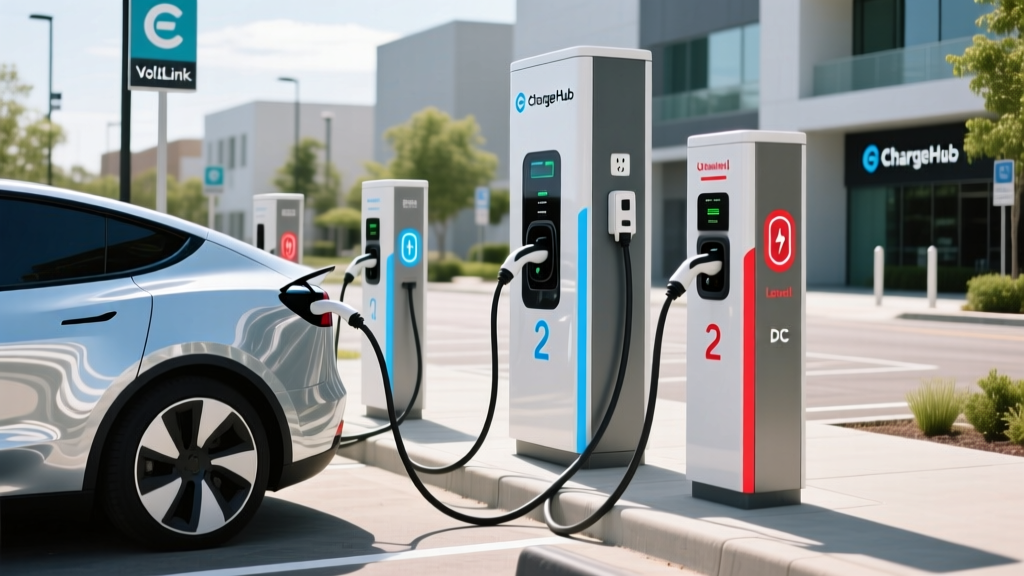
| DC Fast Charging | 400–800V DC | 50–350 kW | 150–1,000+ mi/hr (peak) | Road trips, rapid top-ups (10–80% in 18–40 min) |
At 11.5 kW, the Eviqo adds roughly 37–46 miles of range per hour for efficient sedans (like the Hyundai Ioniq 6 or Tesla Model 3) and 25–32 miles per hour for heavier SUVs and trucks (Rivian R1S, Ford F-150 Lightning). A full overnight session — say, 10 hours — can replenish 300–400 miles in an efficient BEV, far more than most daily commutes require.
Home Installation: Electrical Requirements, Panel Upgrades & Real Costs
The Eviqo is hardwired-only, meaning a licensed electrician must terminate it directly into a 60A, 240V double-pole breaker. This is a deliberate design choice: hardwired connections allow the full 48A continuous draw that the National Electrical Code (NEC) permits on a 60A circuit (continuous loads are capped at 80% of breaker rating, so 60A × 0.80 = 48A). A NEMA 14-50 plug-in setup, by contrast, is typically limited to 40A continuous on a 50A breaker, capping you at 9.6 kW.
What Your Electrical Panel Needs to Support It
- Panel capacity: Most modern 200A service panels can accommodate a 60A breaker. Older 100A panels, common in homes built before 1980, often cannot — adding 60A may exceed the panel's rated bus bar capacity.
- Available breaker spaces: You need two adjacent slots for a double-pole 60A breaker.
- Load calculation: Per NEC Article 220, your electrician must perform a load calculation to confirm the panel isn't already near capacity with existing appliances (HVAC, electric range, dryer, water heater).
- Wire gauge: A 60A circuit requires 6 AWG copper (THHN in conduit) or 4 AWG aluminum. Longer runs (over 100 feet from panel to charger) may require upsizing to 4 AWG copper to limit voltage drop below 3%.
Panel Upgrade: The Cost Many Buyers Miss
If your home has a 100A panel, or your 200A panel is already heavily loaded, you may need a panel upgrade or a service upgrade to 200A or even 400A. This is the single biggest variable in home EV charger installation cost.
| Line Item | Low Estimate | High Estimate | Notes |
|---|---|---|---|
| Eviqo charger unit | $349 | $399 | Depends on connector variant and retailer |
| Electrician labor (short run, <30 ft) | $400 | $800 | Conduit, wire, breaker, termination |
| Electrician labor (long run, 30–80 ft) | $800 | $1,600 | More conduit, possible trenching for detached garage |
| Electrical permit | $50 | $200 | Varies by municipality; some bundle with inspection |
| Panel upgrade (100A → 200A) | $1,500 | $3,500 | Only if needed; includes new panel + utility coordination |
| Service upgrade (200A → 400A) | $3,000 | $7,000 | Rare; needed for very large homes with multiple high-draw circuits |
| Total (no panel upgrade) | $800 | $2,200 | Most common scenario for modern homes |
| Total (with 200A panel upgrade) | $2,300 | $5,500 | Older homes or heavily loaded panels |
Before committing, get at least two quotes from licensed electricians who specify the run length, wire gauge, and whether a load calculation shows adequate capacity. Some utilities and states offer rebates of $250–$1,000 for Level 2 installations — check with your local utility or the Alternative Fuels Data Center for current programs.
Connector Compatibility: NACS, CCS1 & CHAdeMO
The Eviqo ships in two connector variants: J1772 (the standard North American connector used by most non-Tesla EVs through model year 2024) and NACS (the Tesla-originated connector that Ford, GM, Rivian, Hyundai, Kia, and most other automakers have adopted for 2025+ models).
| Connector on Eviqo | Compatible EVs | Adapter Needed? |
|---|---|---|
| J1772 variant | 2024 and older non-Tesla EVs (Hyundai, Kia, VW, BMW, etc.) | None for J1772-port EVs. J1772-to-NACS adapter (~$150–$200) for 2025+ NACS-port EVs. |
| NACS variant | All Tesla vehicles; 2025+ Ford, GM, Rivian, Hyundai, Kia NACS-port EVs | None for NACS-port EVs. NACS-to-J1772 adapter (~$150–$200) for older J1772-port EVs. |
Which variant should you buy? If your current EV has a J1772 port and you plan to keep it for several years, buy the J1772 variant. If you're buying a 2025+ model-year EV (which almost certainly has NACS), buy the NACS variant. If you own both a Tesla and an older non-Tesla EV, buy the NACS variant and use a NACS-to-J1772 adapter for the older car — adapters from Lectron and A2Z are widely available and UL-listed.
Note: CHAdeMO is a DC fast-charging connector used by the Nissan Leaf and Mitsubishi Outlander PHEV. No Level 2 home charger uses CHAdeMO — these vehicles charge at home via their J1772 AC port.
Charging Time Examples: What 11.5 kW Delivers
The Eviqo's 48A/11.5 kW output is near the maximum most residential electrical systems can support without a panel upgrade. Here's how that translates to real charging times for popular 2025–2026 EVs, calculated from 10% to 80% state of charge (the practical daily charging window — charging above 80% slows significantly due to cell-balancing and thermal management).
| Vehicle | Usable Battery (kWh) | Energy for 10–80% (kWh) | Estimated Time |
|---|---|---|---|
| Tesla Model 3 Long Range | 75 kWh | 52.5 kWh | ~4.6 hours |
| Hyundai Ioniq 5 (Long Range) | 77.4 kWh | 54.2 kWh | ~4.7 hours |
| Ford Mustang Mach-E (Extended Range) | 91 kWh | 63.7 kWh | ~5.5 hours |
| Chevrolet Equinox EV | 85 kWh | 59.5 kWh | ~5.2 hours |
| Rivian R1T (Max Pack) | 141 kWh | 98.7 kWh | ~8.6 hours |
| Ford F-150 Lightning (Extended Range) | 131 kWh | 91.7 kWh | ~8.0 hours |
| Toyota bZ4X | 64 kWh | 44.8 kWh | ~3.9 hours |
For most commuters driving 30–50 miles per day, a 10-hour overnight session on the Eviqo adds 250–400 miles — more than enough to start each morning with a full battery. The 11.5 kW rate also means large-battery trucks and SUVs can go from near-empty to 80% in a single overnight sleep, which is the practical advantage over lower-power 32A (7.7 kW) chargers.
Cost to Charge: Home vs. Public vs. Gas per Mile
Electricity prices vary enormously by utility, time of day, and state. The Eviqo has no built-in energy meter, so you'll track charging costs through your utility bill or your vehicle's telematics app (most EVs report kWh consumed per session).
| Scenario | Rate ($/kWh) | Vehicle Efficiency | Cost per Mile | Annual Cost (12,000 mi) |
|---|---|---|---|---|
| Home off-peak (TOU plan, overnight) | $0.08–$0.12 | 3.0 mi/kWh (sedan) | $0.027–$0.040 | $320–$480 |
| Home standard rate (no TOU) | $0.15–$0.20 | 3.0 mi/kWh | $0.050–$0.067 | $600–$800 |
| Public Level 2 (ChargePoint, EVgo) | $0.25–$0.49 | 3.0 mi/kWh | $0.083–$0.163 | $1,000–$1,960 |
| DC fast charging (Electrify America, Tesla Supercharger) | $0.35–$0.55 | 3.0 mi/kWh | $0.117–$0.183 | $1,400–$2,200 |
| Gasoline (25 MPG combined, $3.40/gal) | — | 25 MPG | $0.136 | $1,632 |
Home charging on a time-of-use (TOU) plan remains the cheapest way to fuel any vehicle — roughly one-quarter to one-third the per-mile cost of gasoline. The Eviqo's lack of scheduling means you'll need to either set charge-delay timers in your EV's infotainment system (most EVs support this) or rely on your utility's TOU window to start automatically when off-peak rates begin.
How the Eviqo Compares to ChargePoint, Emporia & Wallbox
The Level 2 home charger market in 2026 is crowded. Here's how the Eviqo stacks up against the three most common alternatives at the 48A tier.
Eviqo 48A Hardwired — $349–$399
- Power: 11.5 kW / 48A
- Connector: J1772 or NACS
- Cable: 25 ft
- Smart features: None (no Wi-Fi, no app)
- Energy metering: None
- Pros: Low price, high power, UL listed, 3-year warranty
- Cons: No scheduling, no remote monitoring, hardwired only
ChargePoint Home Flex — $599–$699
- Power: Up to 11.5 kW / 48A (configurable)
- Connector: J1772 or NACS (2025+ models)
- Cable: 23 ft
- Smart features: Wi-Fi, app scheduling, Alexa/Google Home, utility demand-response
- Energy metering: Built-in, app-tracked
- Pros: Smart scheduling, utility integration, NEMA or hardwired
- Cons: Higher price, Wi-Fi can be finicky in garages
Emporia Vue Smart Home EV Charger — $399–$449
- Power: Up to 11.5 kW / 48A
- Connector: J1772 or NACS
- Cable: 24 ft
- Smart features: Wi-Fi, app, integrates with Emporia Vue energy monitor
- Energy metering: Built-in (detailed per-session tracking)
- Pros: Excellent energy monitoring, solar integration, competitive price
- Cons: Requires Emporia Vue panel monitor for full feature set
Wallbox Pulsar Plus (48A) — $549–$649
- Power: 11.5 kW / 48A
- Connector: J1772 or NACS
- Cable: 25 ft
- Smart features: Wi-Fi + Bluetooth, app scheduling, Power Sharing (multi-charger)
- Energy metering: Built-in
- Pros: Compact size, Power Sharing for dual-charger setups, solar-aware charging
- Cons: Pricier than Eviqo, app UI occasionally buggy
Bottom line: The Eviqo wins on price-per-kW. If you don't need app scheduling or energy metering (and your EV handles charge scheduling internally), it's the most cost-effective 48A unit available. If you want utility demand-response programs (which can earn you $5–$15/month in credits), solar-aware charging, or detailed per-session cost tracking, the Emporia or ChargePoint are worth the premium.
Safety, Code & Permit Requirements
Any Level 2 charger installation in the U.S. must comply with NEC Article 625 (Electric Vehicle Charging System Equipment) and local amendments. Key requirements:
- Dedicated circuit: The 60A breaker must serve only the EV charger — no shared loads.
- GFCI protection: NEC 2023 and later require GFCI protection for all EVSE outlets. Hardwired units like the Eviqo have built-in ground-fault protection, which typically satisfies this requirement without a separate GFCI breaker (which can nuisance-trip with EV chargers). Confirm with your local inspector.
- Outdoor rating: The Eviqo's NEMA 4 rating covers rain and splashing water — it's suitable for outdoor mounting on an exterior wall or garage pillar. It is not rated for submersion or direct pressure-washing.
- Cable management: NEC requires the charging cable to be stored above 18 inches from the floor when not in use to prevent trip hazards and damage. The Eviqo includes a wall-mount holster for this purpose.
- Permit and inspection: Nearly all jurisdictions require an electrical permit for a new 60A circuit. The permit fee is typically $50–$200, and a final inspection confirms proper wire sizing, breaker rating, grounding, and GFCI compliance. Skipping the permit risks insurance claim denial if an electrical fire occurs.
Frequently Asked Questions
How much does it cost to install a home EV charger?
For a hardwired 48A charger like the Eviqo on a 60A circuit, expect $800–$2,200 total (equipment + electrician + permit) if your existing electrical panel has adequate capacity. If a panel upgrade from 100A to 200A is needed, add $1,500–$3,500. Always get a detailed quote that breaks out labor, materials, and permit fees.
How fast will each charging level add range?
Level 1 (120V) adds 3–5 miles per hour. Level 2 at 48A/11.5 kW adds 25–46 miles per hour depending on vehicle efficiency. DC fast charging at 150+ kW can add 150–1,000+ miles per hour at peak, but sessions are typically limited to 18–40 minutes for a 10–80% fill due to charge-curve tapering above 80%.
Which connector/charger is compatible with my EV?
Check your EV's charge port. If it's a J1772 port (most 2024 and older non-Tesla EVs), buy the J1772 variant of the Eviqo. If it's a NACS port (all Teslas, and most 2025+ EVs from Ford, GM, Hyundai, Kia, Rivian), buy the NACS variant. Adapters are available for ~$150–$200 if you need to charge a different connector type occasionally.
How much does charging cost per mile vs gas?
Home charging on an off-peak TOU plan costs roughly $0.03–$0.04 per mile for an efficient EV sedan. Gasoline at $3.40/gal and 25 MPG costs about $0.14 per mile. Even public DC fast charging at $0.45/kWh costs roughly $0.15/mile — comparable to gas. The savings are largest when you can charge at home overnight.
What electrical upgrades might I need?
If your home has a 100A electrical service, a 200A panel upgrade ($1,500–$3,500) is likely required before adding a 60A EV circuit. If your 200A panel is already near capacity (common in homes with electric heat, electric range, and a hot tub), your electrician may recommend a 400A service upgrade ($3,000–$7,000) or a lower-amperage charger (32A on a 40A breaker) to avoid the panel work.
Does the Eviqo qualify for any tax credits or rebates?
The federal §30D tax credit applies to new EV purchases, not to charging equipment. However, the Alternative Fuel Vehicle Refueling Property Credit (IRS Form 8911) covers up to 30% of home charger equipment and installation costs, capped at $1,000, for installations in eligible census tracts. Many utilities also offer $250–$500 rebates for Level 2 charger installation — check with your provider. Consult a tax professional to confirm eligibility, as income limits and census-tract rules apply.
Can I install the Eviqo myself?
No. The Eviqo is hardwired and requires a 60A, 240V dedicated circuit terminated by a licensed electrician. DIY installation of a circuit this size violates NEC in most jurisdictions, voids the Eviqo's warranty, and creates a serious fire and electrocution hazard. It also invalidates homeowner's insurance coverage for electrical-related claims in most policies.
Sources: Alternative Fuels Data Center — State Laws & Incentives; IRS — Alternative Fuel Vehicle Refueling Property Credit; U.S. EPA Fuel Economy (vehicle efficiency data).