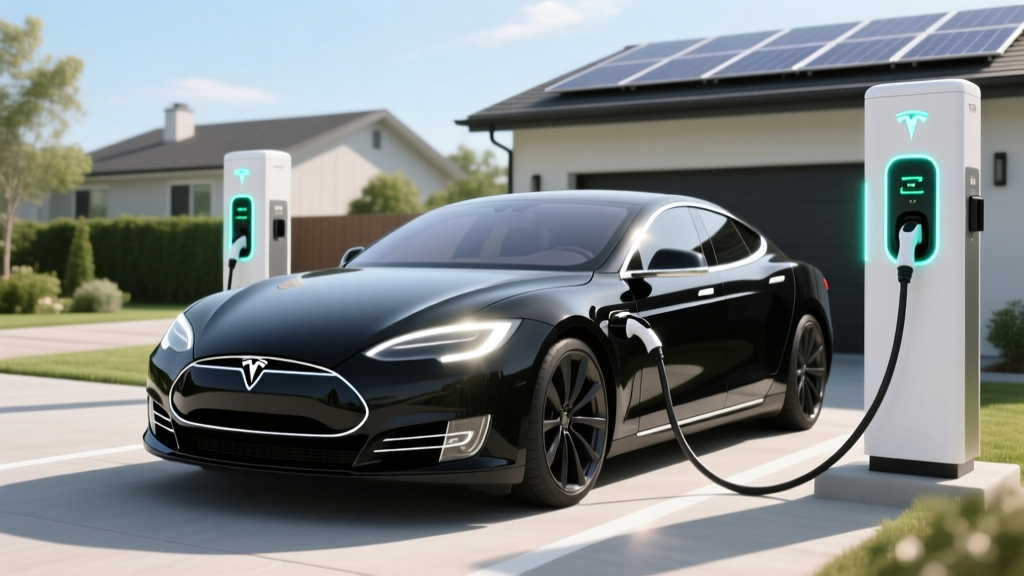
If you own or are considering a Tesla Model 3 Long Range or Model Y Long Range, the EPA range sticker is only half the story. The 2026 Model 3 Long Range carries an EPA estimate of 363 miles, while the Model Y Long Range posts 320 miles. But extracting every one of those long range Tesla miles — and replenishing them quickly when depleted — depends entirely on your charging infrastructure. This guide breaks down exactly how each charging level performs, what a home installation actually costs, and which equipment maximizes your daily readiness and road-trip efficiency.
Understanding kW vs. kWh: The Foundation of EV Charging
Before evaluating any charger, lock in this distinction — it's the single most common source of confusion among new EV owners:
- kWh (kilowatt-hour) is a unit of energy — it measures how much electricity your battery stores. A 2026 Model 3 Long Range has roughly 75 kWh of usable battery capacity.
- kW (kilowatt) is a unit of power — it measures the rate at which energy flows into the battery. A 48-amp Level 2 charger delivers up to 11.5 kW of power.
Think of it like a bathtub: kWh is how full the tub is; kW is how fast the faucet fills it. Every charging speed, cost calculation, and time estimate in this guide relies on getting these units right.
Charging Levels: Speed, Range Added, and Time to Fill
EV charging falls into three tiers. Here's how each one performs with a Tesla Long Range battery (~75 kWh usable):
| Level | Voltage | Max Power (kW) | Miles of Range Added per Hour | 10–80% Charge Time (75 kWh Battery) | Best Use Case |
|---|---|---|---|---|---|
| Level 1 (120V) | 120V / 12A | ~1.4 kW | ~3–5 mi/hr | ~40+ hours (impractical) | Emergency top-ups, PHEVs |
| Level 2 (240V) | 240V / 48A | ~11.5 kW | ~30–44 mi/hr | ~5–6 hours | Daily home charging |
| DC Fast Charge | 400V+ architecture | Up to 250 kW (V3 Supercharger) | ~1,000+ mi/hr (peak) | ~25–30 minutes | Road trips, rapid replenishment |
Real-world context: The 250 kW peak on a V3 Supercharger is not sustained across the entire session. Tesla's charge curve tapers significantly above 50% state of charge (SoC). You'll see peak rates between 10–30% SoC, with power dropping to ~100 kW around 60% and further tapering to ~40 kW by 80%. This is why 10–80% time is the standard benchmark — charging past 80% on DC fast charge is painfully slow and hard on the battery.
Real-World Range Reality Check: The EPA's 363-mile estimate for the Model 3 Long Range assumes a mix of city and highway driving at moderate temperatures. In real-world highway testing at 70 mph, expect roughly 290–320 miles. In cold weather (below 30°F), range can drop 20–30% due to battery resistance and cabin heating demands — plan for 250–280 miles in winter conditions. Source: fueleconomy.gov
Home Charger Installation: Electrical Requirements and True Costs
A Level 2 home charger is the backbone of practical Tesla ownership. Here's what an installation actually requires and costs in 2026.
Electrical Requirements
A full-speed Level 2 Tesla Wall Connector requires a 240V dedicated circuit at 60 amps (which delivers 48 amps continuous to the vehicle, per the National Electrical Code's 80% rule for continuous loads). This translates to up to 11.5 kW of charging power.
- Panel capacity: Most modern homes with a 200-amp service panel can accommodate a 60A EV circuit. Older homes with 100A panels often cannot — a panel upgrade to 200A may be required.
- Wire gauge: 6 AWG copper for runs up to ~50 feet; 4 AWG for longer runs.
- GFCI protection: The 2023 NEC (adopted in most jurisdictions by 2026) requires GFCI protection for EV charging outlets. Hardwired units like the Wall Connector may bypass this requirement in some jurisdictions — check local code.
- Permit: Nearly all jurisdictions require an electrical permit for a new 240V circuit. Permit fees typically range from $50–$200.
Installation Cost Breakdown
Here's what real-world installations cost, from straightforward to complex:
| Component | Simple Install (panel near garage, no upgrade) | Complex Install (long wire run, panel upgrade) |
|---|---|---|
| EV Charger Equipment (Tesla Wall Connector) | $475 | $475 |
| Electrician Labor (2–4 hrs simple / 6–10 hrs complex) | $400–$800 | $1,200–$2,500 |
| Materials (wire, conduit, breaker, junction box) | $100–$300 | $400–$800 |
| Electrical Permit | $50–$150 | $100–$200 |
| Panel Upgrade (100A → 200A, if needed) | N/A | $1,500–$3,000 |
| Total Estimated Range | $1,025–$1,725 | $3,675–$6,975 |
Key insight: If your electrical panel is adjacent to your garage and has spare capacity, expect to spend roughly $1,200–$1,800 all-in. If you need a 200-foot wire run through finished walls or a panel upgrade, costs can easily exceed $5,000. Always get a site assessment from a licensed electrician before purchasing equipment.
How Much Does Charging Cost Per Mile vs. Gas?
One of the strongest arguments for a Long Range Tesla is the per-mile energy cost. Here's how it compares across charging scenarios, using the Model 3 Long Range's efficiency of approximately 25 kWh/100 miles (or ~4 miles per kWh):
| Charging Scenario | Rate ($/kWh) | Cost per Mile (Model 3 LR) | Cost for Full 0–100% (~75 kWh) |
|---|---|---|---|
| Home (off-peak utility rate) | $0.08–$0.12 | $0.020–$0.030 | $6.00–$9.00 |
| Home (standard residential avg.) | $0.16 | $0.040 | $12.00 |
| Public Level 2 (ChargePoint, etc.) | $0.25–$0.39 | $0.063–$0.098 | $18.75–$29.25 |
| Tesla Supercharger (V3/V4 avg.) | $0.28–$0.42 | $0.070–$0.105 | $21.00–$31.50 |
| Gasoline baseline (28 MPG avg. sedan at $3.40/gal) | — | $0.121 | $27.00 (for ~363 mi equivalent) |
The bottom line: Home charging at off-peak rates costs roughly one-quarter to one-fifth of gasoline per mile. Even at Supercharger rates, the Model 3 Long Range is typically cheaper per mile than a 28 MPG gas sedan. Over 15,000 annual miles, home charging at $0.12/kWh saves approximately $1,365 per year compared to gasoline at $3.40/gallon.
Connector Compatibility: NACS, CCS, and the Adapter Landscape
As of 2026, the North American Charging Standard (NACS) — originally Tesla's proprietary connector — has become the dominant connector in the US. Tesla vehicles ship with a native NACS port. Here's where compatibility stands:
| Connector | Tesla Vehicles (2026) | Non-Tesla EVs (2026) | Notes |
|---|---|---|---|
| NACS (J3400) | Native — no adapter needed | New models from Ford, GM, Rivian, Hyundai, etc. ship with NACS | Standard for AC Level 2 and DC fast charging |
| CCS1 | Adapter required (Tesla CCS adapter, ~$175) | Older non-Tesla EVs (pre-2025 models) | Needed for Electrify America, some public DC stations |
| CHAdeMO | Not supported (no adapter available) | Nissan Leaf, older Mitsubishi | Legacy standard; network shrinking |
| J1772 (AC Level 1/2) | Tesla Mobile Connector or J1772 adapter included | All non-Tesla EVs (native) | For public Level 2 stations with J1772 cables |
Practical advice: For home charging, the Tesla Wall Connector uses NACS natively — no adapter needed. On the road, Tesla's Supercharger network (17,000+ stalls in the US) is natively compatible. Keep a Tesla CCS adapter in the frunk for Electrify America and other CCS-only public DC stations. The CHAdeMO network is effectively dead for Tesla owners.
Recommended Home Charging Equipment for Tesla Long Range Owners
These are the chargers we recommend based on power output, reliability, cable management, and smart features:
Tesla Wall Connector (Gen 4)
- Power Output: Up to 11.5 kW (48A at 240V)
- Connector: NACS (native)
- Cable Length: 24 feet
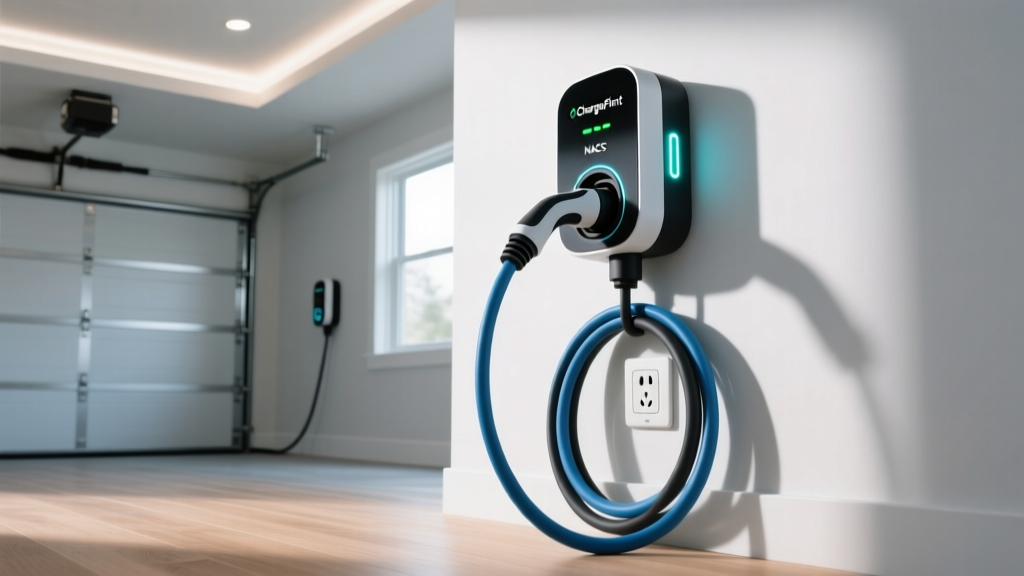
- Smart Features: Wi-Fi enabled, OTA firmware updates, Power Sharing (link multiple units on one circuit), integrated Tesla app scheduling
- Price: $475
- Verdict: Best overall for Tesla owners. Seamless integration, clean design, and 11.5 kW fills a Model 3 LR from 10–80% in roughly 5 hours overnight.
ChargePoint Home Flex
- Power Output: Up to 12 kW (50A at 240V) — configurable from 16A to 50A
- Connector: NACS (2026 model) or J1772 (use Tesla adapter)
- Cable Length: 23 feet
- Smart Features: Wi-Fi, ChargePoint app with detailed session data, Alexa integration, flexible amperage adjustment for older panels
- Price: $549–$599
- Verdict: Best for multi-EV households (Tesla + non-Tesla). The adjustable amperage is ideal if your panel can't support a full 60A circuit.
Emporia Vue Level 2 Charger
- Power Output: Up to 11.5 kW (48A at 240V)
- Connector: J1772 (NACS version available 2026)
- Cable Length: 24 feet
- Smart Features: Wi-Fi, Emporia app, solar integration (pairs with Emporia Vue energy monitor to charge on excess solar production)
- Price: $399
- Verdict: Best budget pick with solar integration. Use the included J1772-to-NACS adapter for Tesla, or opt for the NACS variant.
Safety, Code, and Installation Best Practices
EV charging draws sustained high current for hours — this is not like plugging in a dryer. Proper installation is non-negotiable:
- Dedicated circuit: Your EV charger must be on its own dedicated breaker. Never share a circuit with other appliances.
- Hardwired vs. plug-in: Hardwired installations (no plug) eliminate the need for a 240V receptacle and may avoid GFCI requirements in some jurisdictions. NEMA 14-50 outlets offer portability but require GFCI breakers under current NEC, adding $50–$120 to the breaker cost.
- Outdoor rating: If your charger is mounted outside, ensure it carries a NEMA 4 or NEMA 4X rating for weather resistance. The Tesla Wall Connector is rated for indoor and outdoor use.
- Load calculation: A licensed electrician should perform a NEC Article 220 load calculation to confirm your panel can handle the EV circuit alongside existing loads (HVAC, oven, dryer, etc.).
- Permit and inspection: Always pull a permit. The inspection ensures the work meets code — this protects your home and is required for any utility rebate claims.
Frequently Asked Questions
How much does it cost to install a home EV charger for a Tesla?
A straightforward installation (panel near garage, no upgrade needed) typically costs $1,025–$1,725 all-in, including the Tesla Wall Connector ($475), electrician labor, materials, and permit. Complex installations requiring long wire runs, trenching, or a panel upgrade from 100A to 200A can range from $3,675–$6,975.
How fast will each charging level add range to my Tesla Long Range?
Level 1 (120V) adds roughly 3–5 miles of range per hour — essentially impractical for a 75 kWh battery. Level 2 (240V at 48A) adds approximately 30–44 miles per hour, fully replenishing overnight. DC fast charging at a V3 Supercharger can add up to 175 miles in 15 minutes at peak rate, though the charge curve tapers significantly above 50% SoC.
Which connector is compatible with my 2026 Tesla?
All 2026 Tesla vehicles use the NACS connector natively — no adapter is needed for Tesla Superchargers or the Tesla Wall Connector. For CCS-only public DC fast chargers (like some Electrify America stations), you'll need the Tesla CCS adapter (~$175). A J1772 adapter is included with the vehicle for public Level 2 stations.
How much does charging a Tesla cost per mile vs. gas?
At home off-peak rates (~$0.10/kWh), a Model 3 Long Range costs roughly $0.025 per mile. At average Supercharger rates (~$0.35/kWh), it's about $0.088 per mile. A comparable 28 MPG gas sedan at $3.40/gallon costs $0.121 per mile. Home charging saves $0.08–$0.10 per mile, or roughly $1,200–$1,500 annually at 15,000 miles.
What electrical upgrades might I need for a Level 2 charger?
The most common upgrade is a panel capacity increase from 100A to 200A, which costs $1,500–$3,000 and is needed when your existing panel lacks spare capacity for a 60A dedicated circuit. Other potential upgrades include replacing a Federal Pacific or Zinsco panel (known safety hazards, $2,000–$4,000 replacement), adding a sub-panel in the garage ($500–$1,200), or upgrading the utility service drop for homes with very high total loads. A licensed electrician's load calculation will determine what's required for your specific home.
Should I charge my Tesla Long Range to 100% every day?
No. Tesla recommends setting the daily charge limit to 80–90% for regular use. The Model 3 and Model Y Long Range use NMC (nickel manganese cobalt) battery chemistry, which degrades faster when held at 100% SoC for extended periods. Reserve 100% charges for road trips when you need the full 363 miles (Model 3) or 320 miles (Model Y). The vehicle's built-in battery management system maintains a buffer, but consistent 80% daily limits will extend long-term battery health. Per Tesla's battery care guidance, this practice optimizes longevity.
Getting the most from your long range Tesla miles starts with the right charging foundation. A properly installed Level 2 home charger delivers 30–44 miles of range per hour, costs $1,000–$1,800 in a typical installation, and reduces per-mile fuel cost to pennies. Pair it with smart charging habits — 80% daily limits, preconditioning before Supercharger stops, and off-peak scheduling — and your Tesla's battery and your wallet will both go the distance.