What Exactly Is a Level 3 DC Fast Charger?
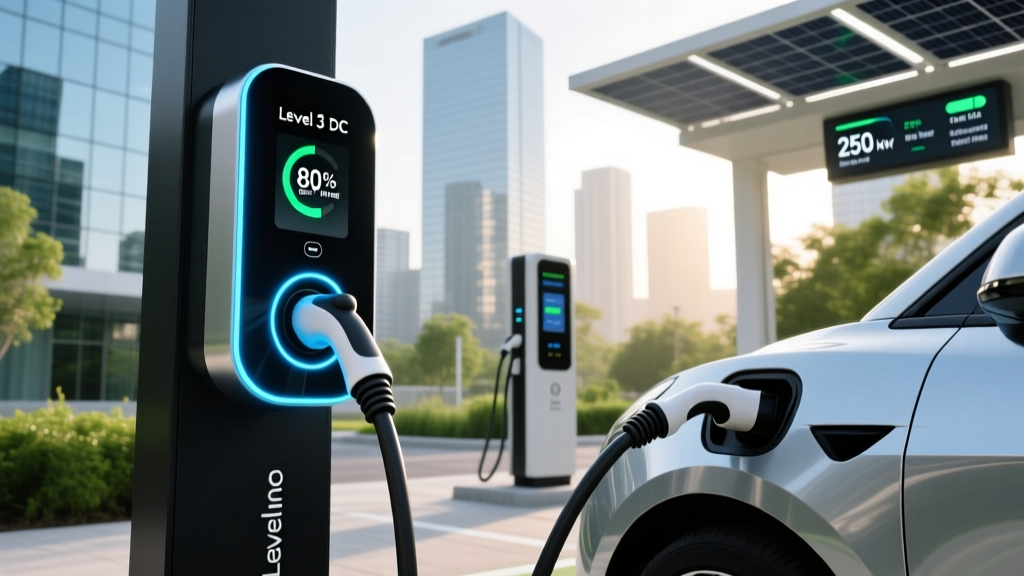
If you've browsed EV forums or spec sheets, you've likely seen the term Level 3 DC fast charger. Unlike Level 1 and Level 2 chargers that feed alternating current (AC) to your car's onboard charger, a DC fast charger (DCFC) bypasses that bottleneck and pushes direct current (DC) straight into the traction battery. The result: charge rates measured in tens or hundreds of kilowatts (kW), not the single-digit kW you get from a wall outlet or home wallbox.
Before going further, let's lock in the single most important distinction in EV charging: kW (kilowatts) measures power — how fast energy flows at a given moment. kWh (kilowatt-hours) measures energy — how much total charge your battery holds. Think of kW as the width of a hose and kWh as the size of the bucket. A 350 kW charger fills that bucket dramatically faster than a 7.2 kW home unit.
Level 3 DC fast chargers are the units you find at highway rest stops, Electrify America plazas, and Tesla Supercharger stations. They are not practical for home installation — we'll explain why shortly — but understanding how they work is essential for road-trip planning and for sizing the Level 2 home charger that will handle 90% of your daily charging.
Charging Levels Compared: Speeds and Range Added Per Hour
The table below summarizes what each charging level delivers in real-world terms. "Miles per hour" figures assume an average EV efficiency of 3.0 miles per kWh (typical for a mid-size crossover like the Hyundai Ioniq 5 or Tesla Model Y).
| Level | Voltage / Phase | Power (kW) | Miles of Range Added Per Hour | Typical Use Case |
|---|---|---|---|---|
| Level 1 | 120V AC, single-phase | 1.0 – 1.9 kW | 3 – 5 mi/hr | Overnight trickle, PHEVs, emergency top-ups |
| Level 2 | 240V AC, single-phase | 3.3 – 19.2 kW | 10 – 60 mi/hr | Home daily charging, workplace, destination |
| Level 3 (DC Fast) | 200 – 920V DC | 50 – 350+ kW | 150 – 1,000+ mi/hr (peak) | Highway road trips, commercial fleets |
Two caveats matter here. First, peak kW is not sustained kW. A charger rated for 350 kW will only deliver that rate during a narrow window of the battery's state of charge (SoC) — typically between 10% and 30%. Above 80% SoC, the battery management system (BMS) tapers current to protect the cells, and charge speed can drop to 50 kW or less. This is the charge curve, and it's why a "10–80% in 18 minutes" claim is far more useful than a peak-kW headline number.
Second, your car sets the ceiling. Plugging a Hyundai Ioniq 5 (peak 240 kW DC) into a 350 kW Electrify America stall won't push 350 kW into the battery — the car will accept only what its architecture allows. Conversely, an 800V-native vehicle like the Kia EV6 or Porsche Taycan can exploit high-power chargers more fully than a 400V vehicle like the Nissan Ariya.
Real-World Charge Times: 10–80% for Common EV Battery Sizes
Here's what a Level 3 DC fast charging session actually looks like for popular 2026-model EVs. Times assume a compatible high-power charger, a preconditioned battery (more on that below), and ambient temperatures between 60–80°F.
| Vehicle (2026 MY) | Battery (kWh usable) | Peak DC Rate (kW) | 10–80% Time (min) | Notes |
|---|---|---|---|---|
| Tesla Model Y Long Range | 75 kWh (NMC) | 250 kW | ~25 min | NACS connector; V4 Supercharger |
| Hyundai Ioniq 5 (Long Range) | 77.4 kWh (NMC) | 240 kW | ~18 min | 800V architecture; CCS1 or NACS |
| Ford F-150 Lightning (Extended) | 131 kWh (NMC) | 150 kW | ~41 min | Large battery limits C-rate |
| Chevrolet Equinox EV (3RS) | 85 kWh (NMC) | 150 kW | ~30 min | NACS native for 2026 |
| BMW i4 eDrive40 | 81.5 kWh (NMC) | 200 kW | ~31 min | CCS1; 400V architecture |
Connector Compatibility: NACS, CCS1, and CHAdeMO in 2026
The North American charging landscape has undergone a seismic shift. Tesla's NACS (North American Charging Standard) connector is now the de facto standard, with Ford, GM, Rivian, Hyundai/Kia, BMW, and most other automakers adopting it for 2025–2026 models. CCS1 (Combined Charging System) remains on some carryover models, and CHAdeMO is effectively legacy — the Nissan Leaf is the last major holdout, and it uses a smaller battery better suited to Level 2 charging anyway.
| Connector | Status (2026) | Major Brands Using It | Adapter Needed? |
|---|---|---|---|
| NACS (Tesla) | Dominant standard | Tesla, Ford, GM, Rivian, Hyundai, Kia, BMW, Volvo, Polestar | CCS1-to-NACS adapters available (~$200) for older CCS vehicles |
| CCS1 | Phasing out but still widespread | VW ID.4 (pre-2026), older BMW i4, legacy models | NACS-to-CCS adapters available for newer NACS vehicles at CCS stations |
| CHAdeMO | Legacy / sunset | Nissan Leaf (discontinued after 2025 MY) | No practical adapter to NACS/CCS |
If you're buying a new EV in 2026, NACS is the connector to have. It grants native access to the Tesla Supercharger network — over 25,000 stalls in North America — without an adapter. If you own a CCS1 vehicle from 2023–2025, a NACS-to-CCS adapter (sold by Tesla, Lectron, and A2Z) lets you use Superchargers, though at the vehicle's peak DC rate, not the stall's maximum.
Home Charging: Electrical Requirements and Installation Costs
Here's the key reality: you will not install a Level 3 DC fast charger at home. DCFCs require 480V three-phase commercial power, cost $30,000–$150,000+ for the hardware alone, and need utility-grade infrastructure. They belong at highway plazas and fleet depots.
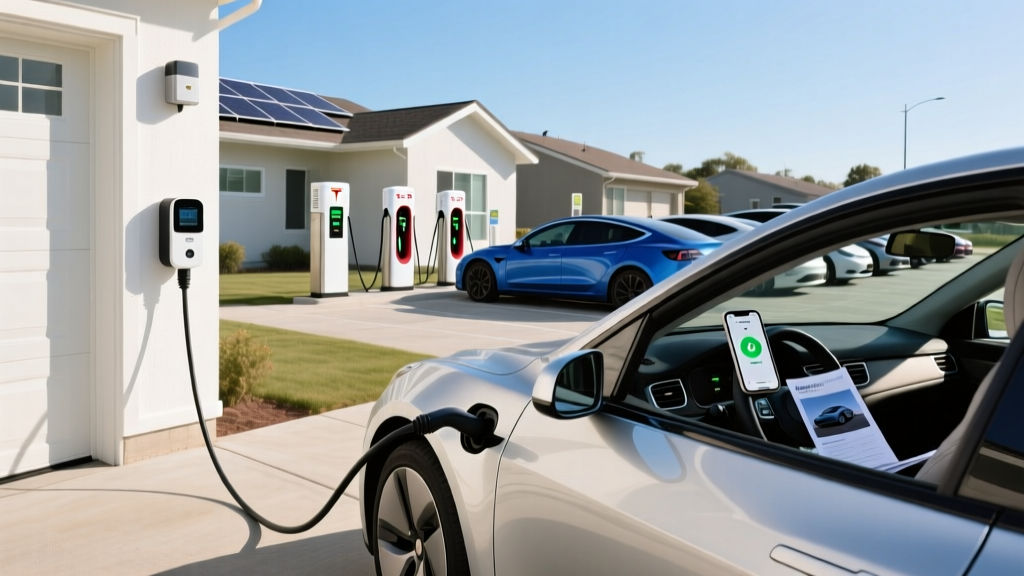
What you will install is a Level 2 home charger on a dedicated 240V circuit. This handles 90%+ of your charging needs — plug in at night, wake up to a full battery every morning. Here's what that installation involves.
Electrical Requirements
A typical Level 2 home charger draws 32A to 48A on a 240V dedicated circuit. By the National Electrical Code (NEC), a continuous load like EV charging must be derated to 80% of the breaker rating, so a 48A charger requires a 60A breaker and appropriately sized wire (typically 6 AWG copper for runs under 100 feet).
- 32A charger: Requires a 40A breaker, delivers up to 7.7 kW — sufficient for most daily needs (adds ~23 miles of range per hour).
- 48A charger: Requires a 60A breaker, delivers up to 11.5 kW — ideal for larger batteries (F-150 Lightning, Rivian R1T) or high daily mileage.
- 80A charger (e.g., Tesla Wall Connector at max config): Requires a 100A breaker, delivers up to 19.2 kW — overkill for most homes and only useful if your vehicle's onboard charger can accept it (few can).
Panel Upgrade Considerations
Many older homes have a 100A or 150A main electrical panel. Adding a 60A EV circuit to an already-loaded 100A panel may exceed capacity, triggering a panel upgrade to 200A. This is the single biggest variable in home charging cost. A licensed electrician will perform a load calculation (NEC Article 220) to determine if your panel has headroom.
Some utilities and jurisdictions now allow automated load management devices (e.g., the Span smart panel or Eve charger with CT clamps) that dynamically throttle EV charging when household demand spikes, potentially avoiding a panel upgrade. Check with your local building department — acceptance varies.
Installation Cost Breakdown
| Cost Component | Low Estimate | High Estimate | Notes |
|---|---|---|---|
| Level 2 charger hardware | $350 | $750 | 32A–48A smart charger (Wi-Fi, scheduling) |
| Electrician labor (standard install) | $500 | $1,500 | Short wire run, panel has capacity |
| Permit and inspection | $50 | $300 | Varies by municipality |
| Panel upgrade (if needed) | $1,500 | $4,000 | 100A → 200A service upgrade |
| Long wire run / conduit (if needed) | $300 | $2,000 | Detached garage, underground runs |
| Total (no panel upgrade) | $900 | $2,550 | Typical attached-garage scenario |
| Total (with panel upgrade) | $2,400 | $6,550 | Older home needing 200A service |
The federal Alternative Fuel Vehicle Refueling Property Credit (IRS Form 8911) covers 30% of home charger hardware and installation costs, up to $1,000, for equipment placed in service in eligible census tracts. Check your eligibility with a tax professional — the census-tract requirement catches many buyers off guard.
Cost to Charge: Home vs. Public DC Fast Charging vs. Gas
One of the strongest economic arguments for EV ownership is the per-mile fuel cost — but only if you charge at home. Public DC fast charging narrows the gap, and in some markets, eliminates it entirely.
| Scenario | Rate ($/kWh) | Cost to Add 200 Miles* | Cost Per Mile |
|---|---|---|---|
| Home (off-peak utility rate) | $0.08 – $0.14 | $5.30 – $9.30 | $0.027 – $0.047 |
| Home (average blended rate) | $0.14 – $0.18 | $9.30 – $12.00 | $0.047 – $0.060 |
| Public Level 2 (workplace, shopping) | $0.20 – $0.35 | $13.30 – $23.30 | $0.067 – $0.117 |
| Public DC Fast (Electrify America, EVgo) | $0.35 – $0.55 | $23.30 – $36.70 | $0.117 – $0.183 |
| Tesla Supercharger (varies by location) | $0.25 – $0.40 | $16.70 – $26.70 | $0.083 – $0.133 |
| Gas car (28 MPG, $3.40/gal) | — | $24.30 | $0.121 |
*Assumes 3.0 mi/kWh EV efficiency (≈ 33 kWh per 100 miles), typical for a mid-size electric crossover per EPA data on fueleconomy.gov.
The takeaway is clear: home off-peak charging is roughly one-quarter to one-third the per-mile cost of gasoline. Public DC fast charging at $0.40–$0.55/kWh can match or exceed gas costs — which is why DCFCs should be treated as road-trip infrastructure, not your daily fueling strategy. Subscription plans (Electrify America's Pass+, EVgo's eExtend) can reduce public rates by 15–25% if you charge on the road frequently.
Recommended Home Level 2 Chargers for 2026
Since Level 3 DC fast chargers aren't a home option, here are the Level 2 wallboxes we recommend for daily charging. All are hardwired or NEMA 14-50 plug-in units with smart features (Wi-Fi scheduling, off-peak optimization, energy tracking).
Tesla Wall Connector (Gen 4)
- Power output: Up to 48A / 11.5 kW (240V)
- Connector: NACS native
- Cable length: 24 ft
- Smart features: Wi-Fi, OTA updates, power-sharing with second unit, access control
- Price: ~$475
- Best for: Tesla owners and NACS-native 2025+ EVs
ChargePoint Home Flex (2nd Gen)
- Power output: Up to 50A / 12 kW (240V, configurable)
- Connector: NACS or J1772 (select at purchase)
- Cable length: 23 ft
- Smart features: Wi-Fi, Alexa integration, detailed energy dashboard, flexible amperage
- Price: ~$550
- Best for: Multi-EV households, renters who may move (plug-in option)
Emporia Level 2 EV Charger
- Power output: Up to 48A / 11.5 kW (240V)
- Connector: NACS or J1772
- Cable length: 24 ft
- Smart features: Wi-Fi, solar integration (pairs with Emporia Vue energy monitor), TOU scheduling
- Price: ~$400
- Best for: Solar-panel owners, budget-conscious buyers
Grizzl-E Smart (United Chargers)
- Power output: Up to 40A / 9.6 kW (240V)
- Connector: NACS or J1772
- Cable length: 24 ft
- Smart features: OCPP-compatible, works with utility demand-response programs, extreme cold rated (-40°F)
- Price: ~$500
- Best for: Cold-climate garages, utility-program participants
Safety and Code Considerations
Every home charger installation must comply with NEC Article 625 and local building codes. Key requirements include:
- Dedicated circuit: Your EV charger must have its own breaker — no sharing with other outlets or appliances.
- GFCI protection: NEC 2020 and later require ground-fault circuit interrupter protection for all EV supply equipment. Many modern chargers have built-in GFCI; if yours does not, the breaker must provide it.
- Outdoor rating: If your charger is installed outside (carport, driveway), it must carry a NEMA 4 or NEMA 4X rating for weather resistance. All chargers listed above meet this standard.
- Permit and inspection: Most jurisdictions require an electrical permit for a new 240V circuit. The inspection verifies wire gauge, breaker sizing, grounding, and GFCI compliance. Do not skip this — unpermitted work can void home insurance and create fire risk.
- Wire gauge: For a 60A breaker (48A charger), 6 AWG copper is standard for runs up to ~100 ft. Longer runs may require 4 AWG to prevent voltage drop. Your electrician will calculate this.
Frequently Asked Questions
Can I install a Level 3 DC fast charger at home?
No. Level 3 DC fast chargers require 480V three-phase commercial power, cost $30,000–$150,000+ for the unit alone, and need utility-scale electrical infrastructure. They are designed for commercial sites — highway plazas, fleet depots, and retail charging stations. For home use, a Level 2 charger on a 240V circuit is the standard and handles the vast majority of daily charging needs.
How much does it cost to install a home Level 2 EV charger?
A straightforward installation (adequate panel capacity, short wire run to an attached garage) typically costs $900–$2,550 including the charger hardware, electrician labor, and permit. If your home needs a panel upgrade from 100A to 200A service, total cost rises to $2,400–$6,550. Always get a load calculation from a licensed electrician before committing.
How fast will each charging level add range?
Level 1 (120V) adds roughly 3–5 miles of range per hour. Level 2 (240V, 48A) adds roughly 30–36 miles per hour — enough to fully recharge most EVs overnight. Level 3 DC fast charging adds 150–1,000+ miles per hour at peak rate, but peak rate is sustained only during a portion of the session (typically 10–50% SoC), and the charge curve tapers significantly above 80%.
Which connector is compatible with my EV?
For 2026 models, NACS is the dominant standard across Tesla, Ford, GM, Rivian, Hyundai, Kia, BMW, and Volvo. CCS1 remains on some carryover and used models. CHAdeMO is effectively discontinued. Check your vehicle's charge port — if it's NACS, you have native access to Tesla Superchargers and a growing number of NACS-equipped public stations. CCS1 owners can use a NACS-to-CCS adapter (~$200) for Supercharger access.
How much does charging cost per mile compared to gas?
Home off-peak charging at $0.10/kWh costs roughly $0.03–$0.05 per mile in a typical electric crossover — about one-quarter the cost of a 28 MPG gas car at $3.40/gallon ($0.12/mile). Public DC fast charging at $0.40–$0.55/kWh can cost $0.12–$0.18 per mile, narrowing the savings or exceeding gas costs. The economic advantage of EV ownership depends heavily on reliable home charging access.
What electrical upgrades might I need for a home charger?
The most common upgrade is a main panel replacement from 100A to 200A service, needed when your existing panel lacks capacity for a new 60A circuit. Other potential upgrades include: replacing a Federal Pacific or Zinsco panel (known fire hazards, often required by insurers), adding a sub-panel for a detached garage, or upgrading the utility service drop. A licensed electrician's load calculation will identify what's needed before work begins.
What is battery preconditioning and why does it matter for DC fast charging?
Preconditioning warms the battery to its optimal charging temperature (typically 77–95°F / 25–35°C) before you arrive at a DC fast charger. Most EVs do this automatically when you navigate to a charger in the car's built-in navigation. Without preconditioning — especially in cold weather — peak charge rates can be cut by 30–50%, adding significant time to your stop. Always navigate to the charger rather than entering the address manually in a phone app if your vehicle supports automatic preconditioning.
Sources: U.S. EPA Fuel Economy, IRS Alternative Fuel Vehicle Refueling Property Credit, manufacturer specifications. Tax credit and incentive rules are subject to change; consult a tax professional for eligibility.