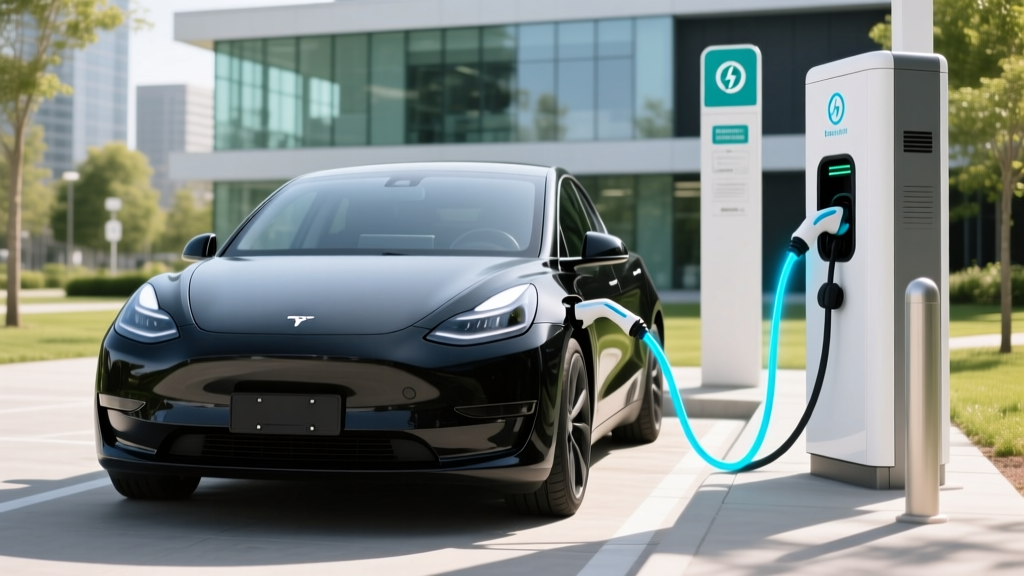
Search for "Level 3 chargers" and you will find a term that the EV industry itself rarely uses. Automakers, charging networks, and the U.S. Department of Energy all classify chargers into three tiers: Level 1, Level 2, and DC Fast Charging (DCFC). What consumers and some third-party sites call a "Level 3 charger" is simply a DC fast charger — a high-power station that bypasses the vehicle's onboard charger and feeds direct current straight into the battery pack.
DC fast chargers range from 50 kW legacy units up to 350 kW (and now 500 kW) ultra-fast stations. They are the only practical way to recharge on a road trip, adding 100 to 250+ miles of range in 15 to 30 minutes depending on the vehicle's peak acceptance rate and battery state of charge. But they are also the most expensive way to charge and are not something you install in your garage. This guide breaks down exactly how Level 3 / DC fast chargers work, what they cost, which connector your EV needs, and how they compare to the Level 2 home chargers where most daily charging actually happens.
Charging Levels Compared: Level 1, Level 2, and Level 3 (DC Fast)
Before focusing on DC fast charging, it helps to see all three levels side by side. The critical distinction: kW (kilowatts) measures power — how fast energy flows. kWh (kilowatt-hours) measures energy — how much the battery holds. A 75 kWh battery charged at 150 kW does not take half an hour to fill; charging speed tapers as the battery approaches full, and real-world sessions are measured from 10% to 80% state of charge.
| Level | Power Source | Typical Power (kW) | Miles of Range Added per Hour | Best For |
|---|---|---|---|---|
| Level 1 | 120V household outlet | 1.2 – 1.4 kW | 3 – 5 mi/hr | Overnight top-ups, PHEVs, emergencies |
| Level 2 | 240V (home or public AC) | 3.3 – 19.2 kW | 12 – 75 mi/hr | Daily home charging, workplace, destinations |
| DC Fast ("Level 3") | 480V+ three-phase (commercial) | 50 – 500 kW | 150 – 1,500+ mi/hr (peak) | Road trips, quick top-ups, fleet depots |
For context, a vehicle averaging 3 mi/kWh (about 33 kWh/100mi, typical for a midsize crossover EV) charging at 11.5 kW (Level 2, 48A) adds roughly 34 miles of range per hour. That same vehicle at a 150 kW DC fast charger can theoretically add 450 miles per hour at peak — but peak rates only last for a portion of the session before the charge curve tapers.
How DC Fast Chargers Actually Work (and Why They Taper)
Level 1 and Level 2 chargers deliver alternating current (AC) to the vehicle. The car's onboard charger converts that AC to DC to charge the battery. DC fast chargers skip this step: the AC-to-DC conversion happens inside the charging station itself, and DC flows directly into the battery at high voltage and high current.
This architecture is why DC fast chargers are large, expensive (a single 350 kW cabinet can cost $50,000 to $150,000+ to install), and require commercial-grade electrical infrastructure. It is also why you will never install one at home — a 350 kW charger would draw roughly 450 amps at 480V three-phase, far beyond any residential electrical panel.
The Charge Curve: Why Peak kW Is Not Sustained kW
When manufacturers advertise "charges from 10-80% in 18 minutes," they are describing the fastest portion of the charge curve. A battery's ability to accept current drops as its state of charge rises. Here is a typical charge curve for a modern EV with NMC chemistry at a 250 kW-capable station:
- 10% – 30% SoC: Peak rate (e.g., 230–250 kW) — maximum current, battery is cool and empty
- 30% – 55% SoC: First taper (e.g., 175–200 kW) — thermal management kicks in
- 55% – 70% SoC: Second taper (e.g., 120–150 kW) — cell voltage rises
- 70% – 80% SoC: Significant taper (e.g., 75–100 kW)
- 80% – 100% SoC: Severe taper (e.g., 25–50 kW) — this is why DC fast charging to 100% is slow and generally unnecessary
This is also why a vehicle rated for 250 kW peak charging might average only 120–140 kW over a full 10–80% session. When planning road trips, look at the average charge rate, not the peak.
Real-World DC Fast Charging Times: 10–80% by Battery Size
Charging time depends on three variables: the battery's usable capacity (kWh), the vehicle's peak charge acceptance rate (kW), and the station's maximum output. Below are realistic 10–80% session times assuming the station can deliver the vehicle's peak rate.
| Vehicle Example | Usable Battery (kWh) | Peak DC Rate (kW) | 10–80% Time (min) | Miles Added (approx.) |
|---|---|---|---|---|
| Hyundai Ioniq 5 (Long Range) | 77.4 | 240 (800V) | ~18 min | ~210 mi |
| Tesla Model Y (Long Range) | 75 | 250 | ~25 min | ~220 mi |
| Ford F-150 Lightning (Ext. Range) | 131 | 150 | ~41 min | ~230 mi |
| Chevrolet Equinox EV | 85 | 150 | ~30 min | ~210 mi |
| Nissan Ariya (e-4ORCE) | 87 | 130 | ~35 min | ~200 mi |
| BMW iX xDrive50 | 105.2 | 200 | ~31 min | ~220 mi |
Note that the Hyundai Ioniq 5's 800V architecture allows it to sustain a higher average charge rate, resulting in a faster session despite a similar battery size to the Model Y. Architecture voltage matters as much as peak kW.
Connector Compatibility: NACS, CCS, and CHAdeMO
The DC fast charging landscape in North America has undergone a massive shift. As of 2025–2026, the North American Charging Standard (NACS) — originally developed by Tesla — has become the dominant connector. Ford, GM, Rivian, Volvo, Polestar, Hyundai, Kia, BMW, and most other major automakers have adopted NACS on new vehicles. CCS1 (Combined Charging System) remains on many 2024 and earlier models. CHAdeMO is effectively legacy, found only on older Nissan Leafs and Mitsubishi Outlander PHEVs.
| Connector | Current Status (2026) | Found On | Adapter Needed? |
|---|---|---|---|
| NACS (Tesla-style) | Dominant standard | Tesla (all), Ford (2025+), GM (2025+), Rivian (2025+), Hyundai/Kia (2025+), Volvo/Polestar (2025+), BMW (2025+) | CCS vehicles need a NACS-to-CCS adapter (often provided free by OEM) to use Tesla Superchargers |
| CCS1 | Legacy but still widely available | Most 2024 and earlier non-Tesla EVs, VW ID.4 (pre-2025), older Hyundai/Kia | NACS vehicles need a CCS adapter to use Electrify America, EVgo CCS stalls |
| CHAdeMO | Phased out | Nissan Leaf (all years), Mitsubishi Outlander PHEV | No practical adapter to NACS/CCS; CHAdeMO stations are declining |
What DC Fast Charging Actually Costs
Public DC fast charging is the most expensive way to power an EV — often approaching or exceeding the per-mile cost of a fuel-efficient gasoline car. Pricing varies wildly by network, location, and time of day.
| Scenario | Typical $/kWh | Cost per Mile (3 mi/kWh vehicle) | Notes |
|---|---|---|---|
| Home Level 2 (off-peak utility rate) | $0.08 – $0.14 | $0.03 – $0.05 | Cheapest option; requires home charger |
| Home Level 2 (standard rate) | $0.13 – $0.20 | $0.04 – $0.07 | Average residential electricity |
| Tesla Supercharger (average) | $0.25 – $0.38 | $0.08 – $0.13 | Varies by location; off-peak discounts available |
| Electrify America / EVgo (DC fast) | $0.32 – $0.56 | $0.11 – $0.19 | Idle fees can add $0.40/min after session ends |
| Gasoline comparison (30 MPG, $3.40/gal) | — | $0.11 | Baseline for comparison |
At home with off-peak rates, an EV costs roughly one-third to one-half what a 30 MPG gasoline car costs per mile. At a public DC fast charger, the savings shrink dramatically — and in some high-cost markets (California, Northeast), DC fast charging can actually exceed the per-mile cost of gasoline. This is the strongest economic argument for installing a Level 2 home charger: the $500–$2,000 installation pays for itself within months through lower per-mile fueling costs.
Home Charging Setup: Level 2 Installation and Costs
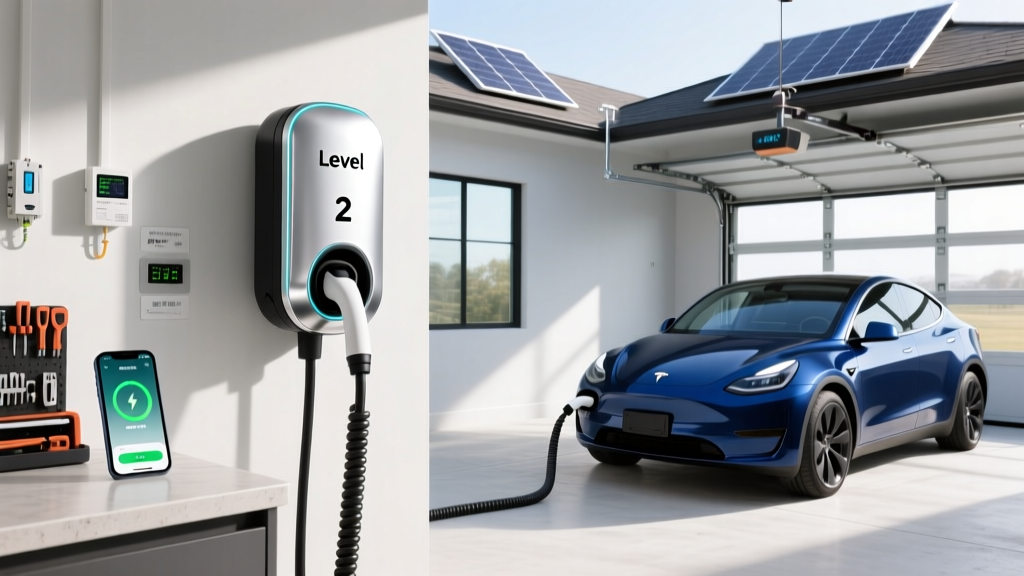
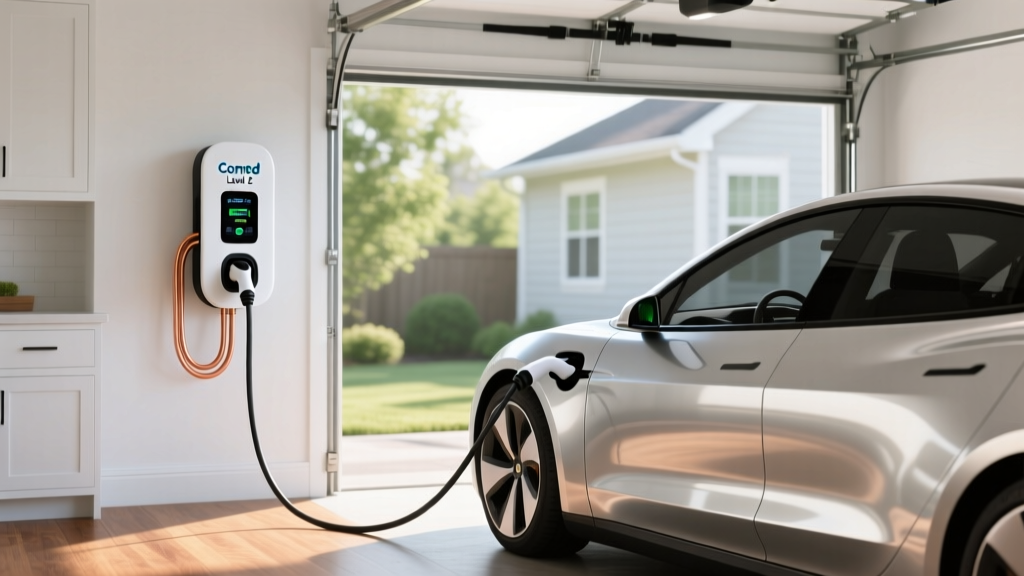
While you cannot install a DC fast charger at home, a properly configured Level 2 charger covers 95%+ of real-world charging needs. Here is what a home Level 2 installation involves.
Electrical Requirements
A standard home Level 2 charger requires a 240V dedicated circuit, the same voltage as an electric dryer or oven. Common configurations:
- 40-amp circuit / 32A continuous: Delivers 7.7 kW — sufficient for overnight charging of most EVs (adds ~23 miles/hr)
- 50-amp circuit / 40A continuous: Delivers 9.6 kW — adds ~29 miles/hr; the most common home setup
- 60-amp circuit / 48A continuous: Delivers 11.5 kW — adds ~34 miles/hr; requires robust panel capacity
- 80-amp circuit / 64A continuous: Delivers 15.4 kW — adds ~46 miles/hr; needs 200A+ panel and heavy-gauge wire
The National Electrical Code (NEC) requires that continuous loads (like EV charging) use no more than 80% of a circuit's rated capacity. A 50-amp breaker therefore supports a maximum 40-amp continuous draw.
Panel Upgrade: The Hidden Cost
Many homes built before 2000 have 100-amp electrical panels. If your panel is already near capacity (running central AC, electric range, dryer, water heater), adding a 50-amp EV circuit may require a panel upgrade to 200 amps — or a smart load-management system that throttles the charger when other appliances draw power. Panel upgrades are the single largest variable in home charging installation cost.
| Component | Cost Range | Details |
|---|---|---|
| Level 2 charging equipment (hardwired or NEMA 14-50 plug) | $350 – $750 | 40A–48A smart chargers; Wi-Fi enabled |
| Electrician labor (standard install, panel adjacent to garage) | $400 – $1,200 | Running conduit, wiring, breaker, mounting |
| Electrical permit and inspection | $50 – $250 | Required by most jurisdictions; varies by city/county |
| Panel upgrade (if needed: 100A → 200A) | $1,500 – $3,500 | Not always required; depends on existing capacity |
| Smart load management system (alternative to panel upgrade) | $300 – $600 | e.g., Emporia, Span panel integration |
| Total (no panel upgrade) | $800 – $2,200 | Typical for homes with 200A panels and garage-proximate panels |
| Total (with panel upgrade) | $2,300 – $5,500 | Older homes with 100A service |
The IRS Residential Clean Energy Credit (§25D) covers 30% of home EV charger equipment and installation costs (up to $1,000) through 2032, though this credit has specific eligibility requirements — consult a tax professional.
Recommended Home Level 2 Chargers (2025–2026)
Since Level 3 / DC fast chargers are not available for home use, here are the best Level 2 chargers for daily charging. All recommendations below are Wi-Fi-enabled smart chargers that support scheduled charging (to exploit off-peak electricity rates) and firmware updates.
ChargePoint Home Flex
- Power: Up to 11.5 kW (48A, requires 60A circuit)
- Connector: NACS or J1772 (select at purchase)
- Cable: 23 ft
- Smart features: Wi-Fi, app scheduling, Alexa, load sharing
- Price: ~$549 (J1772) / ~$599 (NACS)
Best for: Flexible amperage (dip-switch adjustable 16A–48A to match your circuit); excellent app.
Tesla Wall Connector
- Power: Up to 11.5 kW (48A, requires 60A circuit)
- Connector: NACS (native Tesla plug)
- Cable: 24 ft
- Smart features: Wi-Fi, OTA updates, Power Share (load balance with second unit), vehicle integration
- Price: ~$420
Best for: Tesla owners and NACS-equipped 2025+ EVs; best value at this power level.
Emporia Level 2 EV Charger
- Power: Up to 11.5 kW (48A, requires 60A circuit)
- Connector: J1772 (NACS adapter included)
- Cable: 24 ft
- Smart features: Wi-Fi, app, integrates with Emporia Vue energy monitor, solar-aware scheduling
- Price: ~$399
Best for: Budget-conscious buyers who want smart features; solar-home integration.
Grizzl-E Smart
- Power: Up to 9.6 kW (40A, requires 50A circuit)
- Connector: J1772 or NACS
- Cable: 24 ft
- Smart features: Wi-Fi, OCPP compatible, adjustable amperage
- Price: ~$449
Best for: Cold climates (rated to -40°F); rugged aluminum enclosure; Canadian-built.
Safety and Code Considerations
EV charging involves sustained high-current draw — often 8 to 12 hours at a time. This is fundamentally different from intermittent loads like a microwave. Proper installation is not optional.
- Dedicated circuit: Your EV charger must have its own dedicated breaker — not shared with other outlets or appliances.
- GFCI protection: The 2020 NEC (and later editions adopted by most states by 2026) requires GFCI protection for outdoor EV charging outlets. Hardwired chargers with integrated ground-fault protection may not require an additional GFCI breaker.
- Outdoor rating: If mounted outdoors, the charger must carry a NEMA 4 (or IP55+) weather-resistance rating. All chargers listed above qualify.
- Wire gauge: A 50-amp circuit requires 6 AWG copper wire (or 4 AWG aluminum). A 60-amp circuit requires 4 AWG copper. Undersized wire is a fire hazard.
- NEMA 14-50 receptacle vs. hardwired: A plug-in NEMA 14-50 outlet offers portability (take the charger when you move), but the NEC 2023+ requires GFCI breakers for receptacle installations — adding $100–$150 to the electrical cost. Hardwired installations avoid this requirement and are generally preferred for permanent setups.
- Permit and inspection: Nearly all jurisdictions require an electrical permit for EV charger installation. The inspection ensures proper wire sizing, grounding, and breaker rating. Skipping the permit risks insurance denial in the event of an electrical fire.
DC Fast Charging Networks: Where to Find "Level 3" Chargers
Public DC fast charging is dominated by a handful of major networks. Reliability varies — and this remains one of the biggest pain points in EV ownership.
- Tesla Supercharger: ~25,000+ stalls in North America. 150 kW (V2) and 250 kW (V3) and 350 kW (V4). Highest uptime (~97%+). Now open to non-Tesla EVs with NACS connectors or adapters via the Tesla app.
- Electrify America: ~5,000+ stalls. Up to 350 kW. CCS and NACS connectors being added. Mixed reliability — improving but still inconsistent in some markets.
- EVgo: ~4,000+ stalls. Up to 350 kW (newer stations). CCS and NACS. Strong in urban markets and retail locations.
- ChargePoint (DC fast): Smaller DC network, mostly 50–125 kW. Better known for Level 2 destination charging.
- Mercedes-Benz High Power Charging: Expanding network of 400 kW-capable stations at select markets, open to all EVs.
For road trip planning, use A Better Routeplanner (ABRP) or your vehicle's built-in navigation. These tools account for your vehicle's specific charge curve, elevation changes, and weather — providing realistic arrival SoC estimates rather than naive range calculations.
Frequently Asked Questions
Can I install a Level 3 charger at home?
No. DC fast chargers ("Level 3") require commercial-grade three-phase 480V+ power, draw 100–500+ amps, and cost $50,000–$150,000+ for the equipment alone. They are exclusively public/commercial installations. A home Level 2 charger (240V, 40–48A, 9.6–11.5 kW) handles overnight charging for virtually all daily needs and costs $800–$2,200 installed in most homes.
How fast does a Level 3 charger add range?
At peak rate, a 250 kW DC fast charger can add roughly 750 miles of range per hour to an efficient EV (3 mi/kWh). However, peak rates are sustained for only a portion of the session. In practice, expect 150–250 miles added in a typical 20–30 minute session (10–80% SoC), depending on the vehicle's charge acceptance rate and battery size.
Is DC fast charging bad for my battery?
Exclusive DC fast charging accelerates battery degradation slightly compared to Level 2 charging, but the effect is modest for modern batteries with active thermal management. Studies from NREL and real-world fleet data suggest that frequent DC fast charging (daily) may increase capacity loss by 1–3% over 5 years compared to Level 2-only charging. Occasional DC fast charging (road trips, a few times per month) has negligible impact. The bigger degradation risk is consistently charging to 100% and leaving the battery at high state of charge — which is why DC fast sessions typically stop at 80%.
What connector does my EV need for DC fast charging?
For 2025–2026 model-year vehicles: most new EVs use NACS (Tesla, Ford, GM, Rivian, Hyundai, Kia, BMW, Volvo, Polestar). Most 2024 and earlier non-Tesla EVs use CCS1. Older Nissan Leafs use CHAdeMO. Check your vehicle's charge port — NACS is a smaller, 5-pin connector; CCS1 is larger with two additional DC pins below the J1772 AC pins. Adapters are widely available to cross-connect between NACS and CCS networks.
How much does it cost to charge at a DC fast charger vs. home?
Home Level 2 charging at off-peak rates costs roughly $0.03–$0.05 per mile. Public DC fast charging costs $0.08–$0.19 per mile depending on the network and location. For comparison, a 30 MPG gasoline car at $3.40/gallon costs about $0.11 per mile. The economic case for EV ownership is strongest when you charge at home; exclusive reliance on public DC fast charging narrows or eliminates the cost advantage over gasoline.
What electrical upgrades might I need for a home charger?
If your home has a 200-amp electrical panel with available capacity, you likely need only a dedicated 50- or 60-amp circuit — no panel upgrade. Homes with 100-amp panels or panels already near capacity may need a panel upgrade ($1,500–$3,500) or a smart load-management system ($300–$600) that dynamically adjusts charger draw based on other household loads. A licensed electrician can perform a load calculation to determine your specific needs.