What Exactly Is a Level 3 Car Charger?
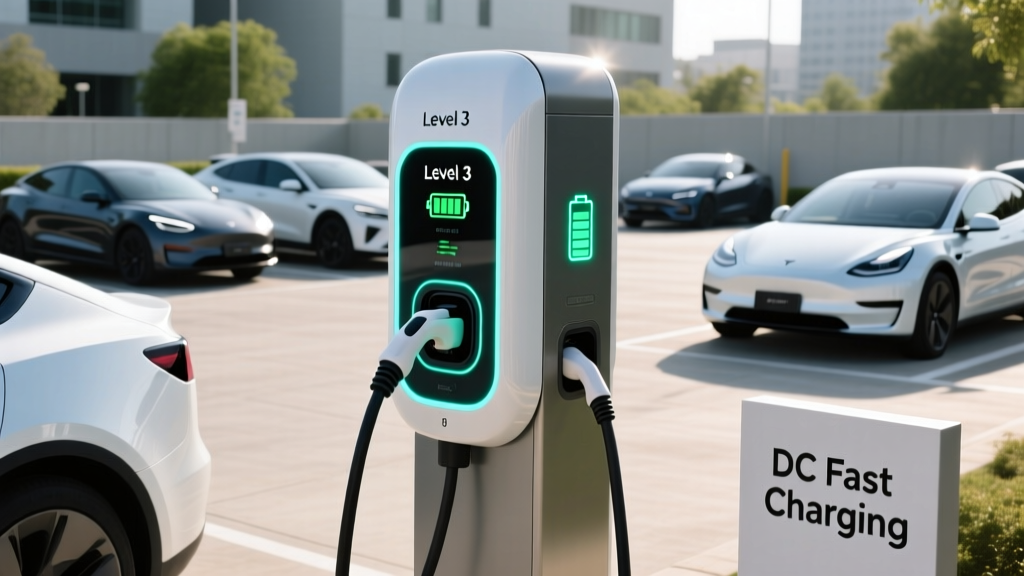
If you've searched for home charging solutions, you've likely encountered the term "Level 3 car charger" and wondered if it's something you can install in your garage. The short answer: no. A Level 3 car charger — more accurately called a DC fast charger (DCFC) — is commercial-grade equipment that delivers direct current (DC) straight to your EV's battery, bypassing the vehicle's onboard charger entirely. These stations operate at 50 kW to 400+ kW and are the massive cabinets you see at highway rest stops and Electrify America or Tesla Supercharger plazas.
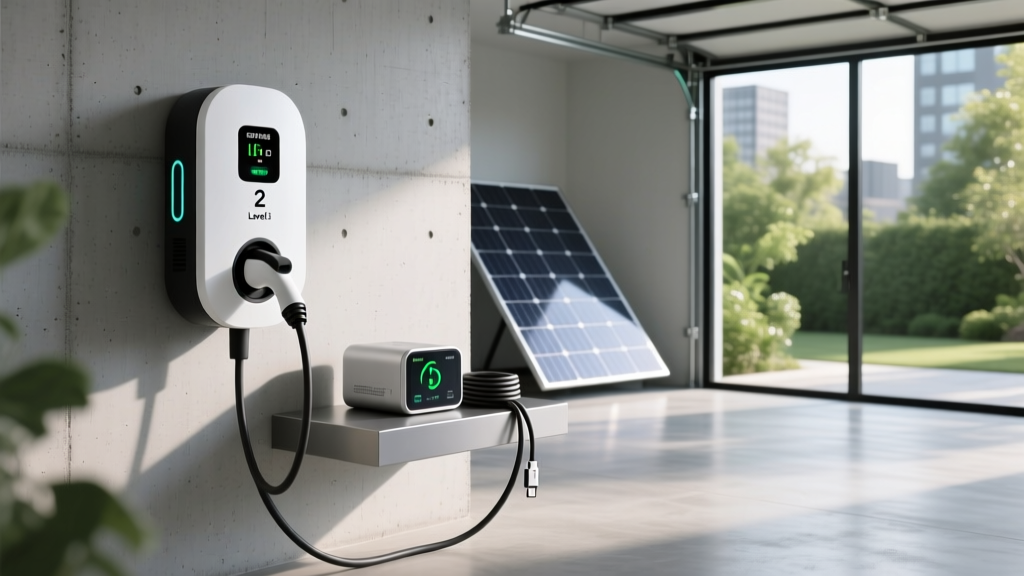
For home use, you're looking at Level 1 (120V standard outlet) or Level 2 (240V dedicated circuit). But understanding Level 3 is essential for road trips, for sizing your EV's fast-charging capability, and for knowing what you're paying for at public stations. Let's map out every charging tier with exact numbers.
Charging Levels Compared: Speeds, Power, and Range Added
The single most important distinction in EV charging: kW (kilowatts) measures power — the rate of energy delivery, while kWh (kilowatt-hours) measures energy — the total amount stored in your battery. Think of kW as the width of a pipe and kWh as the size of the tank you're filling. Confusing these two is the most common EV literacy mistake, and it leads to wildly wrong expectations about charging time and cost.
| Level | Voltage / Current | Max Power (kW) | Miles of Range Added per Hour | Typical Use Case |
|---|---|---|---|---|
| Level 1 | 120V / 12A | ~1.4 kW | 3–5 mi/hr | Overnight trickle; PHEVs, low-mileage drivers |
| Level 2 | 240V / 32–48A | 7.7–11.5 kW | 25–44 mi/hr | Primary home charging; workplace; destination |
| Level 3 (DC Fast) | 400–800V DC | 50–400 kW | 150–1,200+ mi/hr (peak) | Highway road trips; commercial fleets |
A few critical caveats on these numbers. Level 2 range-per-hour assumes an efficient sedan like the Hyundai Ioniq 6 (~4.0 mi/kWh); a heavy truck like the Rivian R1T will yield fewer miles per kWh and therefore fewer miles per hour of charging. Level 3 "miles per hour" figures are peak rates sustained only briefly — the actual charging curve tapers significantly above 80% State of Charge (SoC), which is why the industry measures DC fast charging in 10–80% time, not 0–100%.
Level 3 DC Fast Charging: Real-World Times for Common EVs
Not all EVs accept the same DC fast-charging rate, and your vehicle's onboard battery management system (BMS) limits how much power it will accept regardless of how powerful the station is. Plugging a Chevy Equinox EV (max ~150 kW peak) into a 350 kW Electrify America stall won't charge it any faster than a 150 kW stall.
Here are representative 10–80% DC fast-charge times for popular 2025–2026 EVs, based on manufacturer data and independent testing:
| Vehicle | Battery (kWh usable) | Peak DC Rate (kW) | 10–80% Time | Notes |
|---|---|---|---|---|
| Hyundai Ioniq 5 (Long Range) | 77.4 (NMC) | 240 (800V architecture) | ~18 min | Sustains high rate to ~65% SoC |
| Tesla Model Y (Long Range) | ~75 (NMC) | 250 (V3 Supercharger) | ~25 min | Tapers above 55% |
| Ford F-150 Lightning (Ext. Range) | 131 (NMC) | 150 | ~41 min | Large battery = longer session |
| Chevy Equinox EV (3RS) | ~85 (NMC) | 150 | ~30 min | Acceptable but not class-leading |
| BMW iX xDrive50 | 105.2 (NMC) | 200 | ~31 min | Strong mid-curve sustain |
Home Charging Installation: What Level 2 Actually Requires
Since you can't install a Level 3 car charger at home (the electrical service required would be industrial — think 480V three-phase power and equipment costing $20,000–$100,000+), your home investment focuses on Level 2. Here's what that involves electrically and financially.
Electrical Requirements
A Level 2 home charger requires a dedicated 240V circuit, identical in concept to what powers your electric dryer or oven. The most common configurations:
- 40-amp circuit / 32-amp continuous draw: Delivers 7.7 kW. Sufficient for most EVs with smaller batteries or overnight charging needs. Requires a NEMA 14-50 outlet or hardwired connection.
- 50-amp circuit / 40-amp continuous: Delivers 9.6 kW. The sweet spot for most buyers.
- 60-amp circuit / 48-amp continuous: Delivers 11.5 kW. Maximum for most residential chargers. Requires robust panel capacity.
The National Electrical Code (NEC) requires that continuous loads (anything running 3+ hours, which includes EV charging) use only 80% of a circuit's rated capacity. So a 50-amp breaker safely delivers 40 amps continuous. Your electrician will calculate this — don't try to oversize the load yourself.
Panel Upgrade Reality
Homes built before 2000 often have 100-amp or 150-amp main electrical panels. Adding a 50-amp EV circuit to an already-loaded panel may require a panel upgrade to 200 amps, which is the single largest variable in installation cost. Signs you may need an upgrade:
- Your panel is already near capacity (electric heat, electric water heater, electric dryer, electric range all running)
- You have a 100-amp main breaker
- Your panel is a recalled Federal Pacific or Zinsco unit (these need replacement regardless)
- Your utility service drop can't support 200A (rare, but possible in older neighborhoods)
Installation Cost Breakdown
| Component | Basic Install (Near Panel) | Complex Install (Far Run / Upgrade) |
|---|---|---|
| Level 2 Charger (Equipment) | $400–$650 | $500–$750 |
| Electrician Labor | $300–$600 | $800–$2,000 |
| Permit & Inspection | $50–$150 | $100–$300 |
| Wiring / Conduit Materials | $50–$150 | $200–$600 |
| Panel Upgrade (if needed) | $0 | $1,500–$3,500 |
| Total Estimated Cost | $800–$1,550 | $3,100–$7,150 |
Always get a detailed quote from a licensed electrician who will perform a load calculation on your panel. Some utilities offer rebates of $250–$1,000 for home charger installation — check with your local provider. For final electrical specifications and permit requirements in your jurisdiction, consult your local building department, as codes vary by municipality.
Connector Compatibility: NACS, CCS1, and CHAdeMO
The connector landscape in North America has undergone a seismic shift. As of 2025–2026, the North American Charging Standard (NACS), developed by Tesla, has been adopted by nearly every major automaker for new vehicles. Here's where things stand:
| Connector | Brands Using It (New Vehicles) | Adapter Needed? |
|---|---|---|
| NACS (Tesla-style) | Tesla (all), Ford, GM, Rivian, Volvo, Polestar, Mercedes, BMW, Hyundai/Kia (2025+), Toyota, Subaru, Lucid, Fisker | CCS-to-NACS adapter for legacy CCS stations (~$150–$250) |
| CCS1 (Combo) | Legacy models (2024 and earlier from most non-Tesla brands), VW ID.4 (pre-2025 refresh), some Stellantis models | NACS-to-CCS adapter to use Tesla Superchargers (where permitted) |
| CHAdeMO | Nissan Leaf (discontinued), Mitsubishi Outlander PHEV (legacy) | Limited adapter options; network shrinking |
If you're buying a 2025 or 2026 model-year EV, it almost certainly has a NACS port or will have one imminently. For Level 3 DC fast charging at home-impossible stations, this means you'll plug directly into Tesla Superchargers and the growing number of NACS-equipped Electrify America, EVgo, and ChargePoint stalls. If you own a CCS-equipped vehicle, manufacturers like Ford and GM provide or sell adapters for Supercharger access — confirm compatibility with your specific model year on the manufacturer's site.
Cost to Charge: Per-Mile Economics vs. Gasoline
One of the strongest ownership arguments for an EV is fuel cost savings, but the actual number depends heavily on where and when you charge. Here's a realistic breakdown using a 2026 Hyundai Ioniq 5 (EPA combined efficiency of ~3.6 mi/kWh, per fueleconomy.gov) as our baseline:
| Scenario | Price per kWh | Cost per Mile (Ioniq 5) | Equivalent Gas MPG (at $3.50/gal) |
|---|---|---|---|
| Home — Off-peak utility rate | $0.08–$0.12 | $0.022–$0.033 | 106–159 MPG |
| Home — Standard residential rate | $0.14–$0.18 | $0.039–$0.050 | 70–90 MPG |
| Home — Peak / time-of-use high | $0.25–$0.35 | $0.069–$0.097 | 36–51 MPG |
| Public Level 2 (ChargePoint, etc.) | $0.20–$0.35 | $0.056–$0.097 | 36–63 MPG |
| Level 3 DC Fast (Electrify America, EVgo) | $0.35–$0.55 | $0.097–$0.153 | 23–36 MPG |
| Tesla Supercharger (varies by location) | $0.25–$0.40 | $0.069–$0.111 | 32–51 MPG |
For comparison, a 30 MPG gas sedan at $3.50/gallon costs $0.117 per mile. Home charging almost always wins decisively — even at peak rates, you're roughly breaking even with a fuel-efficient gas car. But exclusive reliance on Level 3 DC fast charging at public rates can approach or exceed gasoline costs, which is why home charging access remains the single biggest factor in EV satisfaction.
Also factor in that many utilities offer dedicated EV time-of-use (TOU) rates with off-peak prices as low as $0.05–$0.08/kWh overnight. If your utility offers this, it's the cheapest "fuel" available for personal transportation.
Recommended Home Level 2 Chargers (2025–2026)
Since Level 3 car chargers aren't a home option, here are top-performing Level 2 units worth considering. All are Wi-Fi-enabled for scheduling, energy tracking, and utility demand-response programs.
ChargePoint Home Flex
- Power: Up to 11.5 kW (48A) on a 60A circuit; configurable down to 16A
- Connector: NACS or J1772 (select at purchase)
- Cable Length: 23 ft
- Smart Features: App scheduling, energy tracking, Alexa, utility integration
- Price: ~$550–$650
- Best For: Flexibility across amperage; strong app ecosystem
Tesla Wall Connector
- Power: Up to 11.5 kW (48A) on a 60A circuit
- Connector: NACS (native); J1772 adapter included for non-Tesla EVs
- Cable Length: 24 ft
- Smart Features: Wi-Fi updates, power sharing (multiple units on one circuit), load management
- Price: ~$475
- Best For: Tesla owners; excellent value; multi-charger garages
Emporia Level 2 Smart Charger
- Power: Up to 11.5 kW (48A)
- Connector: J1772 (NACS adapter available)
- Cable Length: 24 ft
- Smart Features: Detailed energy monitoring, solar integration, off-peak scheduling, V2H-ready ecosystem
- Price: ~$400–$500
- Best For: Budget-conscious buyers; solar panel owners; energy nerds
All three units carry NEMA 4 (outdoor-rated) enclosures, are UL-listed for safety, and support hardwired installation (preferred for highest amperage) or NEMA 14-50 plug connection. Hardwired installations avoid the NEC requirement for GFCI breakers on receptacle outlets — a detail your electrician will handle, but one that can save $50–$100 on breaker cost and eliminate nuisance tripping.
Safety, Code, and Installation Best Practices
EV charging is a continuous, high-draw electrical load that runs for hours — often unattended overnight. Cutting corners is not an option. Key safety and code requirements:
- Dedicated circuit: Your Level 2 charger must be on its own breaker, not shared with other appliances. A 50A or 60A double-pole breaker in your panel is standard.
- GFCI protection: NEC 2020 and later requires GFCI protection for 240V receptacles used for EV charging (NEMA 14-50). Hardwired installations are exempt from this requirement. GFCI breakers for 50–60A circuits cost $80–$150 and can be sensitive to false trips — another reason many electricians prefer hardwiring.
- Outdoor rating: If your charger is mounted outside or in an unsealed garage, ensure it carries a NEMA 4 or NEMA 4X rating for weather resistance.
- Wire gauge: 6 AWG copper for 50A circuits; 4 AWG for 60A circuits over longer runs. Your electrician will size wire based on circuit length and voltage drop calculations.
- Permit and inspection: Virtually all jurisdictions require an electrical permit for a new 240V circuit. The inspection ensures proper grounding, correct breaker sizing, and code compliance. Skipping this can void homeowner's insurance coverage for electrical fires.
- Cable management: Use a wall-mounted holster or retractable cable reel to keep the charging cable off the garage floor and protected from vehicle traffic.
Frequently Asked Questions
How much does it cost to install a home EV charger?
A straightforward Level 2 installation (charger mounted near the electrical panel, no panel upgrade) typically costs $800–$1,550 including equipment, electrician labor, permit, and materials. Complex installations with long wire runs or a required panel upgrade can range from $3,100–$7,150. A Level 3 car charger cannot be installed in a residential setting — the power requirements and equipment cost make it exclusively commercial infrastructure.
How fast will each charging level add range?
Level 1 (120V) adds roughly 3–5 miles of range per hour — adequate for plug-in hybrids with small batteries but impractical for full EVs. Level 2 (240V, 48A) adds 25–44 miles per hour depending on vehicle efficiency, fully replenishing most EVs overnight in 8–10 hours. Level 3 DC fast charging adds 150–1,200+ miles per hour at peak rates, delivering a 10–80% charge in 18–45 minutes depending on the vehicle and station power.
Which connector/charger is compatible with my EV?
For 2025–2026 model-year vehicles, check your EV's charge port: most new models now use NACS (the Tesla-standard connector). Older or carryover models may still use CCS1. The Nissan Leaf uses CHAdeMO. For home Level 2 charging, buy a charger matching your vehicle's connector — or use a J1772-to-NACS adapter if your car has a NACS port and you purchase a J1772 charger. Consult your vehicle manufacturer's charging specifications page for the definitive answer.
How much does charging cost per mile vs. gas?
Home charging at average residential rates ($0.14–$0.18/kWh) costs approximately $0.04–$0.05 per mile in an efficient EV — roughly equivalent to a gas car getting 70–90 MPG at $3.50/gallon. Off-peak utility rates can drop this to $0.02–$0.03 per mile. Exclusive reliance on public Level 3 DC fast charging at $0.35–$0.55/kWh raises costs to $0.10–$0.15 per mile, approaching or exceeding gasoline costs. Home charging access is the key to EV fuel savings.
What electrical upgrades might I need?
The most common upgrade is a main panel replacement from 100A or 150A to 200A service, costing $1,500–$3,500. This is needed when your existing panel lacks capacity for a new 50–60A circuit. Other potential upgrades include: replacing recalled Federal Pacific or Zinsco panels (mandatory), upgrading the utility service drop (rare, handled by your utility), or adding a sub-panel in a detached garage ($500–$1,500). A licensed electrician's load calculation will determine exactly what's needed before any work begins.
Can I use a Level 3 car charger at home?
No. Level 3 DC fast chargers require 480V three-phase power, draw 50–400+ kW, and cost $20,000–$100,000+ for the equipment alone — before the utility infrastructure upgrades needed to deliver that power. Residential electrical service in the US is 240V single-phase, typically 200A maximum, which can supply about 48 kW total to the entire home. Level 3 charging is exclusively public/commercial infrastructure. For home use, a properly installed Level 2 charger covers 90%+ of most EV owners' charging needs.