Buying an electric vehicle is only half the equation. The other half — where, how, and how fast you charge — determines whether EV ownership feels effortless or frustrating. Whether you're evaluating your first charger for a new EV or you're a challenger to the status quo comparing electrified commuting against gasoline, this guide gives you the exact numbers to plan your charging life in 2026.
We'll break down charging levels with real kW figures and miles-per-hour, home installation costs including panel upgrades, the NACS/CCS/CHAdeMO connector landscape, equipment picks, and a honest cost-per-mile comparison against gas. No fluff, no hype — just the data you need.
Charging Levels Explained: kW Speeds and Range Added Per Hour
Before comparing equipment, you need to understand the three charging tiers. The single most important distinction in EV literacy is kW (kilowatts) = power, the rate of energy flow, versus kWh (kilowatt-hours) = energy, the total capacity of your battery. A 77 kWh battery charged at 11 kW takes roughly 7 hours from empty to full. A 250 kW DC fast charger can refill that same battery to 80% in about 25 minutes.
| Level | Voltage | Power (kW) | Miles of Range Added/Hour | Best Use Case |
|---|---|---|---|---|
| Level 1 | 120V AC | 1.0–1.4 kW | 3–5 mi/hr | Overnight top-off, PHEVs, low-mileage drivers |
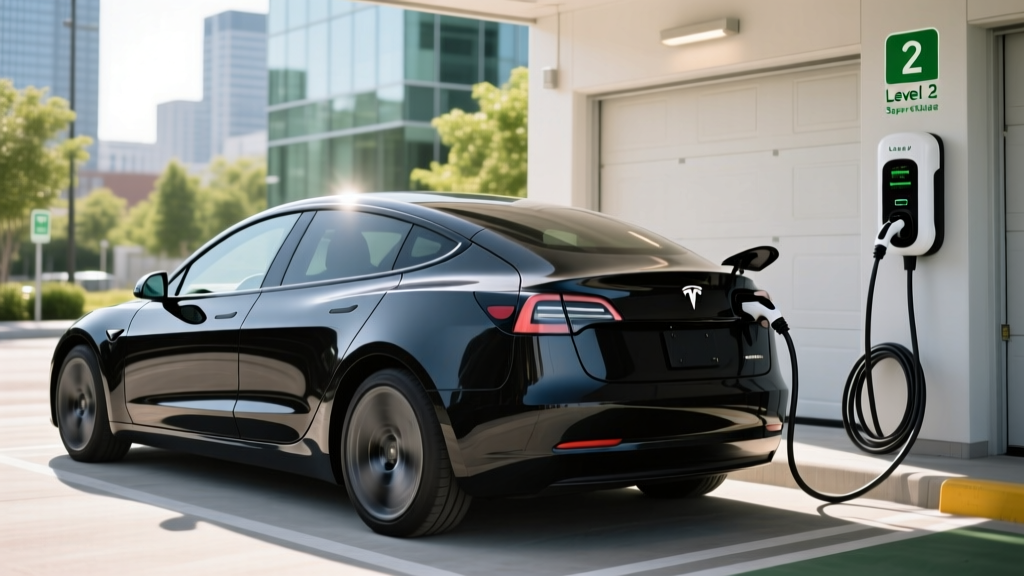
| Level 2 | 240V AC | 3.3–19.2 kW | 12–75 mi/hr | Home daily charging, workplace, destinations |
| DC Fast Charging (Level 3) | 400–900V DC | 50–350 kW | 150–1,000+ mi/hr (peak) | Road trips, highway corridors, quick top-ups |
Most EV batteries range from 50 kWh (Chevrolet Equinox EV) to 131 kWh (Ford F-150 Lightning Extended Range). A typical Level 2 home charger at 11.5 kW adds about 40–44 miles of range per hour for a midsize sedan like the Tesla Model 3 or Hyundai IONIQ 6, which means an overnight session of 8 hours fully replenishes most daily driving needs several times over.
- Tesla Model 3 Long Range (79 kWh, NMC): ~18 min at 250 kW Supercharger; ~6.5 hrs at 11.5 kW home Level 2
- Hyundai IONIQ 5 (77.4 kWh, NMC, 800V architecture): ~18 min at 350 kW Electrify America; ~6 hrs at 11.5 kW home Level 2
- Ford F-150 Lightning Extended Range (131 kWh, NMC): ~41 min at 150 kW DC fast; ~10.5 hrs at 11.5 kW home Level 2
DC fast charging times assume optimal battery temperature and preconditioning. Charging slows significantly above 80% SoC to protect battery health — this is called the charge curve taper. Plan road-trip stops around 10–80% windows, not 0–100%.
Home EV Charger Installation: Costs, Electrical Requirements, and Panel Upgrades
How much does it cost to install a home EV charger? The honest answer ranges from $500 for a simple plug-in setup to $3,200+ if your home needs a panel upgrade. Here's the full breakdown.
Electrical Requirements for Level 2 Home Charging
A standard Level 2 home charger requires a 240-volt dedicated circuit, similar to what an electric dryer or oven uses. The most common residential setup is a 40-amp circuit supporting a 32-amp continuous charger (the National Electrical Code requires circuits be rated at 125% of continuous load). This delivers up to 7.7 kW.
For faster charging, a 60-amp circuit with a 48-amp charger delivers 11.5 kW — the sweet spot for most EV owners. High-output chargers like the Tesla Wall Connector can draw up to 19.2 kW on an 80-amp circuit, but most homes lack the spare capacity without a panel upgrade.
Installation Cost Breakdown
| Component | Simple Install (Panel Adjacent) | Moderate Install (50–80 ft run) | Complex Install (Panel Upgrade + Long Run) |
|---|---|---|---|
| Level 2 Charger Equipment | $250–$600 | $250–$600 | $250–$600 |
| Electrician Labor | $300–$600 | $600–$1,500 | $1,200–$2,500 |
| Permit & Inspection | $50–$150 | $50–$200 | $100–$300 |
| Panel Upgrade (if needed) | $0 | $0 | $1,500–$3,000 |
| Conduit, Wiring, Misc. | $50–$100 | $150–$400 | $300–$700 |
| Total Estimated Cost | $650–$1,450 | $1,050–$2,700 | $3,350–$7,100 |
What electrical upgrades might you need? Older homes with 100-amp electrical service panels often lack the spare capacity for a 40- or 60-amp EV circuit, especially if you already run electric heat, a dryer, and an electric range. A licensed electrician will perform a load calculation per NEC Article 220 to determine whether your panel can handle the added draw. If not, a 200-amp panel upgrade costs $1,500–$3,000 but increases your home's resale value and future-proofs for additional electrification (heat pumps, solar).
Connector Compatibility: NACS, CCS, and CHAdeMO in 2026
Which connector/charger is compatible with your EV? The North American connector landscape has consolidated significantly. Tesla's NACS (North American Charging Standard) is now the dominant connector, adopted by Ford, GM, Rivian, Volvo, Hyundai/Kia, and most other automakers starting with 2025–2026 model-year vehicles.
| Connector Type | Brands Using It (2026) | Public Network Access | Adapter Needed? |
|---|---|---|---|
| NACS (Tesla) | Tesla, Ford, GM, Rivian, Volvo, Polestar, Hyundai, Kia, Genesis, BMW, Mercedes, Nissan (Ariana) | Tesla Superchargers + growing NACS stations on EA, ChargePoint, EVgo | CCS-to-NACS adapters available for older CCS vehicles (~$200–$300) |
| CCS1 (Combo) | Legacy models: pre-2025 VW ID.4, older BMW i4, Stellantis EVs, some Honda Prologue early builds | Electrify America, EVgo, ChargePoint, most non-Tesla networks | NACS-to-CCS adapters for Tesla Supercharger access |
| CHAdeMO | Nissan Leaf (discontinued), Mitsubishi Outlander PHEV (legacy) | Declining availability; some EA and EVgo stations retain one cable | No adapter available for DC fast; use CCS/NACS networks with adapter |
For home Level 2 charging, all vehicles use the J1772 connector — or a NACS connector that is backward-compatible with J1772 for AC charging (Tesla's design). This means any J1772 Level 2 charger will work with every EV sold in the US, with Tesla vehicles using a simple J1772-to-NACS adapter (included with most Teslas).
If you're buying a new EV in 2026, choose a NACS-equipped model for maximum future-proofing. If you own a CCS vehicle, budget $200–$300 for a quality CCS-to-NACS adapter (Ford and GM provide these free to some owners) to unlock the Tesla Supercharger network, which remains the most reliable DC fast-charging infrastructure in the US with over 25,000 stalls.
Cost to Charge: Home vs. Public vs. Gas — The Per-Mile Breakdown
How much does charging cost per mile vs gas? This is where EV ownership economics shine — but the savings depend heavily on where you charge.
| Charging Scenario | Avg. Cost per kWh | Cost per Mile (at 3.5 mi/kWh efficiency) | Annual Fuel Cost (12,000 mi/yr) |
|---|---|---|---|
| Home Level 2 — Off-Peak TOU Rate | $0.08–$0.12/kWh | $0.023–$0.034/mi | $275–$410 |
| Home Level 2 — Standard Residential Rate | $0.14–$0.18/kWh | $0.040–$0.051/mi | $480–$615 |
| Public Level 2 (ChargePoint, EVgo) | $0.25–$0.49/kWh | $0.071–$0.140/mi | $855–$1,680 |
| DC Fast Charging (EA, Supercharger) | $0.32–$0.55/kWh | $0.091–$0.157/mi | $1,095–$1,885 |
| Gasoline (25 MPG combined, $3.40/gal) | $3.40/gallon | $0.136/mi | $1,632 |
| Gasoline (30 MPG combined, $3.40/gal) | $3.40/gallon | $0.113/mi | $1,360 |
Home charging on an off-peak time-of-use (TOU) rate plan delivers the most dramatic savings — roughly $1,200–$1,350 per year less than a 25 MPG gas car. Even on standard residential rates, home-charged EVs cost 60–70% less per mile than gasoline.
However, exclusive reliance on DC fast charging erases most of the cost advantage. If you lack home charging access and rely entirely on public DC fast chargers at $0.45/kWh, your annual "fuel" cost approaches $1,500–$1,900 — comparable to an efficient gas car. This is why home charging access is the single most important factor in EV ownership satisfaction.
According to fueleconomy.gov, the average EV achieves 3–4 miles per kWh. A Tesla Model 3 achieves roughly 4.0 mi/kWh (132 MPGe combined), while a Ford F-150 Lightning achieves about 2.1 mi/kWh (70 MPGe). Adjust the per-mile figures above based on your specific vehicle's efficiency.
Best Level 2 Home EV Chargers for 2026: Equipment Picks
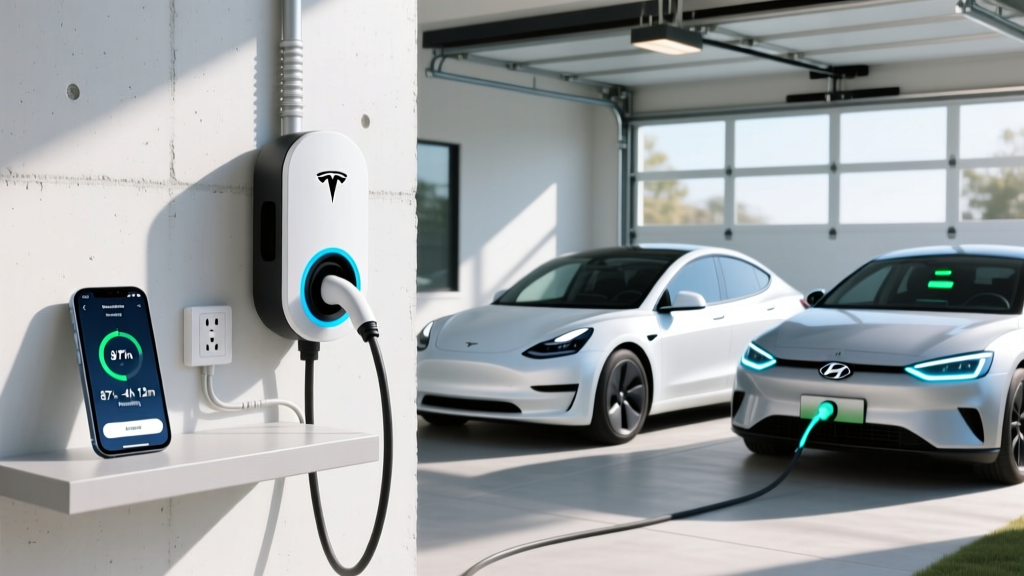
When choosing a home charger, the key specs are power output (kW), connector type, cable length, smart features (Wi-Fi scheduling, load management), and hardwired vs. plug-in installation. Here are our top picks based on real-world testing and current availability.
Tesla Wall Connector (J3400/NACS)
- Power Output: Up to 19.2 kW (80A circuit) / 11.5 kW (60A circuit)
- Connector: NACS (native); J1772 adapter available
- Cable Length: 24 ft
- Smart Features: Wi-Fi, OTA updates, Power Sharing (link up to 6 units on one circuit), Tesla app integration
- Price: ~$475
- Best For: Tesla owners, NACS-equipped Ford/GM/Rivian owners
ChargePoint Home Flex
- Power Output: Up to 12 kW (50A circuit, adjustable down to 16A)
- Connector: J1772 (NACS adapter included)
- Cable Length: 23 ft
- Smart Features: Wi-Fi, ChargePoint app, Alexa integration, flexible amperage dial for panel-constrained homes
- Price: ~$599
- Best For: Universal compatibility, older electrical panels (adjustable amperage)
Emporia Level 2 EV Charger
- Power Output: Up to 11.5 kW (48A, 60A circuit)
- Connector: J1772
- Cable Length: 24 ft
- Smart Features: Wi-Fi, Emporia energy monitoring integration, solar-aware scheduling, load management
- Price: ~$399
- Best For: Budget-conscious buyers, solar-panel homes, energy monitoring
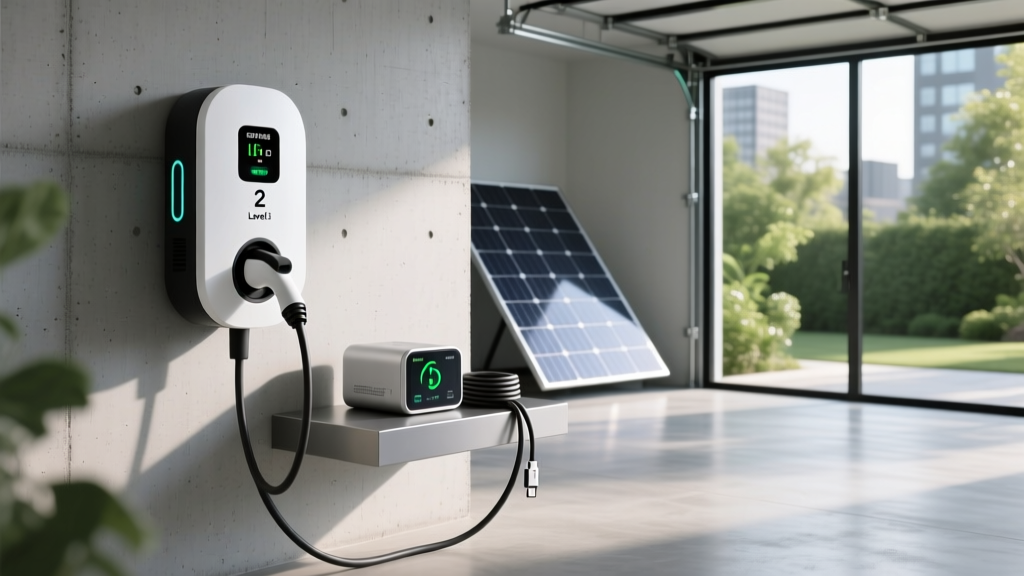
For homes with limited panel capacity, the ChargePoint Home Flex's adjustable amperage (set it to 24A or 32A on a 30A or 40A circuit) makes it the safest choice without a panel upgrade. The Emporia charger stands out for homes with solar panels — its integration with the Emporia Vue energy monitor lets you schedule charging to coincide with solar production, effectively charging for free during peak sun hours.
Safety, Electrical Code, and Installation Best Practices
EV charging draws sustained high current for hours — this is fundamentally different from intermittent loads like a microwave. Proper installation is non-negotiable for safety.
- Dedicated Circuit: Your Level 2 charger must be on its own dedicated circuit — never shared with other appliances. A 60A charger needs a dedicated 60A breaker.
- GFCI Protection: The 2023 NEC (adopted by most jurisdictions by 2026) requires GFCI protection for outdoor EV charging outlets. Hardwired chargers may be exempt in some jurisdictions — confirm with your local inspector.
- Outdoor Rating: If installing outdoors, ensure the charger carries a NEMA 4 (weather-resistant) rating. All major chargers (Tesla Wall Connector, ChargePoint Home Flex, Emporia) are rated for outdoor use.
- Wire Gauge: A 60A circuit requires 6 AWG copper wire (THHN in conduit or NM-B cable rated for 60°C terminations). Your electrician will size wire per NEC Table 310.16 based on run length and ambient temperature.
- Permit & Inspection: Every jurisdiction requires an electrical permit for EV charger installation. The inspection verifies wire sizing, breaker rating, grounding, and GFCI compliance. Never skip this step — unpermitted work can void homeowner's insurance claims.
- Cable Management: Use a wall-mounted cable organizer or retractable reel to keep the charging cable off the ground. This prevents tripping hazards and protects the cable from abrasion and moisture.
For NHTSA-listed safety information on EV charging equipment, look for chargers with UL certification (UL 2202 for EV charging equipment, UL 2594 for the supply cord). All reputable brands carry UL listing — avoid unbranded chargers from online marketplaces that lack third-party safety certification.
Frequently Asked Questions
How much does it cost to install a home EV charger?
A typical Level 2 home charger installation costs between $1,050 and $2,700 when your electrical panel has sufficient capacity. This includes $250–$600 for the charger, $600–$1,500 for electrician labor, $50–$200 for permits, and $150–$400 for wiring and conduit. If your panel needs upgrading from 100A to 200A service, add $1,500–$3,000.
How fast will each charging level add range?
Level 1 (120V) adds 3–5 miles per hour — adequate for PHEVs with small batteries or drivers covering under 30 miles daily. Level 2 (240V) at 11.5 kW adds 40–44 miles per hour for a midsize sedan, fully replenishing a 75 kWh battery overnight. DC fast charging at 150–250 kW can add 150–300+ miles in 20–30 minutes, depending on battery size and charge-curve taper.
Which connector is compatible with my EV?
All 2026-model EVs from Tesla, Ford, GM, Rivian, Hyundai, Kia, Volvo, BMW, and most others now use NACS. Older CCS-equipped vehicles (2024 and earlier VW ID.4, older BMW i4) can use CCS-to-NACS adapters (~$200–$300) to access the Tesla Supercharger network. For home Level 2 charging, all EVs accept J1772 — Tesla includes a J1772-to-NACS adapter in the glovebox.
How much does EV charging cost per mile compared to gas?
Home charging on off-peak rates costs $0.023–$0.034 per mile — roughly 75% less than a 25 MPG gas car at $3.40/gallon ($0.136/mile). Even on standard residential rates ($0.14–$0.18/kWh), EVs cost $0.040–$0.051 per mile. Public DC fast charging at $0.32–$0.55/kWh narrows the gap to $0.091–$0.157 per mile, approaching gas-car costs.
What electrical upgrades might I need for a home charger?
If your home has a 100-amp electrical panel or if your existing loads (electric heat, dryer, range, water heater) already consume most of your panel's capacity, you'll likely need a 200-amp panel upgrade ($1,500–$3,000). A licensed electrician performs a NEC Article 220 load calculation to determine this. Some utilities offer rebates for panel upgrades paired with EV adoption. An alternative is a smart load-management device like the Emporia Smart Load Management system, which dynamically throttles charger amperage when other high-draw appliances are running — potentially avoiding a panel upgrade entirely.
Can I charge my EV with a standard 120V outlet?
Yes, but slowly. Level 1 charging at 120V/12A delivers about 1.4 kW, adding 3–5 miles of range per hour. For a 75 kWh battery, a full charge from empty takes 50+ hours. Level 1 works well for PHEVs with 25–40 miles of electric range (they recharge in 5–8 hours) or for BEV owners who drive less than 30 miles daily and can top off overnight. For any BEV driver covering more than 40 miles daily, Level 2 is essential.
For the latest federal incentive information related to EV ownership, consult the IRS Clean Vehicle Credit page — while the §30D credit applies to vehicle purchase rather than home charging equipment, understanding total incentive eligibility is key to your overall EV economics.