Why a Level 3 Autonomous Cars List Matters for EV Owners in 2026
Searches for a level 3 autonomous cars list have surged as automakers finally bring conditional automation to production vehicles. But before you chase the technology, there's a more immediate question that determines whether owning an advanced EV is practical: how will you charge it? Whether you drive a Level 3-capable Mercedes EQS Sedan with Drive Pilot or a hands-on Level 2 EV like the Hyundai Ioniq 6, the charging infrastructure you set up at home and understand on the road dictates your daily experience far more than any automation feature.
This guide bridges both worlds. We'll clarify what Level 3 autonomy actually means (and which cars qualify), then deliver the complete EV charging breakdown — from Level 1 trickle charging to 350 kW DC fast charging — with exact costs, install requirements, and equipment picks for 2026.
- Level 0: No automation (warnings only)
- Level 1: Single-axis assist (adaptive cruise OR lane centering)
- Level 2: Combined assist (cruise + lane centering) — driver must supervise at all times. Includes Tesla Autopilot/FSD Supervised, GM Super Cruise, Ford BlueCruise.
- Level 3: Conditional automation — the car handles all driving in defined conditions; driver can disengage but must take over when requested.
- Level 4: High automation in geofenced areas — no driver needed (Waymo, Zoox robotaxis).
- Level 5: Full automation everywhere — does not yet exist in production.
The 2026 Level 3 Autonomous Cars List
As of early 2026, the list of production vehicles with certified Level 3 capability remains short. Most "self-driving" marketing still refers to Level 2 systems that require constant driver supervision. Here's what actually qualifies:
| Vehicle | System Name | Level | Conditions | Max Speed | Availability |
|---|---|---|---|---|---|
| Mercedes-Benz EQS Sedan (2025-2026) | Drive Pilot | SAE Level 3 | Mapped divided highways, clear weather, daylight | ~40 mph (US) / 60 km/h (EU expanded) | California & Nevada (US); Germany |
| Mercedes-Benz S-Class (2025-2026) | Drive Pilot | SAE Level 3 | Same as EQS | ~40 mph | California & Nevada |
| BMW 7 Series / i7 (2025-2026) | Personal Pilot L3 | SAE Level 3 | Highway traffic jams, mapped routes | ~37 mph (60 km/h) | Germany (US approval pending) |
| Honda Legend (Japan-only) | Honda SENSING Elite | SAE Level 3 | Traffic jams below 19 mph | ~19 mph | Japan (lease only) |
EV Charging Levels Explained: kW, Miles Per Hour, and Real Charge Times
Regardless of whether your EV has Level 2 driver-assist or Level 3 conditional automation, it charges on one of three levels. Understanding the difference between kW (kilowatts) — the rate of power delivery — and kWh (kilowatt-hours) — the energy stored in your battery — is essential. Think of kW as the width of a hose and kWh as the size of the bucket you're filling.
| Level | Voltage | Power (kW) | Miles of Range Added Per Hour | Best For |
|---|---|---|---|---|
| Level 1 | 120V AC | 1.0–1.9 kW | 3–5 miles/hr | Overnight top-ups, PHEVs, low daily mileage |
| Level 2 | 240V AC | 3.3–19.2 kW | 12–75 miles/hr | Daily home/work charging (primary method for most owners) |
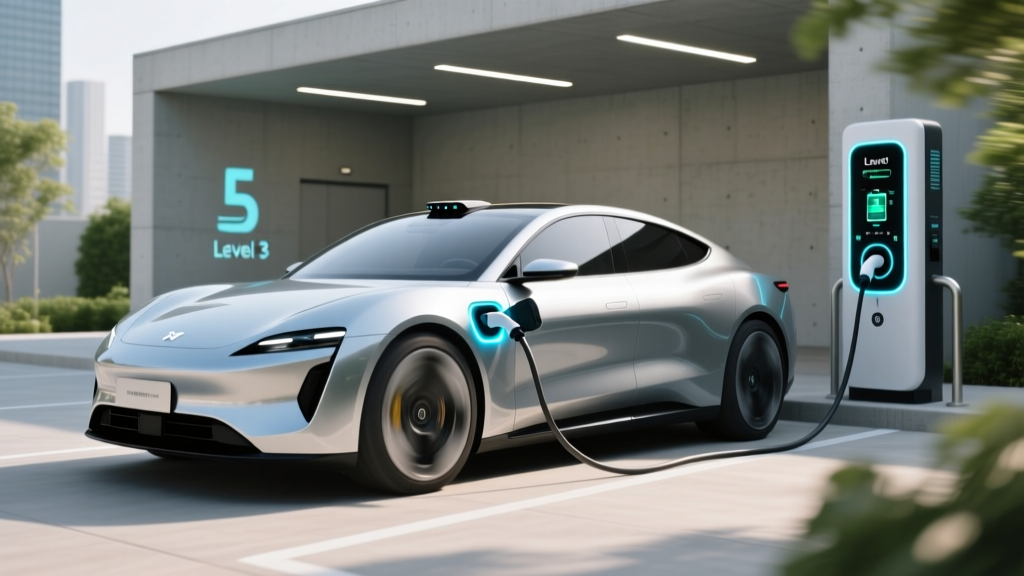
| DC Fast Charge (Level 3) | 200–800V DC | 50–350 kW | 150–1,200+ miles/hr (peak) | Road trips, quick top-ups away from home |
Real-World Charging Time Examples (10-80% SoC)
Charging slows significantly above 80% state of charge (SoC) to protect the battery — this is called the charge curve taper. Here's what to expect for common battery sizes:
- 60 kWh battery (e.g., base Tesla Model 3 RWD): ~20 min at a 250 kW Supercharger; ~8.5 hours on a 7.2 kW Level 2 home charger
- 77 kWh battery (e.g., Hyundai Ioniq 5 Long Range): ~18 min at a 350 kW charger (800V architecture); ~10.5 hours on 7.2 kW Level 2
- 100 kWh battery (e.g., Mercedes EQS 580): ~31 min at a 200 kW charger; ~14 hours on 7.2 kW Level 2
- 131 kWh battery (e.g., Ford F-150 Lightning Extended Range): ~41 min at a 150 kW charger; ~18 hours on 7.2 kW Level 2
Source: EPA and manufacturer data via fueleconomy.gov.
Home Charger Installation: Electrical Requirements, Costs, and Panel Upgrades
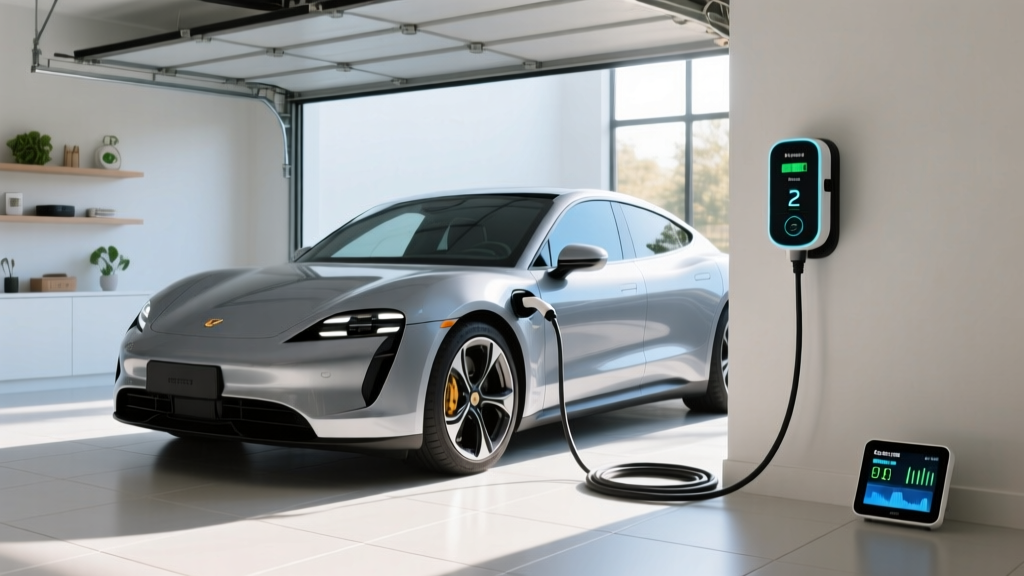
Installing a Level 2 home charger is the single biggest ownership decision you'll make. It determines your daily convenience, your electricity cost, and whether you need to upgrade your home's electrical panel.
Electrical Requirements
Most Level 2 chargers require a dedicated 240V circuit. Common configurations:
- 32A circuit (7.7 kW output): Requires a 40A breaker (NEC rule: continuous loads capped at 80% of breaker rating). Suitable for most daily driving needs.
- 40A circuit (9.6 kW output): Requires a 50A breaker. Faster charging for larger batteries.
- 48A circuit (11.5 kW output): Requires a 60A breaker. Maximum for most residential chargers; ideal for high-capacity EVs like the F-150 Lightning.
- 60A circuit (14.4 kW output): Requires a 75A or 80A breaker. Typically needs a 200A+ electrical panel with spare capacity.
Do You Need a Panel Upgrade?
If your home has a 100A electrical service (common in homes built before 1990), adding a 40A+ dedicated circuit may exceed your panel's capacity. A licensed electrician will perform a load calculation to determine if a panel upgrade to 200A is needed. This is one of the most common surprise costs in EV ownership.
| Item | Typical Cost Range | Notes |
|---|---|---|
| Level 2 Charger Equipment | $300–$750 | Smart Wi-Fi chargers (ChargePoint, Wallbox, Emporia) |
| Electrician Labor (standard install) | $500–$1,500 | Depends on distance from panel, conduit run, wall type |
| Permit & Inspection | $50–$300 | Varies by municipality; required for code compliance |
| Electrical Panel Upgrade (if needed) | $1,500–$4,000 | 100A→200A upgrade; older homes often need this |
| Total (no panel upgrade) | $850–$2,550 | Most homes with 200A service |
| Total (with panel upgrade) | $2,350–$6,550 | Homes with 100A or maxed-out panels |
Safety and Code Considerations
- Dedicated circuit: NEC requires a dedicated breaker for EV charging — no sharing with other appliances.
- GFCI protection: 2020+ NEC requires GFCI for outdoor receptacles; many hardwired chargers include built-in ground-fault protection.
- Outdoor rating: If installing outside, ensure the charger is NEMA 4 rated (weatherproof). Most major chargers (Wallbox Pulsar Plus, ChargePoint Home Flex) carry this rating.
- Hardwired vs. plug: Hardwired installations (no plug) allow higher amperage and avoid the 80% derating rule for NEMA 14-50 receptacles. Many electricians recommend hardwiring for 48A+ chargers.
- Always hire a licensed electrician. Check NECA or your state licensing board for certified professionals.
Connector Compatibility: NACS, CCS, and CHAdeMO in 2026
The connector landscape has shifted dramatically. Tesla's North American Charging Standard (NACS) is now the dominant connector for new EVs sold in the US, with most major automakers adopting it for 2025-2026 models. Here's the current breakdown:
| Connector | Brands Using It (2026 Models) | Adapter Needed? |
|---|---|---|
| NACS (Tesla standard) | Tesla (all), Ford (2025+), GM (2025+), Rivian (2025+), Hyundai/Kia (2025+), Volvo/Polestar, BMW (2026+) | None for new vehicles; CCS vehicles need NACS adapter for Tesla Superchargers |
| CCS1 | Legacy models (pre-2025 VW ID.4, some Stellantis EVs); still used at Electrify America & non-Tesla networks | NACS-to-CCS adapter needed to use Tesla Superchargers (~$200–$250) |
| CHAdeMO | Nissan Leaf (discontinued in US for 2026), Mitsubishi Outlander PHEV (legacy) | CHAdeMO-to-CCS adapters rare and expensive (~$400+); network support declining |
Key takeaway for 2026: If you're buying a new EV, it almost certainly has NACS. If you own a 2023-2024 model with CCS, budget for a NACS adapter (official adapters from Ford, GM, and Rivian are $200–$230) to access the 25,000+ Tesla Supercharger network.
How Much Does Charging Cost Per Mile vs. Gas?
Charging cost varies enormously depending on where and when you charge. Here's a realistic comparison using a mid-size EV averaging 3.5 miles/kWh (like the Tesla Model Y or Hyundai Ioniq 5) versus a comparable gas car at 28 MPG combined:
| Charging Scenario | Rate ($/kWh) | Cost Per Mile (EV) | Gas Equivalent (28 MPG @ $3.40/gal) |
|---|---|---|---|
| Home — Off-Peak (utility TOU rate) | $0.08–$0.12 | $0.023–$0.034 | $0.121 |
| Home — Standard Residential | $0.14–$0.18 | $0.040–$0.051 | $0.121 |
| Public Level 2 (workplace, mall) | $0.20–$0.35 | $0.057–$0.100 | $0.121 |
| DC Fast Charge (Electrify America, Tesla) | $0.30–$0.55 | $0.086–$0.157 | $0.121 |
| DC Fast Charge (peak pricing, urban) | $0.55–$0.69 | $0.157–$0.197 | $0.121 |
The bottom line: Home charging on an off-peak rate saves 70–80% vs. gas per mile. Exclusive DC fast charging in expensive markets can actually exceed gas costs. This is why a home Level 2 installation pays for itself — typically within 12–18 months for a driver covering 12,000 miles/year.
Best Home EV Chargers for 2026: Equipment Picks
Based on power output, reliability, smart features, and value, here are the top Level 2 chargers for most EV owners:
🏆 Best Overall: ChargePoint Home Flex
- Power: Up to 12 kW (50A) — configurable from 16A to 50A
- Connector: NACS (2025+ models); CCS available
- Cable Length: 23 feet
- Smart Features: Wi-Fi, app scheduling, utility TOU integration, Alexa/Google Home, load sharing (two chargers on one circuit)
- Rating: NEMA 4 (indoor/outdoor)
- Price: ~$549 (NACS version)
⚡ Best Value: Emporia Vue Level 2 Charger
- Power: Up to 11.5 kW (48A)
- Connector: NACS or J1772
- Cable Length: 24 feet
- Smart Features: Wi-Fi, app control, solar integration (pairs with Emporia energy monitor), scheduling
- Rating: NEMA 4
- Price: ~$399
🔌 Best for Tesla Owners: Tesla Wall Connector
- Power: Up to 11.5 kW (48A)
- Connector: NACS (native Tesla)
- Cable Length: 24 feet
- Smart Features: Wi-Fi, OTA updates, power sharing with multiple Wall Connectors, integrates with Tesla app
- Rating: NEMA 3R (outdoor-rated, less weatherproof than NEMA 4)
- Price: ~$475
🏠 Best for Older Homes: Wallbox Pulsar Plus (32A)
- Power: Up to 7.7 kW (32A) — lower circuit requirement
- Connector: NACS or J1772
- Cable Length: 25 feet
- Smart Features: Wi-Fi/Bluetooth, app scheduling, Eco-Smart mode (solar matching), Power Boost (dynamic load management)
- Rating: NEMA 4
- Price: ~$449
Frequently Asked Questions
How much does it cost to install a home EV charger?
A standard Level 2 home charger installation costs $850–$2,550 total (equipment, electrician, and permit) if your electrical panel has sufficient capacity. If you need a panel upgrade from 100A to 200A, add $1,500–$4,000, bringing the total to $2,350–$6,550. Always get a load calculation from a licensed electrician before committing.
How fast will each charging level add range?
Level 1 (120V) adds 3–5 miles of range per hour — adequate for PHEVs or drivers covering under 30 miles/day. Level 2 (240V) adds 12–75 miles per hour depending on amperage, fully recharging most EVs overnight. DC fast charging adds 150–1,200+ miles per hour at peak, typically delivering a 10–80% charge in 18–41 minutes depending on battery size and charger power.
Which connector/charger is compatible with my EV?
For 2026 model-year EVs, NACS is the standard for nearly all brands (Tesla, Ford, GM, Hyundai, Kia, Rivian, BMW, Volvo). Older 2023–2024 EVs may have CCS1, which requires a NACS adapter ($200–$250) to use Tesla Superchargers. The Nissan Leaf used CHAdeMO, which has declining network support. Check your vehicle's charge port or the manufacturer's spec page to confirm.
How much does charging cost per mile vs. gas?
Home charging on off-peak utility rates costs $0.02–$0.05 per mile — roughly 60–80% less than gas at $3.40/gallon and 28 MPG. Public DC fast charging at $0.35–$0.55/kWh costs $0.09–$0.16 per mile, approaching or exceeding gas costs. The economic case for EVs depends heavily on access to affordable home charging.
What electrical upgrades might I need?
The most common upgrade is a panel capacity increase from 100A to 200A service, needed when your existing panel can't handle a new 40–60A dedicated circuit alongside existing loads. Other potential upgrades: replacing a Federal Pacific or Zinsco panel (known fire hazards, required replacement in many jurisdictions), adding a sub-panel for detached garages, or upgrading service entrance wiring. A licensed electrician's load calculation (typically $100–$200, often credited toward the install) will identify these needs before work begins.
Does the federal tax credit cover home charger installation?
The Alternative Fuel Vehicle Refueling Property Credit (IRC §30C) covers up to 30% of home charger equipment and installation costs, capped at $1,000. This is separate from the §30D new EV purchase credit. Eligibility depends on income limits and census tract requirements (must be in a non-urban or low-income area). Consult a tax professional and review current IRS guidance before claiming.