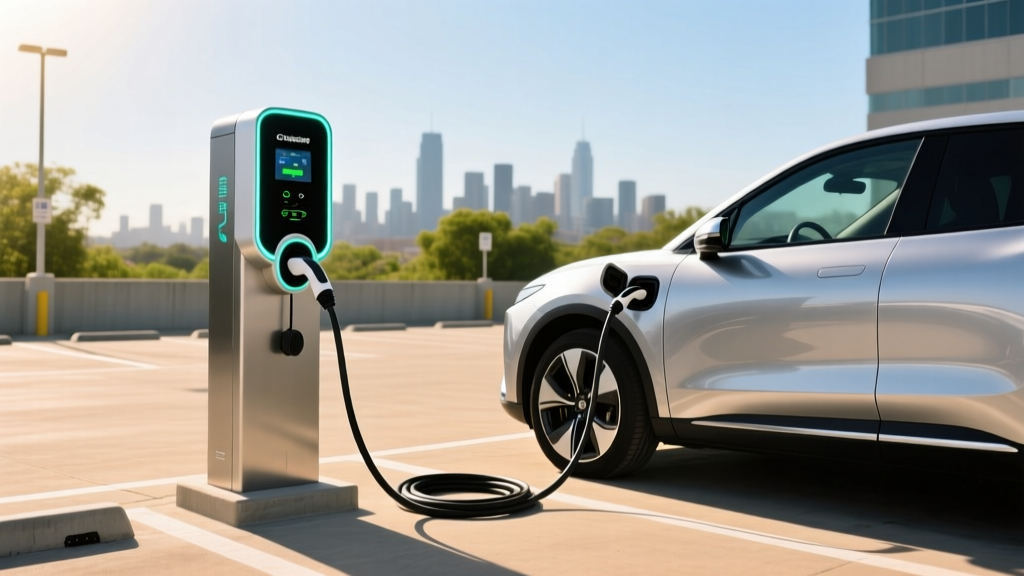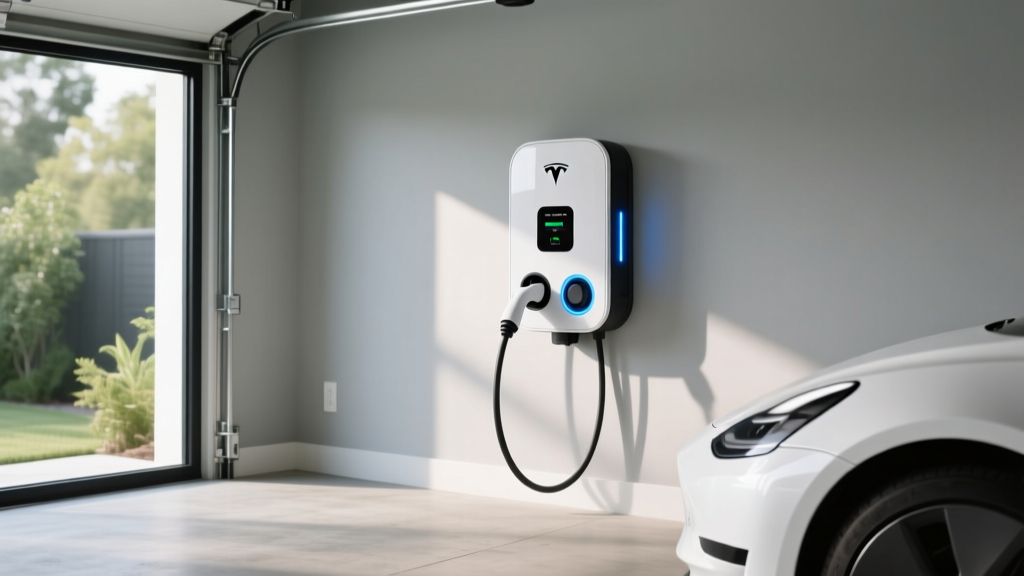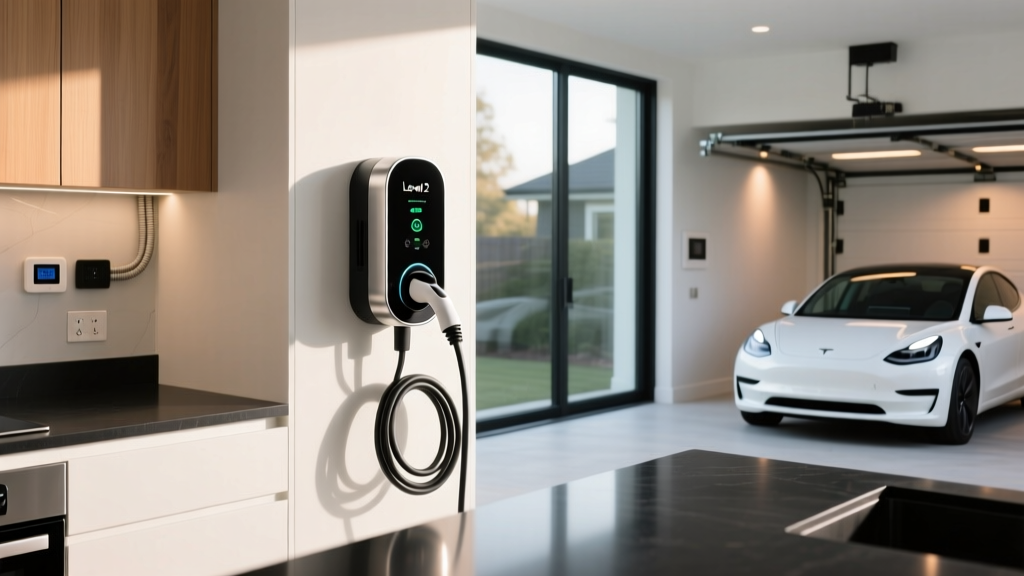
If you're shopping for a Level 2 EV home charger, you've already figured out the most important rule of EV ownership: public charging works for road trips, but daily charging happens at home. A Level 2 wallbox on a dedicated 240-volt circuit replenishes 20 to 40 miles of range per hour parked — enough to refill any EV overnight — while keeping your cost per mile well below gasoline.
This guide walks through every decision point: the electrical requirements your panel must support, realistic installation costs including the panel-upgrade scenario nobody likes to talk about, connector compatibility for 2026 models, ongoing electricity costs, and the specific charger units we recommend based on real-world use. All figures reflect current 2026 pricing and equipment availability.
How Fast Does Each Charging Level Add Range?
Before comparing hardware, the critical distinction: kW (kilowatts) measures power — how fast energy flows into your car. kWh (kilowatt-hours) measures energy — the total capacity of your battery. A 10 kW charger running for 6 hours delivers 60 kWh of energy. Confusing these two is the single most common EV literacy gap, and it leads to buying the wrong equipment.
Here is how each level translates to real-world range recovery:
| Level | Voltage | Power (kW) | Miles of Range/Hour | Best For |
|---|---|---|---|---|
| Level 1 | 120V (standard outlet) | 1.0 – 1.4 kW | 3 – 5 mi/hr | PHEVs, low-mileage drivers, emergency backup |
| Level 2 | 240V (dryer-style circuit) | 3.3 – 19.2 kW | 12 – 60+ mi/hr | Daily home charging for all BEVs and PHEVs |
| DC Fast Charge | 400V–900V DC | 50 – 350+ kW | 150 – 1,000+ mi/hr | Road trips, quick top-ups, fleet depots |
A typical BEV with a 75 kWh battery charging on a 48-amp Level 2 circuit (11.5 kW) goes from 10% to 80% in roughly 4.5 hours. That same session on a 350 kW DC fast charger takes approximately 20–25 minutes to 80%, though sustained charge rates taper significantly above 80% state of charge (SoC) to protect the battery. This taper is why manufacturers quote 10–80% times rather than 0–100%.
For most owners, Level 2 is the permanent home solution. You plug in when you arrive, and the car is full by morning. DC fast charging remains a road-trip tool — frequent use accelerates battery degradation and costs substantially more per kWh than home power.
Electrical Requirements: What Your Panel Must Support
A Level 2 EV home charger requires a dedicated 240-volt circuit, the same type that powers your electric dryer or oven. The circuit amperage determines your maximum charge rate:
- 20-amp circuit: Delivers up to 16 amps continuous (80% rule per NEC), yielding 3.8 kW — adequate for PHEVs or BEVs parked 12+ hours overnight.
- 40-amp circuit: Delivers 32 amps continuous, yielding 7.7 kW — the most common residential setup, sufficient for nearly all BEVs overnight.
- 50-amp circuit: Delivers 40 amps continuous, yielding 9.6 kW — recommended for larger-battery vehicles (100+ kWh) or drivers needing faster turnaround.
- 60-amp circuit: Delivers 48 amps continuous, yielding 11.5 kW — the practical residential maximum; requires robust panel capacity.
- 80-amp circuit: Delivers 64 amps continuous, yielding 15.4–19.2 kW — available on hardwired units like the ChargePoint Home Flex; demands a 200-amp panel with significant spare capacity.
The National Electrical Code (NEC) requires EV chargers to be treated as continuous loads, meaning the circuit must be rated at 125% of the charger's maximum draw. A 48-amp charger therefore needs a 60-amp breaker and appropriately gauged wire (typically 6 AWG copper for runs under 50 feet).
How Much Does It Cost to Install a Home EV Charger?
Installation cost varies enormously based on three factors: the distance from your panel to the charger location, whether your panel needs an upgrade, and local permit fees. Here is a realistic breakdown for a 2026 installation:
| Component | Simple Install (panel nearby, no upgrade) | Complex Install (long run or panel upgrade) |
|---|---|---|
| Charger unit (40–48 amp) | $400 – $700 | $400 – $700 |
| Electrical labor (licensed electrician) | $400 – $800 | $1,000 – $2,000 |
| Wire, conduit, breaker, materials | $100 – $300 | $300 – $800 |
| Permit and inspection | $50 – $200 | $50 – $200 |
| Panel upgrade (if needed) | $0 | $1,500 – $3,500 |
| Total | $950 – $2,000 | $3,250 – $7,200 |
The simple-install scenario assumes your electrical panel is in the garage or on an exterior wall within 20–30 feet of the charger mount point, has spare breaker slots, and passes the load calculation. This is the case for roughly 50–60% of single-family homes built after 2000.
For the complex scenario, the dominant cost driver is usually the panel upgrade or a long wire run (80+ feet through finished walls or underground conduit). Some homeowners in this situation opt for a lower-amperage circuit (20 or 30 amps) to stay within existing panel capacity, trading charge speed for a dramatically lower install bill. A 20-amp circuit delivering 3.8 kW still adds roughly 150 miles of range over a 10-hour overnight session — adequate for most daily driving.
Check your state and utility for rebates. Many utilities offer $250–$500 rebates on Level 2 charger equipment, and some states provide additional installation tax credits. The federal Residential Clean Energy Credit (IRS §25C/25E) may cover up to 30% of charger equipment and installation costs, capped at $1,000 — consult a tax professional for eligibility, as income and principal-residence rules apply.
Connector Compatibility: NACS, CCS, and CHAdeMO
As of 2026, the North American EV market has consolidated heavily around the North American Charging Standard (NACS), originally developed by Tesla. Nearly every major automaker — Ford, GM, Rivian, Hyundai, Kia, BMW, Volvo, and others — has transitioned to NACS connectors on new vehicles. However, hundreds of thousands of CCS1-equipped vehicles from model years 2019–2025 remain on the road.
| Connector | Used By | Level 2 Home Charging | DC Fast Charging |
|---|---|---|---|
| NACS (Tesla-style) | Tesla (all years), Ford, GM, Rivian, Hyundai, Kia, BMW, Volvo, and most 2025+ models | Native on new chargers; J1772-to-NACS adapter for older CCS cars | Native at Tesla Superchargers; growing at third-party networks |
| J1772 | Universal Level 2 standard (all EVs via adapter or native) | All Level 2 chargers use J1772 or NACS; adapters widely available | N/A (AC only) |
| CCS1 | Most non-Tesla EVs from 2019–2024; some 2025 carryover models | Works with any J1772 Level 2 charger (CCS adds DC pins below) | Still widely available at Electrify America, EVgo, ChargePoint |
| CHAdeMO | Nissan Leaf (legacy); discontinued on new models | Works with any J1772 Level 2 charger | Limited and shrinking network |
For Level 2 home charging, the practical rule is simple: every EV sold in the US can charge on a J1772 connector, either natively or via a small adapter. If you own a CCS1 vehicle and want a NACS-connector wallbox (future-proofing for your next car), a CCS-to-NACS adapter costs $100–$200. If you own a Tesla or a newer NACS-native vehicle, a NACS wallbox plugs in directly. Many 2026 chargers, like the ChargePoint Home Flex and Emporia V2, ship with interchangeable connectors or include adapters in the box.
How Much Does Charging Cost Per Mile vs. Gas?
Home charging on a Level 2 circuit is where EV ownership economics shine — but the exact savings depend on your electricity rate, time-of-use plan, and the vehicle's efficiency. Here is a realistic comparison using a mid-size electric SUV consuming 30 kWh per 100 miles (roughly 3.3 mi/kWh, similar to a Tesla Model Y or Hyundai Ioniq 5) versus a comparable gas SUV getting 26 MPG combined:
| Scenario | Rate | Cost per 100 Miles | Cost per Mile |
|---|---|---|---|
| Home off-peak (utility TOU plan) | $0.10/kWh | $3.00 | $0.030 |
| Home standard rate (national avg.) | $0.16/kWh | $4.80 | $0.048 |
| Public Level 2 (network pricing) | $0.30/kWh | $9.00 | $0.090 |
| DC Fast Charge (public) | $0.40/kWh | $12.00 | $0.120 |
| Gas SUV (26 MPG, $3.40/gal) | $3.40/gallon | $13.08 | $0.131 |
At a national average residential rate of $0.16/kWh (per EIA data), home Level 2 charging costs roughly $0.05 per mile — about one-third the fuel cost of a 26 MPG gas vehicle. With a time-of-use plan and off-peak charging (typically 10 PM to 6 AM), rates can drop to $0.08–$0.12/kWh in many utility territories, pushing the cost below $0.04 per mile.
The economic takeaway: if you can charge at home most nights, your annual "fuel" cost for 12,000 miles of driving ranges from $360 (off-peak TOU) to $576 (standard rate), compared to $1,570 for gasoline. That $1,000–$1,200 annual savings typically pays back a Level 2 charger installation within 1–3 years, depending on install cost.
Best Level 2 EV Home Chargers for 2026
We evaluate home chargers on five criteria: maximum power output, connector options, cable length, smart features (scheduling, load management, energy tracking), and build quality for indoor/outdoor use. These are the units we recommend based on sustained real-world use:
ChargePoint Home Flex
- Power: Up to 50 amps (12 kW) on a 60A circuit; configurable down to 16A
- Connector: J1772 (NACS adapter included for 2026 models)
- Cable: 23 feet
- Smart features: Wi-Fi, app scheduling, Alexa, energy reports, load sharing (two units on one circuit)
- Price: ~$650
- Best for: Flexibility across circuit sizes; dual-charger households
Emporia V2 (Vue)
- Power: Up to 48 amps (11.5 kW) on a 60A circuit
- Connector: J1772 (NACS adapter available)
- Cable: 24 feet
- Smart features: Real-time energy monitoring, solar integration, TOU scheduling, whole-home panel integration with Emporia Vue monitor
- Price: ~$400 (best value in class)
- Best for: Budget-conscious buyers who want full smart features and energy tracking
Tesla Wall Connector
- Power: Up to 48 amps (11.5 kW) on a 60A circuit
- Connector: NACS native (J1772 adapter available for non-Tesla EVs)
- Cable: 24 feet
- Smart features: Wi-Fi, OTA updates, power sharing between multiple Wall Connectors, access control
- Price: ~$475
- Best for: Tesla and NACS-native vehicle owners; cleanest integration with Tesla ecosystem
Grizzl-E Smart
- Power: Up to 40 amps (9.6 kW) on a 50A circuit
- Connector: J1772 (NACS adapter sold separately)
- Cable: 24 feet
- Smart features: Wi-Fi, OCPP support, adjustable amperage via dip switches, extreme cold rated (-40°F)
- Price: ~$550
- Best for: Cold-climate durability; Canadian-built; rugged outdoor mounting
A note on amperage selection: your charger's maximum output is capped by the circuit it's installed on. A 48-amp charger on a 40-amp circuit will only deliver 32 amps. Always match the charger's adjustable output to your circuit's continuous-load rating, and have your electrician verify the wire gauge supports the chosen amperage.
Charging Time Examples: How Long to Refill Common EVs
Charge time depends on battery size (kWh), the charger's power output (kW), and charging efficiency losses (typically 5–10% for Level 2 AC-to-DC conversion inside the vehicle's onboard charger). Here are realistic 10–80% charge times on a 48-amp (11.5 kW) Level 2 circuit, which is the most common high-power home setup:
| Vehicle (2026) | Battery (usable kWh) | Onboard Charger Max | Estimated 10–80% Time |
|---|---|---|---|
| Tesla Model Y Long Range | 75 kWh | 11.5 kW | ~4.5 hours |
| Hyundai Ioniq 5 (Long Range) | 77.4 kWh | 10.9 kW | ~5 hours |
| Ford F-150 Lightning (Extended) | 131 kWh | 19.2 kW* | ~8 hours |
| Chevrolet Equinox EV | 85 kWh | 11.5 kW | ~5.2 hours |
| Toyota RAV4 Prime (PHEV) | 14.9 kWh | 6.6 kW | ~1.7 hours |
*The F-150 Lightning Extended Range supports an optional 19.2 kW onboard charger (80-amp circuit required); the standard onboard charger is 10.5 kW.
Every one of these vehicles will comfortably reach 80% overnight on a 40- or 48-amp Level 2 circuit. For daily driving of 30–50 miles, you may only need 2–3 hours of charging — set a schedule in your charger's app to charge during off-peak hours and wake up to a full battery.
Safety, Code Compliance, and Outdoor Installation
Level 2 charger installation is governed by the National Electrical Code (NEC Article 625) and your local jurisdiction's amendments. Key requirements your installation must meet:
- Dedicated circuit: The EV charger must have its own breaker — no sharing with other appliances. This prevents overloads and ensures consistent power delivery.
- GFCI protection: NEC 2020 and later require ground-fault circuit interrupter protection for all EV charging outlets rated 150V to ground or less and 50 amps or less. Hardwired installations may have different GFCI requirements depending on jurisdiction; your electrician will specify the correct approach. Many modern chargers have built-in ground-fault monitoring as a secondary layer.
- Outdoor rating: If mounting outside, the charger must carry a NEMA 4 or NEMA 4X rating (weatherproof against rain, snow, and hose-directed water). All four units recommended above carry outdoor ratings, but the cord and connector should be stored in a holster or protective bracket to prevent UV degradation and physical damage.
- Wire gauge and conduit: Your electrician will size wire based on circuit amperage and run length. For a 60-amp circuit (48A continuous), 6 AWG copper THHN in conduit is standard for runs under 50 feet; longer runs may require 4 AWG to limit voltage drop below 3%.
- Permit and inspection: Nearly all jurisdictions require an electrical permit for EV charger installation. The inspection verifies correct wire sizing, breaker rating, grounding, GFCI compliance, and mounting. Skipping the permit risks insurance denial if an electrical fire occurs and may cause issues during a home sale.
Frequently Asked Questions
Can I install a Level 2 EV charger myself?
Hardwired installations must be performed by a licensed electrician to meet code and pass inspection. Plug-in installations (using a NEMA 14-50 outlet) can technically be plugged in by the homeowner, but the outlet itself must be installed by an electrician on a properly rated circuit with correct wire gauge and GFCI protection. DIY electrical work on 240V circuits carries serious arc-flash and fire risk and will void most homeowner's insurance coverage if done without a permit.
Should I get a plug-in (NEMA 14-50) or hardwired charger?
Hardwired units support higher amperage (up to 48–64 amps continuous) because they avoid the NEC derating that limits NEMA 14-50 outlets to 40 amps continuous (50-amp breaker). Plug-in units offer portability — you can unplug and take the charger when you move — but cap at 32–40 amps continuous. If you want maximum charge speed, go hardwired. If you value flexibility or rent, go plug-in.
Will a Level 2 charger work with solar panels?
Yes, and smart chargers like the Emporia V2 can be configured to charge only when excess solar production is available, effectively charging your EV for "free" during sunny hours. This requires integration with your solar inverter's monitoring system and may require a time-delayed charging schedule. Pairing solar with a Level 2 charger and a home battery (like a Tesla Powerwall) maximizes self-consumption and reduces grid dependence.
How long does a Level 2 charger last?
Quality Level 2 wallboxes from ChargePoint, Emporia, Tesla, and Grizzl-E carry 2- to 3-year warranties and typically last 8–12 years in residential use. The most common failure point is the cable or connector, which can be replaced on most units without replacing the entire wallbox. Outdoor units in extreme climates (sustained 100°F+ sun or -30°F winters) may see cable jacket degradation sooner; store the connector in a holster when not in use.
Do I need a smart charger, or will a basic one work?
A basic ("dumb") Level 2 charger delivers power whenever plugged in and works fine if your electricity rate is flat. A smart charger adds scheduling (charge only during off-peak TOU hours), energy tracking (monitor monthly kWh and cost), load management (share a circuit with a second charger), and remote control (start/stop from your phone). For $50–$150 more than a basic unit, smart features typically save their cost within a year through TOU optimization alone.