Quick Verdict: Who the Tesla Gen 3 Wall Charger Is (and Isn't) For
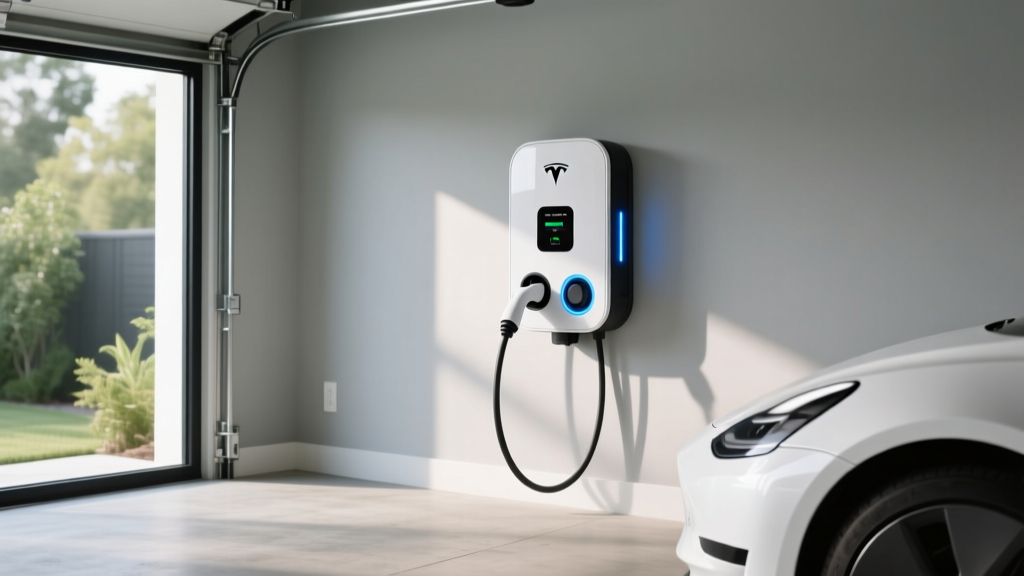
The Tesla Gen 3 Wall Charger remains one of the most popular Level 2 home charging units on the market — and for good reason. At a retail price of roughly $475, it delivers up to 11.5 kW of power (48 amps on a 60-amp dedicated circuit), adds up to 44 miles of range per hour for efficient sedans, and integrates seamlessly with the Tesla app for scheduling and monitoring. Its 24-foot cable and NACS (North American Charging Standard) connector make it a natural fit for Tesla owners.
But here's what most reviews gloss over: if you drive a non-Tesla EV with a CCS1 or CHAdeMO port, the Gen 3 Wall Charger requires an adapter — and that adds cost, friction, and a potential failure point. It also lacks a built-in display and doesn't support load-sharing with a second unit on the same circuit out of the box (Tesla's Power Share feature handles this, but requires specific configuration). For non-Tesla households, chargers like the ChargePoint Home Flex or Emporia Vue may offer better flexibility.
This guide covers everything you need to know: real charging speeds, installation costs (including the panel-upgrade scenario nobody talks about), connector compatibility, and how the Gen 3 stacks up against alternatives.
Charging Levels Explained: kW, Miles Per Hour, and What They Mean
Before evaluating any wall charger, you need to understand the three charging levels and how power (kW) translates into range added per hour. Note: kW measures the rate of energy delivery (power), while kWh measures the total energy stored in your battery. A 48-amp Level 2 charger delivering 11.5 kW for one hour adds 11.5 kWh to your battery.
| Level | Voltage | Max Power (kW) | Miles of Range Per Hour | Typical Use Case |
|---|---|---|---|---|
| Level 1 | 120V AC | 1.4–1.9 kW | 3–5 mi/hr | Overnight trickle; PHEVs with small batteries |
| Level 2 | 240V AC | 3.3–19.2 kW | 12–75 mi/hr | Home daily charging; workplace; public AC stations |
| DC Fast Charging | 400–800V DC | 50–350+ kW | 150–1,000+ mi/hr | Road trips; highway corridors; 10–80% in 15–30 min |
The Tesla Gen 3 Wall Charger operates at Level 2, delivering up to 11.5 kW on a 240V / 60-amp circuit (48 amps continuous, per NEC derating rules requiring circuits to be rated at 125% of continuous load). At this rate, a Tesla Model Y Long Range (75 kWh usable battery, ~3.5 mi/kWh efficiency) gains roughly 40 miles of range per hour. A full charge from 10% to 80% takes approximately 5–6 hours — perfect for overnight replenishment.
Electrical Requirements: What Your Panel Needs
The Gen 3 Wall Charger demands a dedicated 60-amp, 240-volt circuit using 6 AWG copper wire (or 4 AWG aluminum). This is non-negotiable for achieving the full 11.5 kW output. You can configure it on a lower-amperage circuit (e.g., 40A breaker for 32A continuous / 7.7 kW) via internal DIP switch settings, but you sacrifice speed.
Panel Capacity and the Upgrade Reality
Most modern homes have a 200-amp main electrical panel. A 60-amp EV circuit consumes 30% of that capacity. If your panel already runs near capacity — common in homes with electric ranges, dryers, HVAC, and water heaters — adding 60 amps may exceed your service rating. A licensed electrician will perform a NEC Article 220 load calculation to determine whether your panel can handle the addition.
If it can't, you're looking at a panel upgrade to 300A or 400A service, or installing a separate sub-panel. This is the single biggest variable in installation cost and the one most online guides understate.
Permit Requirements
Virtually every jurisdiction in the U.S. requires an electrical permit for a new 240V circuit. Permit fees typically range from $50 to $250 depending on your municipality. The work must pass inspection — don't skip this step, as unpermitted electrical work can void homeowner's insurance and create fire risk.
Installation Cost Breakdown: Equipment, Electrician, and the Panel-Upgrade Wildcard
Here's where real-world costs diverge sharply from the "$500 install" figures some manufacturers advertise. Your total depends on panel capacity, wire run distance, and local labor rates.
| Component | Simple Install (panel has capacity, short run) | Complex Install (long run, conduit, sub-panel) | Full Panel Upgrade Scenario |
|---|---|---|---|
| Tesla Gen 3 Wall Charger (equipment) | $475 | $475 | $475 |
| Electrician labor (2–4 hrs simple / 6–10 hrs complex) | $300–$600 | $800–$1,500 | $1,500–$3,000 |
| Wire, conduit, breaker, mounting hardware | $100–$200 | $300–$600 | $300–$600 |
| Permit and inspection | $50–$150 | $100–$250 | $150–$350 |
| Panel upgrade (if needed: 200A → 300/400A) | $0 | $0 | $2,000–$5,000 |
| Total Estimated Cost | $925–$1,425 | $1,675–$2,825 | $4,425–$9,425 |
Key takeaway: If your 200A panel has headroom and the charger mounts within 20 feet of the panel, expect to spend $1,000–$1,500 all-in. If you need a panel upgrade, budget $4,500–$9,500. Always get a load calculation before purchasing equipment.
Some utilities and states offer rebates for home charger installation. The federal Residential Clean Energy Credit (IRS Form 5695) previously covered 30% of charger and installation costs up to $1,000, but check current-year eligibility on irs.gov as provisions have shifted under recent legislation.
Connector Compatibility: NACS, CCS1, CHAdeMO, and Adapter Needs
The Tesla Gen 3 Wall Charger ships with a NACS (North American Charging Standard) connector — the same plug used on all Tesla vehicles and, starting in 2025, adopted by Ford, GM, Rivian, Hyundai, Kia, BMW, and most other major automakers for new models.
| Connector Type | Compatible EVs (examples) | Works with Gen 3? | Adapter Required? |
|---|---|---|---|
| NACS (Tesla) | Tesla Model 3/Y/S/X, 2025+ Ford F-150 Lightning, GM Ultium models, Rivian R1T/R1S (2025+) | Yes — native | No |
| CCS1 (Combo) | 2024 and earlier Ford Mustang Mach-E, VW ID.4, Hyundai Ioniq 5/6, Kia EV6, BMW i4/iX | Yes — with adapter | Tesla CCS Adapter (~$250) or third-party NACS-to-CCS |
| CHAdeMO | Nissan Leaf (2013–2025), Mitsubishi Outlander PHEV (older) | Limited | No widely available NACS-to-CHAdeMO adapter; not recommended |
If you own a CCS1-equipped EV and plan to keep it for several years, the adapter route works but adds a $200–$250 cost and an extra connection point. If your household has mixed EVs (one Tesla, one CCS), consider a charger with a CCS1 native plug like the ChargePoint Home Flex or use the Tesla Universal Wall Connector ($595), which includes a built-in CCS adapter.
Charging Time Examples: Real-World Scenarios
Charge time depends on your battery size, the vehicle's onboard charger acceptance rate, and your circuit amperage. The Gen 3 Wall Charger outputs up to 11.5 kW, but your car's onboard charger may accept less.
| Vehicle | Usable Battery (kWh) | Onboard Charger Max (kW) | 10%–80% Time (approx.) | Miles Added Per Hour |
|---|---|---|---|---|
| Tesla Model Y Long Range (2026) | 75 kWh | 11.5 kW | ~5 hours | ~40 mi/hr |
| Tesla Model 3 RWD (2026, LFP) | 57.5 kWh | 11.5 kW | ~3.5 hours | ~38 mi/hr |
| Ford F-150 Lightning Ext. Range | 131 kWh | 11.5 kW (19.2 kW capable) | ~9 hours | ~24 mi/hr |
| Hyundai Ioniq 5 (2026, NACS) | 77.4 kWh | 10.9 kW | ~5.5 hours | ~28 mi/hr |
| Chevrolet Equinox EV (2026) | 85 kWh | 11.5 kW | ~6 hours | ~30 mi/hr |
Cold-weather note: In sub-freezing temperatures, expect 15–30% slower charge rates until the battery warms up. Tesla vehicles precondition the battery automatically when navigation is set to a Supercharger, but this doesn't apply to home Level 2 charging unless you schedule departure times in the app — which the Gen 3 supports.
Cost to Charge: Home vs. Public vs. Gas
One of the strongest arguments for home Level 2 charging is cost. Here's how electricity pricing translates to cost per mile compared to gasoline.
| Scenario | Rate | Cost Per kWh | Cost Per Mile (at 3.5 mi/kWh) | Annual Cost (12,000 mi) |
|---|---|---|---|---|
| Home off-peak (utility time-of-use) | $0.09–$0.14/kWh | $0.12 avg | $0.034 | $411 |
| Home standard rate | $0.15–$0.22/kWh | $0.18 avg | $0.051 | $617 |
| Public Level 2 (ChargePoint, EVgo) | $0.25–$0.49/kWh | $0.35 avg | $0.10 | $1,200 |
| DC Fast Charging (Electrify America, Tesla Supercharger) | $0.30–$0.55/kWh | $0.42 avg | $0.12 | $1,440 |
| Gasoline vehicle (28 MPG combined, $3.40/gal) | $3.40/gal | N/A | $0.121 | $1,457 |
Charging at home on an off-peak rate saves roughly $1,000–$1,050 per year versus gasoline at 12,000 miles driven. Even at standard residential rates, you save $840 annually. Relying exclusively on public DC fast charging, however, erases most of that advantage — another reason a reliable home Level 2 setup is essential.
Check your utility for time-of-use (TOU) plans. Many offer super off-peak rates between midnight and 6 AM as low as $0.05–$0.08/kWh, which you can leverage by scheduling charging via the Tesla app.
Equipment Comparison: Gen 3 vs. the Alternatives
Tesla Gen 3 Wall Connector
- Price: ~$475
- Power Output: 11.5 kW (48A, 60A circuit)
- Connector: NACS (native)
- Cable Length: 24 feet
- Smart Features: Wi-Fi, Tesla app scheduling, OTA updates, Power Share (2 units)
- Outdoor Rating: NEMA 3R (suitable for outdoor installation)
- Best For: Tesla-only households; clean integration
ChargePoint Home Flex
- Price: ~$550–$650
- Power Output: Up to 12 kW (50A, 60A circuit) — configurable down to 16A
- Connector: J1772 (CCS1-compatible) or NACS version available
- Cable Length: 23 feet
- Smart Features: Wi-Fi, ChargePoint app, Alexa, flexible amperage dial
- Outdoor Rating: NEMA 4 (superior weather protection)
- Best For: Multi-EV households; flexible amperage for older panels
Emporia Vue EV Charger
- Price: ~$399
- Power Output: Up to 11.5 kW (48A)
- Connector: J1772 or NACS
- Cable Length: 24 feet
- Smart Features: Wi-Fi, energy monitoring, solar integration, scheduling
- Outdoor Rating: NEMA 4
- Best For: Budget-conscious buyers; solar-panel households
Safety, Code, and Installation Best Practices
The National Electrical Code (NEC) governs home EV charger installation. Key requirements and best practices:
- Dedicated circuit: Your Level 2 charger must have its own breaker — no sharing with other appliances.
- GFCI protection: NEC 2020 and later require GFCI protection for all 240V EV charging outlets. Hardwired installations (which the Gen 3 supports) may have different GFCI requirements depending on jurisdiction — your electrician will confirm.
- Outdoor installation: The Gen 3's NEMA 3R rating handles rain and sleet. In regions with driving rain or hose exposure, NEMA 4 (as on the ChargePoint Home Flex) provides better protection.
- Cable management: The 24-foot cable should be routed to avoid trip hazards and vehicle tire contact. Tesla sells a wall-mount cable organizer; third-party options are also available.
- Wi-Fi connectivity: The Gen 3 connects via 2.4 GHz Wi-Fi for firmware updates and app control. Ensure your garage has adequate signal — a Wi-Fi extender may be needed in detached garages.
Frequently Asked Questions
How much does it cost to install a Tesla Gen 3 Wall Charger at home?
Expect $925–$1,425 for a straightforward installation where your 200A panel has capacity and the wire run is short (under 20 feet). Complex runs with conduit or sub-panel additions push costs to $1,675–$2,825. If your panel needs upgrading to 300A or 400A service, total costs can reach $4,500–$9,500. Always get a professional load calculation first.
How fast will the Tesla Gen 3 Wall Charger add range?
At its maximum 11.5 kW output (48A on a 60A circuit), the Gen 3 adds approximately 30–44 miles of range per hour, depending on your vehicle's efficiency. A Tesla Model Y Long Range gains about 40 miles per hour. A less-efficient vehicle like the Ford F-150 Lightning gains roughly 24 miles per hour.
Can I use the Tesla Gen 3 Wall Charger with a non-Tesla EV?
Yes, but only if your EV has a NACS charge port (2025+ Ford, GM, Rivian, Hyundai, Kia, and others). If your EV uses a CCS1 port (most 2024 and earlier non-Tesla EVs), you'll need a NACS-to-CCS adapter, which costs $200–$250. CHAdeMO vehicles like the Nissan Leaf are not practically compatible due to the lack of a reliable adapter.
How much does charging at home cost per mile versus gas?
At a typical residential off-peak rate of $0.12/kWh and vehicle efficiency of 3.5 miles per kWh, home charging costs roughly $0.034 per mile — about 72% less than gasoline at $3.40/gallon and 28 MPG ($0.121/mile). Over 12,000 miles annually, that's a savings of approximately $1,050 per year.
What electrical upgrades might I need for a 60-amp EV charger circuit?
If your home has a 200-amp panel running near capacity (common with electric heating, cooking, and drying), you may need a panel upgrade to 300A or 400A service, which costs $2,000–$5,000. Alternatives include installing the charger on a lower-amperage circuit (e.g., 40A for 7.7 kW) or using a smart load-management device that throttles the charger when other appliances draw heavy current. A licensed electrician can determine the best path via a NEC load calculation.
Does the Tesla Gen 3 Wall Charger qualify for any tax credits or rebates?
The federal Residential Clean Energy Credit (IRS §25D) previously covered 30% of home EV charger equipment and installation costs up to $1,000, but eligibility has changed under recent legislation. Check the current rules on irs.gov. Many utilities and state programs offer separate rebates — search the Alternative Fuels Data Center for incentives in your zip code.