Why Amps Matter More Than You Think for Home EV Charging
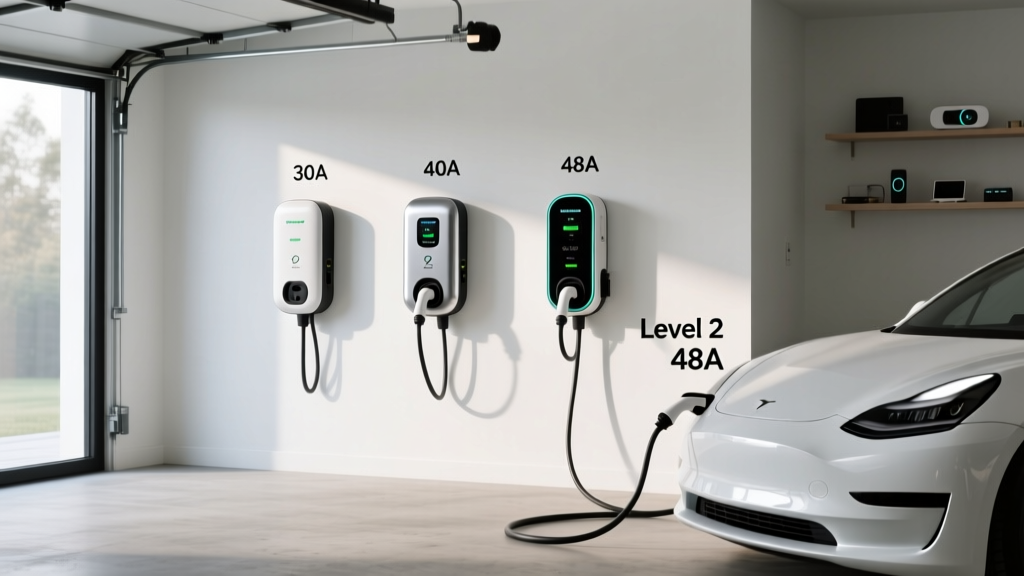
If you're shopping for a Level 2 home charger, you've probably seen options rated at 30A, 40A, 48A, or even 60A. The amperage of your charger directly determines how many kilowatts (kW) of power flow into your EV's battery — and therefore how many miles of range you add per hour. But choosing the right amperage isn't just about going as high as possible. Your home's electrical panel, circuit capacity, and budget all factor in.
This guide breaks down exactly what each amperage tier delivers in real-world charging speed, what your home's electrical system needs to support it, what you'll spend on equipment and installation, and which specific chargers earn our recommendation in 2026.
Charging Levels Explained: Speeds in kW and Miles Per Hour
Before focusing on Level 2 amperage options, here's how all three charging levels compare. These figures assume a typical EV efficiency of 3.0 to 3.5 miles per kWh — representative of vehicles like the Tesla Model Y, Hyundai Ioniq 5, and Ford Mustang Mach-E.
| Level | Voltage | Amperage | Power (kW) | Miles of Range / Hour | Best For |
|---|---|---|---|---|---|
| Level 1 | 120V | 12A | 1.4 kW | 3–5 mi/hr | Overnight top-ups, PHEVs |
| Level 2 (30A) | 240V | 30A | 7.2 kW | 21–25 mi/hr | Smaller panels, budget installs |
| Level 2 (40A) | 240V | 40A | 9.6 kW | 28–34 mi/hr | Most EVs, balanced cost/speed |
| Level 2 (48A) | 240V | 48A | 11.5 kW | 34–40 mi/hr | Large batteries, future-proofing |
| Level 2 (60A) | 240V | 60A | 14.4 kW | 42–50 mi/hr | EVs with 19.2 kW onboard chargers |
| DC Fast | 400–800V | Varies | 50–350 kW | 150–1,000+ mi/hr | Road trips, rapid top-ups |
Real-World Charging Times by Amp Rating and Battery Size
Here's what those amperage ratings actually mean when you plug in after a day of driving. These times assume charging from 10% to 80% state of charge (SoC). Note that Level 2 charging maintains a relatively flat power delivery across most of the SoC range — unlike DC fast charging, which tapers significantly above 80%.
| Charger | Power | ~60 kWh Battery (e.g., Chevy Equinox EV) |
~80 kWh Battery (e.g., Tesla Model Y LR) |
~100 kWh Battery (e.g., Ford F-150 Lightning Ext.) |
|---|---|---|---|---|
| 30A | 7.2 kW | ~5.8 hours | ~7.8 hours | ~9.7 hours |
| 40A | 9.6 kW | ~4.4 hours | ~5.8 hours | ~7.3 hours |
| 48A | 11.5 kW | ~3.6 hours | ~4.9 hours | ~6.1 hours |
| 60A | 14.4 kW | ~2.9 hours | ~3.9 hours | ~4.9 hours |
Critical caveat: Your EV's onboard charger caps the maximum AC power it can accept. Most 2025–2026 EVs accept 11.5 kW (48A) AC. The Tesla Model 3/Y accepts 11.5 kW. The Hyundai Ioniq 5 accepts 10.9 kW. The Ford F-150 Lightning with the extended-range battery accepts up to 19.2 kW — one of the few that benefits from a 60A/80A circuit. If your EV's onboard charger maxes out at 11.5 kW, a 60A charger won't charge it any faster than a 48A unit.
Electrical Requirements: What Your Home Needs for Each Amp Level
The National Electrical Code (NEC) requires that a continuous load — which EV charging qualifies as — cannot exceed 80% of a circuit's rated capacity. This means the circuit breaker must be sized 125% above the charger's maximum amperage draw.
| Charger Amps | Required Circuit Breaker | Minimum Wire Gauge (Copper) | Panel Capacity Needed |
|---|---|---|---|
| 30A | 40A | 8 AWG | ~100A panel (minimum) |
| 40A | 50A | 6 AWG | ~125A panel (recommended) |
| 48A | 60A | 6 AWG (or 4 AWG for long runs) | ~150A panel (recommended) |
| 60A | 75A or 80A | 4 AWG or 3 AWG | ~200A panel (recommended) |
The Panel Upgrade Reality
Many homes built before 2000 have 100A or 125A electrical panels. Adding a 50A or 60A circuit for a 40A or 48A charger may push your panel's total load beyond safe capacity — especially if you already run electric range, dryer, and HVAC. A licensed electrician will perform a load calculation per NEC Article 220 to determine if your panel can handle the new circuit.
If you need a panel upgrade from 100A to 200A, expect to pay $1,500 to $3,500 depending on your utility's requirements, local labor rates, and whether a new meter base or service drop is needed. This is the single biggest variable in home charger installation cost, and it catches many buyers off guard.
Alternatives to a panel upgrade: Some homeowners use a smart load-management device like the Span Drive panel or a DCC (Demand Charge Controller) from manufacturer Emporia. These devices monitor your home's total real-time consumption and throttle the EV charger when other loads spike, allowing you to run a 48A charger on a panel that wouldn't otherwise support it. Expect $300–$600 added to your installation for this hardware.
How Much Does It Cost to Install a Home Level 2 EV Charger?
Installation costs vary enormously based on the distance from your panel to the charger location, whether conduit needs to run through walls or underground, and your local labor rates. Here's a realistic breakdown for a typical 48A hardwired installation:
Install Cost Breakdown — 48A Hardwired Charger
| Component | Simple Install (Panel near garage) |
Moderate Install (20–40 ft run) |
Complex Install (Long run, trenching, or panel upgrade) |
|---|---|---|---|
| Charger unit (48A) | $400–$700 | $400–$700 | $400–$700 |
| Electrical materials (wire, conduit, breaker) | $75–$150 | $150–$400 | $400–$800 |
| Electrician labor | $300–$600 | $600–$1,500 | $1,500–$3,000 |
| Permit and inspection | $50–$150 | $50–$200 | $100–$300 |
| Panel upgrade (if needed) | $0 | $0–$2,500 | $1,500–$3,500 |
| Total estimated cost | $825–$1,600 | $1,200–$5,300 | $3,900–$8,300 |
Per the IRS Alternative Fuel Vehicle Refueling Property Credit (Form 8911), you may be eligible for a federal tax credit of up to 30% of the cost of home EV charging equipment and installation, capped at $1,000. This credit is subject to specific census-tract eligibility requirements — it's only available in non-urbanized areas or low-income census tracts as defined by the IRS. Consult a tax professional to verify your eligibility.
Connector Compatibility: NACS, CCS1, and CHAdeMO
The connector landscape has shifted dramatically. As of 2025–2026, the North American Charging Standard (NACS), originally developed by Tesla, has become the dominant connector for new EVs. Here's what you need to know for Level 2 home charging:
| Connector | Brands Using It (Native) | Level 2 Home Charging | Adapter Needed? |
|---|---|---|---|
| NACS (Tesla) | Tesla, Ford, GM, Rivian, Volvo, Polestar, Hyundai, Kia (2025+), Nissan (2025+) | NACS-equipped home chargers widely available | CCS1-to-NACS adapter for older CCS1 EVs (~$200–$300) |
| CCS1 (J1772 combo) | VW, BMW, Audi, Mercedes, older Ford/GM/Hyundai/Kia models | J1772 connector (Level 2 portion of CCS1) | NACS-to-J1772 adapter if charger has NACS plug (~$150–$250) |
| CHAdeMO | Nissan Leaf (legacy, discontinued 2025) | J1772 connector for Level 2 (CHAdeMO is DC-only) | No adapter needed for Level 2 — all use J1772 |
Key point for Level 2 home charging: All Level 2 charging in North America uses the J1772 signaling protocol. The physical plug is either a J1772 connector or a NACS connector. If you buy a NACS-equipped home charger and own a CCS1 vehicle, you'll need a J1772-to-NACS adapter. If you buy a J1772 charger and own a Tesla or NACS vehicle, Tesla includes a J1772-to-NACS adapter with every vehicle. For maximum household flexibility, consider a charger with a swappable connector or keep an adapter in your garage.
2026 Equipment Recommendations: Top Level 2 Chargers by Amperage
Best 48A Overall: ChargePoint Home Flex (2nd Gen)
- Power: Up to 11.5 kW (48A), adjustable down to 16A via app
- Connector: Available in NACS or J1772
- Cable: 23 ft
- Smart features: Wi-Fi, scheduling, energy tracking, Alexa
- Price: ~$549–$599
- Why: Flexible amperage lets you match your circuit; NEMA 4 outdoor rated; UL listed
Best 48A Hardwired: Tesla Wall Connector
- Power: Up to 11.5 kW (48A)
- Connector: NACS native; J1772 adapter included
- Cable: 24 ft
- Smart features: Wi-Fi, OTA updates, Power-Share (two units on one circuit)
- Price: ~$475
- Why: Best value at 48A; clean design; power-sharing ideal for two-EV households
Best Budget 40A: Emporia Vue EV Charger
- Power: Up to 9.6 kW (40A), adjustable via app
- Connector: J1772 (NACS adapter available)
- Cable: 24 ft
- Smart features: Wi-Fi, solar integration, load management with Emporia Vue panel monitor
- Price: ~$399
- Why: Excellent solar-aware scheduling; load management avoids panel upgrade
Best 60A for Large Batteries: Grizzl-E Smart
- Power: Up to 14.4 kW (60A), dip-switch adjustable to 40A/32A/24A/16A
- Connector: J1772 (NACS version available)
- Cable: 24 ft
- Smart features: Wi-Fi, OCPP support, energy metering
- Price: ~$599–$649
- Why: Canadian-built, extreme cold rated (-40°F); ideal for F-150 Lightning, Rivian R1T owners
Cost to Charge: Home vs Public vs Gas, Per Mile
One of the strongest arguments for home Level 2 charging is the per-mile fuel cost. Here's how common scenarios compare, assuming an EV efficiency of 3.2 mi/kWh (representative of a 2026 Tesla Model Y or Hyundai Ioniq 5) and a gas vehicle at 28 MPG combined.
| Scenario | Rate ($/kWh) | Cost Per Mile | Annual Cost (12,000 mi) |
|---|---|---|---|
| Home (off-peak TOU rate) | $0.08–$0.12 | $0.025–$0.038 | $300–$450 |
| Home (standard residential rate) | $0.14–$0.18 | $0.044–$0.056 | $525–$675 |
| Public Level 2 (ChargePoint, EVgo) | $0.25–$0.49 | $0.078–$0.153 | $938–$1,838 |
| DC Fast Charging (Electrify America, Tesla Supercharger) | $0.35–$0.56 | $0.109–$0.175 | $1,313–$2,100 |
| Gas vehicle (28 MPG, $3.40/gal) | — | $0.121 | $1,457 |
The takeaway: home Level 2 charging on an off-peak time-of-use (TOU) plan is roughly 70–80% cheaper per mile than gasoline. Even at standard residential rates, you'll save $800–$1,100 annually over gas. But if you rely exclusively on public DC fast charging, your costs can actually exceed gasoline — making home charging access the single most important economic factor in EV ownership.
Check with your utility about EV-specific TOU plans. Many utilities offer super off-peak rates between midnight and 6 AM as low as $0.05–$0.08/kWh, which you can schedule through your charger's app or your vehicle's built-in charging scheduler.
Safety, Code Compliance, and Installation Best Practices
EV charging is a continuous, high-draw electrical load — your charger will run at full amperage for 4 to 10 hours at a stretch. Cutting corners on installation is both dangerous and an insurance liability. Here's what the NEC and best practices require:
- Dedicated circuit: Your EV charger must have its own dedicated circuit — it cannot share with any other outlet or appliance. This is non-negotiable per NEC Article 511.
- GFCI protection: The 2020 NEC (and later) requires GFCI protection for all 240V EV charging outlets rated 60A or less. Hardwired installations are exempt from the GFCI requirement in most jurisdictions, which is one reason hardwired is often preferred — it eliminates nuisance tripping.
- Hardwired vs plug-in: Hardwired chargers (directly connected to your electrical panel) are generally more reliable and code-friendly. Plug-in chargers use a NEMA 14-50 outlet, which offers portability but requires GFCI and may be subject to local restrictions. If you choose NEMA 14-50, ensure the outlet is a commercial-grade, industrial-spec receptacle — cheap residential 14-50 outlets have been linked to overheating.
- Outdoor rating: If your charger is mounted outside (carport, driveway wall), it must be rated NEMA 3R or NEMA 4 for weather resistance. All recommended chargers above meet this standard.
- Permit and inspection: Most jurisdictions require an electrical permit for a new 240V circuit. The inspection ensures proper wire gauge, breaker sizing, grounding, and conduit. Skipping the permit can void your homeowner's insurance in the event of an electrical fire.
- Cable management: Use a holster or cable organizer to keep the charging cable off the ground. This prevents damage, tripping hazards, and connector contamination.
Frequently Asked Questions
Can I install a Level 2 charger myself?
If you're experienced with electrical work and your jurisdiction allows homeowner permits, you can pull wire and mount the unit yourself. However, most homeowners should hire a licensed electrician. A mistake on a 50A or 60A continuous-load circuit carries real fire risk, and your insurance company may deny a claim if unpermitted work caused damage. At minimum, have a professional do the final connection and inspection.
Is a 48A charger worth the extra cost over 40A?
It depends on your EV and daily driving. If you drive less than 40 miles per day, a 40A charger (adding ~30 miles per hour) will fully replenish your battery overnight with hours to spare. A 48A charger makes a meaningful difference if you regularly deplete a large battery (80+ kWh), need faster turnaround between trips, or want to future-proof for your next EV. The cost difference in the charger itself is typically only $50–$100, but the 60A circuit required for 48A may cost $200–$500 more in wire and labor than a 50A circuit.
Will a Level 2 charger degrade my EV battery faster than Level 1?
No. Battery degradation is driven primarily by heat, high state of charge (sitting at 100% for extended periods), and deep discharges. Level 2 charging at 7.2–11.5 kW generates minimal additional heat compared to Level 1 — your EV's thermal management system handles it easily. In fact, Level 2 charging is the recommended daily charging method by virtually every manufacturer. For daily use, set your charge limit to 80% (or 100% for LFP batteries, which tolerate full charges better than NMC chemistries).
My EV came with a portable Level 2 charger. Do I need a wall-mounted unit?
The portable cord that came with your EV (often called a mobile connector) typically delivers 24A–32A on a 240V outlet — roughly 5.7 to 7.7 kW. That's adequate for many drivers. A dedicated wall-mounted 48A unit charges 50–60% faster, frees up your mobile connector for travel, and provides smart features like scheduling and energy tracking. If your daily driving is under 30 miles and you have a 240V outlet near your parking spot, the mobile connector may be all you need initially.
Do I need a smart charger, or is a basic "dumb" charger fine?
A basic charger that simply delivers power is functional and safe. However, a smart charger with Wi-Fi and an app gives you three meaningful advantages: (1) scheduling charges during off-peak TOU hours to cut costs by 40–60%; (2) adjusting amperage to match your circuit without rewiring; and (3) monitoring energy usage for budgeting and solar integration. Given that smart chargers cost only $50–$150 more than dumb ones, the utility savings typically pay for the upgrade within the first year.