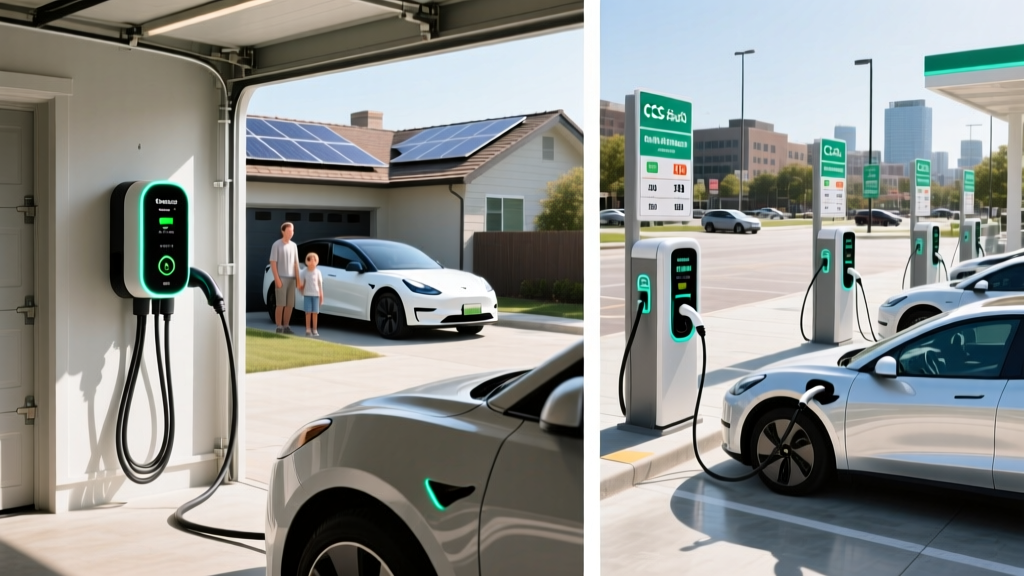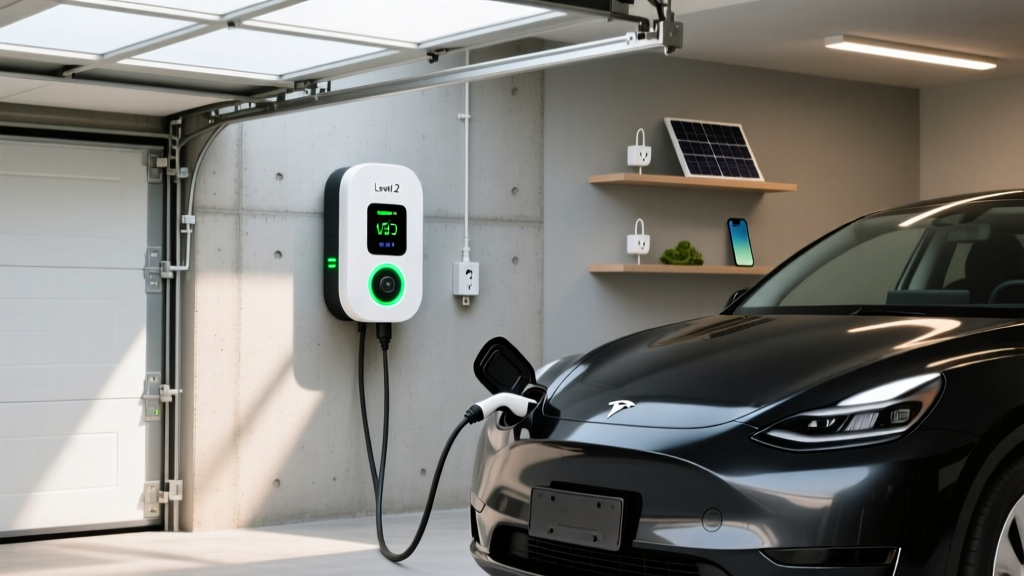
If you're shopping for an at home electric car charger, you're making the single biggest quality-of-life upgrade in EV ownership. Public charging networks have improved, but 80–90% of all EV charging still happens at home — and for good reason. A properly installed Level 2 home charger adds 25–44 miles of range per hour, costs a fraction of public DC fast charging, and means you start every morning with a full battery.
This guide walks through exactly what you need: the electrical requirements, realistic installation costs (including the panel upgrade scenario nobody warns you about), connector compatibility for every major EV brand, and specific equipment recommendations with power output, cable length, and pricing.
Charging Levels Explained: Speed, Power, and Real-World Range Added
Before buying equipment, understand the three charging levels available to EV owners. The critical distinction: kW (kilowatts) measures power — how fast energy flows into your car. kWh (kilowatt-hours) measures energy — the total capacity of your battery. Think of kW as the width of the pipe and kWh as the size of the tank.
| Level | Voltage | Power (kW) | Miles of Range Added Per Hour | Typical Use Case |
|---|---|---|---|---|
| Level 1 | 120V AC | 1.0–1.4 kW | 3–5 mi/hr | Overnight top-up, PHEVs, low-mileage drivers |
| Level 2 | 240V AC | 3.3–19.2 kW | 12–44 mi/hr (varies by amperage) | Home daily charging, workplace, hotels |
| DC Fast Charge | 400–800V DC | 50–350 kW | 150–300+ mi/hr (peak) | Road trips, highway corridors |
For most EV owners, a 48-amp Level 2 charger delivering 11.5 kW is the sweet spot — it adds roughly 30–35 miles of range per hour, fully replenishing a 75 kWh battery (like the Tesla Model Y or Ford Mustang Mach-E Extended Range) in about 7–8 hours overnight.
Electrical Requirements for a Home EV Charger
A Level 2 at home electric car charger requires a dedicated 240-volt circuit, identical to what powers your electric dryer or oven. The most common residential setup is a 60-amp breaker feeding a 48-amp continuous load (the National Electrical Code requires circuits to be rated at 125% of continuous load, so 48A × 1.25 = 60A breaker).
Here's what your electrician will evaluate:
- Panel capacity: Most modern homes have a 200-amp main panel. Adding a 60-amp EV circuit uses 30% of that capacity. If you already run electric heat, a dryer, an oven, and an AC unit, you may be near the panel's limit.
- Panel upgrade: Older homes with 100-amp service almost certainly need an upgrade to 200 amps before adding EV charging. This is the single biggest cost variable — a panel upgrade runs $1,500–$3,500 depending on your utility and local code.
- Wiring: 6 AWG copper wire for a 60-amp circuit (or 4 AWG aluminum, which is cheaper but thicker). Run length from your panel to the garage or driveway affects cost significantly.
- Hardwired vs. NEMA 14-50 outlet: Hardwired chargers are more reliable and avoid the outlet-wear issues some owners experience. A NEMA 14-50 receptacle offers portability — you can unplug and take the charger when you move — but requires a GFCI breaker under current NEC code, adding $100–$150 to the electrical cost.
How Much Does It Cost to Install a Home EV Charger?
Installation costs vary enormously based on your home's electrical setup, the distance from panel to charger location, and local labor rates. Here's a realistic breakdown based on 2026 contractor pricing across U.S. markets:
| Component | Simple Install (panel nearby, no upgrade) | Complex Install (long run or panel upgrade) |
|---|---|---|
| Level 2 charger equipment | $400–$700 | $400–$700 |
| Electrician labor (2–4 hrs simple / 6–10 hrs complex) | $300–$700 | $900–$2,000 |
| Materials (wire, conduit, breaker, mounting) | $100–$250 | $200–$500 |
| Electrical permit | $50–$150 | $50–$150 |
| Panel upgrade (if needed) | $0 | $1,500–$3,500 |
| Total estimated cost | $850–$1,800 | $3,050–$6,850 |
The best-case scenario: you have a 200-amp panel with spare capacity, and the charger mounts on the garage wall directly behind that panel. Total cost: under $1,500 including a quality Level 2 unit. The worst case: a 100-amp panel in a 1960s home, a 60-foot wire run to a detached garage, and a required service upgrade. That scenario pushes past $5,000.
Always get at least two quotes from licensed electricians and confirm they pull a permit. Unpermitted EV charger installations can void home insurance claims and create problems at resale.
Connector Compatibility: NACS, CCS, and CHAdeMO
The connector landscape has consolidated significantly. As of the 2025–2026 model years, nearly every major automaker has adopted the North American Charging Standard (NACS), originally developed by Tesla. Here's where each brand stands:
| Connector | Brands Using It (Native) | Home Charger Availability |
|---|---|---|
| NACS (Tesla connector) | Tesla (all), Ford, GM, Rivian, Volvo, Polestar, Mercedes-Benz, BMW (2025+), Hyundai/Kia (2026+), Honda (2026+) | Widely available — Tesla Wall Connector, ChargePoint Home Flex (NACS), Emporia |
| CCS1 | Volkswagen ID.4 (2024 and earlier), older BMW i4/iX, legacy models | ChargePoint Home Flex (CCS), JuiceBox, Emporia (CCS config) |
| CHAdeMO | Nissan Leaf (all years), Mitsubishi Outlander PHEV (older) | Limited home options — mostly DC fast-charge only |
Adapter note: If you own a CCS-equipped EV (like a 2024 VW ID.4) but want to use Tesla's NACS home chargers or Superchargers, a CCS-to-NACS adapter ($150–$250 from brands like Lectron or A2Z) works for both home and public charging. Tesla also sells a NACS-to-CCS adapter for $250 that lets non-Tesla EVs use Tesla Wall Connectors.
Top At Home Electric Car Charger Picks for 2026
These are the Level 2 chargers we recommend based on power output, build quality, smart features, connector options, and value. All support 240V hardwired or plug-in installation and carry UL or ETL safety certification.
ChargePoint Home Flex (NACS or CCS)
- Power output: Up to 12 kW (50 amps) on a 60A circuit; adjustable down to 16A for lower-capacity panels
- Cable length: 23 feet
- Connector: Available in NACS or CCS1 configurations
- Smart features: Wi-Fi, scheduling, Alexa/Google integration, energy tracking via app
- Price: $599 (NACS) / $649 (CCS)
- Best for: Most EV owners wanting a reliable, feature-rich charger with excellent app support
Tesla Wall Connector (NACS)
- Power output: Up to 11.5 kW (48 amps) on a 60A circuit
- Cable length: 24 feet
- Connector: NACS native — works with all Tesla vehicles and NACS-equipped Fords, GMs, Rivians
- Smart features: Wi-Fi, over-the-air updates, power sharing (link two units on one circuit), load management
- Price: $475
- Best for: Tesla owners and households with multiple NACS EVs (power sharing is a standout feature)
Emporia Vue Smart EV Charger
- Power output: Up to 11.5 kW (48 amps) on a 60A circuit
- Cable length: 24 feet
- Connector: NACS or J1772 (CCS adapter available)
- Smart features: Integrates with Emporia Vue home energy monitor, solar-aware charging, time-of-use scheduling
- Price: $399
- Best for: Budget-conscious buyers and solar-panel owners who want energy-integrated charging
Grizzl-E Smart (NACS or J1772)
- Power output: Up to 10 kW (40 amps) on a 50A circuit
- Cable length: 24 feet
- Connector: NACS or J1772
- Smart features: OCPP-compatible, adjustable amperage, extreme cold-rated (-40°F), rugged aluminum case
- Price: $449
- Best for: Cold-climate owners and outdoor installations where durability matters
How Much Does Charging at Home Cost vs. Gas?
Home charging is where EV ownership economics shine — but the exact savings depend on your local electricity rate and the vehicle's efficiency. Let's compare real numbers.
| Scenario | Rate / Price | Vehicle Efficiency | Cost Per Mile |
|---|---|---|---|
| Home charging (national avg electricity) | $0.17/kWh | 3.0 mi/kWh (typical EV, e.g., Tesla Model Y) | $0.057 |
| Home charging (off-peak TOU rate) | $0.09/kWh | 3.0 mi/kWh | $0.030 |
| Home charging (high-cost state, e.g., CA avg) | $0.30/kWh | 3.0 mi/kWh | $0.100 |
| Public Level 2 (ChargePoint, EVgo) | $0.35–$0.55/kWh | 3.0 mi/kWh | $0.12–$0.18 |
| DC Fast Charging (Electrify America, Tesla Supercharger) | $0.35–$0.55/kWh | 3.0 mi/kWh | $0.12–$0.18 |
| Gasoline (2026 national avg) | $3.30/gallon | 28 MPG (typical gas crossover) | $0.118 |
At the national average electricity rate of $0.17/kWh (per U.S. EIA data), home charging costs roughly half what gasoline costs per mile. With a time-of-use plan and off-peak scheduling, you can cut that to a quarter of the gas cost. Even in high-rate states like California, home charging undercuts gasoline.
For a driver covering 12,000 miles per year, that translates to $680 in home electricity vs. $1,416 in gasoline — roughly $736 in annual fuel savings before any solar or TOU optimization.
Charging Time Examples: 10–80% for Common Battery Sizes
Here's how long a 10–80% charge takes on a typical 48-amp (11.5 kW) Level 2 at home electric car charger for popular 2025–2026 EVs:
- Tesla Model Y Long Range (75 kWh usable): ~5.5 hours (10–80%)
- Ford Mustang Mach-E Extended Range (91 kWh usable): ~6.5 hours
- Hyundai Ioniq 5 (77.4 kWh usable): ~5.5 hours
- Chevrolet Equinox EV (85 kWh usable): ~6 hours
- BMW i4 eDrive40 (81.5 kWh usable): ~6 hours
- Toyota bZ4X (71.4 kWh usable): ~5 hours
- Toyota Prius Prime PHEV (13.6 kWh usable): ~1.2 hours (full charge)
Every one of these completes well within a standard overnight window. For daily driving of 30–50 miles, you'll rarely need a full 10–80% cycle — most nights you're adding 15–25 kWh in 2–3 hours.
Charge curve note: Level 2 home charging delivers consistent power throughout the session (unlike DC fast charging, which tapers above 80%). Your charger outputs its full rated kW from 0% to 100%, making the math straightforward: battery kWh ÷ charger kW = hours.
Safety, Code, and Installation Best Practices
EV charging draws sustained high current for hours — this is not the same as briefly running a microwave. Follow these safety essentials:
- Dedicated circuit: Your Level 2 charger must have its own dedicated breaker — never share a circuit with other appliances.
- GFCI protection: The 2023 NEC (adopted in most states by 2026) requires GFCI protection for all 240V receptacles used for EV charging. Hardwired installations are exempt from this GFCI requirement, which is one reason many electricians prefer hardwiring.
- Outdoor rating: If your charger mounts outside, ensure it carries a NEMA 4 or IP65 rating. All chargers listed above meet outdoor standards.
- Cable management: Use a wall-mounted cable organizer to prevent tripping hazards and cord damage. Never run a charging cable across a driveway where vehicles can crush it.
- Permit and inspection: Most jurisdictions require a permit for new 240V circuits. The inspection ensures proper wire gauge, breaker sizing, grounding, and GFCI compliance. Skipping this risks fire and insurance denial.
- Load management: If your panel is near capacity but you don't want to pay for an upgrade, consider a load-management system like the Emporia Vue or Tesla Wall Connector's built-in load sharing, which dynamically reduces charger power when other household loads spike.
Federal Tax Credit for Home Charger Installation
The IRS §30C Alternative Fuel Vehicle Refueling Property Credit covers 30% of the cost of home EV charging equipment and installation, up to a maximum credit of $1,000. This applies to both the charger hardware and the electrician's labor.
Key eligibility requirements for 2026:
- The equipment must be installed at your primary residence in the United States.
- The property must be placed in service during the tax year.
- The credit is non-refundable — it reduces your tax liability but won't generate a refund beyond what you owe.
- There are no income caps or MSRP caps on this credit (unlike the §30D vehicle purchase credit).
- File IRS Form 8911 with your tax return.
Consult a tax professional to confirm eligibility — rules can change, and state-level incentives may stack on top of the federal credit. Many utilities also offer rebates of $200–$500 for Level 2 charger installations; check with your provider.
Frequently Asked Questions
Can I use a regular 120V outlet to charge my EV at home?
Yes — that's Level 1 charging. It delivers about 1.0–1.4 kW, adding 3–5 miles of range per hour. For a plug-in hybrid with 30 miles of electric range, Level 1 is perfectly adequate overnight. For a full EV with a 75+ kWh battery, Level 1 adds roughly 40 miles overnight — fine for low-mileage commuters but insufficient for drivers covering 50+ miles daily. Most EVs ship with a Level 1 cord; consider it a backup, not a primary solution.
Do I need a Tesla Wall Connector if I own a Tesla?
Not necessarily. The Tesla Wall Connector ($475) is excellent and supports power sharing between two Teslas, but the ChargePoint Home Flex NACS ($599) offers comparable performance plus broader app features and energy tracking. Both deliver up to 48 amps. The Tesla unit's main advantage is its lower price and native integration with Tesla's ecosystem.
What if my home only has a 100-amp electrical panel?
A 100-amp panel is likely insufficient for Level 2 EV charging alongside existing appliances like an electric dryer, oven, and HVAC. You'll need a panel upgrade to 200 amps, costing $1,500–$3,500 depending on your utility's requirements and local labor. Alternatively, you can install a lower-amperage charger (16–24 amps on a 20–30 amp circuit), which adds 12–18 miles per hour — adequate for moderate daily driving without a panel upgrade.
Is a hardwired charger better than a plug-in (NEMA 14-50) charger?
Hardwired connections are generally more reliable long-term. They eliminate the NEMA 14-50 receptacle as a failure point (outlets can loosen with repeated plugging/unplugging under load), avoid the NEC GFCI breaker requirement for receptacles, and allow the full 48-amp continuous draw without the 40-amp limitation some outlets impose. Plug-in offers portability — you can take the charger when you move. If you own your home and plan to stay, hardwire it.
How do I charge two EVs at home without upgrading my panel?
Use a load-sharing charger like the Tesla Wall Connector, which lets you link two units on a single 60-amp circuit. The system dynamically splits available power between the two vehicles. Alternatively, the Emporia charger paired with the Emporia Vue energy monitor can throttle charging based on real-time household load, ensuring you never trip the main breaker. Both solutions avoid a costly panel upgrade.
Does extreme cold affect home Level 2 charging speed?
The charger itself delivers full power regardless of temperature. However, cold batteries (below ~50°F) accept charge more slowly due to lithium-ion chemistry limitations. Most modern EVs precondition the battery when they detect a scheduled charge or when you navigate to a charger — this warms the pack for optimal acceptance. In sub-freezing climates, expect your 10–80% charge to take 20–30% longer in winter unless your vehicle actively preconditions. Garage parking mitigates this significantly.