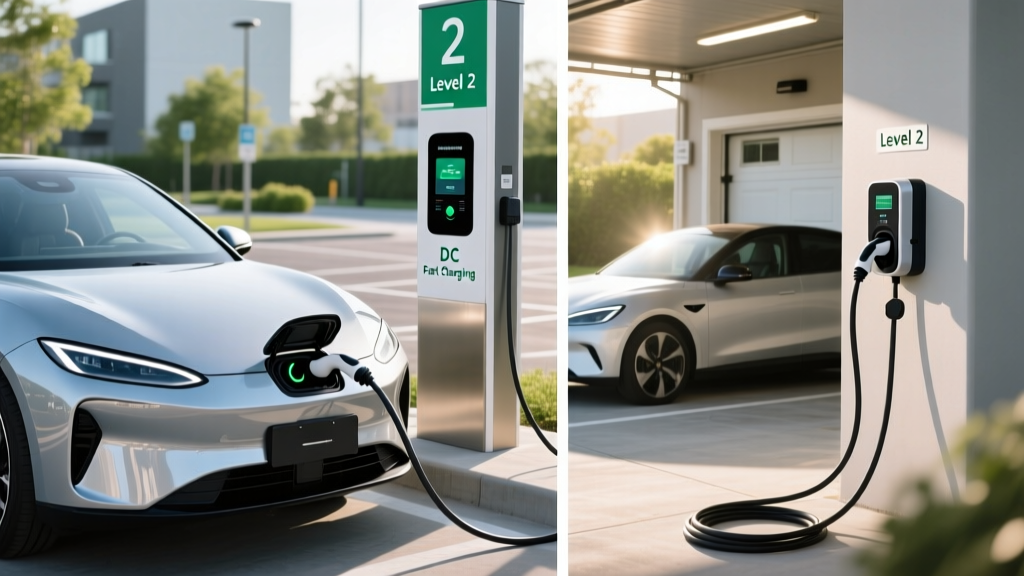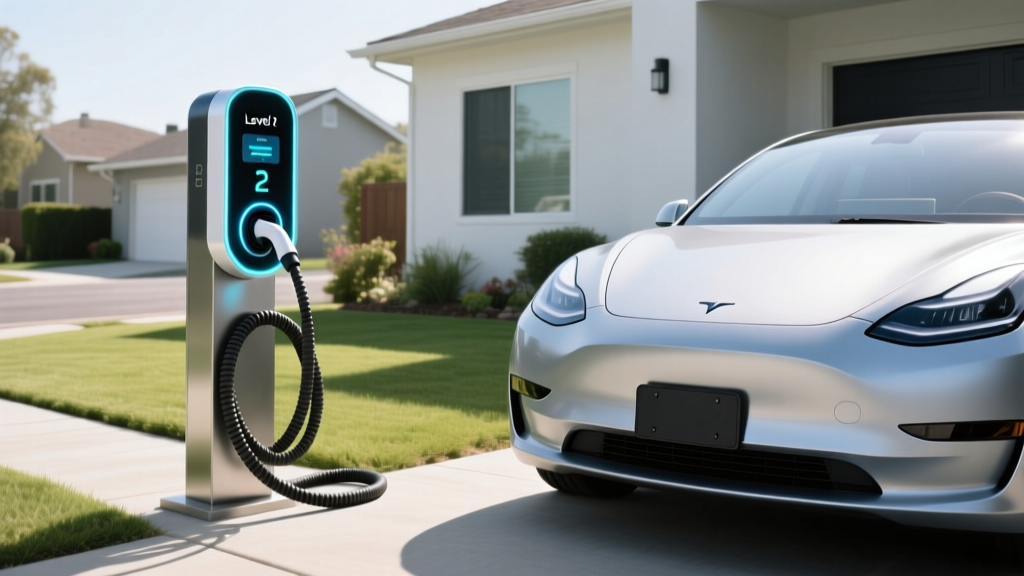
If you have an electric vehicle or are shopping for one, you will quickly learn that the majority of your charging happens at home. But plugging into a standard 120V wall outlet (Level 1) adds range at a pace measured in miles per day, not miles per hour. That is where a Level 2 charging station comes in — it is the single most impactful upgrade you can make to your daily EV ownership experience.
This guide breaks down exactly what a Level 2 charger is, how it compares to other charging levels, what your home electrical panel needs to support one, what it costs, and which stations we recommend in 2026.
The Three EV Charging Levels: Speeds and Real-World Output
Before defining Level 2 specifically, it helps to understand the full charging landscape. EV charging is categorized into three levels based on voltage, power output (measured in kilowatts, or kW), and the rate at which energy (measured in kilowatt-hours, or kWh) flows into your battery.
| Level | Voltage | Power Output | Miles of Range Added per Hour | Typical Use Case |
|---|---|---|---|---|
| Level 1 | 120V AC | 1.0–1.4 kW | 3–5 mi/hr | Overnight top-off; PHEVs; low-mileage drivers |
| Level 2 | 240V AC | 3.3–19.2 kW | 12–75 mi/hr | Home daily charging; workplace; public destinations |
| DC Fast Charging | 400–900V DC | 50–400+ kW | 150–1,000+ mi/hr (peak) | Road trips; highway corridors; commercial fleets |
A few important nuances:
- kW vs. kWh: Kilowatts (kW) measure power — how fast energy flows. Kilowatt-hours (kWh) measure energy — how much your battery holds. A 10 kW charger delivering power for one hour adds 10 kWh to your battery. Confusing these two is the most common EV literacy mistake.
- Peak vs. sustained rate: DC fast chargers advertise peak kW, but the charge curve tapers significantly above 80% State of Charge (SoC). A "350 kW" charger may only sustain that rate for a few minutes before dropping to 150 kW or lower.
- Vehicle-side limits: Your EV's onboard charger caps Level 2 speed. A station rated at 19.2 kW cannot charge faster than your car's onboard charger allows — most EVs accept 11.5 kW (48A) or less on Level 2.
What Is a Level 2 Charging Station, Exactly?
A Level 2 charging station is a 240-volt AC charging device — the same voltage your electric dryer or oven uses — that delivers between 3.3 kW and 19.2 kW of power to your EV. Most home installations operate at 7.2 kW (30 amps), 9.6 kW (40 amps), or 11.5 kW (48 amps), which is the sweet spot for overnight charging virtually any EV on the market.
At 11.5 kW (48 amps on a 60-amp circuit), a Level 2 station adds roughly 35–45 miles of range per hour of charging. That means a 75 kWh battery (like the one in a Tesla Model Y or Hyundai IONIQ 5) can go from 10% to 80% in approximately 5–6 hours — easily completed while you sleep.
Level 2 stations come in two physical formats:
- Hardwired: Directly wired into your electrical panel by a licensed electrician. Supports higher amperage (up to 48A/11.5 kW on a 60A circuit) and is required by code in many jurisdictions for circuits above 40A. More reliable, no plug to loosen.
- Plug-in (NEMA 14-50): Plugs into a 240V outlet, typically a NEMA 14-50 receptacle. Portable between locations if you move. Limited to 40A continuous (9.6 kW) per NEC rules for plug-in devices on a 50A circuit.
Home Installation: Electrical Requirements, Panel Upgrades, and Costs
Installing a Level 2 charger at home is not just about buying the equipment — your home's electrical infrastructure must support it. Here is what you need to know before calling an electrician.
Electrical Requirements
A Level 2 charger requires a dedicated 240V circuit. The amperage of that circuit determines your maximum charging speed:
- 30A circuit → 24A continuous → 5.8 kW (older panels, smaller EVs, PHEVs)
- 40A circuit → 32A continuous → 7.7 kW (common minimum for BEVs)
- 50A circuit → 40A continuous → 9.6 kW (most popular home setup; NEMA 14-50 compatible)
- 60A circuit → 48A continuous → 11.5 kW (maximum for most EVs; hardwired required)
The National Electrical Code (NEC) requires that continuous loads (like EV charging, which runs for 3+ hours) use only 80% of a circuit's rated capacity. This is why a 50A circuit supports only 40A of continuous charging.
Do You Need a Panel Upgrade?
This is the cost variable that catches many homeowners off guard. Your electrical panel has a total amperage rating — typically 100A, 150A, or 200A in US homes. An electrician will perform a load calculation to determine whether your panel can handle the additional 40–60A draw of an EV charger alongside your existing appliances.
Homes with 100A panels, electric heat, electric dryers, and electric ranges often need a panel upgrade to 200A before adding a 48A EV circuit. Newer homes with 200A panels usually have sufficient headroom.
An alternative to a full panel upgrade is a smart load-management device (like the Emporia Smart Load Manager or Span panel integration), which dynamically limits charger draw when other high-load appliances are running. This can avoid a panel upgrade entirely in some cases.
Installation Cost Breakdown
| Component | Cost Range | Notes |
|---|---|---|
| Level 2 charger (equipment) | $350–$700 | Smart Wi-Fi stations; basic units from $250 |
| Electrician labor (standard install) | $400–$1,200 | Short run from panel to garage; longer runs cost more |
| Permit and inspection | $50–$250 | Varies by municipality; some areas waive for EV chargers |
| Electrical panel upgrade (if needed) | $1,500–$3,500 | 100A to 200A upgrade; not always required |
| Conduit, wiring, and misc. materials | $100–$500 | Depends on run length and wall type |
| Total (no panel upgrade) | $900–$2,650 | Most common scenario for modern homes |
| Total (with panel upgrade) | $2,400–$6,150 | Older homes with 100A service |
According to data compiled by the US Department of Energy, the national average for a standard home Level 2 installation (without panel upgrade) falls between $1,000 and $2,500 including equipment.
Federal Tax Credit for Home Charging Equipment
The IRS §30C Alternative Fuel Vehicle Refueling Property Credit covers 30% of the cost of home EV charging equipment and installation, up to $1,000. Eligibility depends on your census tract meeting certain low-income or non-urban criteria. Always verify current-year rules with a tax professional — eligibility requirements have tightened since the credit was expanded under the Inflation Reduction Act.
Connector Types: Will the Charger Fit Your EV?
The physical connector that plugs into your EV has undergone a major consolidation in the US market. Here is where things stand in 2026:
| Connector | Brands Using It | Notes |
|---|---|---|
| NACS (J3400) | Tesla, Ford, GM, Rivian, Volvo, Polestar, Hyundai, Kia (2025+ models) | Now the dominant US standard; adopted by nearly all major OEMs |
| CCS1 (Combo) | VW, BMW, older Ford/GM/Hyundai/Kia models (pre-NACS switch) | Still on many 2023–2024 model-year EVs on the road |
| CHAdeMO | Nissan Leaf (legacy) | Effectively discontinued; no new US EVs use it |
What this means for your Level 2 charger purchase:
- If you own or plan to buy a 2025+ model-year EV from a major brand, you likely need a NACS-connector Level 2 station.
- If you own a 2023–2024 CCS-equipped EV (like a VW ID.4 or older Hyundai IONIQ 5), buy a CCS1 charger — or use a NACS-to-CCS adapter if your charger has a NACS plug.
- Most charger manufacturers now sell stations in both NACS and CCS1 configurations, or offer adapter cables.
For Level 2 home charging, all connectors use the J1772 communication protocol under the hood — the physical plug shape is the only difference. Adapters (NACS-to-J1772 or CCS-to-NACS) cost $100–$250 and work reliably for home use.
Charging Time Examples: How Long Does Level 2 Actually Take?
Charging time depends on your battery size (kWh), the charger's power output (kW), and your EV's onboard charger limit. Here are real-world estimates for popular EVs charging on a 48A/11.5 kW Level 2 circuit:
| Vehicle | Battery (Usable kWh) | Onboard Charger Limit | 10%–80% Time | 0%–100% Time |
|---|---|---|---|---|
| Tesla Model Y (2026) | 75 kWh | 11.5 kW | ~4.5 hours | ~7 hours |
| Hyundai IONIQ 5 (2026) | 77.4 kWh | 10.9 kW | ~5 hours | ~7.5 hours |
| Ford Mustang Mach-E (2026) | 91 kWh (ER) | 10.5 kW | ~6 hours | ~9 hours |
| Chevrolet Equinox EV (2026) | 85 kWh | 11.5 kW | ~5.5 hours | ~8 hours |
| Toyota RAV4 Plug-in Hybrid | 18.1 kWh | 6.6 kW | ~2 hours | ~2.75 hours |
Note: PHEVs like the RAV4 Prime have much smaller batteries, so even a lower-power Level 2 charger (3.3–6.6 kW) is sufficient for overnight charging.
Cost to Charge: Level 2 at Home vs. Public vs. Gas
One of the strongest arguments for a home Level 2 station is cost. Charging at home on a Level 2 circuit is dramatically cheaper than public DC fast charging — and usually cheaper than gasoline per mile driven.
| Scenario | Cost per kWh | Cost per Mile (at 3 mi/kWh) | Equivalent MPG Cost (at $3.40/gal gas) |
|---|---|---|---|
| Home Level 2 (national avg. electricity) | $0.16/kWh | $0.053/mi | ~$1.06/gal equivalent |
| Home Level 2 (off-peak TOU rate) | $0.08–$0.12/kWh | $0.027–$0.04/mi | ~$0.54–$0.80/gal equivalent |
| Public Level 2 (networks like ChargePoint, EVgo) | $0.25–$0.49/kWh | $0.083–$0.163/mi | ~$1.66–$3.26/gal equivalent |
| DC Fast Charging (Electrify America, Tesla Supercharger) | $0.35–$0.55/kWh | $0.117–$0.183/mi | ~$2.34–$3.66/gal equivalent |
| Gas vehicle (28 MPG combined avg.) | — | $0.121/mi | $3.40/gal |
Key takeaway: If you charge primarily at home on an off-peak time-of-use (TOU) rate plan, your per-mile fuel cost drops to roughly $0.03–$0.04 — about a quarter of what a 28 MPG gas car costs. Over 15,000 miles per year, that is a savings of approximately $1,200–$1,400 annually compared to gasoline.
Time-of-use plans are critical to maximizing savings. Many utilities offer rates as low as $0.06–$0.10/kWh during overnight hours (typically 11 PM – 6 AM). Smart Level 2 chargers can be scheduled to charge only during these windows.
Recommended Level 2 Charging Stations for 2026
Based on power output, build quality, smart features, cable length, and real-world reliability, here are our top picks across categories:
Best Overall: ChargePoint Home Flex (2nd Gen)
- Power: Up to 11.5 kW (48A) on a 60A circuit; adjustable down to 16A for smaller circuits
- Connector: Available in NACS or J1772 (CCS via adapter)
- Cable length: 23 feet
- Smart features: Wi-Fi, app scheduling, Alexa/Google Home integration, energy tracking
- Price: ~$550–$650
- Why we recommend it: Flexible amperage settings mean it works on almost any home circuit. UL-listed, Energy Star certified, and the app is the most polished in the industry.
Best Value: Emporia Level 2 EV Charger
- Power: Up to 11.5 kW (48A)
- Connector: J1772 (NACS adapter available)
- Cable length: 24 feet
- Smart features: Wi-Fi, app scheduling, integration with Emporia home energy monitor, solar-aware charging
- Price: ~$350–$400
- Why we recommend it: Best price-to-feature ratio. If you have solar panels, the Emporia ecosystem lets you charge exclusively on solar surplus — a genuinely useful feature no other budget charger offers.
Best for Tesla Owners: Tesla Wall Connector
- Power: Up to 11.5 kW (48A)
- Connector: NACS (native Tesla); also includes J1772 adapter for non-Tesla EVs
- Cable length: 24 feet
- Smart features: Wi-Fi, over-the-air updates, Power Sharing (link multiple units on one circuit), integrated Tesla app control
- Price: ~$475
- Why we recommend it: If you own a Tesla, the native NACS integration and sleek design are hard to beat. Power Sharing is useful for two-EV households that want to avoid a panel upgrade.
Best for Durability (Outdoor): Grizzl-E Smart
- Power: Up to 10 kW (40A)
- Connector: J1772 or NACS
- Cable length: 24 feet
- Smart features: Wi-Fi, OCPP protocol support, adjustable amperage
- Price: ~$450–$550
- Why we recommend it: Built in Canada with an IP67-rated aluminum enclosure. If your charger lives outdoors in harsh weather, the Grizzl-E is the most rugged option we have tested. Three-year warranty.
Safety, Code, and Installation Best Practices
EV chargers draw sustained high current for hours — this is not the same as briefly running a microwave. Proper installation is critical for safety and insurance compliance.
- Dedicated circuit: Your Level 2 charger must be on its own dedicated circuit. Sharing a circuit with other appliances is a code violation and a fire hazard.
- GFCI protection: The 2020 NEC (and later) requires GFCI (Ground Fault Circuit Interrupter) protection for EV charging outlets. Hardwired installations may be exempt in some jurisdictions, but many modern chargers include built-in ground-fault protection regardless.
- Outdoor rating: If installing outdoors, the charger must carry at least an IP54 rating (splash-resistant). Look for IP65 or IP67 for full weather exposure. NEMA 14-50 outlets installed outdoors must be in a weatherproof in-use cover.
- Permit and inspection: Most US jurisdictions require an electrical permit for EV charger installation. Skipping the permit can void your homeowner's insurance in the event of an electrical fire. The inspection ensures proper wire gauge, breaker sizing, and grounding.
- Wire gauge: A 60A circuit requires 6 AWG copper wire (or 4 AWG aluminum). Your electrician will size this correctly, but verify — undersized wire on a high-amperage circuit is a serious fire risk.
For detailed code requirements, reference the National Electrical Code (NFPA 70) Article 625, which governs EV charging systems.
Frequently Asked Questions
How much does it cost to install a home EV charger?
A typical Level 2 home installation costs $900–$2,650 including equipment, electrician labor, and permits — assuming your electrical panel has sufficient capacity. If a panel upgrade from 100A to 200A is needed, add $1,500–$3,500. The federal §30C credit can offset up to $1,000 (30% of equipment + installation) if your census tract qualifies.
How fast will each charging level add range?
Level 1 (120V) adds 3–5 miles per hour. Level 2 (240V) adds 12–75 miles per hour depending on amperage — a 48A/11.5 kW station adds roughly 35–45 miles per hour for most EVs. DC fast charging adds 150–1,000+ miles per hour at peak rates, but tapers sharply above 80% SoC.
Which connector/charger is compatible with my EV?
For 2025+ model-year vehicles from Tesla, Ford, GM, Rivian, Hyundai, Kia, and Volvo, the NACS (J3400) connector is standard. Older EVs (2023–2024) from VW, BMW, and some others still use CCS1. CHAdeMO is limited to the legacy Nissan Leaf. Check your EV's charge port before ordering a station — most manufacturers now offer both NACS and CCS1 variants.
How much does charging cost per mile vs. gas?
Home Level 2 charging on a national average electricity rate ($0.16/kWh) costs about $0.053 per mile. On an off-peak TOU rate ($0.08–$0.12/kWh), it drops to $0.027–$0.04 per mile. A 28 MPG gas car at $3.40/gallon costs $0.121 per mile. Home charging is 2–4x cheaper per mile than gasoline.
What electrical upgrades might I need?
If your home has a 100A electrical panel, you will likely need a panel upgrade to 200A ($1,500–$3,500) to support a 40–48A EV charger alongside existing appliances. Homes with 150A or 200A panels usually have sufficient headroom. A smart load-management device can sometimes avoid a full panel upgrade by dynamically limiting charger draw when other loads are active.
Can I install a Level 2 charger myself?
Plug-in units on an existing NEMA 14-50 outlet are technically DIY if the outlet is already installed and code-compliant. However, installing a new 240V circuit, hardwiring a charger, or upgrading your panel must be done by a licensed electrician. DIY electrical work on high-amperage circuits without a permit can void your home insurance and create serious fire and shock hazards.
Is a smart charger worth the extra cost?
Yes, for most owners. Smart chargers ($350–$650) offer scheduled charging during off-peak utility rates, energy tracking, remote monitoring, and over-the-air firmware updates. A basic "dumb" charger ($200–$300) simply delivers power when plugged in. The $100–$200 premium for a smart charger typically pays for itself through off-peak scheduling savings within 12–18 months.