If you've purchased or are shopping for an electric vehicle, you've likely encountered the term "Level 2 charger" and wondered what separates it from the outlet in your garage or the DC fast charger at a highway rest stop. Understanding charging levels—and choosing the right Level 2 equipment for your home—is the single highest-impact decision you'll make as an EV owner. It determines whether you wake up to a full battery every morning or spend your evenings hunting for public charging.
This guide breaks down the three charging levels with exact kW figures and miles-per-hour data, walks through the real electrical requirements and costs of a home Level 2 installation (including the panel-upgrade scenario nobody warns you about), and recommends specific 2025–2026 charger models with specs and pricing.
The Three EV Charging Levels: Speeds in kW and Miles per Hour
Before picking equipment, you need to understand what each charging level actually delivers. The distinction between kW (kilowatts — the rate of power flow) and kWh (kilowatt-hours — the total energy stored in your battery) is the most critical piece of EV literacy. Think of kW as how fast water flows through a hose; kWh is how full the bucket gets.
| Level | Voltage / Amps | Power Output | Miles of Range per Hour | Typical Use Case |
|---|---|---|---|---|
| Level 1 | 120V / 12A | ~1.4 kW | 3–5 mi/hr | Overnight trickle; PHEVs with small batteries |
| Level 2 | 240V / 32–48A | 7.7–11.5 kW | 25–44 mi/hr | Daily home & workplace charging |
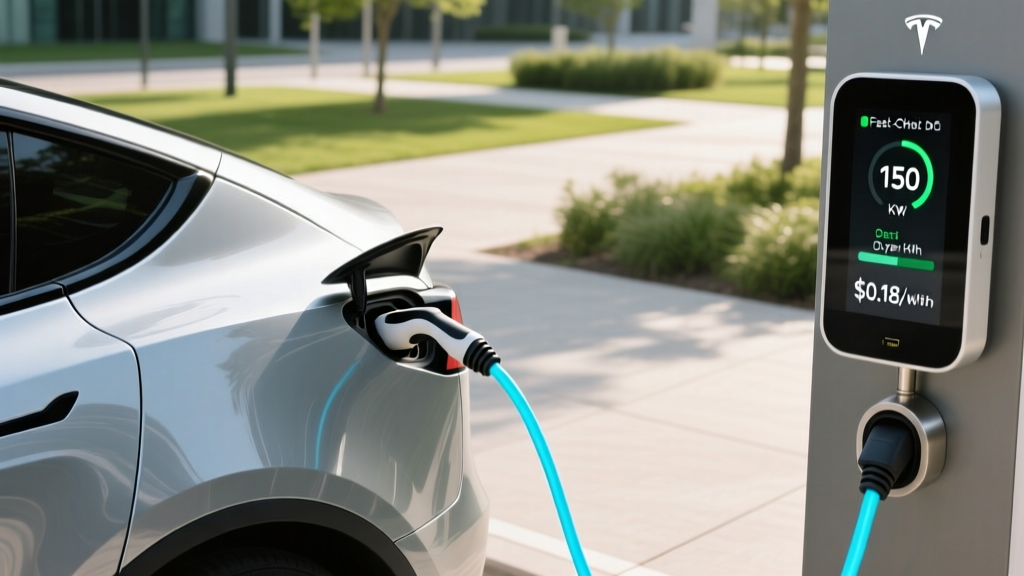
| DC Fast | 400–800V DC | 50–350 kW | 150–1,200+ mi/hr | Highway road trips; rapid top-ups |
Real-world context: A Level 1 outlet adds roughly 40 miles of range over a 10-hour night—adequate for a plug-in hybrid with 30–40 miles of electric range (like the Toyota RAV4 Prime), but painfully slow for a 300-mile BEV. A Level 2 charger at 11.5 kW (48A) replenishes roughly 330 miles in that same 10-hour window, which covers virtually any daily driving need and fully recharges most EV batteries overnight.
DC fast charging bypasses the vehicle's onboard charger and feeds DC current directly to the battery. Peak rates like 250 kW or 350 kW are not sustained—charge curves taper significantly above 80% State of Charge (SoC) to protect battery health. A 350 kW charger might deliver a 10–80% charge in 18 minutes but take another 25 minutes to go from 80–100%.
Home Level 2 Installation: Electrical Requirements and Real Costs
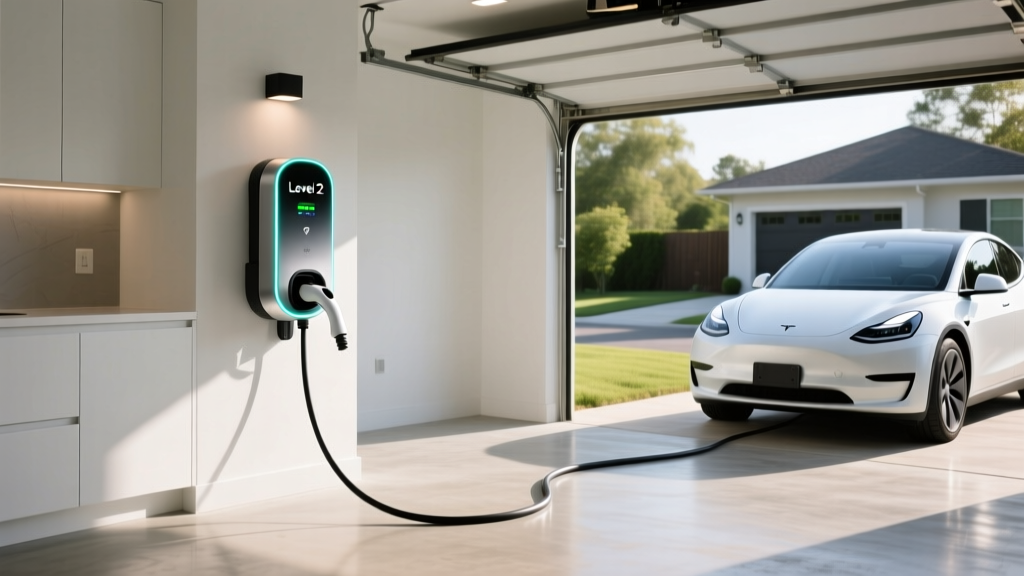
A Level 2 home charger requires a dedicated 240-volt circuit—the same voltage your electric dryer or oven uses. The amperage of that circuit determines your charging speed:
- 40A circuit (32A continuous): Delivers up to 7.7 kW. Adequate for most daily needs; charges a 75 kWh battery (Tesla Model Y Long Range) from 10–80% in roughly 6.5 hours.
- 50A circuit (40A continuous): Delivers up to 9.6 kW. A common sweet spot; charges that same 75 kWh pack in ~5.2 hours.
- 60A circuit (48A continuous): Delivers up to 11.5 kW. Fastest residential option; ~4.4 hours for 10–80% on a 75 kWh pack. Requires a panel with sufficient spare capacity.
The National Electrical Code (NEC) requires that continuous loads (like EV charging, which runs for hours) use no more than 80% of a circuit's rated amperage. That's why a 40A breaker yields 32A of usable charging current.
What Electrical Upgrades Might I Need?
This is where costs can escalate unexpectedly. Your home's electrical panel has a total amperage capacity—typically 100A in older homes and 200A in newer construction. An electrician will perform a load calculation to determine whether your panel can handle the additional 40–60A draw of an EV charger alongside your existing loads (HVAC, water heater, dryer, etc.).
Panel upgrade scenario: If you have a 100A panel in an older home with electric heating and a dryer, you may need a service upgrade to 200A, which involves your utility replacing the service drop and your electrician installing a new panel. This is the single biggest cost variable in EV charger installation.
Alternative — load management: Some smart chargers (like the Enel X JuiceBox with load-sharing or the Emporia V2 with its built-in load management) can dynamically reduce charging amperage when other household loads spike, potentially avoiding a panel upgrade. The Emporia V2, for example, monitors your panel's total draw in real time and throttles the charger accordingly.
Installation Cost Breakdown
| Component | Basic Install (short run, 40A) |
Standard Install (moderate run, 50A) |
Complex Install (long run + panel upgrade) |
|---|---|---|---|
| Charger unit (hardwired or plug-in) | $350–$500 | $400–$700 | $400–$700 |
| Electrician labor (2–8 hrs @ $75–$150/hr) | $200–$400 | $400–$900 | $600–$1,500 |
| Electrical materials (wire, conduit, breaker) | $100–$200 | $200–$500 | $300–$800 |
| Permit fees | $50–$150 | $50–$200 | $100–$250 |
| Panel upgrade (if needed) | — | — | $1,500–$4,000 |
| Total | $700–$1,250 | $1,050–$2,300 | $2,900–$7,250 |
Key variable: The distance from your electrical panel to the charger location is the primary labor driver. A garage install with the panel on the same wall may require only 10 feet of wire. A charger on the far side of the house might need 80+ feet of conduit and wire through attic or crawlspace—tripling the labor cost.
The federal Alternative Fuel Vehicle Refueling Property Credit (IRS Form 8911) offers up to $1,000 (30% of cost, capped) for home charging equipment installed in eligible census tracts. Check your eligibility on the IRS site, as this credit has location-based requirements tied to low-income or non-urban census tracts.
Connector Compatibility: NACS, CCS1, and CHAdeMO
The connector landscape has shifted dramatically since Tesla opened its North American Charging Standard (NACS) to the industry. Here's where things stand for 2025–2026 model-year vehicles:
| Connector | Brands Using It (New Vehicles) | Adapter Needed? |
|---|---|---|
| NACS (J3400) | Tesla (all), Ford, GM, Rivian, Volvo, Polestar, Mercedes-Benz, BMW, Honda, Nissan (new models), Fisker, Lucid (2025+) | CCS1→NACS adapter for legacy CCS vehicles at Tesla Superchargers; most new NACS vehicles include adapter for CCS stations |
| CCS1 (Combo) | Hyundai, Kia, Volkswagen, Audi, Porsche, Stellantis (Jeep, Dodge), legacy Ford/GM/Rivian (pre-2025) | NACS→CCS adapter if charging at NACS-only stations |
| CHAdeMO | Nissan Leaf (discontinued after 2025), Mitsubishi Outlander PHEV (legacy) | Limited adapter options; network declining |
For home Level 2 charging: All Level 2 chargers use the J1772 connector (or NACS for Tesla). Since NACS vehicles accept J1772 via a simple passive adapter (typically included with the vehicle), any J1772-equipped Level 2 charger will work with virtually every EV on the road. Tesla includes a J1772 adapter in the glovebox; Ford and GM include one with their NACS-transition vehicles.
Bottom line: Buy a J1772-connector Level 2 charger for maximum compatibility. If you exclusively own Tesla/NACS vehicles and want the cleanest setup, NACS-connector home chargers (like the Tesla Wall Connector) are available and work seamlessly with the NACS port.
Charging Cost Per Mile: Home vs. Public vs. Gas
One of the strongest economic arguments for EVs is lower per-mile fuel cost—but the savings vary enormously depending on where and when you charge. Here's the real math:
| Scenario | Rate ($/kWh) | Cost per Mile* | Equivalent Gas MPG Cost** |
|---|---|---|---|
| Home — off-peak (utility TOU rate) | $0.08–$0.12 | $0.024–$0.036 | $0.84–$1.26/gal equivalent |
| Home — standard rate | $0.13–$0.18 | $0.039–$0.054 | $1.37–$1.89/gal equivalent |
| Public Level 2 (ChargePoint, etc.) | $0.25–$0.49 | $0.075–$0.147 | $2.63–$5.15/gal equivalent |
| DC fast charging (Electrify America, EVgo) | $0.35–$0.65 | $0.105–$0.195 | $3.68–$6.83/gal equivalent |
| Gas vehicle (30 MPG avg, $3.50/gal) | — | $0.117 | $3.50/gal |
*Based on an average EV efficiency of 3.3 miles per kWh (roughly 30 kWh/100mi, typical for a midsize crossover like the Hyundai Ioniq 5 or Tesla Model Y). Actual efficiency varies by vehicle, temperature, and driving style.
**"Gas equivalent" shows what a gasoline car's per-mile cost would be at that rate—helpful for direct comparison.
The data is clear: home charging at off-peak utility rates is 3–5× cheaper per mile than gasoline. But exclusive reliance on DC fast charging can actually exceed the cost of gas—which is why home Level 2 access is so economically important.
Many utilities offer Time-of-Use (TOU) plans specifically designed for EV owners, with super-off-peak rates between midnight and 6 AM. Check with your local utility; some offer EV-specific plans with rates as low as $0.05–$0.08/kWh during off-peak windows.
Charging Time Examples: How Long to Charge Common EV Batteries
Charge times depend on three factors: battery size (kWh), charger power output (kW), and the vehicle's onboard charger capacity (which caps how much AC power it can accept). Here are real-world estimates for popular 2025–2026 models on a typical 48A (11.5 kW) Level 2 home charger:
- Tesla Model Y Long Range (75 kWh usable, 11.5 kW onboard): 10–80% in ~4.5 hours; 0–100% in ~6.5 hours
- Hyundai Ioniq 5 (77.4 kWh usable, 10.9 kW onboard): 10–80% in ~4.7 hours; 0–100% in ~7.1 hours
- Ford F-150 Lightning Extended Range (131 kWh usable, 19.2 kW onboard): 10–80% in ~8.0 hours at 11.5 kW (note: this truck can accept up to 19.2 kW with an 80A charger, cutting this to ~4.9 hours)
- Chevrolet Equinox EV (85 kWh usable, 11.5 kW onboard): 10–80% in ~5.1 hours
- Toyota bZ4X (71.4 kWh usable, 7.4 kW onboard): 10–80% in ~4.6 hours (capped by the vehicle's 7.4 kW onboard charger—even an 11.5 kW station can only deliver 7.4 kW to this car)
Critical nuance: The vehicle's onboard charger is the bottleneck for AC Level 2 charging. If your car has a 7.4 kW onboard charger (like the Toyota bZ4X or base-trim Nissan Ariya), plugging into an 11.5 kW charger won't speed things up—the car will only draw 7.4 kW. Check your vehicle's onboard charger spec before overspending on a higher-amperage home circuit.
Recommended Level 2 Chargers for 2025–2026
After testing and tracking reliability data across major brands, here are the chargers that deliver the best combination of power output, build quality, smart features, and value:
Emporia V2 (V2 with Load Management)
- Power output: Up to 48A (11.5 kW) on a 60A circuit
- Connector: J1772 (universal)
- Cable length: 24 ft
- Smart features: Real-time load management (avoids panel upgrades), energy monitoring, solar integration, scheduling via app
- Price: ~$399–$449
- Best for: Homes with older 100A panels; solar-panel owners who want to charge from excess generation
ChargePoint Home Flex
- Power output: Configurable 16–50A (3.8–12 kW) via DIP switch; NEMA 14-50 plug or hardwired
- Connector: J1772
- Cable length: 23 ft
- Smart features: Wi-Fi, scheduling, Alexa/Google integration, detailed energy reports
- Price: ~$549–$649
- Best for: Renters or homeowners who want portability (plug-in NEMA 14-50 version can move with you)
Tesla Wall Connector (Gen 3)
- Power output: Up to 48A (11.5 kW) on a 60A circuit
- Connector: NACS (native Tesla) — J1772 adapter available separately
- Cable length: 24 ft
- Smart features: Wi-Fi, power-sharing between multiple units, OTA updates, sleek integrated design
- Price: ~$420–$475
- Best for: Tesla-only households or mixed NACS fleets; best value per kW for NACS vehicles
Grizzl-E Smart
- Power output: Up to 40A (9.6 kW) on a 50A circuit
- Connector: J1772
- Cable length: 24 ft
- Smart features: OCPP-compatible (works with utility demand-response programs), app scheduling, ruggedized for extreme cold (-40°F rated)
- Price: ~$499–$549
- Best for: Cold-climate owners (Minnesota, Alaska, Canada); utility demand-response participants
Safety, Code Compliance, and Installation Best Practices
EV chargers draw sustained high current for hours at a time—more like a furnace than a phone charger. Proper installation isn't optional; it's a fire-safety issue. Here's what to verify:
- Dedicated circuit: Your Level 2 charger must be on its own dedicated breaker—never shared with other outlets or appliances.
- GFCI protection: The NEC 2023 (and most 2026-adopted local codes) requires GFCI protection for all EV charging outlets. Hardwired installations may be exempt in some jurisdictions; confirm with your electrician and local inspector.
- Outdoor rating: If your charger is installed outdoors (carport, driveway post), ensure it carries a NEMA 4 (or NEMA 4X) rating for weather resistance. Indoor-only units will void warranties and fail inspection if mounted outside.
- NEMA 14-50 receptacle quality: If you choose a plug-in charger (rather than hardwired), specify a commercial-grade NEMA 14-50 receptacle (Hubbell or Bryant brand, ~$80–$120). Residential-grade outlets from big-box stores have been linked to melting under sustained EV-charging loads. This is a well-documented issue in EV owner communities.
- Permit and inspection: Most jurisdictions require an electrical permit for a new 240V circuit. Your electrician should pull this permit and schedule a final inspection. Unpermitted work can void homeowner's insurance coverage and create liability in the event of a fire.
- Wire gauge: For a 60A circuit (48A continuous), #6 AWG copper wire is standard. For runs over 50 feet, your electrician may upsize to #4 AWG to reduce voltage drop. This is code-required in many jurisdictions and should not be skipped to save wire cost.
Frequently Asked Questions
How much does it cost to install a home EV charger?
A straightforward Level 2 installation (short wire run, adequate panel capacity, no upgrade needed) typically costs $700–$1,250 total, including the charger unit ($350–$700), electrician labor ($200–$900), materials ($100–$500), and permit fees ($50–$200). If your home requires a 200A panel upgrade, expect the total to rise to $2,900–$7,250. Always get 2–3 quotes; pricing varies significantly by region and electrician.
How fast will each charging level add range?
Level 1 (120V) adds 3–5 miles of range per hour. Level 2 (240V) adds 25–44 miles per hour depending on amperage and vehicle efficiency. DC fast charging adds 150–1,200+ miles per hour at peak rates, but those peak rates are not sustained—real-world 10–80% times on DC fast chargers range from 15–45 minutes depending on the vehicle and station power.
Which connector is compatible with my EV?
For 2025–2026 models: Tesla, Ford, GM, Rivian, Volvo, and most new entrants use NACS. Hyundai, Kia, Volkswagen, and Porsche still use CCS1. Any J1772-connector Level 2 home charger works with all of these via included adapters. CHAdeMO is effectively discontinued for new vehicles. When in doubt, a J1772 home charger is the most universally compatible choice.
How much does charging cost per mile compared to gas?
At home off-peak rates ($0.08–$0.12/kWh), EV charging costs $0.024–$0.036 per mile—equivalent to paying $0.84–$1.26 per gallon of gas. At standard home rates ($0.13–$0.18/kWh), it's $0.039–$0.054/mile. A comparable 30 MPG gas car at $3.50/gal costs $0.117/mile. Home charging saves $0.06–$0.09 per mile, or roughly $900–$1,350 per year at 15,000 miles driven. Public DC fast charging at $0.35–$0.65/kWh can match or exceed gas costs.
What electrical upgrades might I need for a Level 2 charger?
If your home has a 200A panel with moderate existing loads, a 40–60A EV circuit usually fits without upgrades. If you have a 100A panel, electric heating, or high-draw appliances, you may need a panel upgrade to 200A ($1,500–$4,000) or opt for a smart charger with load management (like the Emporia V2) that dynamically adjusts charging current to avoid overloading your panel. Your electrician's load calculation will determine which path is necessary. According to NFPA's NEC guidelines, the load calculation is non-negotiable—it's a code requirement, not a suggestion.
Should I get a plug-in (NEMA 14-50) or hardwired charger?
Hardwired installations are generally preferred for 48A+ chargers: they eliminate the receptacle as a failure point, may be exempt from GFCI breaker requirements (saving $50–$100), and are required by code in some jurisdictions for circuits above 50A. Plug-in (NEMA 14-50) installations offer portability—you can unplug and take the charger when you move, or swap units without an electrician. If you choose plug-in, invest in a commercial-grade receptacle (Hubbell 9450A or equivalent).
Sources: EPA vehicle efficiency data via fueleconomy.gov; IRS Alternative Fuel Vehicle Refueling Property Credit via irs.gov; NFPA National Electrical Code via nfpa.org.