If you own or are buying an electric vehicle, a level 2 charger for EV use at home is the single highest-impact upgrade you can make. It transforms daily EV ownership from a chore into a non-event: plug in at night, wake up with a full battery. But choosing the right unit, understanding your home's electrical capacity, and budgeting for professional installation requires real numbers — not marketing fluff.
This guide covers every practical detail: charging speeds in kW and miles per hour, exact installation costs, connector compatibility across every major brand, per-mile fuel cost versus gas, and specific equipment recommendations with prices and specs current for 2026.
Understanding EV Charging Levels: Speed, Power, and Real-World Range Gains
Before evaluating any charger, you need to understand the three charging tiers and what they actually deliver. The critical distinction: kW (kilowatts) measures power — how fast energy flows into your car. kWh (kilowatt-hours) measures energy — the total capacity of your battery. Think of kW as the diameter of a hose and kWh as the size of the bucket.
| Level | Voltage | Power (kW) | Miles of Range Added per Hour | Typical Use Case |
|---|---|---|---|---|
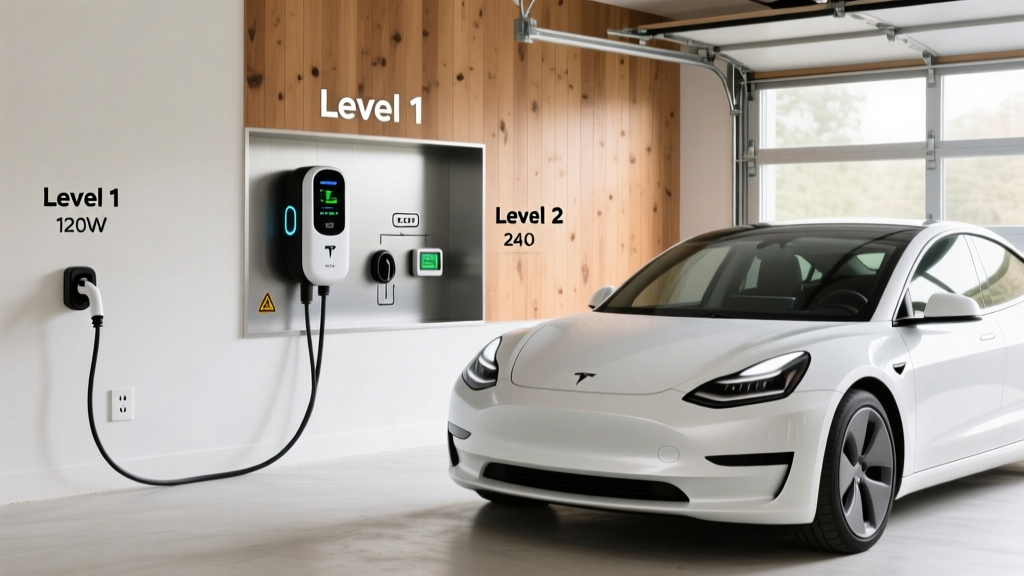
| Level 1 | 120V AC | 1.0–1.9 kW | 2–5 mi/hr | Emergency / overnight trickle for PHEVs |
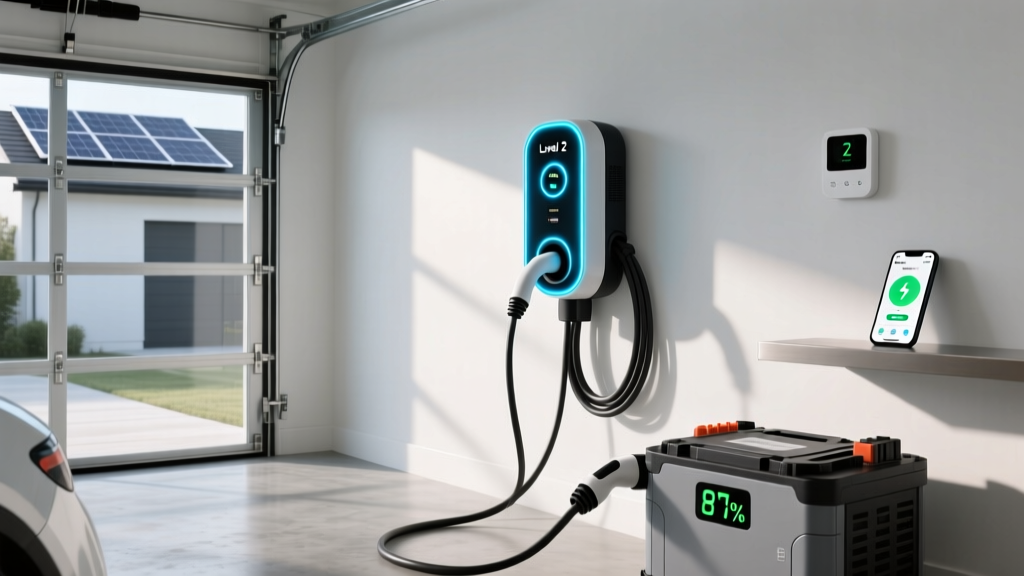
| Level 2 | 240V AC | 3.3–19.2 kW | 12–75 mi/hr | Home daily charging, workplace, public AC |
| DC Fast Charge | 400–900V DC | 50–350 kW | 150–1,000+ mi/hr (equivalent) | Road trips, highway corridors |
For context, a 2026 Tesla Model Y Long Range with an 81 kWh (usable) battery gaining range at 11.5 kW (48A Level 2) adds roughly 44 miles of range per hour. That means a 20–80% session (approximately 49 kWh) completes in about 4.3 hours — perfect for overnight charging. By contrast, a 350 kW DC fast charger on the same vehicle can deliver a 10–80% charge in approximately 20–25 minutes, depending on battery temperature and state of charge.
How Much Does It Cost to Install a Level 2 EV Charger at Home?
Installation cost varies enormously based on your home's electrical panel, the distance from the panel to the charger location, and local permit fees. Below is a realistic breakdown based on national averages in 2026.
| Component | Typical Range | Notes |
|---|---|---|
| Level 2 Charger Equipment | $350–$750 | Hardwired 48A units; smart Wi-Fi models at upper end |
| Electrician Labor | $500–$2,000 | Depends on run length, wall type, conduit needs |
| Electrical Permit | $50–$250 | Varies by municipality; some bundle with inspection |
| Panel Upgrade (if needed) | $1,500–$4,000 | Required if upgrading from 100A to 200A service |
| Total (No Panel Upgrade) | $900–$3,000 | Most homes with 200A service fall here |
| Total (With Panel Upgrade) | $2,400–$6,750 | Older homes with 100A or 150A service |
Most modern homes with 200-amp electrical service can accommodate a dedicated 60A circuit (supporting a 48A continuous-draw charger) without a panel upgrade. The electrician will run a new circuit from your panel to the charger location using appropriately gauged wire (typically 6 AWG copper for 60A) in conduit if exposed.
Homes built before the 1990s often have 100A or 150A panels that may already be near capacity. If your electrician calculates that adding a 60A circuit would exceed 80% of your panel's rated load (a National Electrical Code requirement), you'll need a service upgrade. This is the single biggest cost variable — and the reason getting a detailed quote from a licensed electrician before buying equipment is essential.
The IRS offers a Residential Clean Energy Credit (IRC §25C) that covers up to 30% of the cost of EV charger equipment and installation, capped at $1,000 per year. This credit applies through 2032. Check with a tax professional for eligibility, as income and location restrictions may apply.
Electrical Requirements: What Your Home Needs for a Level 2 Charger
A proper Level 2 installation requires attention to several electrical specifications:
- Voltage: 240V (split-phase, standard US residential — same as your electric dryer or oven)
- Circuit amperage: A 60A breaker supports a 48A continuous-draw charger (NEC requires circuits be rated 125% above continuous load). A 50A breaker supports 40A continuous. A 40A breaker supports 32A continuous.
- Dedicated circuit: Your EV charger must be on its own dedicated breaker — not shared with other appliances
- GFCI protection: NEC 2020 and later requires GFCI protection for EV charging outlets in garages. Hardwired installations may be exempt depending on local code interpretation, which is one advantage of hardwiring over a plug-in setup.
- Outdoor rating: If mounting outside, both the charger and any receptacle must carry a NEMA 4 or NEMA 4X rating for weather resistance
- Wire gauge: 6 AWG copper for 60A circuits; 8 AWG for 40A circuits (longer runs may require upsizing to minimize voltage drop)
Plug-in installations typically use a NEMA 14-50 outlet (the same as an electric range). This offers flexibility — you can unplug the charger and take it if you move, or plug in an RV. However, hardwired installations eliminate the GFCI breaker requirement in many jurisdictions, reduce failure points, and often cost less in materials since no receptacle is needed.
Connector Compatibility: Which Charger Fits Your EV?
The North American EV market has largely standardized around NACS (North American Charging Standard), originally developed by Tesla. However, millions of CCS1-equipped vehicles are still on the road, and adapters bridge the gap.
| Connector | Brands Using It (New Vehicles) | Adapter Needed for Level 2 Home Charging? |
|---|---|---|
| NACS (J3400) | Tesla (all), Ford, GM, Rivian, Volvo, Polestar, Mercedes-Benz, Hyundai, Kia, BMW, Nissan (2026+) | None if charger has NACS connector; otherwise use CCS-to-NACS adapter |
| CCS1 | Legacy models from VW, Audi, Porsche, older Hyundai/Kia, Honda Prologue (2024–2025) | None if charger has CCS1/J1772 connector; NACS-to-J1772 adapter available |
| CHAdeMO | Nissan Leaf (discontinued 2025), Mitsubishi Outlander PHEV | CHAdeMO-specific charger or adapter required; increasingly rare |
As of 2026, most new Level 2 home chargers ship with either a J1772 connector (which physically fits CCS1 inlets for AC charging) or a NACS connector. If you buy a J1772-equipped charger and drive a NACS vehicle, a simple J1772-to-NACS adapter (typically $40–$100) solves the problem. The reverse — charging a CCS1 car from a NACS home charger — requires a NACS-to-J1772 adapter from brands like Lectron or A2Z.
CHAdeMO is effectively a legacy standard. If you own a Nissan Leaf or Mitsubishi Outlander PHEV with CHAdeMO DC charging, your AC Level 2 inlet is still J1772, so any J1772 home charger works fine. CHAdeMO matters only at public DC fast chargers.
Cost to Charge: EV Electricity Cost Per Mile vs. Gas
One of the strongest arguments for a Level 2 home charger is fuel cost savings. Here's a realistic comparison using 2026 energy prices.
| Scenario | Cost per kWh | Cost per Mile (3.5 mi/kWh avg) | Annual Cost (12,000 mi) |
|---|---|---|---|
| Home Level 2 (national avg residential) | $0.16/kWh | $0.046/mi | $549 |
| Home Level 2 (off-peak TOU rate) | $0.08/kWh | $0.023/mi | $274 |
| Home Level 2 (high-cost state: CA/MA) | $0.30/kWh | $0.086/mi | $1,029 |
| Public Level 2 (network charging) | $0.30–$0.49/kWh | $0.086–$0.14/mi | $1,029–$1,680 |
| DC Fast Charge (public, road trips) | $0.35–$0.55/kWh | $0.10–$0.16/mi | $1,200–$1,920 |
| Gasoline (25 MPG combined, $3.40/gal) | — | $0.136/mi | $1,632 |
| Gasoline (25 MPG combined, $4.00/gal) | — | $0.16/mi | $1,920 |
The math is clear: home charging on any rate plan beats gasoline. Even in high-cost electricity states, Level 2 home charging is typically 35–50% cheaper per mile than a 25 MPG gas car. Time-of-use (TOU) plans that offer off-peak rates between 10 PM and 6 AM can cut your fuel cost to roughly $0.02–$0.03 per mile — effectively 80% less than gasoline.
Public charging is a different story. DC fast charging at Electrify America, EVgo, or Tesla Superchargers often costs as much as or more than gasoline per mile. The economics of EV ownership depend heavily on reliable home charging access. According to fueleconomy.gov, the average EV achieves 3–4 miles per kWh; efficiency varies from about 2.5 mi/kWh (large trucks like the Rivian R1T) to over 4.5 mi/kWh (efficient sedans like the Lucid Air).
Top Level 2 Charger Picks for 2026: Equipment Compared
These recommendations are based on power output, reliability, smart features, cable length, connector options, and price. All units listed are hardwired-capable, UL-listed (or equivalent), and widely available.
ChargePoint Home Flex (NACS)
- Power: Up to 19.2 kW (80A circuit, 64A continuous) — adjustable down to 16A
- Connector: NACS native
- Cable: 23 feet
- Smart features: Wi-Fi, app scheduling, Alexa integration, energy tracking, TOU optimization
- Price: ~$599
- Best for: NACS-vehicle owners wanting maximum power and app control
Tesla Wall Connector
- Power: Up to 11.5 kW (60A circuit, 48A continuous)
- Connector: NACS native; includes J1772 adapter in box
- Cable: 24 feet
- Smart features: Wi-Fi, OTA updates, power sharing (link multiple units on one circuit), vehicle-specific access control
- Price: ~$450
- Best for: Tesla owners; excellent value and the J1772 adapter adds CCS compatibility
Emporia Level 2 EV Charger
- Power: Up to 11.5 kW (60A circuit, 48A continuous)
- Connector: J1772 (CCS1 AC compatible)
- Cable: 24 feet
- Smart features: Wi-Fi, app control, solar integration, load management, energy monitoring with Emporia Vue panel monitor
- Price: ~$399
- Best for: Budget-conscious buyers; solar-home integration; CCS1-vehicle owners
Grizzl-E Smart
- Power: Up to 9.6 kW (50A circuit, 40A continuous) — adjustable
- Connector: J1772 or NACS (select at purchase)
- Cable: 24 feet
- Smart features: Wi-Fi, OCPP-compatible, adjustable amperage, extreme cold rated (-40°F)
- Price: ~$449
- Best for: Cold-climate owners; rugged outdoor installation; no-frills reliability
A note on amperage selection: your charger's maximum output is limited by both the unit's capability and your car's onboard charger. Most 2026 EVs accept 11.5 kW (48A) on Level 2 AC. A few, including the Tesla Model S/X and the Ford F-150 Lightning (extended range), accept up to 19.2 kW (80A). Buying a 19.2 kW charger for a car that only accepts 11.5 kW is safe — the car simply draws what it can — but the extra cost may not be justified unless you plan to upgrade vehicles later.
Charging Time Examples: 10–80% for Common EV Battery Sizes
Level 2 charging speed depends on your car's onboard charger capacity and battery size. Here's how long a 10–80% session takes for popular 2026 models using a 48A (11.5 kW) Level 2 charger:
| Vehicle | Usable Battery (kWh) | Onboard Charger (kW) | 10–80% Time at 11.5 kW | Miles Added per Hour |
|---|---|---|---|---|
| Tesla Model Y Long Range | 81 kWh | 11.5 kW | ~4.9 hours | ~44 mi/hr |
| Hyundai Ioniq 5 (Long Range) | 84 kWh | 10.9 kW | ~5.4 hours | ~42 mi/hr |
| Ford Mustang Mach-E (Ext. Range) | 91 kWh | 10.5 kW | ~6.1 hours | ~40 mi/hr |
| Chevrolet Equinox EV | 85 kWh | 11.5 kW | ~5.2 hours | ~43 mi/hr |
| BMW i4 eDrive40 | 81 kWh | 11.0 kW | ~5.2 hours | ~42 mi/hr |
| Toyota bZ4X | 64 kWh | 7.2 kW | ~4.7 hours | ~28 mi/hr |
Note the Toyota bZ4X's slower onboard charger (7.2 kW). Even with an 11.5 kW wall unit, the car limits intake to 7.2 kW. This is a specification worth checking before investing in a high-amperage charger — your vehicle's onboard charger is the bottleneck for AC charging.
For DC fast charging, the same vehicles charge far more quickly. The Ioniq 5 with its 800V architecture peaks at approximately 240 kW on DC, achieving a 10–80% charge in roughly 18 minutes at a compatible station. The Model Y peaks around 250 kW, with a 10–80% time of approximately 22–25 minutes. Remember that DC fast charging follows a taper curve: the battery charges rapidly from 10–50%, then progressively slows above 80% to protect cell longevity.
Safety, Code Compliance, and Installation Best Practices
A Level 2 charger installation involves significant continuous electrical load — typically 40–48 amps for hours at a time. This is among the heaviest sustained draws in a residential setting. Safety is non-negotiable.
- Use a licensed electrician: DIY electrical work on a 60A, 240V circuit is dangerous and typically violates local code. A licensed electrician ensures proper wire sizing, breaker selection, torque specifications, and grounding.
- Pull a permit: Most jurisdictions require an electrical permit for new 240V circuits. The inspection ensures code compliance and protects your homeowner's insurance coverage in the event of a fault.
- UL listing: Only purchase chargers that carry a UL (Underwriters Laboratories) listing or equivalent NRTL certification. Uncertified chargers imported from overseas marketplaces may lack critical safety components and can void insurance coverage.
- Load management: If your panel is near capacity but you want to avoid a full upgrade, consider a smart load-management system. Devices like the Emporia Vue with smart charger integration or the Span smart panel can dynamically reduce charger amperage when other household loads spike, keeping total draw within panel limits.
- Cable management: A 24-foot cable is heavy and stiff. Plan for a wall-mounted cable organizer or holster to keep the connector off the ground and prevent trip hazards and cable damage.
- Outdoor installations: Ensure the charger carries a NEMA 4 rating. Use an in-use cover for any outdoor receptacle. Mount the unit at least 18 inches above grade to avoid snow/ice submersion.
The NHTSA and the National Fire Protection Association (NFPA) both note that properly installed, UL-listed EV charging equipment presents very low fire risk — comparable to any other major appliance. The danger lies in uncertified equipment, undersized wiring, or unpermitted work.
Frequently Asked Questions
Can I use a regular 120V outlet to charge my EV?
Yes, but it's extremely slow. A standard 120V/15A outlet delivers about 1.4 kW, adding roughly 3–4 miles of range per hour. This is sufficient for plug-in hybrids with small batteries (10–20 kWh) but impractical for battery-electric vehicles with 70–100 kWh batteries. A full charge from empty on Level 1 could take 50+ hours for a long-range EV.
Do I need a Tesla Wall Connector if I own a Tesla?
Not necessarily. The Tesla Wall Connector is excellent and competitively priced at ~$450, but any NACS-equipped Level 2 charger works with Tesla vehicles. The ChargePoint Home Flex (NACS version), Grizzl-E (NACS), and others are fully compatible. The Tesla unit's main advantage is power sharing (linking two units on a single circuit) and seamless integration with the Tesla app.
Will installing a Level 2 charger increase my home's value?
Potentially, yes. A 2026 Zillow analysis found that homes with EV charging infrastructure listed for approximately 1.5% more than comparable homes without. More importantly, as EV adoption grows, buyers increasingly expect home charging capability. A permitted, professionally installed 240V circuit with a mounted charger is a tangible selling point.
How long do Level 2 chargers last?
Quality Level 2 chargers from reputable brands typically last 10–15 years with minimal maintenance. The main failure points are the cable (if repeatedly run over or kinked) and the connector pins (if exposed to weather without a cover). Most carry 2–3 year warranties. Since there are no moving parts or consumables, the electronics themselves are generally reliable.
Is a 48A charger better than a 32A charger?
A 48A charger (requiring a 60A circuit) delivers up to 11.5 kW, charging roughly 50% faster than a 32A unit (7.7 kW on a 40A circuit). For most EV owners, 48A is the sweet spot — it fully replenishes a 75–85 kWh battery overnight in 5–6 hours. A 32A charger works if your panel can't support a 60A circuit, but you'll need 7–8+ hours for the same charge.
Can I install a Level 2 charger myself?
Technically, if you have electrical experience, but it is strongly discouraged. A 240V/60A circuit carries lethal current, and improper installation creates fire risk and insurance liability. Most jurisdictions require a licensed electrician and permit for this work. The labor cost ($500–$2,000) is justified by safety and code compliance.