Every EV owner faces the same question within their first week: how do I actually charge this thing at home, and what will it cost? The answer hinges on understanding the gap between Level 1 and Level 2 charging — two fundamentally different approaches to refueling your electric vehicle. One plugs into a standard wall outlet and trickles in electrons overnight. The other requires a dedicated 240-volt circuit but replenishes your battery five to seven times faster.
This guide breaks down the exact speeds, electrical requirements, installation costs, and equipment you need to make an informed decision — with real numbers, not marketing fluff.
Charging Levels Explained: kW, Speeds, and Miles Per Hour
Before comparing hardware, let's nail the terminology that trips up new EV buyers. A kilowatt (kW) measures power — how fast energy flows into your battery. A kilowatt-hour (kWh) measures energy capacity — how much total electricity your battery stores. Think of kW as the diameter of a hose and kWh as the size of the bucket you're filling. Confusing the two is the single most common mistake in EV discussions.
Here's how each charging level translates to real-world range recovery:
| Level | Voltage | Power Output | Miles of Range Added Per Hour | Typical Use Case |
|---|---|---|---|---|
| Level 1 | 120V AC | 1.0–1.4 kW | 3–5 miles | Overnight at standard outlet |
| Level 2 | 240V AC | 3.3–19.2 kW | 12–75 miles | Home garage, workplace, public AC stations |
| DC Fast Charge | 400–900V DC | 50–350 kW | 150–1,000+ miles (equivalent rate) | Road trips, highway corridors |
Level 1 Charging: What 120V Actually Gets You
Level 1 is the default that ships with nearly every EV: a portable cordset that plugs into a standard NEMA 5-15 household outlet. It delivers roughly 1.2 kW continuously, limited by the 12-amp continuous draw on a 15-amp circuit.
Who Level 1 works for: Plug-in hybrid owners with 15–40 miles of electric range (a Toyota RAV4 Prime's 18.1 kWh battery charges fully in about 12 hours at Level 1). It also suits BEV owners who drive under 30 miles daily and can leave the car plugged in for 10+ hours overnight. A Chevrolet Equinox EV with an 85 kWh battery, however, would take roughly 70 hours from empty to full on Level 1 — effectively useless for anyone with a real commute.
Level 1 has zero installation cost if your outlet is within cable reach of where you park. But it's not a long-term solution for most battery-electric owners.
Level 2 Charging: The Home Charging Standard
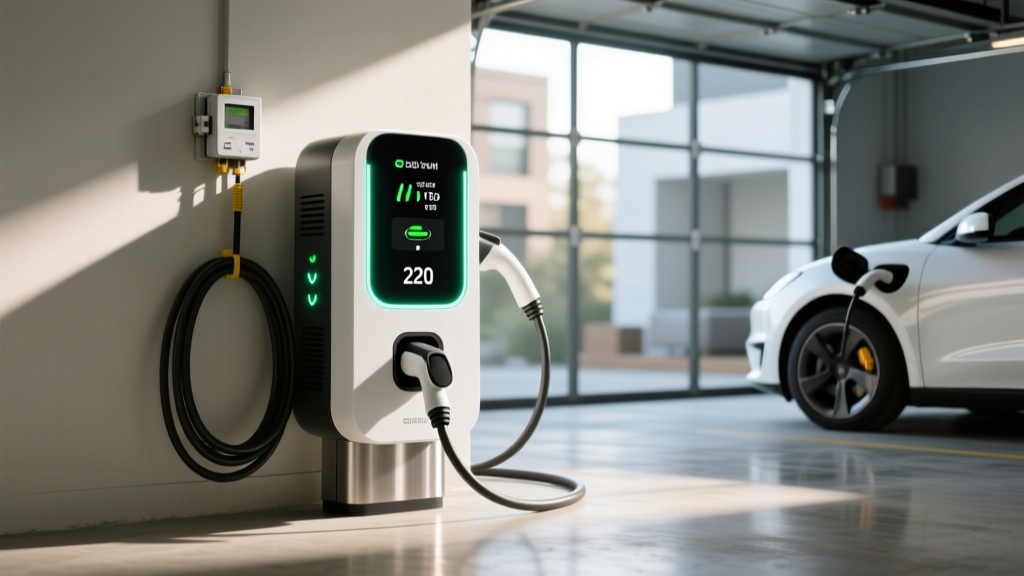
Level 2 operates on 240 volts — the same voltage as your electric dryer or oven — and spans a wide power range from 3.3 kW (16A) up to 19.2 kW (80A). Most residential installations land between 7.7 kW (32A) and 11.5 kW (48A), which covers the sweet spot of charging speed and electrical panel capacity.
Charging time examples for common battery sizes (10%–80% SoC):
- Tesla Model Y (75 kWh usable, Long Range): ~10.5 hours at 7.7 kW; ~7 hours at 11.5 kW
- Ford F-150 Lightning (131 kWh usable, Extended Range): ~18 hours at 7.7 kW; ~12 hours at 11.5 kW
- Hyundai Ioniq 5 (77.4 kWh usable): ~10.5 hours at 7.7 kW; ~7 hours at 11.5 kW
- Chevrolet Bolt EV (65 kWh usable): ~9 hours at 7.7 kW; ~6 hours at 11.5 kW
Most EVs max out their onboard charger between 7.7 kW and 11.5 kW, meaning a 48-amp Level 2 circuit (delivering 11.5 kW) will fully utilize nearly every vehicle on the market. The notable exception is the Tesla Model S/X with the optional 17.2 kW onboard charger, which benefits from an 80-amp circuit.
Home Installation: Electrical Requirements and Real Costs
Here's where the rubber meets the road. Installing a Level 2 charger isn't just buying a $500 box — it's an electrical project that varies enormously based on your home's wiring, panel age, and the distance from your electrical panel to your parking spot.
Electrical Requirements
A typical 48-amp Level 2 charger requires a dedicated 60-amp breaker (the National Electrical Code mandates circuits be rated 125% above continuous load: 48A × 1.25 = 60A). This runs on 240V using 6 AWG copper wire for runs up to ~100 feet, stepping up to 4 AWG for longer distances.
If your electrical panel is already near capacity — common in older homes with 100-amp service — you may need a panel upgrade to 200 amps before adding an EV circuit. This is the single biggest cost variable that online calculators tend to ignore.
Installation Cost Breakdown
| Component | Simple Install (panel nearby, no upgrade) | Complex Install (long run, panel upgrade) |
|---|---|---|
| Charger equipment (hardwired or plug-in) | $350–$650 | $350–$650 |
| Electrician labor (2–4 hrs simple; 6–12 hrs complex) | $300–$800 | $900–$2,500 |
| Materials (wire, conduit, breaker, subpanel if needed) | $100–$300 | $400–$1,200 |
| Electrical panel upgrade (if 100A → 200A needed) | $0 | $1,500–$3,500 |
| Permit and inspection | $50–$200 | $50–$200 |
| Total estimated cost | $800–$1,950 | $3,200–$8,050 |
Permit and Code Requirements
Most jurisdictions require an electrical permit for a new 240V circuit. Inspections verify proper wire gauge, breaker sizing, grounding, and — in many areas — GFCI protection for outdoor installations. Skipping the permit risks insurance coverage denial if a fire occurs and can create issues during a home sale. Always pull the permit.
Connector Compatibility: NACS, CCS, and CHAdeMO
The physical plug connecting your charger to your car matters, and the landscape has shifted dramatically. As of the 2025–2026 model years, the North American Charging Standard (NACS), pioneered by Tesla, has become the dominant connector. Most automakers — Ford, GM, Rivian, Volvo, Hyundai/Kia, and others — have adopted NACS on new vehicles.
| Connector | Brands Using It (New Vehicles) | Notes |
|---|---|---|
| NACS (Tesla) | Tesla, Ford, GM, Rivian, Volvo, Polestar, Hyundai, Kia, Mercedes, BMW, Nissan (new) | Industry standard going forward; compact design |
| CCS1 (Combo) | VW ID.4 (2024 and earlier), older BMW i4/iX, legacy models | Being phased out on new models; adapters available |
| CHAdeMO | Nissan Leaf (all years), Mitsubishi Outlander PHEV | Legacy standard; declining infrastructure support |
If you own a CCS-equipped vehicle and want to use Tesla Superchargers (which now offer a Magic Dock CCS adapter at select locations) or buy a NACS home charger, you'll need a CCS-to-NACS adapter. Tesla sells an official adapter for ~$250. For Level 2 home charging specifically, most charger manufacturers now offer both NACS and J1772/CCS connector options, so you can match your vehicle at purchase.
Cost to Charge: $/kWh Scenarios and Cost Per Mile vs Gas
One of the strongest arguments for home Level 2 charging is cost. Electricity prices vary by state and utility, but the economics consistently favor charging at home over buying gasoline.
| Scenario | Avg $/kWh | Cost to Add 200 Miles* | Cost Per Mile |
|---|---|---|---|
| Home Level 2 (off-peak utility rate) | $0.08–$0.14 | $5.60–$9.80 | $0.028–$0.049 |
| Home Level 2 (standard rate) | $0.14–$0.22 | $9.80–$15.40 | $0.049–$0.077 |
| Public Level 2 (ChargePoint, EVgo AC) | $0.25–$0.49 | $17.50–$34.30 | $0.088–$0.172 |
| DC Fast Charge (Electrify America, Tesla SC) | $0.30–$0.56 | $21.00–$39.20 | $0.105–$0.196 |
| Gasoline (25 MPG avg, $3.40/gal) | — | $27.20 | $0.136 |
*Assumes 3.5 mi/kWh vehicle efficiency (typical midsize EV sedan/SUV). Actual cost varies with vehicle efficiency, battery size, and local rates. Source: fueleconomy.gov efficiency data.
The takeaway: home off-peak Level 2 charging costs roughly one-quarter to one-third of what gasoline costs per mile. Even at standard residential rates, you're saving 40–60% versus gas. Public DC fast charging, however, can exceed the cost of gasoline on a per-mile basis — which is why home charging is the economic backbone of EV ownership.
Many utilities offer time-of-use (TOU) rates that make overnight charging dramatically cheaper. Check with your local utility about EV-specific rate plans before installing your charger.
Equipment Recommendations: Top Level 2 Chargers for 2026
The market is saturated with Level 2 chargers, but a few stand out for reliability, features, and value. Here are four proven options across different budgets and needs:
ChargePoint Home Flex (NACS or J1772)
- Power output: Up to 12 kW (50A) on a 60A circuit; adjustable down to 16A for smaller panels
- Cable length: 23 feet
- Connector options: NACS or J1772 (CCS adapter available)
- Smart features: Wi-Fi, app scheduling, Alexa integration, utility TOU integration, energy tracking
- Price: ~$550–$650
- Best for: Most homeowners wanting a reliable smart charger with broad panel compatibility
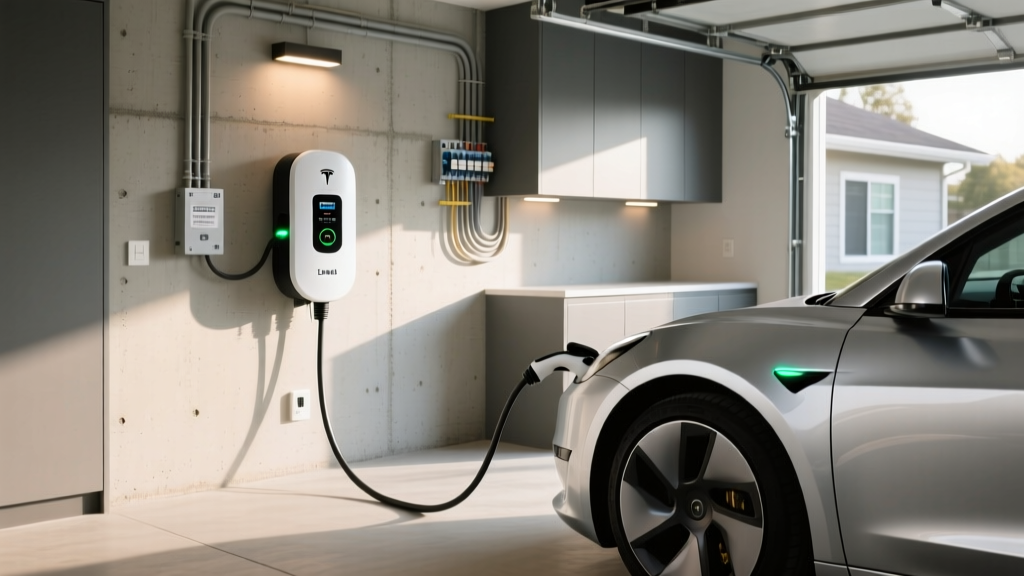
Tesla Wall Connector (NACS)
- Power output: Up to 11.5 kW (48A) on a 60A circuit
- Cable length: 24 feet
- Connector: NACS native; J1772 adapter included for non-Tesla EVs
- Smart features: Wi-Fi, firmware OTA updates, load sharing (multiple units on one circuit), Tesla app integration
- Price: ~$450–$500
- Best for: Tesla owners and households with multiple EVs (load sharing reduces panel strain)
Emporia Level 2 Smart Charger
- Power output: Up to 11.5 kW (48A) on a 60A circuit
- Cable length: 24 feet
- Connector: J1772 (NACS adapter available separately)
- Smart features: Wi-Fi, detailed energy monitoring, solar integration, scheduling, load management
- Price: ~$350–$400
- Best for: Budget-conscious buyers who want smart features and energy monitoring without a premium price
Grizzl-E Smart (NACS or J1772)
- Power output: Up to 10 kW (40A) on a 50A circuit
- Cable length: 24 feet
- Connector: NACS or J1772
- Smart features: Wi-Fi, OCPP protocol support, adjustable amperage, outdoor-rated (NEMA 4)
- Price: ~$450–$550
- Best for: Outdoor/driveway installations in harsh climates; Canadian-built durability
All four chargers above are UL-listed (or ETL-listed to UL standards), which is essential for insurance compliance and passing electrical inspection. Avoid unlisted chargers from unknown brands on marketplace sites — they may lack proper safety certifications.
Safety, Code, and Installation Best Practices
EV charging draws high continuous current for hours — far longer than most household appliances. This makes proper installation non-negotiable:
- Dedicated circuit: Your Level 2 charger must be on its own breaker. Sharing a circuit with other appliances risks tripping and fire hazard.
- Wire gauge: 6 AWG copper for most 48A/60A breaker installations. Your electrician will size wire based on run length and local code amendments.
- GFCI protection: NEC 2020 and later require GFCI for outdoor receptacles. Hardwired chargers may not require a GFCI breaker in some jurisdictions, which avoids nuisance tripping — another reason hardwired installations are often preferred outdoors.
- Outdoor rating: If your charger lives outside, it needs a NEMA 4 (or higher) enclosure rating. All four chargers recommended above meet this standard.
- Plug-in vs. hardwired: A NEMA 14-50 outlet lets you unplug and take the charger when you move, but requires a GFCI breaker in many jurisdictions (adding $100–$200). Hardwired connections avoid the GFCI requirement in some areas and eliminate the plug as a potential failure point.
Hire a licensed electrician — not a general handyman. EV charging circuits carry enough continuous load that mistakes have real consequences. Verify they have experience with EV charger installations specifically.
Frequently Asked Questions
How much does it cost to install a home EV charger?
A straightforward Level 2 installation with the electrical panel nearby and no upgrade needed typically costs $800–$1,950 including equipment, labor, materials, and permits. If your home needs a panel upgrade from 100A to 200A service or has a long wire run (over 50 feet through walls or underground), costs climb to $3,200–$8,050. Always get two or three quotes from licensed electricians before committing.
How fast will each charging level add range?
Level 1 (120V) adds approximately 3–5 miles of range per hour. Level 2 (240V) at 7.7 kW adds roughly 25–30 miles per hour; at 11.5 kW, it adds 35–45 miles per hour depending on your vehicle's efficiency. DC fast charging can add 150+ miles in 15–20 minutes at peak rates, though charging slows significantly above 80% state of charge due to battery protection protocols.
Which connector/charger is compatible with my EV?
Check your vehicle's charge port. For 2025–2026 model year vehicles, most new EVs from Tesla, Ford, GM, Hyundai, Kia, Rivian, Volvo, and BMW use NACS. Older CCS1-equipped vehicles (2024 and earlier VW ID.4, legacy models) still charge fine on CCS home chargers, and CCS-to-NACS adapters are available for ~$250. CHAdeMO (Nissan Leaf, Mitsubishi) uses its own connector with limited new charger options. Match your charger's connector to your vehicle's port, or buy the appropriate adapter.
How much does charging cost per mile vs gas?
At home on off-peak electricity ($0.10–$0.14/kWh), most EVs cost $0.03–$0.05 per mile to charge — roughly one-quarter the cost of gasoline at $3.40/gallon and 25 MPG ($0.14/mile). Even at peak residential rates ($0.20/kWh), EV charging costs about $0.06–$0.07 per mile. Public DC fast charging ($0.35–$0.56/kWh) narrows or eliminates the savings, making home charging the key to EV economics.
What electrical upgrades might I need?
The most common upgrade is a panel capacity increase from 100A to 200A service, which costs $1,500–$3,500 and is necessary when your home's existing load calculation doesn't have headroom for a 40–60A EV circuit. You may also need a subpanel if your main panel is full, upgraded service entrance wiring in very old homes, or a new conduit run if the wire path is long or complex. A licensed electrician's load calculation — typically free as part of a quote — will tell you exactly what's needed.
Is Level 1 charging enough if I drive less than 30 miles a day?
Technically, yes — if you can plug in for 10+ hours overnight, Level 1 recovers 30–50 miles, covering most daily commutes. But it leaves no margin for unexpected longer drives, cold-weather range loss (which can reduce range 20–30%), or days you forget to plug in. For BEV owners, Level 2 is strongly recommended as the baseline. PHEV owners with smaller batteries (15–20 kWh) can often get by with Level 1.
For more information on federal incentives that may offset your home charging installation, the IRS clean vehicle credits page covers current eligibility rules, and the Alternative Fuels Data Center maintains a database of state and utility incentives for charger installation.