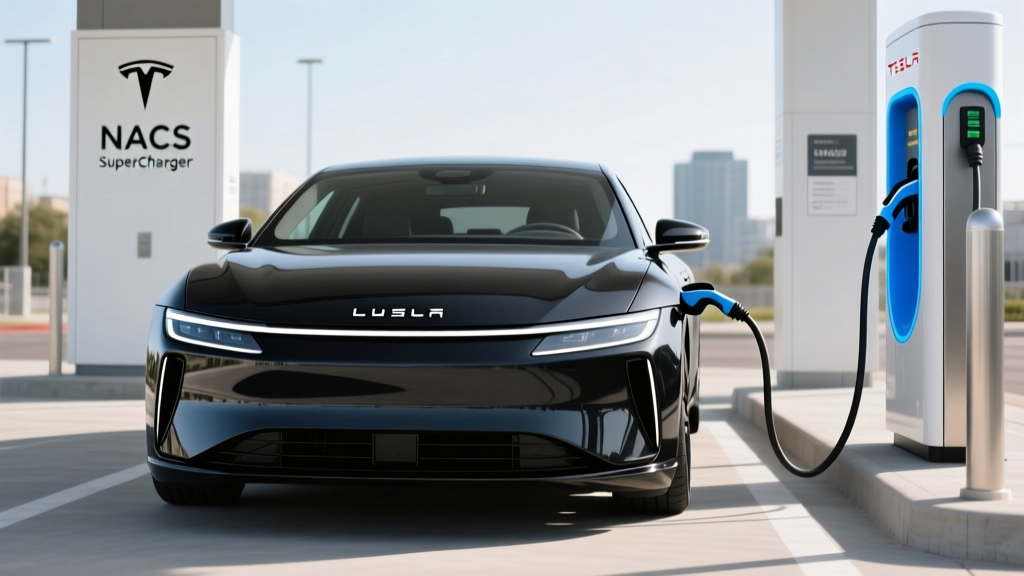
If you own a Lucid Air or are eyeing the Lucid Gravity, one question dominates every road-trip planning session: can Lucid use Tesla chargers? The short answer for 2026 is yes — but with important caveats around adapters, charge speeds, and connector standards that every Lucid owner needs to understand before plugging in.
Lucid Motors has been navigating the industry-wide shift from CCS1 to NACS (the Tesla-designed North American Charging Standard). Tesla opened its Supercharger network to non-Tesla EVs, and Lucid vehicles can now access these stations with the right adapter. But compatibility is only half the story. This guide breaks down exactly how Lucid owners can charge at home and on the road, what equipment you need, what it costs, and the electrical realities of installing a Level 2 charger in your garage.
Can Lucid Use Tesla Chargers? The 2026 Compatibility Picture
Lucid Air models built from late 2024 onward ship with a NACS charge port as standard, meaning they can plug directly into Tesla Superchargers without any adapter. Earlier Lucid Air models (2022–mid 2024) were equipped with a CCS1 port and require a CCS-to-NACS adapter to use Tesla Superchargers.
The Lucid Gravity, which entered production in late 2025, ships exclusively with NACS from the factory. If you're buying a 2026 Lucid, you'll have native Supercharger access.
Here's what that looks like in practice:
| Lucid Model / Year | Native Port | Tesla Supercharger Access | Adapter Required? |
|---|---|---|---|
| Lucid Air (2022–mid 2024) | CCS1 | Yes, via adapter | CCS-to-NACS adapter (~$200–$250) |
| Lucid Air (late 2024–2026) | NACS | Yes, native | None for Superchargers; NACS-to-CCS adapter needed for older CCS stations |
| Lucid Gravity (2025–2026) | NACS | Yes, native | None for Superchargers; NACS-to-CCS adapter needed for older CCS stations |
Real-world note: Tesla's Supercharger network is the most reliable DC fast-charging network in the U.S., with over 6,000 stations and 30,000+ stalls nationwide. However, when using an adapter on a CCS-equipped Lucid Air, expect slightly longer handshake times at the stall and potential compatibility quirks at older V2 Superchargers. V3 and V4 Superchargers work more seamlessly.
Charging Levels Explained: How Fast Will Each Level Add Range?
Before we get into costs and equipment, let's clarify the three charging levels and what they mean for your Lucid. Understanding the difference between kW (kilowatts) — the rate of power delivery — and kWh (kilowatt-hours) — the total energy stored in your battery — is essential. Think of kW as how fast water flows from a hose, and kWh as the size of the bucket you're filling.
| Charging Level | Voltage | Power (kW) | Miles of Range Added Per Hour | Best For |
|---|---|---|---|---|
| Level 1 (Standard Outlet) | 120V | 1.0–1.4 kW | 3–5 miles/hour | Overnight top-ups, emergencies |
| Level 2 (Home / Workplace) | 240V | 7.2–19.2 kW | 25–70 miles/hour | Daily charging, full overnight recharge |
| DC Fast Charging | 400–900V DC | 50–300+ kW | 200–900+ miles/hour (peak) | Road trips, rapid top-ups |
The Lucid Air Pure has a 88 kWh usable battery, while the Air Grand Touring carries a massive 112 kWh usable pack. The Lucid Gravity is expected at approximately 120 kWh. Here's what charge times look like in practice:
- Level 1 (1.4 kW): A full charge on the Air Grand Touring's 112 kWh battery would take roughly 80 hours. Level 1 is only practical as a trickle-charge or emergency option.
- Level 2 at 11.5 kW (48A): The Air Grand Touring charges from 10–100% in about 10 hours. The Air Pure in roughly 8 hours.
- Level 2 at 19.2 kW (80A): Lucid's Air supports up to 19.2 kW AC charging (a class-leading spec). At this rate, the Grand Touring recharges 10–100% in about 6 hours.
- DC Fast Charging (peak 250+ kW): The Lucid Air Grand Touring can peak at approximately 250 kW on a compatible DC fast charger. In real-world conditions, a 10–80% charge takes roughly 20–25 minutes. Note that charging speed tapers significantly above 80% to protect battery health — the charge curve is not a flat line at peak kW.
Real-World Range Reality: The Lucid Air Grand Touring carries an EPA-estimated 516 miles of range — the highest of any production EV. In real-world highway driving at 70+ mph, expect roughly 400–440 miles. In cold weather (below 30°F), plan for 350–390 miles. The Air Pure (EPA 419 miles) delivers approximately 330–360 miles on the highway.
Home Charger Installation: Costs, Electrical Requirements & Panel Upgrades
Installing a Level 2 home charger is the single biggest quality-of-life upgrade an EV owner can make. But the costs vary dramatically depending on your home's electrical infrastructure.
Electrical Requirements for a Lucid-Compatible Level 2 Charger
To get the most from Lucid's onboard charger (which supports up to 19.2 kW / 80A AC), you'll want a 240V circuit with a 100A breaker for a hardwired 80A charger. Most homes opt for a 48A charger on a 60A breaker (240V), which delivers 11.5 kW — sufficient for overnight charging of any Lucid model.
Key electrical specs to discuss with your electrician:
- Voltage: 240V (same as a dryer or oven circuit)
- Amperage: 40A, 48A, 60A, or 80A circuit depending on charger choice
- Dedicated circuit: Required by NEC — you cannot share this circuit with other appliances
- GFCI protection: Required for outdoor installations per NEC 2023/2026 updates
- Outdoor rating: If your charger is outside, it must carry a NEMA 4 or NEMA 4X rating
Installation Cost Breakdown
| Cost Component | Basic Install (48A, short run) | Complex Install (48A, long run or panel upgrade) |
|---|---|---|
| Level 2 Charger Equipment | $400–$700 | $400–$700 |
| Electrician Labor | $500–$1,200 | $1,500–$3,000 |
| Electrical Permit | $50–$200 | $50–$200 |
| Panel Upgrade (if needed) | $0 | $1,500–$3,500 |
| Conduit & Wiring Materials | $100–$300 | $300–$800 |
| Total Estimated Cost | $1,050–$2,400 | $3,750–$8,200 |
Panel upgrade reality check: Many older homes have 100A electrical panels. Adding a 48A or 60A EV circuit to a panel already serving central AC, an electric dryer, and an electric oven may require upgrading to a 200A panel. This is the single biggest variable in home charging cost. Always get a licensed electrician to perform a load calculation before committing to a charger. Some utility companies offer rebates of $500–$1,500 for panel upgrades paired with EV charger installation — check your local utility.
The federal Alternative Fuel Vehicle Refueling Property Credit (IRS Form 8911) may cover up to 30% of home charger equipment and installation costs, capped at $1,000, subject to census-tract eligibility requirements. Consult a tax professional for your specific situation.
Level 2 Home Charger Recommendations for Lucid Owners
Lucid's class-leading 19.2 kW onboard charger means you can take advantage of higher-amperage Level 2 units that most other EVs can't fully utilize. Here are our top picks for 2026:
ChargePoint Home Flex (NACS)
- Power Output: Up to 12 kW (50A) on a 60A circuit
- Connector: NACS (native), also available in J1772 with adapter
- Cable Length: 23 feet
- Smart Features: Wi-Fi, app-based scheduling, energy tracking, Alexa integration
- Price: ~$550–$650
- Best For: Most Lucid owners who want a reliable smart charger with scheduling for off-peak rates
Wallbox Pulsar Plus (48A)
- Power Output: Up to 11.5 kW (48A) on a 60A circuit
- Connector: NACS or J1772 (select at purchase)
- Cable Length: 25 feet
- Smart Features: Wi-Fi + Bluetooth, load balancing, Power Sharing (daisy-chain two units on one circuit)
- Price: ~$450–$550
- Best For: Budget-conscious buyers who still want smart features and a compact form factor
Ford Charge Station Pro (80A) / Lucid Connected Home Charger
- Power Output: Up to 19.2 kW (80A) on a 100A circuit
- Connector: NACS
- Cable Length: 25 feet
- Smart Features: Wi-Fi, scheduled charging, integration with Lucid app
- Price: ~$800–$1,200 (plus higher install cost for 100A circuit)
- Best For: Lucid Air Grand Touring or Gravity owners who want to maximize the 19.2 kW onboard charger and minimize overnight charge time
Editor's pick: For most Lucid Air owners, the ChargePoint Home Flex at 50A hits the sweet spot. It delivers enough power to fully recharge an Air Pure overnight and comes within a few hours of fully charging the Grand Touring. The 80A option is worth the extra electrical work only if you regularly need a full charge in under 6 hours or own a Gravity with its larger battery.
How Much Does Charging Cost? Lucid Per-Mile vs. Gas
One of the strongest arguments for any EV — and the Lucid Air in particular, with its exceptional efficiency — is fuel cost savings. Let's break it down with real numbers.
| Charging Scenario | Cost per kWh | Cost to Charge Air Pure (88 kWh, 10–80%) | Cost per Mile (est.) |
|---|---|---|---|
| Home (off-peak utility rate) | $0.08–$0.14 | $5.45–$9.55 | $0.02–$0.03 |
| Home (standard residential rate) | $0.15–$0.22 | $8.18–$13.55 | $0.03–$0.04 |
| Public Level 2 (workplace, mall) | $0.25–$0.49 | $15.40–$30.00 | $0.05–$0.09 |
| Tesla Supercharger (V3/V4) | $0.28–$0.48 | $17.25–$29.57 | $0.05–$0.08 |
| Electrify America / EVgo DC Fast | $0.35–$0.56 | $21.56–$34.50 | $0.07–$0.10 |
Gas comparison: A comparable luxury sedan getting 25 MPG combined at $3.50/gallon costs $0.14 per mile. Even at standard residential electricity rates, the Lucid Air Pure (rated at roughly 131 MPGe combined per fueleconomy.gov) costs approximately $0.03–$0.04 per mile to charge at home — a 70–78% reduction in fuel cost per mile.
On a 12,000-mile annual driving schedule, a Lucid Air owner charging primarily at home saves roughly $1,200–$1,500 per year compared to a gas-powered luxury sedan.
Public Charging for Lucid: Beyond Tesla Superchargers
While Tesla's Supercharger network is the gold standard for reliability, Lucid owners in 2026 have access to a broad and growing public charging ecosystem:
- Tesla Superchargers: Open to NACS-equipped Lucid vehicles natively, and CCS-equipped models via adapter. Use the Tesla app or Lucid's in-car navigation to locate and initiate sessions at non-Tesla-accessible Superchargers.
- Electrify America: Most stations now feature both CCS and NACS connectors as of 2025–2026 retrofits. The Air's peak ~250 kW DC fast-charging capability means you can take full advantage of EA's 150–350 kW stalls.
- EVgo: Expanding NACS connector availability. Existing CCS stalls work with the Air's native CCS port (older models) or via a NACS-to-CCS adapter (newer NACS-equipped models).
- ChargePoint: Predominantly Level 2 public charging. Useful for destination charging at hotels, shopping centers, and workplaces.
Pro tip: Lucid's onboard navigation system routes through available chargers and preconditions the battery for optimal DC fast-charging speeds when a fast-charger is selected as your destination. Always navigate to the charger rather than just driving there — preconditioning can shave 5–10 minutes off your charge time, especially in cold weather.
Safety, Electrical Code & Smart Charging Practices
EV charging involves sustained high-current electrical loads. Cutting corners on safety is not an option. Here's what every Lucid owner installing a home charger must know:
- Dedicated circuit: Your Level 2 charger must be on its own dedicated breaker — no shared circuits. This is required by the National Electrical Code (NEC).
- Proper wire gauge: A 48A charger on a 60A breaker typically requires 6 AWG copper wire. An 80A charger on a 100A breaker requires 3 AWG or larger. Your electrician will size this correctly.
- GFCI protection: Required for outdoor receptacles and increasingly required for indoor EV charging circuits under updated NEC guidelines.
- Hardwired vs. plug-in: Hardwired chargers (no plug) are generally safer and more reliable for high-amperage installations (60A+). NEMA 14-50 plug-in installations are convenient but limited to 40A continuous draw (50A breaker) and are prone to receptacle wear over time.
- Permit and inspection: Most jurisdictions require an electrical permit and post-installation inspection. This protects your home insurance coverage and ensures code compliance.
- Surge protection: Consider a whole-home surge protector ($150–$300 installed) to safeguard your charger and vehicle from voltage spikes.
Frequently Asked Questions
Can Lucid use Tesla chargers without an adapter?
Yes — if your Lucid Air was built from late 2024 onward or if you own a 2025–2026 Lucid Gravity, your vehicle has a native NACS port and can plug directly into any Tesla Supercharger. Earlier Lucid Air models (2022–mid 2024) with CCS1 ports require a CCS-to-NACS adapter, available from Lucid or third-party manufacturers for approximately $200–$250.
How much does it cost to install a home EV charger for a Lucid?
A basic Level 2 installation with a short wiring run and no panel upgrade typically costs $1,050–$2,400 (equipment + electrician + permit). If your home needs a 200A panel upgrade, expect $3,750–$8,200 total. Always get a licensed electrician to perform a load calculation first.
How fast will a home Level 2 charger add range to my Lucid Air?
At 11.5 kW (48A), you'll add roughly 40–46 miles of range per hour on the Lucid Air Pure, or about 38–42 miles per hour on the Grand Touring (heavier vehicle, slightly lower efficiency). At the maximum 19.2 kW (80A), add roughly 65–75 miles per hour.
Does charging at Tesla Superchargers void my Lucid warranty?
No. Using a Tesla Supercharger with a proper adapter (or natively with a NACS port) does not void your Lucid battery or powertrain warranty. Lucid's battery warranty covers 8 years / 100,000 miles (with a capacity retention threshold of 70%+). However, consistently DC fast-charging to 100% and leaving the battery at high state of charge can accelerate degradation over time — the same applies to any DC fast charger, not just Tesla's.
Is it cheaper to charge at home or at Tesla Superchargers?
Home charging is significantly cheaper. Off-peak home electricity at $0.10/kWh costs roughly $0.02–$0.03 per mile. Tesla Superchargers at $0.35/kWh average cost roughly $0.06–$0.08 per mile. For a Lucid Air Grand Touring owner driving 12,000 miles/year, exclusive home charging saves approximately $500–$700 annually compared to exclusive Supercharger use.
What electrical upgrades might I need for a Lucid home charger?
The most common upgrade is a panel upgrade from 100A to 200A service ($1,500–$3,500), needed when your existing panel doesn't have enough spare capacity for a dedicated 48A–80A EV circuit. Other possible upgrades include: new conduit runs for long distances from the panel to the garage ($5–$15 per foot), a sub-panel installation, or utility service upgrades for homes with very old electrical infrastructure.