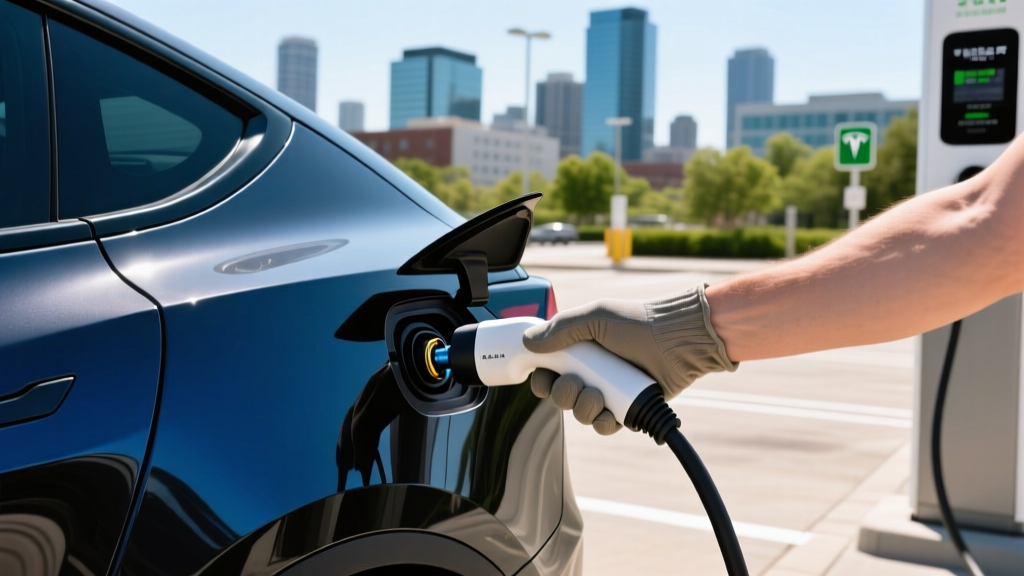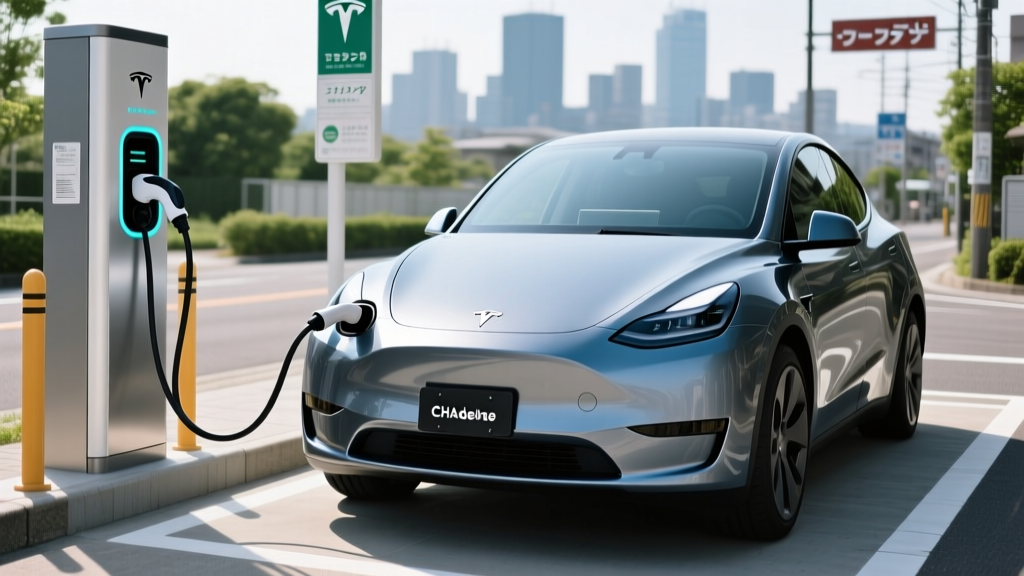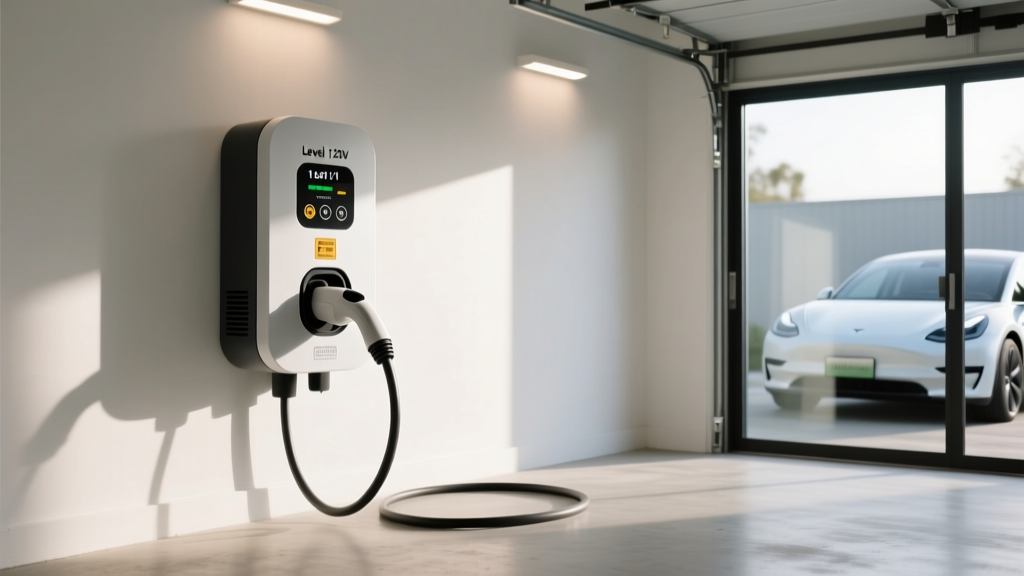
If you've just ordered your first electric vehicle, you already have a charger — it came in the box. That portable cord, plugging into a standard 120-volt household outlet, is what the industry calls a level 1 car charger. For some EV owners, it's genuinely all they need. For others, it's a frustrating bottleneck that sends them shopping for a 240V Level 2 wallbox within the first month.
This guide breaks down exactly what Level 1 charging delivers in real-world use, how it compares to Level 2 and DC fast charging, what it costs per mile, and how to decide whether 120V is enough for your driving pattern — or whether it's time to call an electrician.
What Is a Level 1 Car Charger, Exactly?
A level 1 car charger is any EV charging equipment that operates on a standard North American 120-volt AC household circuit. Most new EVs and PHEVs ship with a portable charging cord that has a NEMA 5-15 plug on one end (the standard three-prong household plug) and a J1772 or NACS connector on the other.
The critical distinction every EV owner must internalize: kW (kilowatts) measures power — how fast energy flows into your car. kWh (kilowatt-hours) measures energy — how much your battery holds. Think of kW as the flow rate of a hose and kWh as the size of the bucket. A level 1 car charger delivers roughly 1.2 to 1.4 kW of power. A typical EV battery holds 60 to 100 kWh of energy. The math explains why Level 1 is slow.
Most Level 1 cords draw 12 amps continuously on a 15-amp circuit (EVs limit draw to 80% of circuit capacity per the National Electrical Code). That yields approximately 1.4 kW. On a dedicated 20-amp circuit, some units can pull 16 amps for roughly 1.9 kW — but most included cords are hard-limited to 12A regardless.
Charging Levels Compared: Speeds and Range Added
Understanding where Level 1 fits in the charging landscape helps you decide if it's sufficient or if you need an upgrade. Here's the full spectrum:
| Charging Level | Voltage | Power (kW) | Miles of Range Added Per Hour | Typical Use Case |
|---|---|---|---|---|
| Level 1 | 120V AC | 1.2–1.9 kW | 3–5 miles | Overnight home, PHEVs, low-mileage drivers |
| Level 2 | 240V AC | 7.2–19.2 kW | 20–60 miles | Home wallbox, workplace, public AC stations |
| DC Fast Charging | 400–800V DC | 50–350 kW | 150–1,000+ miles | Road trips, highway corridors, quick top-ups |
Those "miles per hour" figures assume an efficiency of roughly 3–4 miles per kWh, which is typical for mainstream EVs like the Tesla Model Y, Hyundai Ioniq 5, or Chevrolet Equinox EV. Larger, less efficient vehicles like the Ford F-150 Lightning or Rivian R1T will see fewer miles per hour at every level.
Real-World Charging Time: Level 1 vs. Level 2
Abstract kW numbers don't mean much until you translate them into actual charging sessions. Here's how long common EV battery sizes take to charge from 10% to 80% state of charge (SoC):
| Battery Size (usable kWh) | Example Vehicles | Level 1 at 1.4 kW (10–80%) | Level 2 at 11.5 kW (10–80%) | DC Fast (10–80%) |
|---|---|---|---|---|
| 15–18 kWh | Toyota Prius Prime, PHEVs | 8–10 hours | ~1 hour | N/A (most PHEVs lack DCFC) |
| 58–62 kWh | VW ID.4, base Tesla Model 3 | 30–35 hours | ~4 hours | 18–28 minutes |
| 75–82 kWh | Tesla Model Y LR, BMW iX | 38–45 hours | ~5 hours | 18–25 minutes |
| 98–131 kWh | F-150 Lightning Ext, Hummer EV | 50–70 hours | 7–10 hours | 25–45 minutes |
Who Can Actually Live With a Level 1 Car Charger?
Level 1 charging works well for a specific subset of EV owners. You're a strong candidate if all of the following apply:
- Your daily driving is under 30–40 miles round-trip, with predictable patterns
- You can park within cord-reach of a standard 120V outlet — garage, carport, or a ground-floor exterior outlet
- You own a PHEV with a smaller battery (10–20 kWh) that fully replenishes overnight on Level 1
- You have reliable access to DC fast chargers for the occasional long trip or heavy-driving day
- You're renting or can't modify the electrical panel — Level 1 requires no installation
PHEV owners are the Level 1 sweet spot. A Toyota RAV4 Prime's 18.1-kWh battery fully charges in roughly 9–10 hours on a 120V/12A outlet — perfectly suited to overnight replenishment. For the RAV4 Prime's 42 miles of EPA electric range, that's enough for most daily commutes.
BEV owners with longer commutes, frequent road trips, or large batteries will find Level 1 frustratingly slow. If you drive 60+ miles daily, a Level 1 charger simply cannot replenish what you use overnight.
Level 1 Charging Cost Per Mile vs. Gas
One area where even the slowest Level 1 charger shines: cost. Charging at home on Level 1 uses the same electricity as any household appliance — no special tariff required, though time-of-use plans can lower costs further.
| Scenario | Cost per kWh | Cost to Add 100 Miles* | Cost per Mile |
|---|---|---|---|
| Home Level 1 (national avg. residential) | $0.17/kWh | $5.10–$5.70 | $0.05–$0.06 |
| Home Level 1 (off-peak TOU rate) | $0.09/kWh | $2.70–$3.00 | $0.03 |
| Public Level 2 (typical network) | $0.30–$0.45/kWh | $9.00–$15.30 | $0.09–$0.15 |
| DC Fast Charging (Electrify America, etc.) | $0.40–$0.55/kWh | $12.00–$18.50 | $0.12–$0.19 |
| Gas car at 28 MPG combined, $3.30/gal | — | $11.79 | $0.12 |
*Assumes EV efficiency of 3.0–3.4 miles/kWh (roughly 30–34 kWh/100mi), typical for a midsize crossover EV.
Even at the national average residential rate, Level 1 home charging costs roughly half what gasoline does per mile. If your utility offers off-peak rates overnight — when you'd be Level 1 charging anyway — the savings widen dramatically. According to the U.S. Energy Information Administration, the national average residential electricity price sits around $0.17/kWh as of early 2026, but rates vary enormously by state (Louisiana averages ~$0.11/kWh; California can exceed $0.30/kWh on standard tiers).
Equipment: What Level 1 Chargers Are Available?
Most EVs ship with a basic Level 1 cord, but aftermarket options offer better build quality, longer cables, or dual-voltage flexibility. Here are solid choices current as of 2026:
OEM-Included Portable Cord
Power: 1.2–1.4 kW (120V, 12A)
Connector: J1772 or NACS (vehicle-dependent)
Cable length: Typically 15–20 ft
Smart features: None (dumb charger)
Price: Included with vehicle; replacements $200–$350
Functional but basic. No app connectivity, no scheduling. Fine for occasional use. The Tesla Mobile Connector and Ford Mobile Power Cord are representative examples.
Emporia Level 1 EV Charger
Power: 1.4 kW (120V, 12A)
Connector: J1772 (NACS adapter available)
Cable length: 24 ft
Smart features: Wi-Fi, app scheduling, energy tracking, solar integration
Price: ~$150–$200
Rare for a Level 1 unit to offer smart features. The Emporia app lets you schedule charging during off-peak hours and track energy use — useful for TOU rate optimization.
ChargePoint Home Flex (used at 120V)
Power: 1.4 kW at 120V / up to 11.5 kW at 240V
Connector: J1772 (NACS version available)
Cable length: 23 ft
Smart features: Wi-Fi, app, Alexa, scheduled charging, amperage adjustable
Price: ~$550–$650
A dual-voltage unit that works on a standard 120V outlet today and upgrades to 240V Level 2 later without replacing hardware. Smart investment if you plan to install a 240V circuit eventually.
Connector Compatibility: Will It Plug Into My EV?
The connector landscape shifted significantly between 2023 and 2026 as most automakers adopted the North American Charging Standard (NACS), originally developed by Tesla. Here's the current state:
| Connector | Brands Using It (2026 Models) | Level 1 Compatible? |
|---|---|---|
| NACS (Tesla connector) | Tesla (all), Ford, GM, Rivian, Volvo, Polestar, Hyundai, Kia (2025+) | Yes — OEM cords include NACS |
| J1772 | Remaining legacy models, most PHEVs, older EVs, Nissan Ariya (2024–2025) | Yes — J1772 is the original Level 1/2 standard |
| CCS1 (Combined Charging) | Being phased out; some 2023–2024 models still on road | N/A — CCS1 is DC-only; Level 1/2 uses J1772 portion |
| CHAdeMO | Nissan Leaf (discontinued after 2025 model year) | N/A — CHAdeMO is DC-only; Leaf uses J1772 for Level 1/2 |
For Level 1 charging specifically, the picture is simple: every EV sold in North America charges on Level 1 via either a J1772 or NACS connector. If your car has a NACS port and you buy a J1772 Level 1 cord, you'll need a J1772-to-NACS adapter (~$100–$150). The reverse also applies. Most OEM-included cords match your vehicle's native port, so adapter needs are rare for Level 1.
Safety and Electrical Code: What to Know Before Plugging In
Level 1 charging seems trivial — just plug into a wall outlet — but a few safety considerations matter, especially for daily use:
- Use a dedicated circuit when possible. A 15A circuit running 12A continuous for 10+ hours leaves little headroom. If that circuit also powers a freezer, sump pump, or exterior lights, you risk tripping the breaker. A dedicated 20A circuit is ideal.
- Inspect the outlet. Standard 120V outlets aren't designed for sustained high-amperage loads. If the plug feels warm after an hour of charging, stop and have an electrician inspect the wiring and receptacle. Outlets degrade over time; a fresh 20A-rated NEMA 5-20 receptacle ($5–$10 part) is a smart upgrade.
- No extension cords. The NEC and every charger manufacturer explicitly prohibit extension cords for EV charging. Voltage drop over length creates heat and fire risk. If your outlet isn't close enough, have an electrician install one where you park — a simple job, typically $150–$400.
- GFCI protection. The 2020 and 2023 NEC require GFCI (Ground Fault Circuit Interrupter) protection on 125V/150V outlets in garages and outdoors. If your garage outlet predates this, upgrading to a GFCI receptacle is a $15–$25 DIY fix or a quick electrician visit.
- Outdoor rating. If you're charging outside, the outlet must be in a weatherproof cover box ("in-use" cover), and the charger unit itself should carry an outdoor/NEMA 4 rating. Most OEM cords are rated for outdoor use, but verify before leaving one exposed to rain.
When Level 1 Isn't Enough: The Case for Upgrading to Level 2
If you've been living with a level 1 car charger and finding yourself rationing trips, watching the battery percentage drop day over day, or timing your life around 14-hour charge sessions, a 240V Level 2 home charger will transform your EV ownership experience.
Here's what a Level 2 installation involves and what it costs:
| Component | Cost Range | Notes |
|---|---|---|
| Level 2 charger unit (40A–48A) | $350–$700 | Emporia, ChargePoint, Wallbox, Tesla Wall Connector |
| Electrical permit | $50–$200 | Varies by municipality; some jurisdictions waive for EV circuits |
| Electrician labor (standard install) | $400–$1,200 | Short run from panel to garage: lower end. Long run through walls/attic: higher end. |
| 240V outlet (NEMA 14-50) or hardwire | $50–$150 | Hardwire is often preferred — avoids outlet failure and is code-required above 48A |
| Panel upgrade (if needed) | $1,500–$4,000+ | Older homes with 100A service often need a 200A upgrade. Not always required. |
| Total (no panel upgrade) | $850–$2,250 | Typical range for homes with adequate panel capacity |
| Total (with panel upgrade) | $2,350–$6,250+ | Older homes or those adding multiple high-draw circuits |
The federal government offers the Residential Clean Energy Credit, which can cover up to 30% of the cost of EV charging equipment and installation (capped at $1,000 for the charger hardware/installation under the current alternative fuel vehicle refueling property credit). Check current-year IRS guidance as rules and caps can shift.
Frequently Asked Questions
How much does it cost to install a home EV charger?
For Level 1, installation cost is effectively zero — you plug into an existing 120V outlet. For a Level 2 (240V) home charger, expect $850–$2,250 for a straightforward installation with adequate panel capacity, or $2,350–$6,250+ if your home needs an electrical panel upgrade. Equipment runs $350–$700, with labor and permitting making up the rest.
How fast will a level 1 car charger add range?
A level 1 car charger adds approximately 3 to 5 miles of range per hour of charging, depending on your EV's efficiency and whether you're drawing 12A (1.4 kW) or 16A (1.9 kW) on a 20A circuit. Over a typical 10-hour overnight session, expect 30–50 miles of range — enough for many commutes, but not for heavy drivers.
Which connector/charger is compatible with my EV?
For Level 1 charging, your EV uses either a NACS (Tesla-style) or J1772 connector. All 2025–2026 models from Tesla, Ford, GM, Rivian, Hyundai, Kia, and Volvo use NACS. Older models and some remaining PHEVs use J1772. Your OEM-included charging cord matches your car's port. Adapters are available if you buy a third-party cord with the wrong connector.
How much does charging cost per mile vs. gas?
Home Level 1 charging at the national average electricity rate (~$0.17/kWh) costs roughly $0.05–$0.06 per mile for a typical EV. That compares to about $0.12 per mile for a gas car averaging 28 MPG at $3.30/gallon. Off-peak utility rates can drop Level 1 costs to $0.03/mile. Public DC fast charging is more expensive, often $0.12–$0.19/mile — comparable to or slightly above gasoline.
What electrical upgrades might I need for Level 1?
Level 1 typically needs no upgrades — any standard 120V household outlet works. However, for reliable daily use, consider having an electrician verify the outlet's wiring is in good condition, install a dedicated 20A circuit if the current one is shared, add GFCI protection if your garage outlets predate current NEC requirements, and install a weatherproof in-use cover for outdoor outlets. None of these are expensive ($50–$400 total), but they prevent overheating and nuisance breaker trips.
Can I use a Level 1 charger with a large-battery EV like the F-150 Lightning?
You can, but it's impractical as a primary charging method. The F-150 Lightning Extended Range has a 131 kWh usable battery. Charging from 10% to 80% on a 1.4 kW Level 1 outlet takes roughly 65 hours — nearly three full days. For a truck this size, Level 2 at home is essentially mandatory, supplemented by DC fast charging for road trips.
Is it safe to leave a Level 1 charger plugged in overnight every night?
Yes, provided the outlet and wiring are in good condition and the circuit isn't overloaded. EV chargers have built-in safety systems that communicate with the vehicle and will stop charging if they detect faults. The main risk with Level 1 is thermal — sustained 12A draw on an aging or loose outlet can generate heat. If the plug or outlet face feels warm after charging, replace the receptacle and have the wiring inspected.