Level 1 and 2 EV Charger: What's the Real Difference?
If you're plugging in an EV for the first time, the jargon hits fast — kW, kWh, NACS, CCS1, 40A circuits. The core question is simple: which level 1 and 2 EV charger setup actually fits your home, your car, and your budget? The answer depends on three variables you can measure today: your daily mileage, your electrical panel capacity, and your battery size.
Before we break it down, the single most important distinction in EV charging:
- kW (kilowatts) = the rate of power flowing into the battery (the speed of the hose).
- kWh (kilowatt-hours) = the total energy stored in the battery (the size of the tank).
A 11.5 kW Level 2 charger filling an 80 kWh battery is like a garden hose filling a 55-gallon drum. Mix these up and you'll buy the wrong equipment.
Charging Levels Explained: Speeds in kW and Miles Per Hour
Here's what each level actually delivers in real-world conditions, not marketing claims.
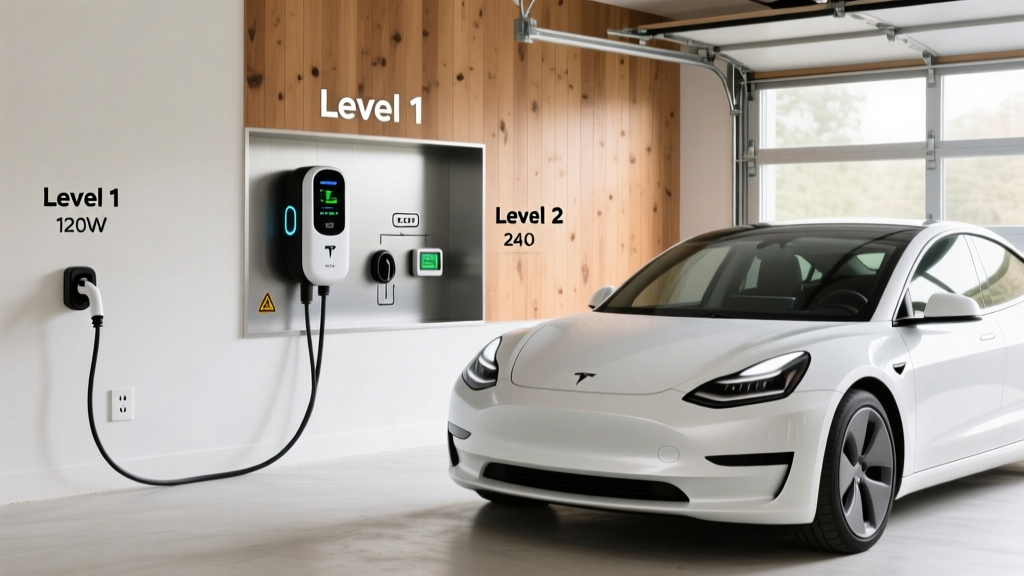
| Level | Voltage | Power (kW) | Miles of Range Added Per Hour | Typical Use Case |
|---|---|---|---|---|
| Level 1 | 120V AC | 1.2–1.9 kW | 3–5 mi/hr | Overnight, low-mileage drivers, PHEVs |
| Level 2 | 240V AC | 3.3–19.2 kW | 12–75 mi/hr | Daily home charging, most BEVs |
| DC Fast (Level 3) | 400–800V DC | 50–350+ kW | 150–1,000+ mi/hr (peak) | Road trips, highway corridors |
Source: fueleconomy.gov EV technology overview
Two important caveats. First, "miles per hour" varies by vehicle efficiency — a 4 mi/kWh Rivian R1T gains fewer miles per kW than a 4.5 mi/kWh Hyundai Ioniq 6. Second, DC fast charging tapers sharply above 80% State of Charge (SoC), so the advertised peak kW (say, 350 kW) is only sustained for a narrow band, often 10–40% SoC. Expect a 10–80% session on a 250 kW charger to average closer to 120–160 kW for most 400V architectures.
How Much Does It Cost to Install a Home EV Charger?
This is where most online guides go vague. A real-world install cost depends on four line items, and the panel is the wild card.
| Item | Typical Range | Notes |
|---|---|---|
| Level 2 charger (hardware) | $350–$800 | 40A–48A smart Wi-Fi models |
| Electrician labor (240V/50A circuit) | $500–$1,500 | Depends on run length from panel |
| Permit & inspection | $50–$250 | Varies by municipality |
| Panel upgrade (if needed) | $1,500–$4,000 | 100A → 200A service; older homes |
| Total (no panel upgrade) | $900–$2,550 | Most 200A-panel homes |
| Total (with panel upgrade) | $2,400–$6,550 | Pre-1990s homes, high-load panels |
Final spec must come from a licensed electrician — these ranges reflect 2026 national averages.
When You'll Need a Panel Upgrade
A Level 2 charger on a 48A circuit draws roughly 11.5 kW continuously — that's like running three electric dryers at once. If your home has a 100A service (common in pre-1990 construction) and you already run electric heat, an electric water heater, and an electric range, you'll likely exceed capacity. A load calculation by a licensed electrician is the only way to know for sure. Some utilities now offer "managed charging" programs that throttle the charger during peak demand, letting you avoid a panel upgrade entirely.
Federal Tax Credit for Home Charging
The IRS §30D-related Alternative Fuel Vehicle Refueling Property Credit (Form 8911) covers up to 30% of home charger hardware and install costs, capped at $1,000, but only for taxpayers in eligible census tracts (typically low-income or rural areas). Check the IRS guidance on the refueling property credit before assuming eligibility — tract eligibility changed significantly after 2023.
Which Connector and Charger Is Compatible With My EV?
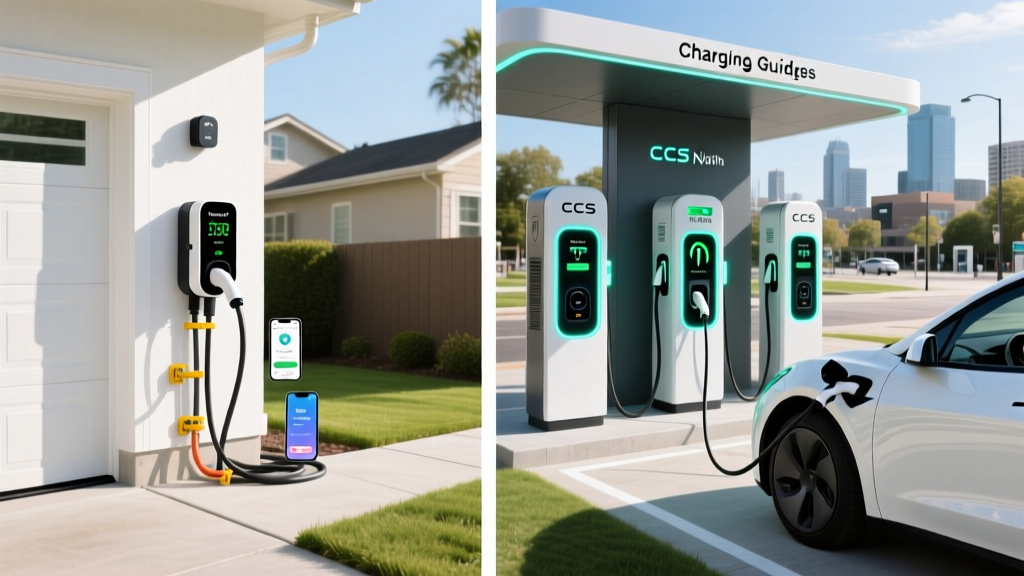
North America has consolidated around two primary connectors for AC Level 2 charging, with CHAdeMO fading into legacy territory.
| Connector | Used By | Notes |
|---|---|---|
| NACS (J3400) | Tesla (all), Ford, GM, Rivian, Volvo, Polestar, Hyundai/Kia (2025+), most new 2026 BEVs | Now the dominant North American standard; compact plug |
| J1772 (CCS1 for DC) | Legacy: pre-2025 non-Tesla BEVs, most 2026 PHEVs (Toyota, Jeep 4xe) | Adapters widely available for NACS stations |
| CHAdeMO | Nissan Leaf (discontinued after 2025), older Mitsubishi | DC-only; effectively orphaned in the US |
For Level 2 home charging, the practical rule: buy a charger with the native connector your EV uses today. If you own a pre-2025 Ford Mustang Mach-E or Hyundai Ioniq 5 with J1772, a J1772 Level 2 charger is the right call. If you drive a 2026 Tesla Model Y or a 2026 GM Equinox EV with NACS, get a NACS-terminated wallbox. Adapters (J1772-to-NACS, ~$150–$250) exist for travel flexibility but aren't ideal for daily home use due to added connection points.
Charging Cost Per Mile: EV vs Gas
The "fuel" cost of an EV varies dramatically based on where and when you charge. Here's a realistic breakdown using a 2026 BEV averaging 3.5 mi/kWh (about 285 Wh/mi, typical of a mid-size crossover like the Model Y or Ioniq 5).
| Scenario | Rate | Cost Per Mile |
|---|---|---|
| Home, off-peak utility rate | $0.10/kWh | $0.029 |
| Home, blended avg rate | $0.17/kWh | $0.049 |
| Public Level 2 (ChargePoint, etc.) | $0.30/kWh | $0.086 |
| DC fast charging (EA, EVgo, Tesla) | $0.48/kWh | $0.137 |
| Gas car, 28 MPG combined @ $3.40/gal | $3.40/gal | $0.121 |
The takeaway: home off-peak charging is roughly 4x cheaper per mile than gas. Public DC fast charging, however, can be more expensive per mile than a fuel-efficient gas car. This is why home Level 2 access is the economic backbone of EV ownership — without it, your cost advantage narrows significantly.
Charging Time Examples: 10–80% for Common Battery Sizes
How long will a Level 2 charger actually take to refill your EV? Here are real scenarios using typical 2026 BEV battery sizes, calculated to an 80% SoC target (charging above 80% slows dramatically to protect the battery).
- 77 kWh battery (Ford Mustang Mach-E Extended Range): 10–80% on a 48A/11.5 kW Level 2 charger ≈ 4.7 hours. Same pack on a 1.4 kW Level 1 outlet ≈ 38 hours — effectively unusable for full recharges.
- 84 kWh battery (Hyundai Ioniq 5 Long Range): 10–80% on 11.5 kW ≈ 5.1 hours. Overnight-friendly if you plug in by 9 PM.
- 123 kWh battery (GMC Hummer EV): 10–80% on 11.5 kW ≈ 7.5 hours. This is where a higher-output Level 2 (19.2 kW, requiring a 100A circuit) becomes worth considering, cutting time to ~4.5 hours.
- 18 kWh battery (Toyota RAV4 Prime PHEV): 10–80% on a 16A/3.8 kW Level 2 ≈ 3.2 hours. Level 1 at 1.4 kW ≈ 9 hours — still viable overnight for PHEVs.
For daily driving under 50 miles, even Level 1 can keep up with most BEVs. The problem is recovery — if you arrive home at 15% SoC after a road trip, Level 1 won't get you back to 80% before morning. That's the core case for Level 2.
2026 Equipment Picks: Level 1 and Level 2 EV Chargers Worth Buying
These are chargers I've either used personally or tracked across multiple owner reports. Every recommendation below includes its power output, connector, cable length, and current street price.
Best Level 2 Chargers for Home
ChargePoint Home Flex (NACS or J1772)
- Power output: up to 12 kW (50A circuit) — adjustable down to 16A for weaker panels
- Connector: available in NACS (J3400) or J1772
- Cable length: 23 ft
- Smart features: Wi-Fi, scheduling, utility demand-response integration, Alexa
- Price: ~$550 (NACS), ~$500 (J1772)
Why it earns the top spot: the adjustable amperage means you can install it on a 30A, 40A, 50A, or 60A circuit depending on what your panel supports, without buying a different unit.
Tesla Wall Connector (NACS native)
- Power output: up to 11.5 kW (48A / 60A circuit)
- Connector: NACS only — no J1772 variant
- Cable length: 24 ft
- Smart features: Wi-Fi, OTA updates, power sharing between two units on one circuit
- Price: ~$475
Best value for Tesla and NACS-equipped owners. If you own a non-Tesla NACS vehicle (2026 Ford, GM, Rivian), this works natively — no adapter required.
Emporia Level 2 EV Charger
- Power output: up to 11.5 kW (48A)
- Connector: J1772 (NACS adapter sold separately)
- Cable length: 24 ft
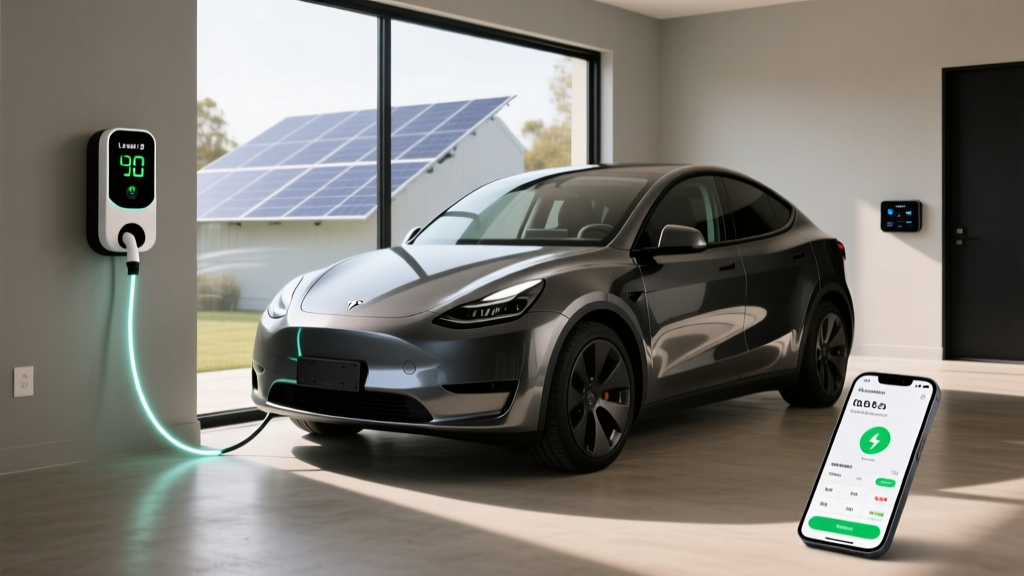
- Smart features: Wi-Fi, solar integration (pairs with Emporia Vue energy monitor), time-of-use scheduling
- Price: ~$400
Budget pick with strong energy-monitoring integration — ideal if you have rooftop solar and want to charge only on excess production.
Level 1 Chargers (120V) — When They're Enough
Every new EV ships with a Level 1 mobile charging cord (typically 1.2–1.4 kW). For PHEV owners with 18–25 kWh batteries, the included cord is often sufficient for overnight replenishment. BEV owners should treat Level 1 as an emergency/travel backup, not a primary strategy — unless you drive under 30 miles daily and can commit to 14+ hour plug-in windows.
Safety, Code, and Installation Non-Negotiables
A 240V circuit running 40–50 amps continuously for hours is a serious electrical load. Here's what the National Electrical Code (NEC) and best practice require:
- Dedicated circuit: Your Level 2 charger must be on its own breaker — no sharing with outlets, lights, or appliances.
- 80% rule: NEC requires continuous loads (defined as 3+ hours) to use only 80% of a breaker's rating. A 48A charger requires a 60A breaker. A 40A charger requires a 50A breaker. Never undersize.
- GFCI protection: NEC 2020 and later requires GFCI protection for 240V EV charging outlets (625.40). Hardwired units are exempt in many jurisdictions — another reason hardwiring is often preferred over a 14-50 receptacle.
- Outdoor rating: If your charger is mounted outside (carport, driveway), it must carry a NEMA 4 or IP56+ rating. All major chargers listed above meet this standard.
- Wire gauge: 6 AWG copper for 50A circuits; 4 AWG for 60A. Aluminum is cheaper but requires larger gauge — your electrician will spec this based on run length and local code.
- Permit and inspection: Required in virtually every US jurisdiction for a new 240V circuit. Skip this and you risk voiding homeowner's insurance coverage for any resulting electrical fire.
One often-missed detail: the NEMA 14-50 receptacle, commonly installed for Level 2 charging, has come under scrutiny. Several EV charger manufacturers now recommend hardwiring over plug-in 14-50 installations due to reported thermal failures in consumer-grade receptacles under sustained EV loads. Ask your electrician about hardwiring — it typically adds only $50–$150 in labor and eliminates a failure point.
Frequently Asked Questions
How fast will each charging level add range to my EV?
Level 1 (120V) adds roughly 3–5 miles of range per hour — about 40–60 miles overnight. Level 2 (240V) adds 12–75 miles per hour depending on the charger's kW output and your vehicle's onboard charger acceptance rate. A 48A/11.5 kW Level 2 charger will fully replenish a typical 77–84 kWh BEV battery from 10% to 80% in about 4.5–5.5 hours. DC fast charging can add 150+ miles in 15–20 minutes at peak rates, but sustained averages are lower due to charge-curve taper above 80% SoC.
How much does it cost to install a home EV charger?
A typical Level 2 home installation (48A charger, 60A dedicated circuit, 20–40 ft wire run) costs $900–$2,550 total in homes with an existing 200A electrical panel. Homes with older 100A panels may need a service upgrade adding $1,500–$4,000. Always get a load calculation from a licensed electrician before committing to equipment.
Which connector/charger is compatible with my EV?
For 2026 model-year EVs: Tesla, Ford, GM, Rivian, Volvo, Polestar, and most new Hyundai/Kia models use the NACS (J3400) connector. Pre-2025 non-Tesla EVs and most current PHEVs use J1772. Match your home charger's connector to your vehicle's native port. CHAdeMO is effectively discontinued in North America. For DC fast charging on the road, NACS-equipped vehicles can access Tesla Superchargers (17,000+ stalls) plus third-party networks using adapters where needed.
How much does charging cost per mile vs gas?
At a typical blended home electricity rate of $0.17/kWh, a mid-size BEV averaging 3.5 mi/kWh costs about $0.049/mile to charge. A comparable gas car at 28 MPG combined and $3.40/gallon costs about $0.121/mile. Home off-peak rates as low as $0.10/kWh drop EV fueling to under $0.03/mile. However, public DC fast charging at $0.45–$0.55/kWh can push EV costs to $0.13–$0.16/mile — equal to or above gas. The economic case for EVs is strongest with reliable home Level 2 access.
What electrical upgrades might I need for a Level 2 charger?
The most common upgrade is a panel service increase from 100A to 200A, required when your existing panel can't accommodate the additional 50–60A continuous load of a Level 2 circuit alongside existing appliances. Signs you may need one: your home was built before 1990, you already run electric heat/stove/dryer on a 100A panel, or your electrician's load calculation exceeds 80% of your panel's rated capacity. Some utilities offer managed-charging programs or smart-panel solutions (like Span) that can defer or eliminate a full upgrade.