If you have been putting off buying a home EV charger, consider this your last call. The connector landscape has shifted dramatically toward NACS, utility rate structures keep changing, and home electrical panels in older houses are proving to be the real bottleneck. This guide consolidates every decision — charging speeds, installation costs, connector compatibility, equipment picks, and operating economics — so you can stop researching and start charging.
Charging Levels Explained: kW Speeds and Miles Per Hour
The single most important distinction in EV charging is between kW (kilowatts), which measures power or charge rate, and kWh (kilowatt-hours), which measures energy or battery capacity. Think of kW as how fast water flows from a hose, and kWh as the size of the bucket. A 50 kW charger fills your battery faster than a 7 kW charger, but your battery's kWh capacity determines how far you can drive on a full charge.
| Level | Voltage | Power (kW) | Miles of Range Added Per Hour | Typical Use Case |
|---|---|---|---|---|
| Level 1 | 120V AC | 1.0 – 1.4 kW | 3 – 5 mi/hr | Overnight top-ups, PHEVs, low-mileage drivers |
| Level 2 | 240V AC | 3.3 – 19.2 kW | 12 – 70 mi/hr | Home daily charging, workplace, destination |
| DC Fast Charge | 400–800V DC | 50 – 350 kW | 150 – 1,200+ mi/hr (peak) | Road trips, highway corridors, commercial fleets |
A few real-world nuances most spec sheets gloss over:
- Level 2 sweet spot: Most homes with a 40-amp dedicated circuit deliver 9.6 kW (32 amps continuous on a 40A breaker, per NEC 80% rule). That adds roughly 30–36 miles of range per hour — enough to fully replenish a 75 kWh battery overnight in about 8 hours.
- DC fast charging taper: A charger rated at 250 kW will only sustain peak power between roughly 10–40% State of Charge (SoC). Above 60%, the vehicle's Battery Management System (BMS) throttles intake to protect cell health. Expect a 10–80% session on a 350 kW charger to average 120–160 kW sustained for a typical 80 kWh battery.
- Cold-weather slowdown: Below 40°F, lithium-ion cells accept charge more slowly. Without active battery preconditioning, a DC fast session can take 25–40% longer. Always precondition if your EV supports it (Tesla, Hyundai/Kia E-GMP, and most newer models do).
Home Charger Installation: Electrical Requirements and Real Costs
Installing a Level 2 home charger is an electrical project, not a plug-and-play appliance purchase. Here is what you are actually signing up for:
Electrical Panel and Circuit Requirements
- Dedicated circuit: A Level 2 charger requires its own dedicated 240V circuit — typically 40A, 50A, or 60A depending on charger amperage. The NEC requires continuous loads (like EV charging) to use only 80% of the breaker rating, so a 48A charger needs a 60A breaker.
- Panel capacity: Your home's electrical panel must have enough spare amperage to support the new circuit. A 200-amp panel with existing heavy loads (electric range, dryer, HVAC) may not have headroom for a 48A charger. An electrician will perform a load calculation to verify.
- Panel upgrade: If your home has a 100-amp panel (common in pre-1980 construction), you will likely need an upgrade to 200 amps. This is the single biggest cost variable in EV charger installation.
- GFCI protection: The 2020 NEC (and 2023 update, which most jurisdictions now enforce) requires GFCI protection for 240V EV charging outlets. Hardwired chargers may or may not require GFCI depending on local code — your electrician will determine this.
- Permit: Virtually all jurisdictions require an electrical permit for a new 240V circuit. Inspections ensure the work meets code and protect your homeowner's insurance coverage.
Installation Cost Breakdown
| Cost Component | Simple Install (panel nearby, no upgrade) | Complex Install (long run or panel upgrade) |
|---|---|---|
| Level 2 Charger Equipment | $350 – $700 | $350 – $700 |
| Electrician Labor (2–4 hrs typical) | $400 – $1,000 | $1,500 – $4,000 |
| Materials (conduit, wire, breaker) | $100 – $300 | $300 – $800 |
| Electrical Permit | $50 – $200 | $50 – $200 |
| Panel Upgrade (if needed) | N/A | $1,500 – $3,500 |
| Total Estimated Cost | $900 – $2,200 | $3,700 – $9,200 |
The wide range reflects real-world variables: distance from panel to garage (longer wire runs = more copper and conduit), whether your panel has spare slots and amperage headroom, and local labor rates. According to data aggregated by the U.S. Department of Energy, the national average for a straightforward Level 2 install falls between $1,000 and $2,500, but panel upgrades push costs significantly higher.
Pro tip: Some utilities offer rebates of $250–$1,000 for home charger installation, and a few states offer additional incentives. Check with your local utility before scheduling work. The federal Alternative Fuel Vehicle Refueling Property Credit (IRC §30C) covers up to 30% of home charging equipment and installation costs (capped at $1,000), but eligibility depends on your census tract meeting specific low-income or non-urban criteria — confirm with a tax professional.
Connector Compatibility: NACS, CCS, and CHAdeMO in 2026
The connector wars have largely resolved in favor of NACS (North American Charging Standard, originally the Tesla connector). Here is where things stand for the 2026 model year:
| Connector | Brands Using It (2025–2026 Models) | Public DC Network Access |
|---|---|---|
| NACS (J3400) | Tesla (all), Ford, GM, Rivian, Volvo, Polestar, Hyundai/Kia (2025+), Toyota, Subaru, Lucid (2025+), BMW (2025+), Mercedes (2025+) | Tesla Supercharger (open to all NACS), Electrify America (NACS stalls deploying), EVgo, ChargePoint |
| CCS1 | Legacy models: older VW ID.4, BMW i4 (pre-2025), some Stellantis EVs; most non-Tesla EVs built before 2025 | Electrify America, EVgo, ChargePoint, Ionity (EU) |
| CHAdeMO | Nissan Leaf (discontinued after 2025 model year), Mitsubishi Outlander PHEV (older) | Limited and shrinking — most new DC stations omit CHAdeMO |
What This Means for Your Home Charger Purchase
- Buying a new 2025–2026 EV? It almost certainly uses NACS. Buy a NACS-connector home charger.
- Driving a 2022–2024 non-Tesla EV? You likely have CCS1. Buy a CCS1 home charger or use a NACS-to-CCS adapter (Tesla, Lectron, and A2Z offer these for ~$150–$250).
- Level 2 home charging: All non-Tesla EVs built before 2025 use the J1772 connector for AC Level 2 charging. Tesla provides a J1772 adapter with every vehicle. Newer NACS-equipped EVs from other brands include a J1772-to-NACS adapter for Level 2 compatibility.
Cost to Charge: Home vs. Public vs. Gas Per Mile
The economics of EV charging depend heavily on where you charge. Home charging on an off-peak rate is dramatically cheaper than DC fast charging or gasoline.
| Charging Scenario | Avg Cost ($/kWh) | Cost to Add 200 Miles* | Cost Per Mile |
|---|---|---|---|
| Home Level 2 (off-peak utility rate) | $0.08 – $0.14 | $5.60 – $9.80 | $0.028 – $0.049 |
| Home Level 2 (standard residential rate) | $0.14 – $0.20 | $9.80 – $14.00 | $0.049 – $0.070 |
| Public Level 2 (network like ChargePoint) | $0.20 – $0.40 | $14.00 – $28.00 | $0.070 – $0.140 |
| DC Fast Charging (EA, EVgo, Tesla Supercharger) | $0.30 – $0.55 | $21.00 – $38.50 | $0.105 – $0.193 |
| Gasoline vehicle (25 MPG avg, $3.40/gal) | — | $27.20 | $0.136 |
*Based on an EV averaging 3.5 miles per kWh (roughly 285 Wh/mi), representative of vehicles like the Tesla Model Y, Hyundai Ioniq 5, and Chevrolet Equinox EV. Data referenced from fueleconomy.gov EPA efficiency ratings.
The takeaway: home charging saves 60–80% versus gasoline per mile. Even DC fast charging is often cheaper than gas on a per-mile basis, though the gap narrows considerably. If you charge exclusively at home on a time-of-use plan, your annual "fuel" cost for 12,000 miles of driving falls between $340 and $590 — versus roughly $1,630 for a 25 MPG gas car.
Charging Time Examples: 10–80% for Common Battery Sizes
Most EV owners charge between 10% and 80% SoC in daily use — charging to 100% regularly accelerates battery degradation in NMC cells, and most manufacturers recommend 80% for daily driving (LFP batteries are an exception; they tolerate 100% sessions better).
| Battery Size (kWh usable) | Level 2 at 9.6 kW (40A/240V) | DC Fast at 150 kW Peak | DC Fast at 250 kW Peak | DC Fast at 350 kW Peak (800V) |
|---|---|---|---|---|
| 40 kWh (small EV / PHEV) | ~3 hrs (10–80%) | ~20 min | ~15 min | N/A (most 400V) |
| 65 kWh (mid-size sedan/crossover) | ~4.75 hrs | ~28 min | ~20 min | N/A (most 400V) |
| 80 kWh (large crossover/SUV) | ~5.75 hrs | ~35 min | ~22 min | ~18 min (800V) |
| 100 kWh (full-size truck/luxury) | ~7.25 hrs | ~45 min | ~28 min | ~22 min (800V) |
Critical caveat: These times assume the vehicle can accept the charger's full peak rate. A Chevy Equinox EV with a 150 kW max charge rate won't charge faster on a 350 kW stall. And vehicles with 800V architectures (Hyundai Ioniq 5/6, Kia EV6/EV9, Porsche Taycan, Genesis GV60, Lucid Air) unlock the fastest tier. Always check your EV's maximum DC charge rate — it is the limiting factor, not the charger.
Equipment Recommendations: Top Home Level 2 Chargers for 2026
ChargePoint Home Flex (NACS or J1772)
- Power Output: Up to 12 kW (50A) — adjustable down to 16A for lower-capacity panels
- Connector: Available in NACS or J1772 (for CCS-era vehicles)
- Cable Length: 23 feet
- Smart Features: Wi-Fi, app-based scheduling, energy tracking, Alexa/Google integration, utility demand-response compatible
- Price: ~$549 (NACS) / ~$499 (J1772)
- Best For: Most buyers — flexible amperage, proven reliability, strong app
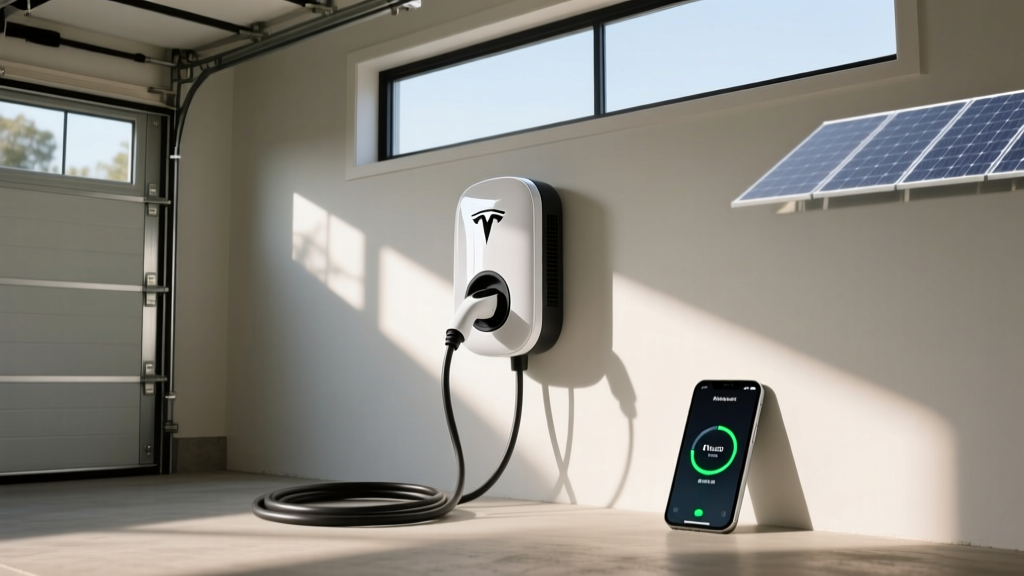
Tesla Wall Connector (NACS)
- Power Output: Up to 11.5 kW (48A)
- Connector: NACS native; includes J1772 adapter in box
- Cable Length: 24 feet
- Smart Features: Wi-Fi, over-the-air updates, power sharing (link up to 6 units on one circuit), Tesla app integration
- Price: ~$425
- Best For: Tesla owners and NACS-adopting EV buyers — best value at 48A
Emporia Vue Level 2 Charger (J1772 / NACS adapter)
- Power Output: Up to 11.5 kW (48A)
- Connector: J1772 native (NACS adapter available separately)
- Cable Length: 24 feet
- Smart Features: Wi-Fi, solar integration (pairs with Emporia Vue energy monitor), scheduled charging, load management
- Price: ~$399
- Best For: Solar homeowners who want energy-monitoring integration and budget pricing
Grizzl-E Smart (J1772 or NACS)
- Power Output: Up to 10 kW (40A) — DIP-switch adjustable to 16/24/32/40A
- Connector: J1772 or NACS
- Cable Length: 24 feet
- Smart Features: OCPP-compatible, works with multiple network apps, no proprietary lock-in
- Price: ~$449
- Best For: Cold-climate and outdoor installs — built in Canada, rated to -40°F, rugged aluminum enclosure
Key Specs to Check Before You Buy
- Amperage adjustability: If your panel can only support a 40A circuit, you need a charger that can be set to 32A continuous. Fixed-48A chargers require a 60A circuit.
- Hardwired vs. plug: Hardwired installations avoid the need for a 240V receptacle (NEMA 14-50 or 6-50) and may not require GFCI breakers in some jurisdictions, saving $100–$200. However, a plug-in charger is portable if you move.
- Outdoor rating: If your charger will be mounted on an exterior wall or in an uncovered carport, verify it carries a NEMA 4 (weatherproof) rating. Most quality chargers do.
- Cable length: 18 feet reaches most single-car garages; 24–25 feet is safer for two-car garages or driveway parking.
Safety, Code, and Panel-Upgrade Gotchas
Do not skip the permit. Unpermitted electrical work can void your homeowner's insurance in the event of an electrical fire. It can also cause problems during a home sale inspection. The permit fee is typically $50–$200 — a small price for code compliance and peace of mind.
Additional safety considerations every EV buyer should know:
- Dedicated circuit is mandatory: Never share a 240V circuit between your EV charger and another large appliance (dryer, oven). EV charging is a continuous load that runs for hours — shared circuits risk overheating.
- NEMA 14-50 outlet quality: If you choose a plug-in charger, invest in a commercial-grade outlet (Hubbell, Bryant) rather than a residential-grade Leviton. Multiple reports from EV owners and electricians document residential-grade 14-50 receptacles overheating under sustained EV charging loads. A quality outlet costs $25–$40 versus $10–$15.
- Wire gauge matters: A 50A circuit requires 6 AWG copper wire; a 60A circuit requires 4 AWG. Your electrician will spec this correctly, but understanding the basics helps you evaluate quotes.
- Load management devices: If your panel is tight on capacity but you want to avoid a full panel upgrade, devices like the Emporia Smart Load Management or Tesla Wall Connector power-sharing feature can dynamically throttle the charger when other appliances draw heavily. This can save $2,000–$4,000 versus a panel upgrade.
Frequently Asked Questions
How much does it cost to install a home EV charger?
For a straightforward installation with a 200-amp panel, nearby garage location, and no panel upgrade, expect $900–$2,200 total (equipment + electrician + permit). If you need a panel upgrade from 100A to 200A, total costs typically land between $3,700 and $9,200. Always get at least two quotes from licensed electricians.
How fast will each charging level add range?
Level 1 (120V) adds 3–5 miles per hour — fine for PHEVs with small batteries or drivers covering under 30 miles daily. Level 2 (240V, 40A) adds roughly 30–36 miles per hour, fully replenishing most EVs overnight. DC fast charging adds 150–1,200+ miles per hour at peak, but tapers significantly above 60% SoC, so realistic 10–80% sessions take 18–45 minutes depending on battery size and vehicle charge rate.
Which connector/charger is compatible with my EV?
For 2025–2026 model-year vehicles, most manufacturers have adopted NACS. If you drive a Tesla, Ford, GM, Rivian, Hyundai, Kia, Toyota, or Volvo EV from 2025 or later, you need a NACS home charger. For 2022–2024 non-Tesla EVs, you likely have CCS1 and should use a J1772 Level 2 charger (the AC standard for CCS vehicles) or a NACS charger with a NACS-to-J1772 adapter. CHAdeMO is effectively discontinued — only older Nissan Leaf and Mitsubishi models use it.
How much does charging cost per mile vs gas?
Home charging at typical residential rates ($0.12–$0.18/kWh) costs $0.04–$0.06 per mile for an average EV — roughly 60–70% cheaper than a 25 MPG gas car at $3.40/gallon ($0.136/mile). Even public DC fast charging at $0.40/kWh costs about $0.11/mile, still undercutting gasoline. The savings compound: at 12,000 miles per year, home charging saves $800–$1,200 annually versus gas.
What electrical upgrades might I need?
The most common upgrade is a panel capacity increase from 100A to 200A, required in older homes that lack headroom for a 40–60A dedicated EV circuit. This costs $1,500–$3,500. You may also need a new breaker slot, heavier-gauge wiring for long conduit runs (over 50 feet from panel to charger), or a load-management device if your panel is near capacity. Have a licensed electrician perform a NEC Article 220 load calculation before committing to a charger amperage.
This is your last call to get set up properly. Buy a charger matched to your vehicle's connector, hire a licensed electrician who will pull a permit, and verify your panel has the headroom before you commit to a 48A unit. The hardware is mature, the economics are compelling, and the installation process is straightforward — as long as you go in with the right numbers.