Search for "kinetic energy charger" and you'll find a swirl of crowdfunding pitches, physics-class demos, and patent filings promising to harvest motion, vibration, or braking energy to recharge an electric vehicle. The idea is alluring: capture wasted motion and push electrons back into your battery pack. But how does this concept stack up against the charging infrastructure that actually keeps 30+ million EVs on the road in 2026?
This guide separates regenerative-energy concepts from the practical realities of Level 1, Level 2, and DC fast charging. We'll cover exactly how many miles per hour each level delivers, what a home installation really costs (including the panel upgrade nobody warns you about), which connectors fit which vehicles, and how charging cost per mile compares to gasoline. If you've been wondering whether kinetic energy recovery could replace plugging in — or how to maximize the regen your EV already has — you'll find hard numbers ahead.
What "Kinetic Energy Charger" Actually Means for EVs
In automotive engineering, kinetic energy recovery isn't speculative — it's standard equipment on every EV and hybrid sold today. Regenerative braking converts the vehicle's momentum into electrical energy during deceleration, feeding it back into the traction battery. A Tesla Model Y, Hyundai Ioniq 5, or Ford F-150 Lightning recovers between 15% and 30% of the energy that would otherwise be lost to friction brakes, depending on driving style and terrain.
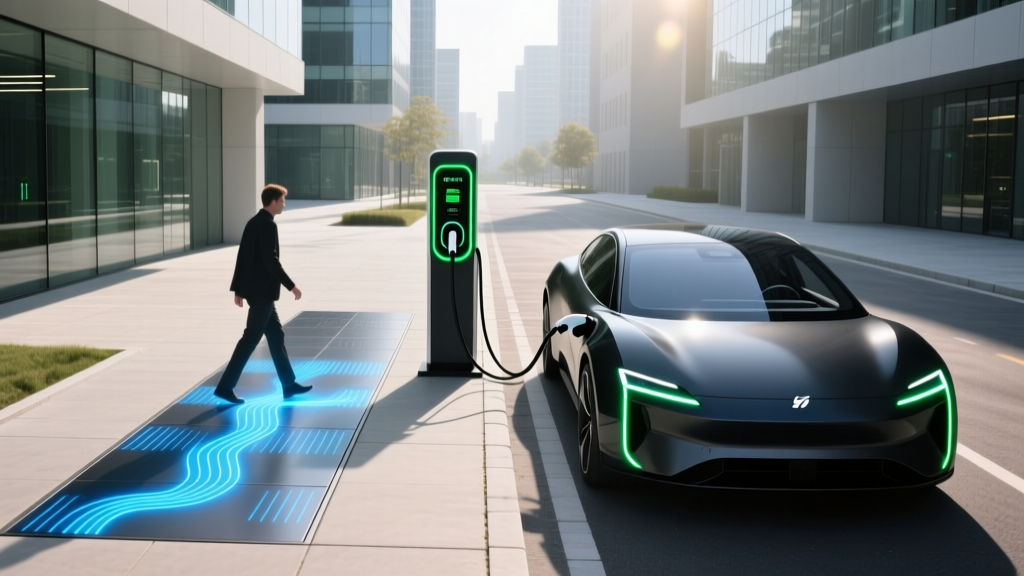
However, the term "kinetic energy charger" is sometimes used to describe aftermarket or conceptual devices that claim to generate meaningful charge from suspension movement, wheel rotation, or even piezoelectric road surfaces. Here's the physics reality check:
- Regenerative braking (real, integrated): Recovers up to ~60 kW momentarily during hard deceleration. Over a typical commute, this might add 5–15 miles of range back to a 75 kWh battery.
- Suspension-based harvesters (conceptual): Lab prototypes from companies like Levant Power have demonstrated 100–400 watts of continuous harvest — roughly 0.1–0.4 kWh per hour of driving. That translates to less than 1 mile of added range per hour.
- Piezoelectric road systems (experimental): Tested in Israel and Italy, these generate power at the infrastructure level, not the vehicle level, and feed the grid rather than charging a specific car.
The bottom line: kinetic energy recovery via regen braking is a meaningful efficiency booster already built into your EV. Standalone "kinetic energy charger" devices cannot meaningfully replace plugging in. For real range replenishment, you need electrons from the grid. Let's break down how that works.
Charging Levels Explained: Speeds, kW, and Miles Per Hour
Understanding EV charging requires keeping two units straight: kW (kilowatts) measures power — the rate at which energy flows. kWh (kilowatt-hours) measures energy — the total amount stored in your battery. Think of kW as the width of a pipe and kWh as the size of the tank you're filling.
| Level | Voltage | Max Power (kW) | Miles of Range Added Per Hour | Best Use Case |
|---|---|---|---|---|
| Level 1 (120V) | 120V AC | 1.4–1.9 kW | 3–5 mi/hr | Overnight top-up, PHEVs, emergencies |
| Level 2 (240V) | 240V AC | 7.2–19.2 kW | 20–60 mi/hr | Daily home charging, workplace, destinations |
| DC Fast Charge | 200–900V DC | 50–350+ kW | 150–1,200+ mi/hr (peak) | Road trips, rapid top-ups, fleet depots |
Real-world context: A 2026 Tesla Model 3 Long Range with an 82 kWh (usable ~79 kWh) battery charges from 10% to 80% at a V4 Supercharger (250 kW peak) in approximately 22 minutes. At a 48-amp Level 2 home charger (11.5 kW), that same 10–80% session takes about 5 hours. On a standard 120V outlet (1.4 kW), expect roughly 56 hours — which is why Level 1 is only practical for plug-in hybrids with smaller batteries or very low daily mileage.
Charging speed is not linear. Batteries accept maximum power only at low states of charge (typically 10–40% SoC). Above 80%, the charge curve tapers significantly to protect cell health. A charger rated at 250 kW may sustain that peak for only 5–8 minutes before dropping to 150 kW, then 90 kW, then 40 kW as SoC climbs. This is why we report 10–80% times rather than 0–100%.
Home Charger Installation: Electrical Requirements and Real Costs
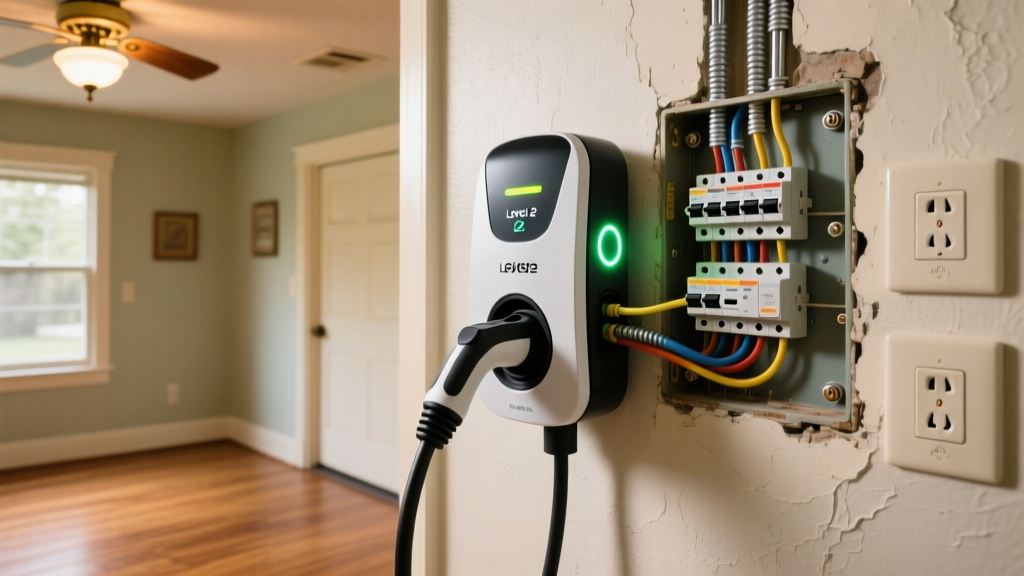
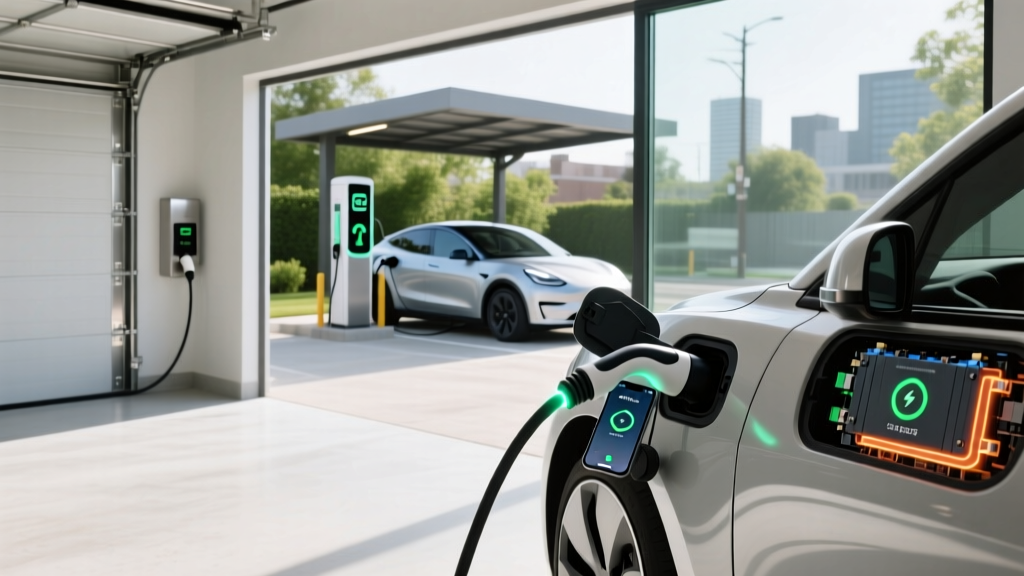
Most EV owners do 80% or more of their charging at home, and a hardwired Level 2 station is the gold standard. Here's what's involved electrically:
- Circuit requirement: A 48-amp charger needs a dedicated 60-amp circuit (NEC code requires circuits rated at 125% of continuous load). A 40-amp charger needs a 50-amp circuit.
- Voltage: 240V, single-phase — the same as your electric dryer or oven.
- Wire gauge: Typically 6 AWG copper for 60A circuits, 8 AWG for 50A, depending on run length.
- Panel capacity: Your main electrical panel must have spare amperage. A 200-amp panel with 160 amps already allocated may need a load calculation or an upgrade to accommodate a 60A EV circuit.
| Component | Low Estimate | High Estimate | Notes |
|---|---|---|---|
| Level 2 charger (hardware) | $350 | $750 | 40A–48A smart charger, NACS or J3400 connector |
| Electrician labor | $500 | $2,000 | Depends on panel proximity, wall material, conduit run |
| Electrical permit | $50 | $250 | Varies by municipality |
| Panel upgrade (if needed) | $1,500 | $4,000 | 200A→200A load reconfig or 200A→400A full upgrade |
| Conduit/wiring materials | $100 | $500 | Long runs, outdoor conduit, or trenching add cost |
| Total (no panel upgrade) | $1,000 | $3,500 | Most homes with adequate panel capacity |
| Total (with panel upgrade) | $2,500 | $7,500 | Older homes with 100A–150A service |
Panel upgrade reality: Homes built before 1990 often have 100-amp or 150-amp main panels. Adding a 60-amp EV circuit can push these past safe capacity, especially if you also have electric heat, an electric oven, and a dryer. A licensed electrician will perform a NEC Article 220 load calculation. If you're over capacity, options include a panel upgrade ($2,500–$4,000), a smart circuit-sharing device like the NeoCharge Smart Splitter (~$500, shares a dryer outlet), or a lower-amperage charger (32A/7.7 kW) that fits within existing capacity.
The federal Residential Clean Energy Credit (IRS §25D) covers 30% of home EV charger equipment and installation costs up to $1,000 through 2032, which can offset $300–$1,050 of your total bill.
Connector Compatibility: NACS, CCS, and CHAdeMO in 2026
The North American charging connector landscape has consolidated dramatically since Tesla opened its Supercharger network and the NACS (North American Charging Standard, now formalized as SAE J3400) connector became the industry standard. Here's where things stand:
| Connector | Brands Using It Natively | Max DC Fast Power | Adapter Needed For |
|---|---|---|---|
| NACS / J3400 | Tesla, Ford, GM, Rivian, Volvo, Polestar, Mercedes-Benz, Hyundai/Kia (2025+), BMW, Lucid | Up to 350 kW (V4 Supercharger) | CCS chargers → NACS adapter ($150–$250) |
| CCS1 (legacy) | Older VW ID.4, older Hyundai/Kia, older BMW iX, Stellantis | Up to 350 kW (Electrify America) | NACS chargers → CCS adapter ($200–$300) |
| CHAdeMO | Nissan Leaf (discontinued 2025), Mitsubishi Outlander PHEV (legacy) | Up to 100 kW | Limited adapter options; network shrinking |
What to buy in 2026: If you're purchasing a new EV, it almost certainly uses NACS. For home Level 2 charging, NACS connectors are standard on new wall chargers. For public DC fast charging, Tesla Superchargers (now open to all NACS-equipped EVs) and Electrify America's newer stations both support NACS natively. If you own a 2023–2024 model with a CCS port, most automakers now offer a NACS adapter, and Tesla provides a CCS-to-NACS adapter for accessing non-Tesla chargers.
CHAdeMO is effectively a legacy standard. The Nissan Leaf, the last major CHAdeMO vehicle, ended US production in 2025. Public CHAdeMO stalls still exist but are not being expanded.
Cost to Charge: Home, Public, and DC Fast Charging Per Mile
One of the strongest economic arguments for EVs is lower fueling cost per mile — but the savings depend heavily on where and when you charge.
| Scenario | Avg $/kWh | Cost to Add 200 Miles* | Cost Per Mile | Equivalent Gas MPG** |
|---|---|---|---|---|
| Home, off-peak utility rate | $0.09–$0.13 | $5.40–$7.80 | $0.027–$0.039 | 85–120 MPG |
| Home, standard rate (no TOU) | $0.14–$0.18 | $8.40–$10.80 | $0.042–$0.054 | 62–80 MPG |
| Public Level 2 (ChargePoint, etc.) | $0.25–$0.49 | $15.00–$29.40 | $0.075–$0.147 | 23–45 MPG |
| DC Fast (Tesla Supercharger) | $0.28–$0.36 | $16.80–$21.60 | $0.084–$0.108 | 30–40 MPG |
| DC Fast (Electrify America, EVgo) | $0.35–$0.55 | $21.00–$33.00 | $0.105–$0.165 | 20–32 MPG |
| Gasoline baseline (28 MPG avg, $3.40/gal) | — | $24.29 | $0.121 | 28 MPG |
*Based on a vehicle averaging 3.3 miles per kWh (approx. 100 MPGe combined), typical of a mid-size SUV like the Tesla Model Y or Hyundai Ioniq 5. Per fueleconomy.gov, efficiency varies by model from 2.5 mi/kWh (trucks) to 4.5 mi/kWh (sedans).
**Equivalent gas MPG = the fuel economy a gas car would need to match this cost per mile at $3.40/gallon.
The takeaway: home charging during off-peak hours delivers the strongest savings — roughly one-quarter the cost per mile of gasoline. Exclusive reliance on public DC fast charging narrows the gap substantially, and in some high-cost markets (California, Hawaii), peak DC rates can actually exceed the cost per mile of an efficient hybrid. This is why home Level 2 access remains the single most important factor in EV ownership economics.
Charging Time Examples: 10–80% for Common Battery Sizes
Charge times depend on battery capacity (kWh), peak charge rate (kW), and the vehicle's charge curve. Here are real-world estimates for popular 2026 models:
- Tesla Model 3 Long Range (82 kWh, 250 kW peak): 10–80% in ~22 minutes at a V4 Supercharger; ~5 hours on a 48A Level 2 home charger (11.5 kW).
- Hyundai Ioniq 5 (84 kWh, 240 kW peak, 800V architecture): 10–80% in ~18 minutes at a compatible 350 kW station; ~5.5 hours on Level 2.
- Ford F-150 Lightning Extended Range (131 kWh, 150 kW peak): 10–80% in ~41 minutes at a 150 kW DC charger; ~8.5 hours on Level 2.
- Chevrolet Equinox EV (85 kWh, 150 kW peak): 10–80% in ~30 minutes at a 150 kW charger; ~5.5 hours on Level 2.
- Toyota RAV4 Plug-in Hybrid (18.1 kWh, no DC fast charge): 0–100% in ~2.5 hours on Level 2 (16A/3.3 kW); ~5.5 hours on Level 1 (120V/12A).
The Hyundai Ioniq 5's 800-volt architecture allows it to sustain higher charge rates longer than 400V competitors, which is why its 10–80% time beats vehicles with similar battery sizes but lower voltage systems. When evaluating charging speed, sustained kW matters more than peak kW.
Recommended Home Level 2 Chargers (2026)
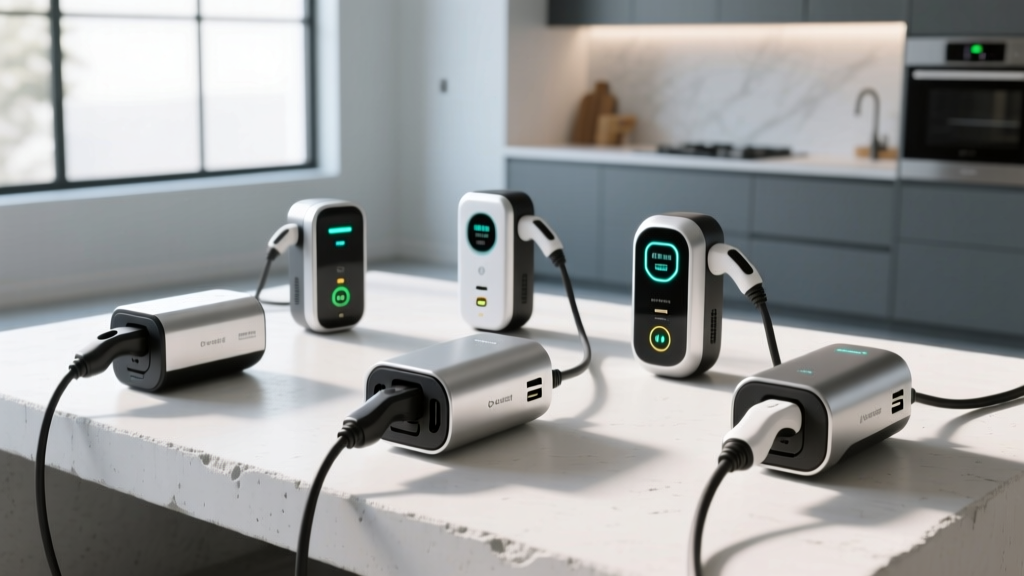
These are the chargers we'd recommend based on reliability, power output, connector availability, and smart features:
ChargePoint Home Flex (NACS)
- Power: Up to 50 amps / 12 kW (adjustable down to 16A for limited panels)
- Connector: NACS (J3400) native; CCS adapter available
- Cable length: 23 feet
- Smart features: Wi-Fi, scheduled charging, utility integration, Alexa/Google Home
- Price: ~$599
- Best for: Flexible amperage settings for homes with panel constraints
Tesla Wall Connector (NACS)
- Power: Up to 48 amps / 11.5 kW
- Connector: NACS native; J1772 adapter included for non-Tesla EVs
- Cable length: 24 feet
- Smart features: Wi-Fi, OTA updates, power sharing (link multiple units on one circuit), load management
- Price: ~$475
- Best for: Tesla owners and multi-EV households (power sharing feature)
Emporia Vue Level 2 Charger
- Power: Up to 48 amps / 11.5 kW
- Connector: NACS (2025+ models); CCS available
- Cable length: 24 feet
- Smart features: Energy monitoring, solar integration, time-of-use scheduling, EMPORIA ecosystem
- Price: ~$399
- Best for: Budget-conscious buyers wanting energy monitoring and solar pairing
Grizzl-E Smart (United Chargers)
- Power: Up to 40 amps / 9.6 kW
- Connector: NACS or J1772 options
- Cable length: 24 feet
- Smart features: OCPP-compatible, works with multiple apps, adjustable amperage via DIP switches
- Price: ~$449
- Best for: Cold-climate durability (rated to -40°F), outdoor installations, commercial use
Safety, Electrical Code, and Installation Best Practices
A Level 2 charger draws significant continuous current — often for 6–10 hours at a stretch. Safety and code compliance are non-negotiable:
- Dedicated circuit: NEC requires a dedicated breaker for EVSE. Never share a circuit with other major appliances.
- GFCI protection: The 2023 NEC (Article 625.54) requires GFCI protection for all receptacle-connected EVSE rated 150V or less to ground. Hardwired units are exempt but must follow manufacturer instructions.
- Outdoor rating: If installing outdoors, ensure the charger is NEMA 4 or NEMA 4X rated (weatherproof). Most major chargers (ChargePoint, Tesla, Grizzl-E) meet this standard.
- Hardwired vs. plug: Hardwired installations (no plug) are preferred for 48A+ chargers. NEMA 14-50 receptacles are acceptable up to 40A continuous (50A breaker) but require a high-quality industrial-grade receptacle — cheap $10 hardware-store outlets have caused melting incidents at sustained EV loads.
- Permit and inspection: Most jurisdictions require an electrical permit for new 240V circuits. The inspection ensures proper wire gauge, breaker sizing, grounding, and GFCI compliance. Skipping the permit risks insurance denial in the event of an electrical fire.
- Load management: If your panel is near capacity, consider a smart load-management system (e.g., Tesla Gateway, Span panel, or Myenergi hub) that dynamically throttles charger amperage based on real-time household consumption.
Kinetic Energy Recovery vs. Grid Charging: The Practical Verdict
Your EV's regenerative braking system is already a kinetic energy charger — and a surprisingly effective one. On hilly commutes or stop-and-go city driving, regen can recover 15–30% of consumed energy. Some vehicles, like the Nissan Ariya and Hyundai Ioniq 6, offer adjustable regen levels and one-pedal driving modes that maximize recovery.
But physics sets hard limits. A 4,500-lb vehicle decelerating from 65 mph to 0 carries roughly 0.28 kWh of recoverable kinetic energy. Even with 70% regen efficiency (exceptionally high), that's ~0.2 kWh per full stop — enough to add about 0.6 miles of range. Over a 30-mile commute with 15 stops, you might recover 9 miles of range. That's meaningful for efficiency, but it doesn't eliminate the need to plug in.
No aftermarket kinetic energy harvesting device available in 2026 can replace a Level 2 home charger or DC fast charging session. The energy density of grid electricity delivered at 11.5 kW (Level 2) or 250 kW (DC fast) dwarfs what motion harvesting can produce. Focus your investment on proper home charging infrastructure — that's where the real ownership experience is made or broken.
Frequently Asked Questions
How much does it cost to install a home EV charger?
A typical Level 2 home charger installation costs $1,000–$3,500 total (equipment + electrician + permit) if your electrical panel has adequate capacity. If your home needs a panel upgrade from 100A/150A to 200A or higher, add $1,500–$4,000, bringing the total to $2,500–$7,500. The federal §25D tax credit covers 30% of costs up to $1,000.
How fast will each charging level add range?
Level 1 (120V) adds 3–5 miles per hour. Level 2 (240V, 48A) adds roughly 35–45 miles per hour for most EVs. DC fast charging at 150–250 kW can add 150–300+ miles in a 20–25 minute session (10–80% SoC). Exact rates depend on vehicle efficiency (miles per kWh) and the battery's charge curve.
Which connector/charger is compatible with my EV?
For 2025–2026 model-year vehicles from Tesla, Ford, GM, Hyundai, Kia, Rivian, BMW, Mercedes, Volvo, and Polestar, the NACS (J3400) connector is standard. Older CCS-equipped EVs (2022–2024) may need a NACS adapter (~$150–$300) to access Tesla Superchargers. CHAdeMO is a legacy standard limited to older Nissan Leafs and Mitsubishi PHEVs.
How much does charging cost per mile vs. gas?
Home charging at off-peak rates ($0.09–$0.13/kWh) costs roughly $0.03–$0.04 per mile — about one-third the cost of gasoline at $3.40/gallon in a 28 MPG vehicle ($0.12/mile). Public DC fast charging at $0.28–$0.55/kWh costs $0.08–$0.17 per mile, narrowing or eliminating the savings. Maximizing home charging is key to EV economics.
What electrical upgrades might I need?
The most common upgrade is a panel capacity increase. Homes with 100A or 150A service often need an upgrade to 200A ($2,000–$3,500) to safely add a 48–60A EV circuit. Alternatives include installing a lower-amperage charger (32A), using a smart splitter to share an existing dryer circuit, or adding a dedicated energy management system. A licensed electrician should perform a NEC load calculation before installation.
Can regenerative braking replace plugging in?
No. Regen braking typically recovers 15–30% of energy on a trip with frequent stops, which might add 5–15 miles back to your battery over a typical commute. It improves overall efficiency but cannot replenish a depleted battery. Grid charging via Level 2 or DC fast charging remains essential for daily use.