Charging the Kia EV9 Light Long Range: What Owners Need to Know
The Kia EV9 Light Long Range is a three-row electric SUV with a 99.8 kWh usable battery (NMC chemistry), an EPA-estimated 304 miles of range, and a peak DC fast-charging rate of 236 kW. That's a large battery in a heavy vehicle — which means charging strategy matters more here than on smaller EVs. Plug into a standard 120V outlet and you'll add roughly 3 miles per hour, requiring over 30 hours for a full charge. Set up a proper Level 2 home charger and that same battery refills overnight. Use a 350 kW DC fast charger and you'll go from 10% to 80% in roughly 24 minutes.
This guide covers every charging scenario EV9 Light Long Range owners will encounter — from home installation requirements and costs to public charging networks, connector compatibility, and what you'll actually pay per mile compared to a gas-powered three-row SUV.
Charging Levels Explained: kW, Miles Per Hour, and What Each Delivers
The most common mistake new EV owners make is confusing kW (kilowatts — a measure of power, or how fast energy flows) with kWh (kilowatt-hours — a measure of energy, or how much the battery holds). Think of kW as the width of a hose and kWh as the size of the bucket. The EV9 Light Long Range's bucket is 99.8 kWh. How fast you fill it depends on the hose.
| Level | Voltage / Amperage | Max Power (kW) | Miles Added Per Hour | Full Charge Time (99.8 kWh) |
|---|---|---|---|---|
| Level 1 (120V) | 120V / 12A | ~1.4 kW | ~3–4 mi/hr | ~70+ hours |
| Level 2 (240V) | 240V / 40A–48A | 9.6–11.5 kW | ~25–33 mi/hr | ~9–11 hours |
| DC Fast (CCS/NACS) | 400V–800V DC | Up to 236 kW (peak) | ~500+ mi/hr (at peak) | 10–80% in ~24 min |
Level 1 is effectively an emergency trickle for the EV9's large battery. If you drive 30 miles per day, Level 1 can barely keep up — and only if the car sits plugged in for 10+ hours nightly. It's fine for topping off a PHEV with a small battery, but inadequate for daily use with a 99.8 kWh pack.
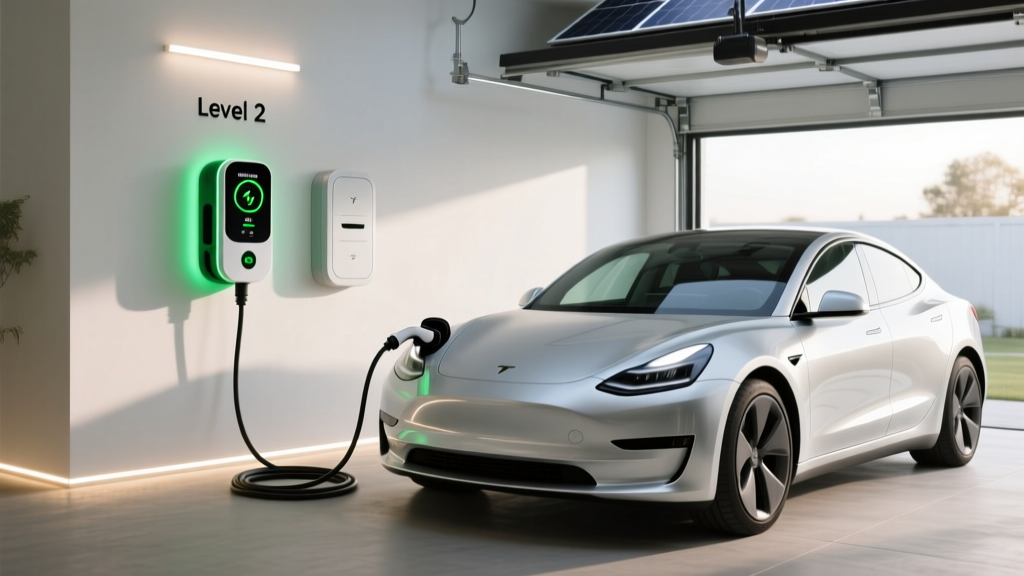
Level 2 is the practical home standard. A 48-amp (11.5 kW) charger replenishes roughly 30 miles of range per hour, meaning a full overnight charge (10 hours) restores about 300 miles — essentially the EV9's full battery. This is what nearly all EV9 owners should install.
DC fast charging is for road trips and quick top-ups. The EV9's 800V electrical architecture allows it to accept up to 236 kW at compatible stations. However, that peak rate is sustained only between roughly 10% and 45% State of Charge (SoC). Above 60%, the charge curve tapers significantly — from 236 kW down to under 80 kW past 80%. This is normal battery physics: charging slows to protect cell longevity. Expect 10–80% in about 24 minutes at a 350 kW station, but 80–100% could take another 30+ minutes. On road trips, plan to charge to 80% and move on.
Home Charger Installation: Electrical Requirements, Costs, and Panel Upgrades
Installing a Level 2 home charger for the EV9 Light Long Range requires a dedicated 240V circuit — the same voltage your electric dryer or oven uses. The EV9's onboard charger accepts up to 10.9 kW (48A at 240V), so you'll want a charger rated for at least 48 amps on a 60-amp dedicated circuit (electrical code requires circuits to be rated 125% above continuous load).
Electrical Requirements at a Glance
- Voltage: 240V (split-phase, standard US residential)
- Amperage: 60A dedicated breaker for a 48A charger (or 50A breaker for a 40A charger)
- Wire gauge: 6 AWG copper (for 60A circuit) or 8 AWG (for 50A), depending on run length
- Circuit type: Dedicated — no sharing with other appliances
- GFCI protection: Required by NEC 2020+ for EV charging outlets (breaker-integrated or charger-integrated)
- Permit: Required in nearly all US jurisdictions for new 240V circuits
Installation Cost Breakdown
| Component | Simple Install (panel nearby) | Complex Install (panel far / upgrade needed) |
|---|---|---|
| Level 2 charger (hardware) | $400–$700 | $400–$700 |
| Electrician labor (2–4 hrs) | $500–$1,000 | $1,500–$3,000 |
| Electrical permit | $50–$200 | $100–$350 |
| Wiring / conduit materials | $100–$300 | $400–$1,200 |
| Panel upgrade (if needed) | $0 (not needed) | $1,500–$3,500 |
| TOTAL | $1,050–$2,200 | $3,900–$8,750 |
The wide cost range comes down to one question: does your electrical panel have capacity? Homes built after 2000 typically have 200-amp panels with spare slots — a straightforward $1,000–$2,000 install. Older homes with 100-amp panels, or panels already near capacity (electric heat, hot tub, dryer), may need a panel upgrade to 200A, which adds $1,500–$3,500. Some utilities offer panel-upgrade rebates — check with your local provider.
Panel capacity check: A licensed electrician will perform a load calculation per NEC Article 220. If your existing loads plus the new 60A EV circuit exceed 80% of your panel's rated capacity, an upgrade is required. Don't skip this — overloading a panel is a fire hazard and will fail inspection.
Connector Compatibility: NACS, CCS, and the EV9 in 2026
The 2025–2026 Kia EV9 sold in North America comes equipped with a CCS1 (Combined Charging System) port for both Level 2 AC and DC fast charging. However, Kia has confirmed that starting with the 2026 model year, select Kia models will transition to the NACS (North American Charging Standard / Tesla connector). Check your specific vehicle's charge port to confirm which connector you have.
| Connector | Used By | EV9 Compatibility | Adapter Needed? |
|---|---|---|---|
| CCS1 | Kia, Hyundai, VW, BMW, Ford, GM (legacy), most non-Tesla | Native (2025 models, some 2026) | No — plug directly at Electrify America, EVgo, ChargePoint DC stations |
| NACS (Tesla) | Tesla, Ford (2025+), GM (2025+), Rivian, Kia (select 2026+) | Native (select 2026+ models) or via adapter | CCS-to-NACS adapter (~$200–$250) for CCS-equipped EV9s to use Tesla Superchargers |
| CHAdeMO | Nissan Leaf (legacy), Mitsubishi | Not compatible | No adapter available — avoid CHAdeMO-only stations |
| J1772 (AC only) | All EVs (Level 2 AC standard) | Native (top portion of CCS port) | No — all Level 2 public chargers use J1772 |
Practical advice: If your EV9 has a CCS1 port, purchase a CCS-to-NACS adapter (Kia-approved or Tesla's official CCS adapter) to unlock access to Tesla's Supercharger network — over 25,000 stalls in North America. This dramatically expands your road-trip charging options. Verify adapter compatibility with your specific model year on Kia's official site.
Charging Cost: Home vs. Public vs. Gas — What You'll Actually Pay Per Mile
The EV9 Light Long Range's efficiency is rated at approximately 3.3 kWh per mile (roughly 87 MPGe combined per fueleconomy.gov). Here's what that translates to in real dollars across common charging scenarios:
| Scenario | Price per kWh | Cost per Mile | Cost for 300 Miles |
|---|---|---|---|
| Home (off-peak utility rate) | $0.09–$0.14 | $0.03–$0.05 | $9–$14 |
| Home (average US residential) | $0.16–$0.18 | $0.05–$0.06 | $16–$18 |
| Public Level 2 (ChargePoint, etc.) | $0.25–$0.49 | $0.08–$0.16 | $25–$48 |
| DC Fast Charging (Electrify America, EVgo) | $0.35–$0.55 | $0.12–$0.18 | $35–$55 |
| Tesla Supercharger (with adapter) | $0.25–$0.40 | $0.08–$0.13 | $25–$40 |
| Gas SUV (22 MPG combined, $3.40/gal) | $3.40/gallon | $0.15 | $46 |
The bottom line: Home charging on an off-peak rate saves roughly 70–80% compared to a comparable gas-powered three-row SUV (think Kia Telluride at 22 MPG combined). Even at DC fast-charging prices, the EV9 is cost-competitive with gas on a per-mile basis. The savings compound: a driver covering 15,000 miles per year at home off-peak rates saves approximately $1,800–$2,200 annually versus gas.
However, if you rely exclusively on public DC fast charging at $0.45+/kWh, your cost per mile can equal or exceed a gas SUV. Home charging access is the single biggest factor in EV economics.
Recommended Level 2 Home Chargers for the EV9
With a 99.8 kWh battery, you want a charger that can deliver the EV9's full 10.9 kW AC acceptance rate. A 48-amp charger on a 60-amp circuit is the sweet spot. Here are proven units that match the EV9's capabilities:
ChargePoint Home Flex
- Power: Up to 12 kW (50A) on 240V
- Connector: J1772 (CCS-compatible)
- Cable length: 23 ft
- Smart features: Wi-Fi, app scheduling, Alexa, energy tracking
- NEMA 14-50 or hardwired
- Price: ~$550–$650
Best for: Most EV9 owners wanting a reliable, app-connected charger with flexible amperage settings.
Emporia Level 2 EV Charger
- Power: Up to 11.5 kW (48A) on 240V
- Connector: J1772
- Cable length: 24 ft
- Smart features: Wi-Fi, solar integration, real-time energy monitoring, load management
- Hardwired or NEMA 14-50
- Price: ~$350–$400
Best for: Budget-conscious buyers and homes with solar panels wanting granular energy data.
Grizzl-E Smart
- Power: Up to 10 kW (40A) on 240V
- Connector: J1772
- Cable length: 24 ft
- Smart features: OCPP-compatible, adjustable amperage, outdoor-rated (IP67)
- NEMA 14-50 or hardwired
- Price: ~$450–$550
Best for: Outdoor installations, cold climates, and Canadian/extreme-weather garages. Built like a tank.
Tesla Universal Wall Connector
- Power: Up to 11.5 kW (48A) on 240V
- Connector: NACS (Tesla) + integrated J1772 adapter
- Cable length: 24 ft
- Smart features: Wi-Fi, OTA updates, power sharing (2 units on 1 circuit)
- Hardwired only (60A circuit)
- Price: ~$600
Best for: Multi-EV households with both Tesla and CCS/NACS vehicles. The integrated J1772 adapter charges your CCS-equipped EV9 without a separate dongle.
Hardwired vs. plug-in (NEMA 14-50): Hardwired installations allow full 48A continuous draw and avoid the ~$80–$150 cost of a 14-50 receptacle. Plug-in units offer portability — useful if you may move. For the EV9's large battery, hardwired is preferred to maximize charging speed and eliminate receptacle wear over time.
Safety, Code, and Installation Best Practices
EV charging draws maximum current for hours at a time — far longer than a dryer cycle. This places sustained thermal stress on wiring and connections. Follow these non-negotiable safety requirements:
- Dedicated circuit: Your EV charger must have its own breaker — never share with a dryer, HVAC, or other appliance.
- GFCI protection: NEC 2020 and later requires ground-fault protection for EV charging. Most modern chargers include integrated GFCI; if not, your electrician must install a GFCI breaker.
- Outdoor rating: If your charger is mounted outside or in an open carport, ensure it carries an IP65 or higher ingress-protection rating. Indoor garage installations can use IP54-rated units.
- Cable management: Use a wall-mounted holster or retractable cable system. A 23-foot cable left on a garage floor is a trip hazard and degrades the cable jacket over time.
- Permit and inspection: Pull a permit. An inspection verifies wire gauge, breaker sizing, grounding, and GFCI compliance. Unpermitted work can void home insurance claims in the event of an electrical fire.
- Load management: If your panel is near capacity but you don't want to upgrade, consider an Energy Management System (EMS) — devices like the Emporia VUE or ChargePoint Flex with load-sharing can dynamically limit charger draw based on real-time household consumption. This may avoid a costly panel upgrade.
Public DC Fast Charging on Road Trips: Networks, Speeds, and the Charge Curve
The EV9 Light Long Range's 800V architecture is its road-trip advantage. At a 350 kW-capable DC fast charger (Electrify America, select EVgo stations), the EV9 peaks at 236 kW — but only for a portion of the session. Here's a realistic charging timeline based on the charge curve:
- 10% → 45% SoC: ~200–236 kW sustained. Adds roughly 130 miles in 10 minutes.
- 45% → 65% SoC: ~150–180 kW. Adds roughly 70 miles in 8 minutes.
- 65% → 80% SoC: ~80–120 kW. Adds roughly 45 miles in 6 minutes.
- 80% → 100% SoC: ~40–60 kW tapering. Adds roughly 60 miles in 25+ minutes.
Total 10–80%: approximately 24 minutes at a 350 kW station. At a 150 kW station, expect 32–38 minutes for the same range.
Preconditioning matters. The EV9 will precondition its battery when you navigate to a DC fast charger via the built-in navigation system. This warms (or cools) the cells to the optimal temperature for accepting maximum charge rate. In cold weather (below 40°F), skipping preconditioning can reduce peak charge speed by 30–50%. Always navigate to your charger — don't just drive there from memory.
Network recommendations for EV9 owners:
- Electrify America: Largest CCS-native network. 350 kW stalls at most highway locations. Reliability has improved significantly in 2025–2026 with the introduction of Plug&Charge on Kia vehicles.
- Tesla Supercharger (with NACS adapter): The most reliable network in North America. V3 stalls deliver up to 250 kW (the EV9 will be capped by its adapter throughput — verify adapter kW rating). V4 stalls with CCS magic dock accommodate CCS vehicles natively at select locations.
- EVgo: Growing 350 kW footprint. Good urban coverage. Pricing varies — check the app for per-kWh rates before plugging in.
- ChargePoint: Dominant in Level 2 public charging. DC fast locations are fewer but expanding.
Frequently Asked Questions
How much does it cost to install a home EV charger for the Kia EV9?
A straightforward Level 2 installation (60A circuit, panel nearby, no upgrade needed) typically costs $1,050–$2,200 including the charger, electrician labor, permit, and materials. If your home needs a 200A panel upgrade or a long conduit run, costs can reach $3,900–$8,750. Get 2–3 quotes from licensed electricians and verify they include permit costs.
How fast will each charging level add range to the EV9 Light Long Range?
Level 1 (120V) adds roughly 3–4 miles per hour — impractical for daily use with a 99.8 kWh battery. Level 2 (240V, 48A) adds approximately 30 miles per hour, fully recharging overnight in 9–11 hours. DC fast charging at 236 kW peak can add 130+ miles in 10 minutes, with 10–80% taking about 24 minutes at a 350 kW station.
Which connector does the Kia EV9 use, and do I need an adapter?
The 2025 EV9 uses a CCS1 connector natively. Some 2026 model-year EV9s may ship with NACS. If your EV9 has CCS1 and you want access to Tesla Superchargers, you'll need a CCS-to-NACS adapter ($200–$250). For Level 2 public charging, the CCS port's upper section accepts standard J1772 connectors — no adapter needed.
How much does charging the EV9 cost per mile compared to a gas SUV?
At home off-peak rates ($0.09–$0.14/kWh), the EV9 costs roughly $0.03–$0.05 per mile — about 70–80% less than a 22 MPG gas SUV at $3.40/gallon ($0.15/mile). On public DC fast chargers at $0.45/kWh, the cost rises to $0.12–$0.18 per mile, roughly equivalent to gas. Home charging access is the key to maximizing savings.
What electrical upgrades might I need for a Level 2 charger?
You'll need a 240V, 60-amp dedicated circuit. If your electrical panel is 100A or already near capacity, you may need a panel upgrade to 200A ($1,500–$3,500). Older homes may also need updated grounding, a new service drop from the utility, or conduit runs through finished walls. A licensed electrician's load calculation (per NEC Article 220) determines exactly what's required.
Does the Kia EV9 qualify for the federal EV tax credit?
Federal §30D tax credit eligibility depends on MSRP caps (under $80,000 for SUVs), buyer income limits ($150K single / $300K joint), and battery critical-mineral and component sourcing requirements that tighten annually. The EV9's starting MSRP falls within the cap, but battery sourcing compliance varies by model year and production batch. Check the latest eligibility list on IRS.gov and consult a tax professional. The credit can now be transferred to the dealer as a point-of-sale discount.
Should I charge the EV9 to 100% every night?
No. The EV9's NMC battery lasts longest when kept between 20–80% SoC for daily use. Set the charge limit to 80% in the vehicle's charging menu for routine overnight charging. Charge to 100% only before long road trips. Kia's battery warranty covers 10 years / 100,000 miles with a capacity retention threshold of 70%, per manufacturer specifications.
Quick-Reference Spec Table: 2025/2026 Kia EV9 Light Long Range
| Specification | Value |
|---|---|
| EPA Range | 304 miles (real-world highway: ~250–275 mi) |
| Battery (usable) | 99.8 kWh, NMC chemistry |
| Efficiency | ~87 MPGe combined / 3.3 kWh/mi |
| Peak DC Fast Charge | 236 kW (800V architecture) |
| 10–80% DC Fast Time | ~24 min (at 350 kW station) |
| Level 2 AC Acceptance | 10.9 kW (48A @ 240V) |
| Motor / Drivetrain | Single motor RWD, 215 hp, 258 lb-ft |
| 0–60 mph | ~7.8 seconds |
| Base MSRP (Light Long Range) | ~$59,900 (before incentives) |
| Battery Warranty | 10 years / 100,000 miles (70% capacity retention) |
| Charge Port | CCS1 (2025); NACS on select 2026 models |
Sources: EPA range and efficiency data from fueleconomy.gov. Federal tax credit rules per IRS.gov §30D. Vehicle specifications from Kia Motors America. Installation cost ranges based on national electrician averages and NEC code requirements. Always verify current pricing, eligibility, and local code with qualified professionals.