Why Would Anyone Convert a 2015 Jaguar XF 3.0 Supercharged to Electric?
The 2015 Jaguar XF 3.0 Supercharged is a 340-horsepower executive sedan with a supercharged V6 that delivers 0-60 mph in about 5.8 seconds and returns roughly 22 MPG combined on premium fuel. It's also a car whose engine timing chain guides, water pumps, and supercharger isolators are ticking time bombs past 80,000 miles. For owners who love the XF's aluminum chassis, ride quality, and interior but dread the next $4,000 repair bill, an EV conversion has become an increasingly real option.
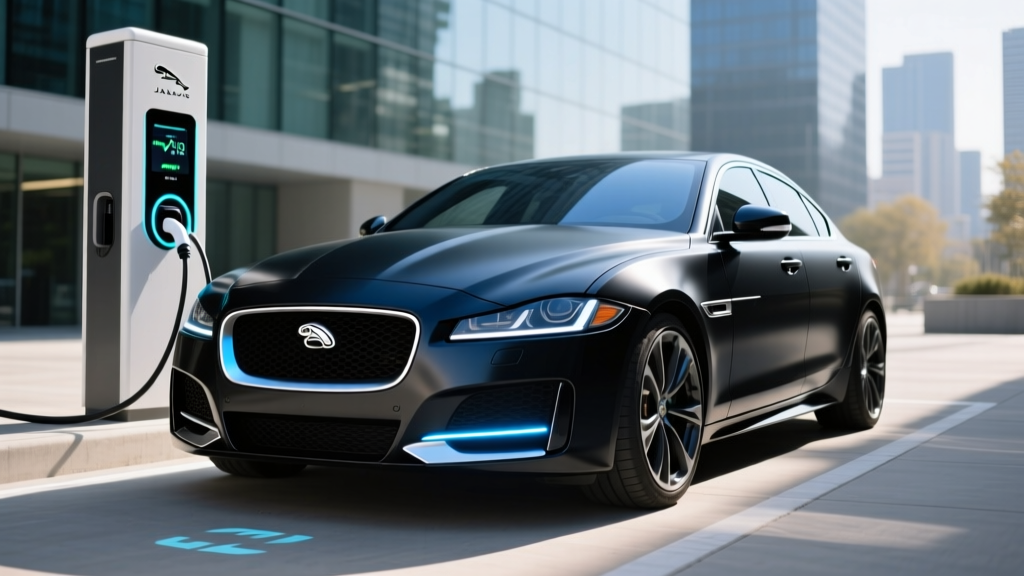
A professional EV conversion of a 2015 Jaguar XF 3.0 Supercharged typically involves removing the engine, transmission, exhaust, and fuel system, then installing an electric motor (commonly a salvaged Tesla large drive unit or a NetGain Hyper9 system), a battery pack (usually 40-75 kWh of repurposed modules), and a controller. The result is a car that retains its luxury interior and chassis dynamics while gaining instant torque, lower running costs, and freedom from Jaguar's notorious timing chain service intervals.
But the conversion is only half the project. Once your XF is electric, you need to charge it — and the charging setup for a converted vehicle has unique considerations that factory-built EV owners never think about.
Charging Levels Explained: What Speeds Can a Converted XF Handle?
Before we get to hardware, let's clarify the critical distinction between kW (kilowatts — the rate of power flow, like water pressure) and kWh (kilowatt-hours — the total energy stored, like gallons in a tank). Your converted Jaguar XF might have a 55 kWh battery pack. The charger's kW rating determines how fast that pack fills.
| Level | Voltage | Power (kW) | Miles of Range Added Per Hour | Typical Use Case |
|---|---|---|---|---|
| Level 1 | 120V AC | 1.0–1.9 kW | 3–5 mi/hr | Emergency/overnight trickle; rare for conversions |
| Level 2 | 240V AC | 3.3–19.2 kW | 12–70 mi/hr | Primary home and workplace charging |
| DC Fast Charge | 400–800V DC | 50–350 kW | 150–1,000+ mi/hr | Road trips; requires CCS/NACS port and BMS support |
Most 2015 Jaguar XF EV conversions are equipped with a Level 2 onboard charger rated at 6.6 kW or 7.2 kW. This means even if you plug into a 19.2 kW (80-amp) wall connector, the car can only accept 6.6 kW. That's roughly 20-25 miles of range added per hour of charging — adequate for daily driving if you charge overnight.
DC fast charging is a different story. Adding CCS or NACS DC fast-charge capability to a conversion requires a compatible Battery Management System (BMS), high-voltage contactors, proper CAN bus communication, and a DC charge port. Many budget conversions skip this, limiting the car to Level 2 only. If your converter included DC fast charging (typically 50 kW max on conversions using Tesla drive units), you can expect a 10-80% charge in roughly 45-60 minutes depending on pack size.
Home Charger Installation: Electrical Requirements and Real Costs
For a converted 2015 Jaguar XF with a 6.6 kW onboard charger, you need a 240V circuit rated for at least 30 amps (the National Electrical Code requires circuits to be rated at 125% of continuous load, so a 24A continuous draw requires a 30A breaker). However, most EV owners install a 50A or 60A circuit to future-proof for higher-power vehicles or a second EV.
What Electrical Upgrades Might You Need?
A 2015-era home (or older) may need one or more of the following before a Level 2 charger can be installed:
- Panel capacity check: A licensed electrician will calculate your existing load. If your main panel is 100A and already near capacity (common with electric ranges, dryers, and HVAC), you may need a 200A panel upgrade — typically $1,500–$3,500.
- Dedicated circuit: Level 2 charging requires a dedicated breaker — no sharing with other outlets or appliances.
- GFCI protection: The 2020 and 2023 NEC require GFCI protection for EV receptacles (NEMA 14-50 or hardwired). Some chargers have built-in GFCI; for receptacle installs, a GFCI breaker adds $50–$150.
- Permit: Most jurisdictions require an electrical permit for EV charger installation, typically $50–$250. Your utility may also require notification.
| Component | Simple Install (Near Panel) | Complex Install (Long Run / Upgrade) |
|---|---|---|
| EVSE Equipment (Level 2 charger) | $350–$700 | $350–$700 |
| Electrician Labor | $300–$800 | $1,000–$2,500 |
| Electrical Permit | $50–$150 | $100–$250 |
| Panel Upgrade (if needed) | $0 | $1,500–$3,500 |
| Conduit, Wire, Misc. | $50–$200 | $200–$600 |
| Total | $750–$1,850 | $3,150–$7,550 |
According to the U.S. Department of Energy's Alternative Fuels Data Center, the national average for a straightforward Level 2 home installation is approximately $1,200–$2,000 including equipment.
Connector Compatibility: Which Plug Does a Converted Jaguar XF Use?
This is where EV conversions diverge sharply from factory-built EVs. The connector on your converted 2015 Jaguar XF depends entirely on what your converter installed:
| Connector | Type | Common On | Notes for Conversions |
|---|---|---|---|
| J1772 | AC Level 1/2 | All North American EVs (standard) | Most conversions use J1772 inlet for Level 2 AC charging |
| NACS (Tesla) | AC + DC | Tesla (all), Ford, GM, Rivian (2025+) | Some converters install NACS inlet; adapters available for J1772 |
| CCS1 | DC Fast | Most non-Tesla factory EVs | Rare on conversions due to BMS complexity |
| CHAdeMO | DC Fast | Nissan Leaf, Mitsubishi | Largely obsolete; avoid for new conversions |
Most likely scenario: Your converted XF has a J1772 inlet for Level 2 charging and no DC fast-charge port. This means you can charge at home and at most public Level 2 stations. For DC fast charging on road trips, you'd need a J1772-to-NACS adapter (like the Lectron or A2Z EV adapter, approximately $150–$250) if your converter also installed a NACS-capable DC port and BMS. If not, DC fast charging is unavailable, and your road trips require overnight stops with Level 2 access.
Charging Cost: How Much Per Mile vs. the Supercharged V6?
Here's where the EV conversion math gets compelling. The 2015 Jaguar XF 3.0 Supercharged requires premium fuel (91+ octane) and averages about 22 MPG combined. At $4.20/gallon for premium (2026 national average), that's roughly $0.19 per mile in fuel alone.
A converted XF with a 55 kWh battery pack consuming roughly 3.5 miles per kWh (realistic for a 4,000-lb sedan with a conversion drivetrain) would use about 28.6 kWh per 100 miles. Here's how that translates to cost:
| Scenario | Cost per kWh or Gallon | Cost per Mile | Annual Cost (12,000 mi) |
|---|---|---|---|
| Gas XF 3.0 Supercharged | $4.20/gal (premium) | $0.19 | $2,280 |
| Home charging (off-peak utility rate) | $0.12/kWh | $0.034 | $411 |
| Home charging (standard rate) | $0.17/kWh | $0.049 | $583 |
| Public Level 2 (ChargePoint/EVgo) | $0.30/kWh | $0.086 | $1,029 |
| DC Fast Charge (Electrify America) | $0.48/kWh | $0.137 | $1,646 |
Even charging exclusively on public Level 2 networks, the converted XF costs roughly half what the supercharged V6 demands in fuel. Home charging slashes the cost by 75-85%. Over five years and 60,000 miles, home charging saves approximately $9,000–$10,000 compared to premium fuel.
Equipment Recommendations: Best Level 2 Chargers for Your Converted XF
Since most conversions accept a maximum of 6.6 kW (28 amps at 240V), you don't need the most powerful charger on the market. But investing in a quality EVSE with smart features and a long cable pays dividends in convenience and safety.
Emporia Level 2 EV Charger
Power: Up to 11.5 kW (48A) | Connector: J1772 (NACS adapter available) | Cable: 24 ft | Smart Features: Wi-Fi, app scheduling, solar integration, energy monitoring | Price: ~$399
Best for conversion owners who want energy tracking and off-peak scheduling to minimize electricity costs. The 48A output exceeds what most conversions can accept, but the charger auto-negotiates to the vehicle's limit.
ChargePoint Home Flex
Power: Up to 12 kW (50A) | Connector: J1772 | Cable: 23 ft | Smart Features: Wi-Fi, Alexa integration, flexible amperage setting (16A–50A) | Price: ~$549
A flexible option that lets you dial the amperage to match your circuit. If your garage has a 30A circuit, set the Flex to 24A; upgrade later and increase to 50A without replacing hardware.
Tesla Wall Connector (Universal)
Power: Up to 11.5 kW (48A) | Connector: NACS with built-in J1772 adapter | Cable: 24 ft | Smart Features: Wi-Fi, OTA updates, power sharing for multi-charger setups | Price: ~$599
Future-proof choice. The Universal version includes a J1772 adapter tip, so it works with your conversion's J1772 inlet now and any NACS-equipped vehicle you might add later.
Charging Time Examples: How Long to Fill a Converted XF?
Assuming a typical conversion battery pack of 55 kWh (usable capacity approximately 50 kWh to preserve battery health with an 80% daily charge limit), here's what to expect:
- Level 1 (120V, 1.4 kW): 10-80% in approximately 28 hours. Practically useless except for emergency trickle.
- Level 2 (240V, 6.6 kW — car's onboard limit): 10-80% in approximately 5.5 hours. This is your primary charging mode.
- Level 2 (240V, 3.3 kW — some budget onboard chargers): 10-80% in approximately 11 hours. Still works overnight but tight for high-mileage days.
- DC Fast Charge (50 kW, if equipped): 10-80% in approximately 45 minutes. Note that charge speed tapers significantly above 80% SoC — charging from 80-100% can take as long as 10-80%.
Real-world tip: Lithium-ion battery packs in conversions (typically repurposed NMC modules from Tesla, Nissan Leaf, or Chevy Volt packs) degrade faster if routinely charged to 100%. Set your charger's software to stop at 80% for daily use and only charge to 100% before long trips. This single habit can extend pack life by years.
Safety and Code Considerations for Converted EVs
EV conversions exist in a regulatory gray area in many states. While the charger installation follows standard NEC rules, the vehicle itself raises additional safety questions:
- High-voltage safety: Your conversion's battery pack operates at 300-400V DC — lethal if mishandled. Ensure your converter installed proper high-voltage interlocks, orange-coded cabling, and emergency disconnect switches.
- BMS quality: The Battery Management System monitors cell voltage, temperature, and current. A cheap or poorly configured BMS is a fire risk. Reputable converters use systems from Thunderstruck Motors, Orion BMS, or SimpBMS.
- Insurance: Many mainstream insurers won't cover conversions. Specialty insurers like Hagerty or Grundy may offer agreed-value policies. Document your conversion with receipts and photos.
- State inspection: Some states require special inspection for converted vehicles. Check with your local DMV — states like California, Oregon, and Vermont have established EV conversion registration pathways, while others may require a reconstructed vehicle title.
Frequently Asked Questions
How much does it cost to install a home EV charger for my converted Jaguar XF?
A straightforward Level 2 installation near your electrical panel typically costs $750–$1,850 including the charger, electrician labor, wire, and permit. If your home needs a panel upgrade (common in houses built before 2000 with 100A service), total costs can reach $3,150–$7,550. Always get quotes from licensed electricians who specifically list EV charger installation experience.
How fast will each charging level add range to my converted XF?
Level 1 (120V) adds 3-5 miles of range per hour. Level 2 (240V) at 6.6 kW — the typical onboard charger limit for conversions — adds approximately 20-25 miles per hour. DC fast charging at 50 kW (if your conversion supports it) can add 100+ miles in 30 minutes. Remember: kW is the rate of flow; your car's onboard charger caps how fast AC power converts to DC for the battery.
Which connector is compatible with my EV-converted 2015 Jaguar XF?
Most EV conversions use a J1772 inlet for Level 2 AC charging, which is compatible with every public Level 2 station in North America. If your converter installed DC fast-charge capability, you likely have a CCS1 or NACS port. Check with your converter for the exact inlet type. J1772-to-NACS adapters ($150-$250) are available if you need Tesla Supercharger access and your car's BMS supports it.
How much does charging cost per mile compared to the original supercharged V6?
The gas XF 3.0 Supercharged costs about $0.19/mile on premium fuel. Home charging the converted version costs $0.03–$0.05/mile depending on your utility rate — a 75-85% reduction. Even public DC fast charging at $0.48/kWh comes to roughly $0.14/mile, still 25% cheaper than premium gasoline. Over 12,000 annual miles, home charging saves approximately $1,800-$1,900 per year.
What electrical upgrades might my home need for an EV charger?
The most common upgrade is a panel capacity increase from 100A to 200A ($1,500-$3,500), necessary if your existing panel is near its load limit. You'll also need a dedicated 240V circuit with appropriate breaker size (30A minimum for a 6.6 kW charger, 50A recommended for flexibility). Homes built after 2010 usually have sufficient panel capacity. An electrician's load calculation — required for the permit — will determine your specific needs. Per the National Electrical Code, all EV charging circuits must have GFCI protection.
Can I charge my converted XF at Tesla Superchargers?
Only if your converter installed a NACS DC port and a BMS that can communicate with Tesla's Supercharger protocol. Most conversions cannot access Superchargers because Tesla's handshake protocol requires specific CAN bus communication that aftermarket BMS systems typically don't replicate. For road trips, rely on Electrify America, EVgo, and ChargePoint DC stations with CCS1 connectors — or plan overnight Level 2 stops.
Will a home charger work with both my converted XF and a future factory EV?
Yes, if you choose a J1772-based charger (which covers all non-Tesla EVs and most conversions) or a Tesla Universal Wall Connector (which includes a J1772 adapter tip). Installing a 48A or 50A circuit now ensures you won't need electrical work when you add a second EV that can accept higher charge rates.