If you've unboxed a new electric vehicle or plugged into a public Level 2 station, you've almost certainly handled a J1772 connector. Officially known as the SAE J1772 standard, this five-pin coupling is the universal language for AC charging in North America. Every EV sold in the U.S. — whether it ships with a NACS port, a CCS1 port, or the legacy J1772 inlet — can accept AC power through a J1772 connector, either natively or with a simple adapter.
Yet confusion persists. New owners mix up kW (the rate of power flow) with kWh (the total energy stored), assume all home chargers are equal, or overlook the electrical panel work that can double an installation budget. This guide breaks down exactly what J1772 connectors do, how fast they charge, what your home electrical system needs, and which hardware earns a spot on your garage wall in 2026.
What the J1772 Connector Actually Does
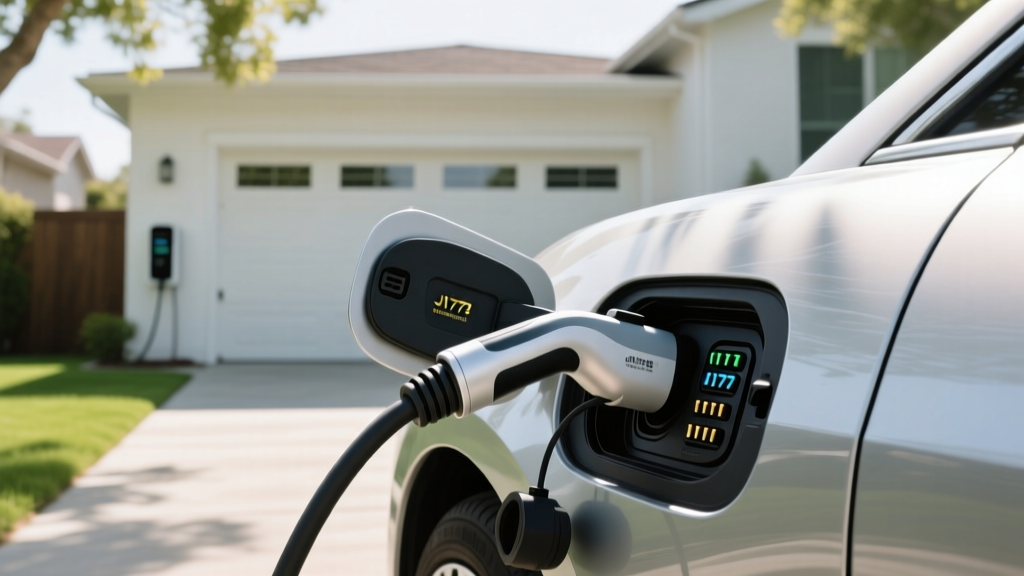
The J1772 connector handles alternating current (AC) charging only — that means Level 1 (120V household) and Level 2 (240V residential/commercial). It does not carry DC fast-charge current. When you plug a J1772 handle into your car, AC electricity flows from the grid through the cable and into your vehicle's onboard charger, which converts it to DC to fill the battery pack.
The connector's five pins serve distinct roles: two for AC power delivery (L1 and L2), one ground, one neutral reference, and one proximity/control pilot pin that negotiates the maximum safe current between the charger and the car before any electricity flows. This handshake is why a 48-amp charger won't overwhelm a vehicle limited to 32 amps of onboard acceptance — the system self-regulates.
Physically, the J1772 inlet is round with a flattened top, roughly 1.7 inches in diameter. It's been the mandated AC standard in North America since 2010, and even as Tesla's NACS port overtakes DC fast charging, J1772 remains the AC backbone because every NACS vehicle includes a J1772 adapter in the glovebox or supports one natively.
Charging Levels: kW Speeds and Miles Per Hour
The single most important distinction in EV charging is between kW (kilowatts), which measures power — how fast energy flows — and kWh (kilowatt-hours), which measures energy capacity — how much the battery holds. Think of kW as the width of a pipe and kWh as the size of the tank you're filling. A wider pipe (higher kW) fills the tank faster.
| Level | Voltage | Max Power (kW) | Miles of Range Added Per Hour | Typical Use Case |
|---|---|---|---|---|
| Level 1 | 120V AC | 1.4 – 1.9 kW | 3 – 5 miles | Overnight top-off, emergency, PHEV daily charging |
| Level 2 | 240V AC | 3.3 – 19.2 kW | 12 – 75 miles | Home daily charging, workplace, public destinations |
| DC Fast Charge | 400 – 800V DC | 50 – 350 kW | 150 – 1,200+ miles (equivalent) | Road trips, highway corridors, 10–80% top-ups |
Level 2 is where the J1772 connector does its most important work. A typical 40-amp Level 2 circuit delivers 9.6 kW (240V × 40A), which adds roughly 30–35 miles of range per hour for an efficient sedan like the Hyundai Ioniq 6 or about 25 miles per hour for a heavier SUV like the Ford F-150 Lightning. That means an overnight session from 10 PM to 6 AM replenishes 200+ miles — more than enough for daily driving and most weekend trips.
The vehicle's onboard charger caps your Level 2 speed regardless of how powerful the wall unit is. The Chevrolet Equ EV accepts up to 11.5 kW on Level 2; the Tesla Model Y can accept up to 11.5 kW (48A); the BMW iX supports up to 11 kW. Plugging any of these into a 19.2 kW (80A) charger won't speed things up — the car simply draws what it can handle.
Connector Compatibility: J1772, NACS, CCS1, and CHAdeMO
The EV market is mid-transition on DC connectors, but the AC side remains stable. Here's how J1772 fits into the broader picture:
| Connector | Current Type | Used By | J1772 Relationship |
|---|---|---|---|
| J1772 (SAE) | AC (Level 1 & 2) | All North American EVs and PHEVs | Native standard for AC charging |
| NACS (Tesla) | AC + DC | Tesla (all), Ford, GM, Rivian, Volvo, Polestar, others (2025+) | AC pin uses J1772 protocol; adapter needed for J1772 stations |
| CCS1 (Combo) | AC + DC | Hyundai, Kia, VW, BMW, Stellantis (pre-2026 models) | Upper portion is a J1772 inlet; DC pins below |
| CHAdeMO | DC only | Nissan Leaf (legacy), Mitsubishi Outlander PHEV | Separate DC-only connector; J1772 inlet also present for AC |
The key takeaway: J1772 is universal for AC. If you pull up to a public Level 2 station with a J1772 tethered cable, every EV on the road can plug in — NACS vehicles use a compact J1772-to-NACS adapter (often included with the car), and CCS1 vehicles plug in directly because the CCS1 port incorporates the J1772 inlet in its upper section.
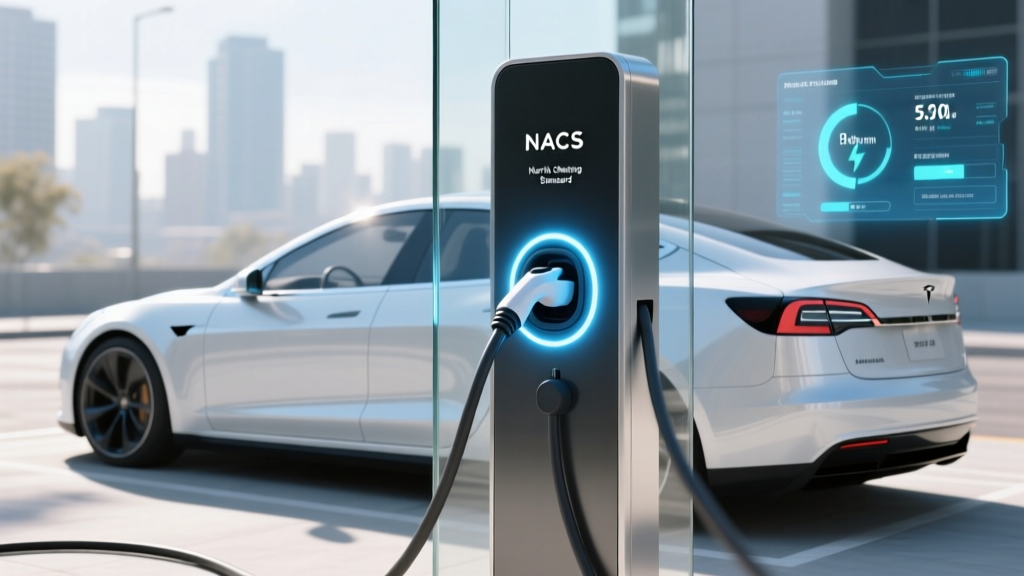
For DC fast charging, the landscape is different. NACS is rapidly becoming the dominant DC standard in North America as automakers adopt Tesla's Supercharger network access. CCS1 remains widely available at Electrify America, EVgo, and ChargePoint DC stations. CHAdeMO is effectively sunset — new stations rarely include it. If you drive a vehicle with a CCS1 port (most non-Tesla EVs built before 2025), you'll need a CCS1-to-NACS adapter to use Tesla Superchargers, which now welcome non-Tesla vehicles at many locations.
Home Charger Installation: Electrical Requirements and Real Costs
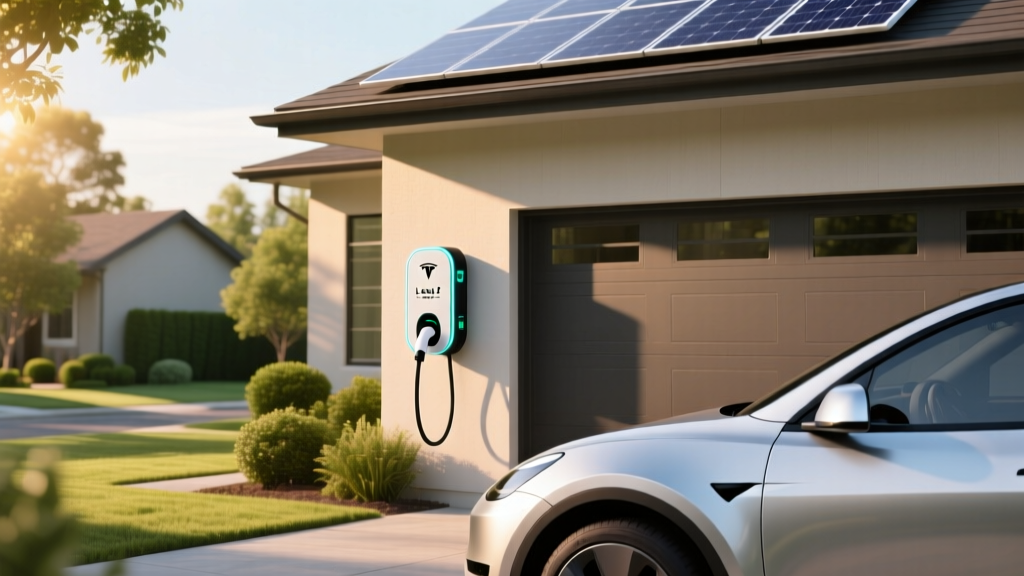
Installing a Level 2 home charger is the single biggest quality-of-life upgrade in EV ownership. But costs vary enormously depending on your home's electrical panel, the distance from panel to garage, and local permitting. Here's what to expect.
Electrical Requirements
A Level 2 charger requires a dedicated 240-volt circuit, the same type of outlet your electric dryer or oven uses. The most common configurations:
- 40-amp circuit (delivers 32A continuous / 7.7 kW): Requires a 50-amp breaker with 6 AWG copper wire. This is the sweet spot for most homes — sufficient for overnight charging and doesn't always require a panel upgrade.
- 50-amp circuit (delivers 40A continuous / 9.6 kW): Requires a 60-amp breaker with 4 AWG copper wire. Ideal if your vehicle supports 11.5 kW onboard charging and your panel has capacity.
- 60-amp circuit (delivers 48A continuous / 11.5 kW): Requires a 70-amp breaker with 4 AWG copper wire. Maximizes charging for vehicles like the Tesla Model Y or Ford F-150 Lightning.
National Electrical Code (NEC) requires that continuous loads (anything running 3+ hours, which includes EV charging) use only 80% of a circuit's rated capacity. So a 50-amp breaker supports 40 amps of continuous draw — not 50.
Panel Upgrade Reality
Older homes with 100-amp electrical service often lack spare capacity for a 40–60 amp EV circuit. An electrician will perform a load calculation adding up your existing circuits (HVAC, water heater, dryer, range) to determine headroom. If you're maxed out, a panel upgrade to 200 amps typically costs $1,500–$3,500 before the charger circuit is even installed. Some homes can avoid this with a smart load-management device like the Span smart panel or an EV charger with built-in load sharing that dynamically reduces charging amps when other appliances kick on.
Installation Cost Breakdown
| Component | Low End | High End | Notes |
|---|---|---|---|
| Level 2 Charger (hardware) | $300 | $700 | 32A–48A smart chargers; Wi-Fi enabled |
| Electrician labor (simple install) | $400 | $800 | Panel to garage <20 ft, same wall or adjacent |
| Electrician labor (complex run) | $800 | $2,000+ | Long conduit runs, attic/crawlspace routing, trenching |
| Electrical permit | $50 | $250 | Varies by municipality; some bundle with inspection |
| Panel upgrade (if needed) | $1,500 | $3,500 | 100A → 200A service; not always required |
| Total (no panel upgrade) | $750 | $2,750 | Most common scenario for newer homes |
| Total (with panel upgrade) | $2,250 | $6,250 | Older homes with limited capacity |
Many utilities offer rebates of $200–$500 for Level 2 charger installation, and the federal Residential Clean Energy Credit (IRS Form 5695) covers 30% of charger hardware and installation costs up to $1,000 through 2032, provided you live in an eligible census tract. Check with your tax professional for eligibility.
Charging Time Examples: What to Expect With J1772
Real-world charging time depends on battery size (kWh), onboard charger acceptance (kW), and the depth of discharge. Here are practical 10–80% charging times on a 9.6 kW (40A) Level 2 J1772 connection — the most common home setup:
- Tesla Model Y Long Range (75 kWh usable, 11.5 kW onboard): ~5.5 hours from 10% to 80%. At 9.6 kW, you're slightly below the car's max acceptance, adding ~35 miles/hour.
- Hyundai Ioniq 5 (77.4 kWh usable, 10.9 kW onboard): ~5.8 hours from 10% to 80%, adding ~32 miles/hour.
- Ford F-150 Lightning Extended Range (131 kWh usable, 19.2 kW onboard): ~9.5 hours at 9.6 kW. This truck benefits enormously from a 48A/11.5 kW or higher circuit to cut that to ~8 hours.
- Chevrolet Equinox EV (85 kWh usable, 11.5 kW onboard): ~6.3 hours from 10% to 80%.
- Toyota RAV4 Prime PHEV (18.1 kWh usable, 3.3 kW onboard): ~3.8 hours for a full 0–100% charge. PHEV batteries are small enough that even Level 1 (1.4 kW) handles overnight replenishment in ~9 hours.
These times assume you're charging from roughly 10% State of Charge (SoC) to 80%, which is the daily-use sweet spot. Level 2 charging doesn't taper significantly the way DC fast charging does — the onboard charger draws near its maximum rate consistently until the battery approaches full, where a brief absorption phase slows the final 80–100%. For daily driving, setting a charge limit to 80% (or 90% for LFP batteries) preserves long-term battery health.
Cost to Charge: J1772 at Home vs. Public vs. Gas
One of the strongest arguments for home Level 2 charging via J1772 is cost. Electricity rates vary widely, but the per-mile economics almost always beat gasoline.
| Scenario | Rate | Cost per Mile (3.5 mi/kWh EV) | Cost per Mile (30 MPG gas car @ $3.40/gal) |
|---|---|---|---|
| Home Level 2 (off-peak utility rate) | $0.10/kWh | $0.029 | $0.113 |
| Home Level 2 (average U.S. residential) | $0.17/kWh | $0.049 | $0.113 |
| Public Level 2 (network pricing) | $0.25–$0.49/kWh | $0.071–$0.140 | $0.113 |
| DC Fast Charge (highway corridor) | $0.35–$0.60/kWh | $0.100–$0.171 | $0.113 |
At home on an off-peak rate, you're paying roughly a quarter of what gasoline costs per mile. Even at average residential rates, the EV costs less than half. Public Level 2 and DC fast charging can approach or exceed gas costs — which is exactly why home charging is the economic backbone of EV ownership. According to fueleconomy.gov, the average EV achieves 100+ MPGe, translating to 3–4 miles per kWh for sedans and 2.5–3 miles per kWh for larger SUVs and trucks.
Maximize savings by enrolling in your utility's time-of-use (TOU) plan and scheduling charging sessions for off-peak hours (typically 10 PM – 6 AM). Most smart J1772 chargers let you set schedules through their companion apps.
Best J1772 Chargers for Home Use in 2026
The market is saturated with Level 2 chargers, but a handful consistently deliver on reliability, smart features, and build quality. All units below use a J1772 connector natively; NACS-vehicle owners simply plug in a J1772-to-NACS adapter.
ChargePoint Home Flex (NACS Edition)
Power: Up to 12 kW (50A) | Connector: J1772 (NACS adapter available) | Cable: 23 ft | Price: ~$550
Adjustable amperage (16A–50A) lets you match the circuit your electrician installs. Wi-Fi connected with excellent app scheduling, energy tracking, and utility integration. UL-listed and rated for indoor/outdoor use (NEMA 4). The most popular residential charger in North America for good reason — flexible, reliable, and backed by ChargePoint's network support.
Emporia Vue Smart EV Charger
Power: Up to 11.5 kW (48A) | Connector: J1772 | Cable: 24 ft | Price: ~$400
Best value in the smart-charger category. Integrates with the Emporia Vue whole-home energy monitor for real-time load management — if your dryer kicks on, the charger automatically reduces amps to prevent breaker trips. Excellent for homes with tight panel capacity. Wi-Fi scheduling, solar integration for homes with PV systems, and a compact wall-mount design.
Wallbox Pulsar Plus
Power: Up to 11.5 kW (48A) | Connector: J1772 | Cable: 20 ft | Price: ~$500
Compact and well-built with a clean industrial design. Power Sharing feature lets you daisy-chain two Pulsar Plus units on a single circuit — ideal for two-car garages. App control with scheduling, access control (lock/unlock for shared properties), and energy reports. Available in both hardwired and plug-in (NEMA 14-50) configurations.
Grizzl-E Smart
Power: Up to 10 kW (40A) | Connector: J1772 | Cable: 24 ft | Price: ~$450
Built in Canada and engineered for extreme cold — tested to -40°F. The thickest, most durable cable in the segment, which resists cracking in freezing temperatures. If you live in Minnesota, Montana, or anywhere with brutal winters, the Grizzl-E's cold-weather pedigree matters. Smart version includes Wi-Fi and OCPP compatibility for utility demand-response programs.
Safety, Code, and Installation Best Practices
EV charging draws significant current for hours at a time — longer and more sustained than almost any other household appliance. Cutting corners on installation is a fire risk. Here's what proper installation looks like:
- Dedicated circuit: Your Level 2 charger must have its own dedicated breaker — never shared with other outlets or appliances. This prevents overload and nuisance trips.
- GFCI protection: NEC 2020 and later require GFCI (ground-fault circuit interrupter) protection for EV charging outlets. Hardwired chargers often have GFCI built into the unit; plug-in units require a GFCI breaker. Some older panels may need a GFCI breaker upgrade.
- Outdoor rating: If your charger mounts outside or in an open carport, it must carry a NEMA 3R or NEMA 4 rating for weather resistance. All four chargers recommended above meet this standard.
- Wire gauge: Your electrician will size wire to the breaker — 6 AWG for 50A circuits, 4 AWG for 60A+. Undersized wire creates heat buildup and fire hazard. Never use extension cords with EV chargers.
- Permit and inspection: Most jurisdictions require an electrical permit for new 240V circuits. The inspection ensures code compliance and is often required to claim utility rebates or the federal charger tax credit. Budget $50–$250 and 1–3 weeks for the inspection cycle.
- Hardwired vs. plug-in: Hardwired chargers (directly connected to the circuit) eliminate the NEMA 14-50 receptacle as a potential failure point and are required for circuits above 50A in many jurisdictions. Plug-in units offer portability — you can take the charger when you move. Both are safe when properly installed.
Hire a licensed electrician experienced with EV charger installations. Ask for their load calculation in writing, confirm they'll pull the permit, and verify they're familiar with NEC Article 625 (Electric Vehicle Charging System Equipment). The National Fire Protection Association publishes the full NEC code reference.
Frequently Asked Questions About J1772 Connectors
Do I need a J1772 adapter if my EV has a NACS port?
Yes, for AC Level 2 charging at stations equipped with J1772 cables. Most NACS-vehicle manufacturers (Ford, GM, Rivian, Tesla) include or sell a compact J1772-to-NACS adapter. At home, if you install a J1772 charger, you'll use this adapter every session. Many NACS owners find the adapter small enough to leave permanently attached to the home charger cable.
Can I charge a NACS car with a CCS1 charger?
Not directly for DC fast charging — CCS1 and NACS are physically incompatible DC connectors. However, for AC Level 2 charging, the CCS1 port's upper section is a J1772 inlet, so any CCS1 vehicle charges natively from a J1772 cable. For DC, you'd need a CCS1-to-NACS adapter (available from companies like Lectron and A2Z) to use Tesla Superchargers with a CCS1 vehicle.
How much does it cost to install a home EV charger?
For most homes with a 200-amp panel and a short cable run, expect $750–$2,750 total including the charger, electrician labor, and permit. Older homes needing a panel upgrade should budget $2,250–$6,250. Utility rebates and the 30% federal charger credit (up to $1,000) can offset a meaningful portion.
Is a 32-amp charger enough, or do I need 48 amps?
A 32-amp charger (7.7 kW) adds roughly 25–28 miles of range per hour and fully replenishes most EVs overnight in 7–9 hours. If you drive under 60 miles daily, 32A is perfectly adequate. For larger batteries (100+ kWh in trucks and large SUVs) or high-mileage days, a 48-amp charger (11.5 kW) cuts charging time by 20–30% and provides future-proofing for your next EV.
Does J1772 support DC fast charging?
No. J1772 is an AC-only standard. DC fast charging uses separate connectors: CCS1 (which incorporates the J1772 shape plus two DC pins below), NACS (Tesla's unified AC/DC connector), or CHAdeMO (legacy Japanese standard). When you see "J1772" on a public charging map, it always refers to Level 2 AC — typically 6.6–19.2 kW, not the 50–350 kW you'd get from a DC station.
What's the difference between kW and kWh?
kW (kilowatts) measures power — the rate at which energy flows, like water pressure in a hose. kWh (kilowatt-hours) measures energy — the total amount delivered over time, like gallons of water in a bucket. A 75 kWh battery charged at 7.5 kW takes roughly 10 hours. Your charger's kW rating determines speed; your battery's kWh capacity determines how much energy it stores.