If you've watched a Tesla navigate city streets on Full Self-Driving (Supervised) and wondered, "Is Tesla FSD Level 3?" — you're not alone. It's one of the most common questions in EV forums, and the answer affects both your expectations behind the wheel and how you plan your charging routine. In this guide, we'll settle the FSD autonomy question first, then pivot to the practical infrastructure side of EV ownership: exactly what it takes to charge at home in 2026, what it costs, and how fast each level adds real range.
Is Tesla FSD Level 3? The SAE Automation Truth
Tesla FSD (Supervised) remains an SAE Level 2 driver-assistance system, not Level 3. Despite the "Full Self-Driving" branding, Tesla's own owner's manual and the NHTSA's automated driving guidance make clear that the driver must remain attentive, keep hands available, and accept full liability. Tesla's cabin camera monitors your eyes, and the system will issue escalating warnings — then disengage — if it detects inattention.
What FSD Supervised does well in 2026: it handles most highway lane-keeping, on-ramp/off-ramp transitions, city stoplights, and protected turns with increasing smoothness. What it does not do: assume liability, operate without supervision, or handle all edge cases (construction zones, unmapped roads, severe weather). If you're buying a Tesla expecting to nap or text legally, FSD isn't there yet — and neither is any other consumer system outside of Mercedes' geo-fenced Drive Pilot.
- Drive without your active supervision — you are the responsible operator at all times
- Handle all construction zones, emergency vehicles, or unmapped intersections reliably
- Operate in heavy snow, fog, or conditions that obscure lane markings and sensors
- Replace the need for your auto insurance — you remain fully liable
Now that the autonomy question is settled, let's talk about the infrastructure that makes owning a Tesla (or any EV) practical day to day. Because whether you're using FSD on your commute or driving manually, you still need to charge — and doing it at home is where the real ownership economics win or lose.
Charging Levels Explained: kW, Speeds, and Real Range Added
Before we get to equipment, let's clear up the single most common EV confusion: kW (kilowatts) measures power — the rate of energy delivery. kWh (kilowatt-hours) measures energy — the battery's total capacity. Think of kW as how wide the hose is, and kWh as how big the bucket is. You'll see both throughout this guide, and they are never interchangeable.
| Level | Power (kW) | Voltage / Amperage | Miles of Range Added per Hour | Best For |
|---|---|---|---|---|
| Level 1 | 1.0–1.9 kW | 120V / 12–16A | 3–5 miles | Overnight top-up, PHEVs, low-mileage drivers |
| Level 2 | 7.2–19.2 kW | 240V / 30–80A | 25–60 miles | Daily home charging, most EV owners |
| DC Fast | 50–350 kW | 400–800V DC | 150–1,000+ miles (equivalent rate) | Road trips, rapid top-ups (10–80% in 15–35 min) |
Real-world charging time examples (10–80% SoC):
- Tesla Model Y (75 kWh usable battery): ~27 minutes at a 250 kW V4 Supercharger; ~8 hours on a 7.2 kW Level 2 home charger
- Hyundai Ioniq 5 (77.4 kWh usable): ~18 minutes at a 350 kW Electrify America station (peak); ~9 hours on a 7.2 kW Level 2
- Ford F-150 Lightning Extended Range (131 kWh usable): ~41 minutes at a 150 kW DC charger; ~15 hours on a 7.2 kW Level 2
A critical caveat: DC fast-charging speeds are peak rates, not sustained rates. A vehicle that advertises "250 kW peak" may only hold that rate between 10–30% SoC before tapering to 150 kW, then 80 kW, then 40 kW as the battery fills. This charge-curve taper is why 10–80% time is the industry-standard metric — charging from 80–100% can take as long as 10–80% due to cell-balancing and thermal management.
Home Charger Installation: Costs, Electrical Requirements, and Gotchas
A Level 2 home charger is the backbone of practical EV ownership. Here's what it actually takes to install one in 2026.
Electrical Requirements
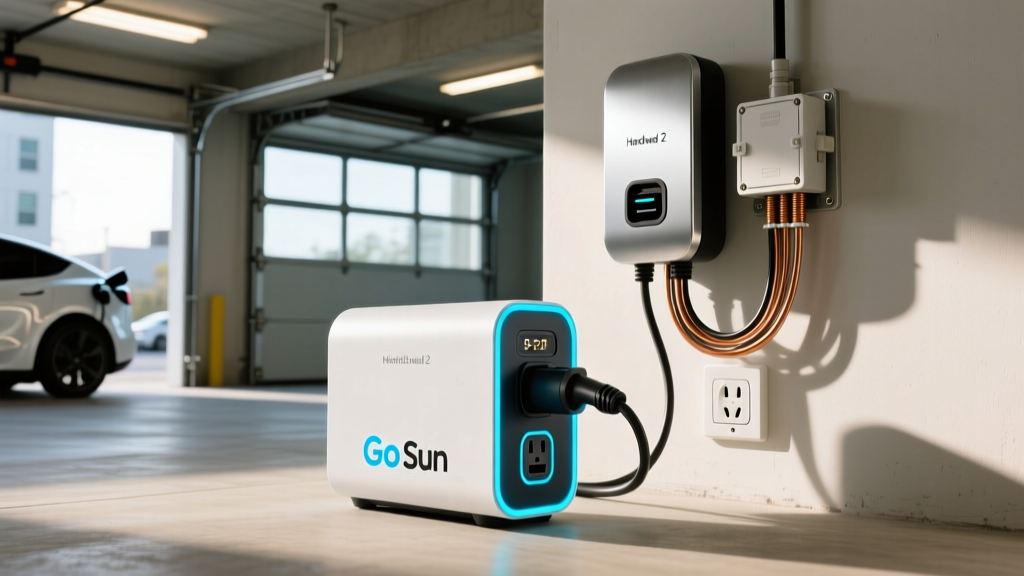
Most Level 2 chargers require a 240V dedicated circuit, similar to what an electric dryer or oven uses. The two most common configurations:
- 40-amp circuit (NEMA 14-50 outlet or hardwired): Delivers up to 9.6 kW (32A continuous draw). Sufficient for most EVs and the most common residential setup.
- 60-amp circuit (hardwired): Delivers up to 11.5 kW (48A continuous). Faster charging, recommended for larger batteries like the F-150 Lightning or Rivian R1T.
Panel Upgrade Reality
If your home has a 100-amp main electrical panel — common in homes built before 1990 — adding a 40A or 60A EV circuit may exceed your panel's capacity, especially if you already run electric heat, a dryer, and an oven. A panel upgrade to 200A typically costs $1,500–$3,000 and is the single biggest surprise cost in EV charger installation. Have a licensed electrician perform a load calculation before committing to equipment.
| Component | Typical Cost Range | Notes |
|---|---|---|
| Level 2 charger unit | $350–$750 | Varies by brand, power output, smart features |
| Electrician labor (standard install) | $400–$1,200 | Depends on run length from panel to garage/carport |
| Permit and inspection | $50–$250 | Required by most jurisdictions; varies by municipality |
| Electrical panel upgrade (if needed) | $1,500–$3,000 | Needed for older homes with 100A panels |
| Total (no panel upgrade) | $800–$2,200 | Most common scenario for modern homes |
| Total (with panel upgrade) | $2,300–$5,200 | Older homes or high-load households |
Safety and Code Considerations
- Dedicated circuit: NEC Article 625 requires EV chargers to have their own dedicated circuit — no sharing with other appliances.
- GFCI protection: 2020 NEC and later requires GFCI breakers for outdoor receptacles used for EV charging. Hardwired installations may not require GFCI in all jurisdictions.
- Outdoor rating: If your charger is outside (carport, driveway), ensure the unit carries a NEMA 4 or IP65 weather rating.
- Wire gauge: A 40A circuit requires minimum 8 AWG copper wire; a 60A circuit requires 6 AWG. Your electrician will spec this based on run length.
Connector Compatibility: NACS, CCS, and CHAdeMO in 2026
The connector landscape has consolidated dramatically since 2024, when Ford, GM, Rivian, Volvo, and most other automakers committed to adopting Tesla's North American Charging Standard (NACS). Here's where things stand for 2026 model-year vehicles:
| Connector | Brands Using It (2026) | Adapter Needed? |
|---|---|---|
| NACS (Tesla) | Tesla, Ford, GM, Rivian, Volvo, Polestar, Mercedes, Nissan (new models), Hyundai/Kia (2025+) | No — native on most new EVs. CCS-to-NACS adapters ($150–$250) available for legacy CCS vehicles accessing Superchargers. |
| CCS1 | Legacy models (pre-2025 VW ID.4, BMW iX, Stellantis, some Hyundai/Kia) | CCS-to-NACS adapter needed for Tesla Supercharger access |
| CHAdeMO | Nissan Leaf (discontinued 2025), Mitsubishi Outlander PHEV (legacy) | CHAdeMO stations declining; adapters limited and expensive |
Key takeaway for 2026 buyers: If you're purchasing a new EV, it almost certainly has a NACS port. The CCS public-charging network (Electrify America, EVgo) is adding NACS cables to new stations, but many existing CCS-only stalls still require an adapter. Budget $150–$250 for a quality adapter if you own a CCS vehicle and want Supercharger access.
Charging Cost Per Mile: Home vs. Public vs. Gas
The economics of EV charging depend heavily on where you charge. Here's a realistic breakdown using 2026 national averages and a 3.5 mi/kWh efficiency vehicle (typical for a midsize crossover like the Tesla Model Y or Hyundai Ioniq 5):
| Charging Scenario | Cost per kWh | Cost per Mile | Annual Cost (12,000 mi) |
|---|---|---|---|
| Home (off-peak utility rate) | $0.09–$0.14 | $0.026–$0.040 | $310–$480 |
| Home (standard rate, no TOU) | $0.14–$0.18 | $0.040–$0.051 | $480–$620 |
| Public Level 2 (ChargePoint, etc.) | $0.20–$0.35 | $0.057–$0.100 | $685–$1,200 |
| DC Fast Charging (Supercharger, EA) | $0.28–$0.48 | $0.080–$0.137 | $960–$1,645 |
| Gasoline baseline (27 MPG, $3.40/gal) | — | $0.126 | $1,512 |
The bottom line: If you charge at home on off-peak rates — which roughly 70% of EV owners do as their primary charging method — you'll spend $310–$480 per year on electricity for 12,000 miles of driving. That's roughly 70–80% less than the gasoline equivalent. Even exclusive DC fast-charging is competitive with gas. The savings shrink if you rely entirely on premium-priced public chargers, which is why home charging access remains the single biggest factor in EV satisfaction.
Equipment Picks: Top Level 2 Home Chargers for 2026
Here are three Level 2 chargers we recommend based on real-world reliability, feature sets, and value. All support NACS natively or via included adapter for 2026 vehicles.
Tesla Wall Connector (Gen 4)
- Power output: 11.5 kW (48A) on a 60A circuit
- Connector: NACS native
- Cable length: 24 feet
- Smart features: Wi-Fi updates, power-sharing (two units on one circuit), Tesla app integration, load management
- Price: ~$475
- Best for: Tesla owners wanting maximum charge speed and seamless ecosystem integration
ChargePoint Home Flex (2nd Gen)
- Power output: Up to 12 kW (50A) on a 60A circuit; configurable down to 16A for lower-capacity panels
- Connector: NACS native (2025+ models); J1772 on older stock
- Cable length: 23 feet
- Smart features: Wi-Fi, Alexa/Google Home, ChargePoint app with scheduling, utility demand-response programs, energy tracking
- Price: ~$550–$650
- Best for: Multi-EV households, utility time-of-rate optimization, non-Tesla EVs
Emporia Level 2 Smart Charger
- Power output: Up to 11.5 kW (48A) on a 60A circuit
- Connector: NACS (2025+ models)
- Cable length: 24 feet
- Smart features: Wi-Fi, Emporia Energy app, solar-integration scheduling, detailed per-session cost tracking
- Price: ~$399
- Best for: Budget-conscious buyers with solar panels or those wanting detailed energy monitoring
All three units are UL-listed, carry NEMA 4 outdoor ratings for carport or driveway installation, and qualify for the federal Alternative Fuel Vehicle Refueling Property Credit (up to 30% of equipment and installation cost, capped at $1,000 — available through 2032 for eligible census tracts per IRS Form 8911).
Frequently Asked Questions
How much does it cost to install a home EV charger?
A standard Level 2 home charger installation (40A–60A circuit, no panel upgrade) typically costs $800–$2,200 all-in: $350–$750 for the charger unit, $400–$1,200 for electrician labor, and $50–$250 for permits. If your home needs a 200A panel upgrade, add $1,500–$3,000, bringing the total to $2,300–$5,200. Always get a load calculation from a licensed electrician before purchasing equipment.
How fast will each charging level add range?
Level 1 (120V) adds 3–5 miles of range per hour — enough for PHEVs or low-mileage commuters. Level 2 (240V) adds 25–60 miles per hour depending on the charger's kW output and your vehicle's onboard charger capacity. DC fast charging adds the equivalent of 150–1,000+ miles per hour at peak rates, though real-world sessions are typically 18–40 minutes for a 10–80% charge due to tapering above 80% SoC.
Which connector/charger is compatible with my EV?
For 2026 model-year vehicles, NACS is now the dominant standard across Tesla, Ford, GM, Rivian, Hyundai/Kia, Volvo, and most others. If you drive a pre-2025 EV with a CCS port (like an early VW ID.4 or BMW iX), you'll need a CCS-to-NACS adapter ($150–$250) to use Tesla Superchargers. CHAdeMO is effectively discontinued for new vehicles. Check your vehicle's charge port or owner's manual to confirm.
How much does charging cost per mile vs gas?
Home charging on off-peak rates costs $0.026–$0.040 per mile for a typical midsize EV — roughly 70–80% cheaper than gasoline at $3.40/gal and 27 MPG ($0.126/mi). Even DC fast charging at $0.35–$0.48/kWh ($0.080–$0.137/mi) is competitive with or cheaper than gas. Your biggest savings come from charging at home, which is why Level 2 installation pays for itself within 1–3 years for most drivers.
What electrical upgrades might I need?
The most common upgrade is a 200A panel replacement for homes with older 100A service — this costs $1,500–$3,000 and is necessary when your existing loads (electric heat, dryer, oven) plus the EV circuit exceed your panel's capacity. Other potential upgrades include: replacing a Federal Pacific or Zinsco panel (safety hazard, $2,000–$4,000), running new conduit for long wire runs from panel to garage (adds $200–$600), or adding a sub-panel if your garage is detached ($800–$1,500). A licensed electrician's load calculation will identify exactly what's needed before you commit.
Does Tesla FSD work while charging or preconditioning?
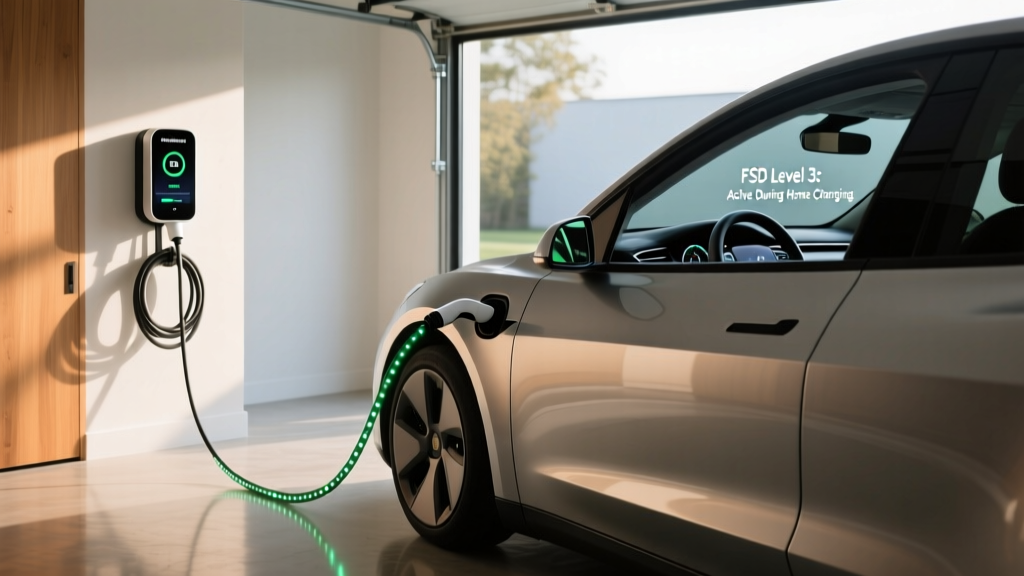
FSD (Supervised) is a driving-only feature — it's inactive when parked or charging. However, if you're using Scheduled Departure to precondition your Tesla's battery before a Supercharger session or morning commute, the vehicle will warm the battery to optimal temperature, which improves both regenerative braking performance and DC fast-charging speed. Preconditioning typically begins 10–30 minutes before your scheduled departure time and uses grid power when plugged in.
Whether you're evaluating Tesla's driver-assist capabilities or planning your home charging setup, the key is separating marketing language from engineering reality. FSD remains Level 2 — impressive, but driver-dependent. And home Level 2 charging, properly installed, remains the single most impactful upgrade you can make for EV ownership satisfaction and long-term cost savings.