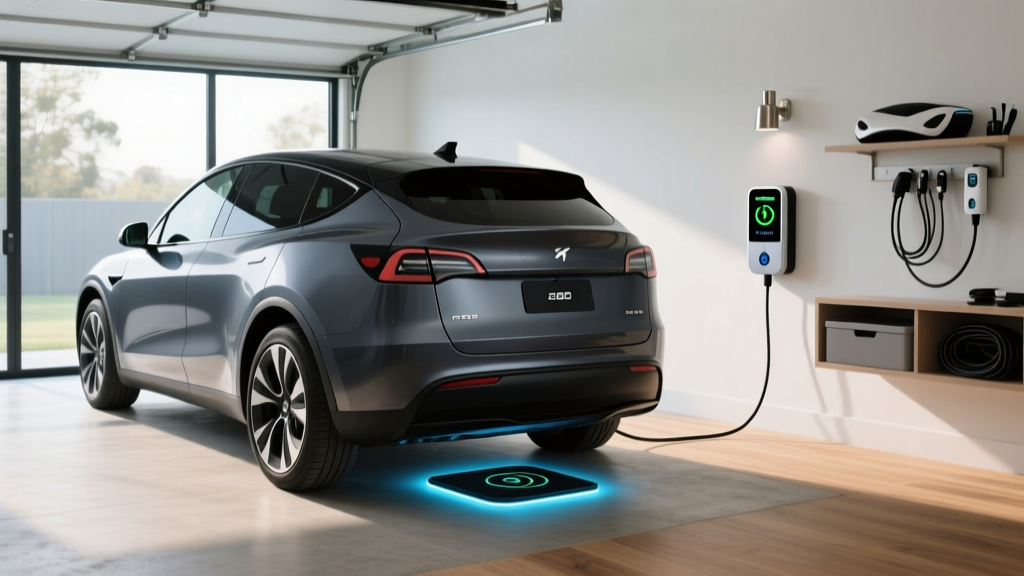
Plug-free charging sounds like the ultimate EV convenience: park over a pad in your garage and let the electrons flow through thin air. For electric SUV buyers in 2026, wireless (inductive) charging is transitioning from concept to driveway reality — but only a handful of models support it, and the home infrastructure required is more complex than a standard Level 2 wallbox. This guide breaks down which electric SUVs offer wireless charging, how the technology stacks up against wired Level 2 and DC fast charging in both speed and efficiency, and exactly what it costs to install a wireless pad at home.
How Wireless EV Charging Actually Works
Wireless EV charging — formally known as inductive power transfer — uses two magnetic coils: one embedded in a ground-mounted pad and one mounted on the vehicle's undercarriage. Alternating current in the ground coil generates a magnetic field that induces current in the vehicle coil, which then feeds the onboard charger and ultimately the traction battery.
The governing standard is SAE J2954, which defines power levels up to 11 kW for light-duty vehicles (WPT/Z1 through Z3 classes). In practice, most consumer-grade wireless pads currently deliver between 3.6 kW and 11 kW, depending on the alignment, air gap, and vehicle receiver rating.
Which 2026 Electric SUVs Support Wireless Charging?
As of the 2026 model year, factory-installed wireless charging receivers remain limited to a small set of premium and luxury electric SUVs. Most mainstream EVs — including the Tesla Model Y, Hyundai IONIQ 5, and Ford Mustang Mach-E — rely exclusively on wired connections (NACS or CCS1).
| Vehicle | Wireless Power (kW) | Battery (kWh) | EPA Range | MSRP (Base) | Status |
|---|---|---|---|---|---|
| BMW iX xDrive50 | 11 kW (optional) | 111.5 (NMC) | 324 mi | $87,250 | Available |
| Mercedes-Benz EQS SUV 580 | 11 kW (optional) | 108.4 (NMC) | 305 mi | $105,550 | Available |
| Genesis GV60 (Facelift) | 11 kW (optional) | 77.4 (NMC) | 264 mi | $53,350 | Available |
| BMW iX3 (Next-Gen) | 11 kW (announced) | ~80 (NMC est.) | ~280 mi (est.) | TBA | Announced late 2026 |
Sources: fueleconomy.gov, manufacturer press sites. Range figures are EPA estimates; expect 10–20% reduction in sustained highway or cold-weather driving.
Charging Levels Explained: Wireless vs. Wired Speeds
Understanding the hierarchy of EV charging is essential before you invest in any home equipment. Here is how wireless inductive charging compares to the three standard wired levels, measured in both power (kW) and practical range added per hour.
| Charging Level | Voltage | Max Power (kW) | Miles of Range Added/Hour | Typical Use Case |
|---|---|---|---|---|
| Level 1 (120V outlet) | 120V AC | 1.2–1.9 kW | 3–5 mi/hr | Overnight trickle, PHEVs |
| Level 2 (240V wired) | 240V AC | 7.2–19.2 kW | 20–60 mi/hr | Home daily charging |
| Wireless Inductive | 240V AC → pad | 3.6–11 kW | 12–36 mi/hr | Premium home convenience |
| DC Fast Charging | 400–800V DC | 50–350 kW | 150–1,000+ mi/hr | Road trips, commercial fleets |
Key takeaway: An 11 kW wireless pad charges at roughly the same rate as a 48-amp Level 2 wallbox delivering ~11.5 kW. However, because of inductive efficiency losses, the vehicle actually receives closer to 9.5–10 kW of usable energy. For a 100 kWh battery going from 10% to 80% state of charge (SoC), expect roughly 7.5–8.5 hours on an 11 kW wireless pad, compared to 6.5–7 hours on a wired 11.5 kW Level 2 unit.
Home Installation: Electrical Requirements and Costs
Installing a wireless charging pad in your garage or driveway requires a dedicated 240V circuit, just like a hardwired Level 2 charger — plus additional considerations for the pad's ground-mounted hardware and alignment system.
Electrical Specifications
- Circuit requirement: Dedicated 240V / 50A or 60A circuit (for an 11 kW pad drawing up to 48A continuous)
- Wire gauge: 6 AWG copper (50A) or 4 AWG copper (60A) run from panel to pad controller
- Breaker: Double-pole 50A or 60A, depending on pad amperage
- GFCI protection: Required by NEC 2023/2026 for all EV supply equipment (EVSE); most modern pads include built-in GFCI
- Outdoor rating: Ground pads are rated IP67 or IP68 (submersion-resistant), but the wall-mounted power controller must be in a weatherproof enclosure if installed outdoors
Panel Upgrade Considerations
If your home has a 100A main electrical panel — common in houses built before 2000 — adding a 50A or 60A dedicated EV circuit may exceed your panel's available capacity, especially if you also run electric heating, a dryer, and an oven. A licensed electrician will perform a load calculation (per NEC Article 220) to determine if your panel can handle the additional draw.
If an upgrade is needed, expect to pay $1,500–$3,500 for a 200A panel upgrade, depending on your utility's service drop requirements and local labor rates. Homes with 200A panels usually have sufficient headroom for an 11 kW wireless pad without an upgrade.
| Cost Component | Typical Range | Notes |
|---|---|---|
| Wireless pad + controller hardware | $2,500–$5,500 | Varies by brand and kW rating; vehicle receiver is separate (factory option) |
| Electrician labor (circuit run + mount) | $800–$2,200 | Depends on run distance from panel, conduit needs, drywall repair |
| Electrical permit | $50–$250 | Required in most jurisdictions; varies by municipality |
| Panel upgrade (if needed) | $1,500–$3,500 | Only if existing panel lacks capacity; 200A upgrade typical |
| Total (no panel upgrade) | $3,350–$7,950 | |
| Total (with panel upgrade) | $4,850–$11,450 |
Always hire a licensed electrician familiar with NEC Article 625 (EV charging). Some utilities offer rebates of $250–$1,000 for EVSE installation — check with your local provider. Federal tax credits under IRS §30C may cover up to 30% of home charging equipment and installation costs (capped at $1,000), subject to census-tract eligibility.
Connector Compatibility: Wireless Pads and Wired Backup
Even if your electric SUV has a wireless receiver, you will still need a wired charging port for DC fast charging on road trips and as a backup for higher-speed Level 2 sessions. Here is how the connector landscape looks in 2026:
| Connector Type | Brands Using It (2026) | Max AC Power | Max DC Power |
|---|---|---|---|
| NACS (Tesla / SAE J3400) | Tesla, Ford, GM, Rivian, Volvo, Polestar, Hyundai (new models) | 19.2 kW | 350+ kW |
| CCS1 (legacy) | VW ID.4 (older), some BMW, Mercedes, legacy models | 19.2 kW | 350 kW |
| CHAdeMO | Nissan Leaf (discontinued), Mitsubishi (legacy only) | 6.6 kW | 100 kW |
| Wireless (SAE J2954) | BMW iX, Mercedes EQS SUV, Genesis GV60 (optional) | 11 kW | N/A |
Adapter needs: If you drive a CCS1-equipped SUV and want to access Tesla Superchargers (now open to non-Tesla EVs via NACS), you will need a CCS-to-NACS adapter (~$200–$250). Wireless-capable SUVs like the BMW iX and Mercedes EQS SUV sold in 2026 are increasingly shipping with NACS ports natively, but verify your specific trim. A NACS-to-CCS adapter is also available if you need to use older Electrify America or ChargePoint CCS stations.
Cost to Charge: Wireless vs. Wired vs. Gas
One of the strongest arguments for any home EV charging setup — wireless included — is the per-mile fuel cost advantage over gasoline. Here is how the numbers stack up for a typical mid-size electric SUV (efficiency: ~3.0 mi/kWh or ~100 MPGe combined).
| Charging Scenario | Rate ($/kWh) | Cost per Mile | Annual Cost (12,000 mi) |
|---|---|---|---|
| Home Level 2 / Wireless (off-peak utility rate) | $0.09–$0.14 | $0.03–$0.047 | $360–$564 |
| Home (standard residential rate, no TOU) | $0.16–$0.22 | $0.053–$0.073 | $640–$880 |
| Public Level 2 (ChargePoint, etc.) | $0.25–$0.49 | $0.083–$0.163 | $1,000–$1,960 |
| DC Fast Charging (Electrify America, EVgo) | $0.35–$0.55 | $0.117–$0.183 | $1,400–$2,200 |
| Gas SUV (25 MPG combined, $3.40/gal) | — | $0.136 | $1,632 |
Even accounting for the ~10% efficiency penalty of wireless charging (meaning you draw slightly more kWh from the grid for the same miles added), home wireless charging on a time-of-use (TOU) off-peak rate remains the cheapest way to fuel an SUV — roughly 70–75% less per mile than gasoline. The savings narrow if you rely heavily on public DC fast charging, which is why home installation remains the economic backbone of EV ownership.
Recommended Wireless Charging Equipment for 2026
The consumer wireless EV charging market is still small, but several certified SAE J2954-compliant pads are available for home installation. Below are the leading options as of 2026.
WiTricity Halo (11 kW)
Power output: 11 kW (SAE J2954 WPT/Z3)
Compatibility: BMW, Mercedes, Genesis (with factory receiver)
Cable length: 25 ft from controller to pad
Smart features: Wi-Fi app, alignment assist, energy scheduling
Price: ~$4,200–$4,800 (hardware only)
Outdoor rating: IP68 pad, NEMA 4 controller
Plugless Power (7.2 kW)
Power output: 7.2 kW (SAE J2954 WPT/Z2)
Compatibility: Select BMW and Mercedes models (check receiver spec)
Cable length: 20 ft
Smart features: Basic app monitoring, auto-start on park
Price: ~$2,800–$3,200 (hardware only)
Outdoor rating: IP67 pad, indoor-rated controller (outdoor enclosure available)
Important: The vehicle must have a factory-installed wireless receiver — aftermarket underbody receivers are not widely available or certified for consumer vehicles as of 2026. Confirm receiver availability with your dealer before purchasing a pad.
Charging Time Examples: 10–80% SoC
Below are estimated 10–80% charging times for common electric SUV battery sizes across different charging methods. These assume optimal conditions; real-world times may be longer due to thermal management, charge-curve tapering, or cold battery temperatures.
| Battery Size (kWh usable) | 11 kW Wireless | 11.5 kW Level 2 (wired) | 150 kW DC Fast | 250 kW DC Fast |
|---|---|---|---|---|
| 77 kWh (e.g., Genesis GV60) | ~5.5 hrs | ~4.8 hrs | ~28 min | ~18 min |
| 100 kWh (e.g., BMW iX) | ~7.2 hrs | ~6.3 hrs | ~36 min | ~23 min |
| 108 kWh (e.g., Mercedes EQS SUV) | ~7.8 hrs | ~6.8 hrs | ~39 min | ~25 min |
Charge-curve reality: DC fast charging speeds listed above represent peak rates. In practice, charging slows significantly above 80% SoC to protect battery longevity. Most EVs will taper from 150 kW down to 50 kW or less past 80%, which is why the industry standard benchmark is 10–80% time, not 0–100%. Wireless and Level 2 AC charging rates remain constant throughout the session since the vehicle's onboard charger regulates the draw.
Safety, Code, and Practical Considerations
Wireless EV charging pads are subject to the same National Electrical Code (NEC) requirements as wired EVSE, plus additional considerations unique to ground-mounted inductive hardware:
- Dedicated circuit: NEC Article 625 requires a dedicated branch circuit for all EVSE — you cannot share the circuit with other appliances.
- GFCI protection: Mandatory for all EVSE circuits; integrated into modern wireless pad controllers.
- Pad placement: The ground pad must be positioned precisely where the vehicle parks. Many systems include visual or app-guided alignment markers. Misalignment greater than ~3 inches can reduce power transfer or prevent charging entirely.
- Foreign object detection (FOD): All SAE J2954-compliant pads include FOD sensors that halt power transfer if metal objects (tools, coins, pet collars with metal tags) are detected between pad and vehicle.
- Living thing protection: SAE J2954 also requires living-object protection, which detects if a pet or person is near the active pad and shuts down the field.
- Snow and ice: IP68-rated pads are sealed against moisture, but accumulated snow or ice on the pad surface can increase the air gap and reduce efficiency. Some premium pads include heating elements to melt ice — verify this feature if you live in a freezing climate.
- Tripping hazard: Unlike a wall-mounted cable, the pad itself sits flush with the floor, but the cable run from the wall controller to the pad may require floor conduit or a ramp cover in a garage.
Frequently Asked Questions
How much does it cost to install a wireless EV charger at home?
Expect $3,350–$7,950 total for hardware, electrician labor, and permits if your electrical panel has sufficient capacity. If a panel upgrade to 200A is required, add $1,500–$3,500, bringing the total to $4,850–$11,450. The wireless pad hardware itself typically costs $2,800–$5,500 depending on power rating and brand.
How fast will wireless charging add range compared to a wired Level 2 charger?
An 11 kW wireless pad adds approximately 30–36 miles of range per hour (accounting for ~10% inductive efficiency loss), compared to 35–40 miles per hour from a wired 11.5 kW Level 2 charger. The gap is meaningful but modest — about 1 extra hour to go from 10–80% on a 100 kWh battery.
Which electric SUVs are compatible with wireless charging pads?
As of 2026, the BMW iX, Mercedes-Benz EQS SUV, and Genesis GV60 offer optional factory-installed wireless receivers. The vehicle must have this receiver to use a wireless pad — it is not something you can easily add aftermarket. Always confirm receiver availability before purchasing pad hardware.
How much does charging an electric SUV cost per mile vs. a gas SUV?
Home wireless charging on an off-peak utility rate (~$0.12/kWh) costs roughly $0.04–$0.05 per mile for a mid-size electric SUV. A comparable gas SUV getting 25 MPG at $3.40/gallon costs about $0.14 per mile. That is a 65–75% per-mile savings, even with wireless efficiency losses factored in.
What electrical upgrades might I need for a wireless charging pad?
You will need a dedicated 240V/50A or 60A circuit run from your electrical panel to the pad's wall-mounted controller. Homes with 100A panels may need a $1,500–$3,500 upgrade to 200A. Homes with existing 200A panels usually have enough headroom. A licensed electrician should perform a load calculation before installation.
Is wireless charging safe in rain, snow, and extreme weather?
Yes. SAE J2954-compliant pads are rated IP67 or IP68 (dustproof and water-submersion resistant). They include foreign-object and living-thing detection that automatically shuts off power. However, thick snow or ice buildup on the pad can increase the air gap and reduce charging efficiency — some premium pads include built-in heating to address this.
Can I use a wireless pad AND a wired charger at home?
Absolutely — and many owners do. A wireless pad handles overnight convenience charging, while a wired Level 2 unit (or access to DC fast charging) provides faster top-ups when needed. However, each requires its own dedicated circuit, so factor in the additional electrical work if planning both.
For the latest federal incentive details on home EV charging equipment, see the IRS §30C Alternative Fuel Vehicle Refueling Property Credit. Vehicle efficiency and range data sourced from fueleconomy.gov and manufacturer specifications. Always consult a licensed electrician for final installation specifications and your local building department for permit requirements.