The iPhone Charger Hack Myth — and Why It Matters for EV Owners
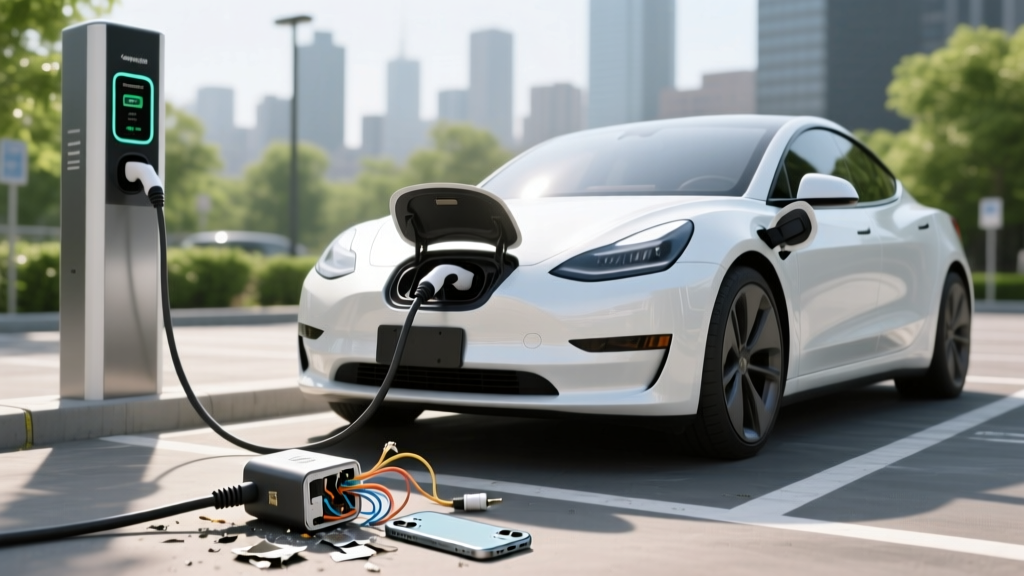
A recurring DIY trend on social media involves "hacking" an iPhone charger — rewiring USB power bricks or modifying Apple cables to somehow deliver power to a device they were never designed to support. While this makes for viral content, the underlying confusion reveals a widespread misunderstanding about electrical power delivery that directly impacts electric vehicle owners. The same physics that make a 20W USB-C power adapter useless for charging a 4,000-pound EV also govern why your home charging setup must be spec'd correctly.
An iPhone charger outputs roughly 20 watts (W) of power through a USB-C connector. A Level 2 home EV charger delivers between 7,200W and 19,200W — that's 360 to 960 times more power. Attempting to "hack" any consumer electronics charger into an EV charging solution isn't just impractical; it's a fire hazard that violates the National Electrical Code (NEC). Let's break down what actually works for EV charging in 2026, from electrical requirements to real costs.
Understanding EV Charging Levels: Speeds in kW and Miles Per Hour
EV charging is categorized into three levels, each defined by voltage, amperage, and resulting power output measured in kilowatts (kW). Remember: kW measures the rate of power delivery (like water pressure from a hose), while kWh measures total energy stored in your battery (like the size of the tank).
| Level | Voltage | Max Power (kW) | Miles of Range Added Per Hour | Typical Use Case |
|---|---|---|---|---|
| Level 1 | 120V AC | 1.4–1.9 kW | 3–5 miles/hr | Overnight trickle; PHEVs; emergency backup |
| Level 2 | 240V AC | 7.2–19.2 kW | 20–60 miles/hr | Primary home charging; workplace; destination |
| DC Fast Charging | 400–800V DC | 50–350 kW | 150–1,000+ miles/hr (peak) | Road trips; highway corridors; commercial fleets |
For context, a 2026 Tesla Model Y Long Range with an 82 kWh (usable ~75 kWh) battery would take roughly 50+ hours on Level 1, about 8–10 hours on a 9.6 kW Level 2, and approximately 18–25 minutes from 10–80% on a 250 kW DC fast charger (accounting for charge-curve taper above 80% SoC).
- 60 kWh battery (e.g., Nissan Leaf, base Bolt): ~45 min at 50 kW DCFC; ~5.5 hrs at 9.6 kW L2
- 82 kWh battery (e.g., Model Y LR, Ioniq 5): ~18 min at 250 kW (Ioniq 5); ~25 min at 250 kW (Model Y); ~7 hrs at 9.6 kW L2
- 100+ kWh battery (e.g., F-150 Lightning Extended, Rivian R1S): ~30–41 min at 150–320 kW DCFC; ~9–12 hrs at 9.6 kW L2
Home EV Charger Installation: Electrical Requirements and Costs
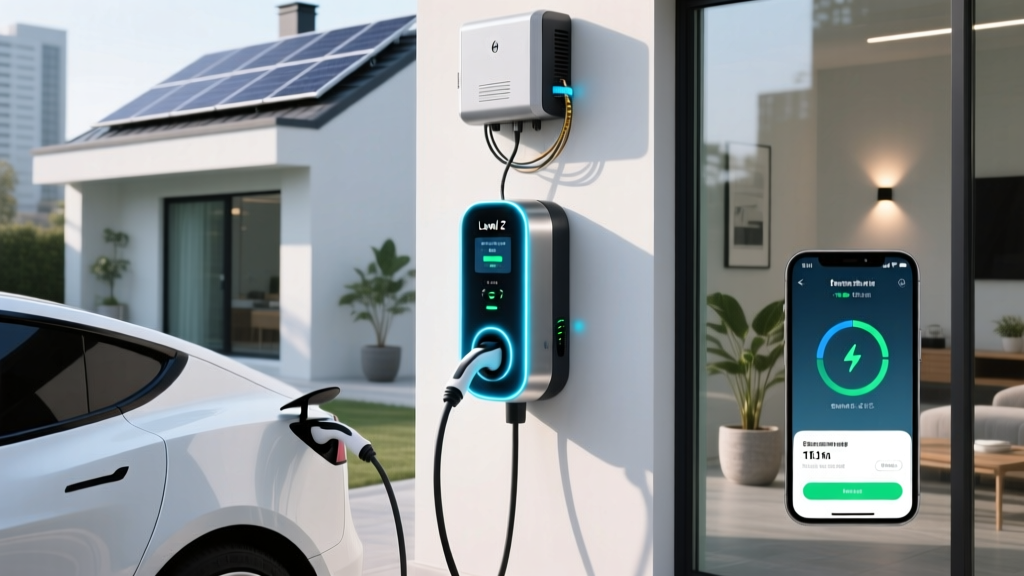
Installing a dedicated Level 2 home charger requires a 240-volt circuit — the same voltage your electric dryer or oven uses. The most common residential setup is a 240V/40A circuit on a NEMA 14-50 outlet or a hardwired connection, delivering up to 9.6 kW continuously. Higher-power units (11.5 kW or 19.2 kW) require 50A or 80A circuits respectively.
Here's what most homeowners don't anticipate: many older homes (pre-2000 construction) have 100A or 150A electrical service panels that may already be near capacity. Adding a 40A EV circuit can push total load past 80% of panel rating — the NEC threshold that triggers a mandatory panel upgrade to 200A service.
| Component | Cost Range | Notes |
|---|---|---|
| Level 2 Charger Unit (Equipment) | $300–$750 | Smart Wi-Fi-enabled units; basic units from ~$250 |
| Electrician Labor | $500–$2,000 | Depends on run length from panel to garage/driveway |
| Electrical Permit | $50–$250 | Required by most jurisdictions; varies by municipality |
| Panel Upgrade (if needed) | $1,500–$4,000 | 100A→200A service upgrade; common in older homes |
| Conduit, Wiring, Misc. Materials | $100–$500 | 6 AWG copper for 40A; 4 AWG for 50A circuits |
| Total (no panel upgrade) | $850–$3,500 | Typical range for most installations |
| Total (with panel upgrade) | $2,350–$7,500 | Older homes with 100A/150A service |
Before hiring an electrician, check your panel's amperage rating (printed on the main breaker) and calculate existing loads. Many utilities offer free or discounted home energy audits that include EV-readiness assessments. Some states and utilities also offer rebates of $250–$1,000 for Level 2 charger installation — check the Alternative Fuels Data Center for state-specific incentives.
Connector Compatibility: NACS, CCS1, and CHAdeMO in 2026
The connector landscape has shifted dramatically. As of 2026, the North American Charging Standard (NACS), originally developed by Tesla, has been adopted by nearly every major automaker for new vehicles. CCS1 remains on many 2022–2025 models still on the road, while CHAdeMO is effectively legacy (Nissan Leaf being the last major holdout).
| Connector | Brands Using It (2026 Models) | Adapter Availability |
|---|---|---|
| NACS (Tesla) | Tesla, Ford, GM, Rivian, Volvo, Polestar, Mercedes, BMW, Hyundai, Kia, Nissan (new models) | Native on new vehicles; CCS→NACS adapters ~$150–$250 for older CCS vehicles |
| CCS1 | Remaining 2022–2025 model-year vehicles; Volkswagen ID.4 (some trims); legacy fleet | NACS→CCS1 adapters available (~$200); Electrify America adding NACS cables |
| CHAdeMO | Nissan Leaf (2025 and earlier); Mitsubishi Outlander PHEV (older) | Declining network support; no practical adapter to NACS for DCFC |
For home Level 2 charging, all non-Tesla EVs use a J1772 connector, while Teslas use a proprietary connector. Most Level 2 home chargers ship with J1772; Tesla owners use the included J1772-to-Tesla adapter or purchase a NACS-equipped charger. When buying a home charger in 2026, choose one with the connector matching your vehicle — or buy a universal unit with swappable connector heads.
Cost to Charge: Home vs. Public vs. Gas — $/Mile Breakdown
One of the strongest economic arguments for EVs is the per-mile energy cost, but it varies enormously depending on where and when you charge. The national average residential electricity rate in early 2026 is approximately $0.17/kWh, but off-peak rates in many utility territories drop to $0.08–$0.12/kWh. Public DC fast charging networks (Electrify America, EVgo, Tesla Superchargers) typically charge $0.30–$0.55/kWh.
| Scenario | Rate | Vehicle Efficiency | Cost Per Mile |
|---|---|---|---|
| Home Level 2 (off-peak) | $0.10/kWh | 3.0 mi/kWh (typical sedan) | $0.033/mi |
| Home Level 2 (standard rate) | $0.17/kWh | 3.0 mi/kWh | $0.057/mi |
| Public DC Fast Charging | $0.42/kWh (avg) | 3.0 mi/kWh | $0.140/mi |
| Tesla Supercharger (member pricing) | $0.28/kWh | 3.2 mi/kWh (Model 3) | $0.088/mi |
| Gasoline Vehicle (30 MPG combined) | $3.30/gal (2026 avg) | 30 MPG | $0.110/mi |
| Gasoline Vehicle (22 MPG combined) | $3.30/gal | 22 MPG | $0.150/mi |
At 12,000 miles driven annually, home off-peak charging saves roughly $920/year versus a 30 MPG gas car, and $1,400/year versus a 22 MPG truck or SUV. Even at public DCFC rates, most EVs still match or beat the per-mile cost of an efficient gas car — though the savings narrow significantly. To maximize savings, program your charger (or your car's scheduled charging feature) to charge during overnight off-peak hours.
Safety, Code, and Electrical Considerations
EV charging places a sustained high-amperage load on your home's electrical system — unlike a dryer that cycles on and off, an EV charger may draw maximum current for 6–10 hours continuously. This makes proper installation non-negotiable.
- Dedicated circuit: Your Level 2 charger must be on its own dedicated breaker — never shared with other appliances. A 40A charger requires a 50A breaker (NEC requires circuits rated at 125% of continuous load).
- GFCI protection: The 2020 NEC and later require GFCI protection for all EV charging outlets. Hardwired installations with integrated ground-fault protection in the charger unit satisfy this requirement.
- Outdoor rating: If your charger is installed outdoors (carport, driveway), the unit must carry a NEMA 4 or IP65 weatherproof rating. All reputable chargers from ChargePoint, Emporia, and Tesla meet this standard.
- Wire gauge: 6 AWG copper wire for 40A circuits; 4 AWG for 50A; 3 AWG for 60A. Aluminum wire requires one gauge larger. Never undersize wiring — this is the #1 cause of EV charging electrical fires.
- No extension cords: Never use an extension cord with an EV charger. If the cable doesn't reach, relocate the charger or purchase a unit with a longer integrated cable (25 ft is the recommended minimum).
2026 Equipment Recommendations: Best Home Level 2 Chargers
Emporia Vue Level 2 EV Charger
- Power Output: Up to 11.5 kW (48A) on a 60A circuit
- Connector: J1772 (NACS version available)
- Cable Length: 24 ft
- Smart Features: Wi-Fi, energy monitoring, solar integration, scheduled charging, load management
- Price: ~$399
- Best For: Solar-panel owners wanting integrated energy tracking; best value per kW
ChargePoint Home Flex
- Power Output: Configurable 16A–50A (up to 12 kW on 60A circuit)
- Connector: J1772 (NACS adapter included with newer units)
- Cable Length: 23 ft
- Smart Features: Wi-Fi, Alexa/Google integration, amperage adjustment via app, detailed session logs
- Price: ~$549–$699
- Best For: Flexibility across panel capacities; adjust amperage without rewiring
Tesla Wall Connector (Gen 4)
- Power Output: Up to 11.5 kW (48A) on a 60A circuit
- Connector: NACS native; J1772 adapter included for non-Tesla vehicles
- Cable Length: 24 ft
- Smart Features: Wi-Fi, OTA updates, power sharing between multiple units, Tesla app integration
- Price: ~$475
- Best For: Tesla owners; multi-EV households with power-sharing needs
Grizzl-E Smart
- Power Output: Up to 9.6 kW (40A) on a 50A circuit
- Connector: J1772
- Cable Length: 24 ft
- Smart Features: OCPP-compatible, works with multiple network apps, adjustable amperage
- Price: ~$449
- Best For: Cold-climate durability (rated to -40°F); rugged outdoor installs
Frequently Asked Questions
How much does it cost to install a home EV charger?
A typical Level 2 home charger installation runs $850–$3,500 total (equipment, electrician, permit, and materials) if your electrical panel has sufficient capacity. Homes needing a 200A panel upgrade should budget $2,350–$7,500. Always get 2–3 quotes from licensed electricians and confirm they have specific EV charger installation experience.
How fast will each charging level add range?
Level 1 (120V) adds 3–5 miles of range per hour — adequate only for PHEVs with small batteries or overnight trickle-charging. Level 2 (240V) adds 20–60 miles per hour depending on amperage, fully recharging most EVs overnight. DC fast charging adds 150–1,000+ miles per hour at peak rates, typically delivering a 10–80% charge in 18–41 minutes depending on the vehicle's charge acceptance rate and battery size.
Which connector/charger is compatible with my EV?
For 2026 models: nearly all new EVs use NACS (the Tesla-standard connector). Vehicles from 2022–2025 may have CCS1 — check your charge port. The Nissan Leaf uses CHAdeMO. For home Level 2 charging, non-Tesla EVs use J1772, and Teslas use their proprietary connector (most chargers include adapters). Buy a charger matching your vehicle's connector, or use the appropriate adapter.
How much does charging cost per mile vs. gas?
Home off-peak charging costs approximately $0.03–$0.04 per mile — about one-third the cost of a 30 MPG gas car at $3.30/gallon ($0.11/mile). Standard-rate home charging runs ~$0.05–$0.06/mile. Public DC fast charging at $0.35–$0.55/kWh costs $0.12–$0.18/mile, roughly matching or slightly exceeding gasoline costs. The greatest savings come from consistent home charging on time-of-use plans.
What electrical upgrades might I need?
The most common upgrade is a panel capacity increase from 100A or 150A to 200A service, costing $1,500–$4,000. You may also need: a new dedicated 240V circuit with appropriate breaker (50A for a 40A charger); upgraded wire from the meter to the panel; or a smart load-management device (like the Emporia Smart Panel or Span Drive) that shares capacity between the EV charger and other appliances without requiring a full panel upgrade. Ask your electrician to perform a load calculation per NEC Article 220 before deciding.
For more on federal EV incentives that can offset charging infrastructure costs, see the IRS clean vehicle credit guidelines and check fueleconomy.gov for EPA-rated efficiency data on specific EV models to calculate your personal cost-per-mile.