Most EV owners do 80% or more of their charging at home. If you can install a Level 2 charger in your garage or driveway, you'll wake up to a full battery every morning, avoid unreliable public networks, and pay the lowest per-mile fuel cost available. But the phrase "install car charger at home" hides a lot of variables: your electrical panel's capacity, local permit rules, which connector your EV uses, and whether you need a $2,000 service upgrade or just a $500 outlet wiring job.
This guide walks through every decision point with exact numbers — kilowatt charge rates, circuit requirements, real equipment prices, and installation cost ranges based on 2026 electrician labor rates. No marketing fluff, just the specs you need to scope your project and budget accurately.
Understanding EV Charging Levels: kW, kWh, and Miles Per Hour
Before you buy hardware or call an electrician, you need to understand the three charging levels and how fast each adds range. First, a critical distinction: kW (kilowatts) measures power — how fast energy flows into your car. kWh (kilowatt-hours) measures energy — the total capacity of your battery, like gallons in a fuel tank. A 75 kWh battery charged at 11.5 kW takes roughly 6.5 hours from empty to full (75 ÷ 11.5 = 6.5). Never confuse these two units.
| Level | Voltage | Max Power (kW) | Miles of Range Added Per Hour | Typical Use Case |
|---|---|---|---|---|
| Level 1 | 120V AC | 1.0–1.4 kW | 3–5 mi/hr | Overnight top-ups, PHEVs, emergencies |
| Level 2 | 240V AC | 3.3–19.2 kW | 12–75 mi/hr | Home daily charging, workplace, hotels |
| DC Fast Charge | 400–800V DC | 50–350 kW | 150–1,200 mi/hr (peak) | Road trips, highway corridors |
For home installation, Level 2 is the practical standard. A 48-amp (11.5 kW) Level 2 charger on a 60-amp dedicated circuit will fully replenish a typical 75–85 kWh battery overnight in 7–8 hours. Level 1 technically works with the cord that ships with most EVs, but at 3–5 miles of range per hour, it can't keep up with daily driving for most BEV owners. A plug-in hybrid with a 15 kWh battery, however, can fully recharge on Level 1 overnight — making it adequate for PHEV-only households.
DC fast charging is public infrastructure only. You won't install a 150 kW DC charger in your garage (it requires commercial-grade three-phase power and costs $50,000+). But knowing DC speeds matters for road trip planning: a vehicle like the Hyundai Ioniq 5 with 800V architecture can charge from 10–80% in about 18 minutes at a 350 kW Electrify America station, while a 400V vehicle like the Ford Mustang Mach-E takes 35–45 minutes at the same station.
Electrical Requirements: What Your Home's Wiring Must Handle
Most Level 2 home chargers run on a 240-volt dedicated circuit — the same voltage as your electric dryer or oven. The amperage of that circuit determines your charge speed:
- 20-amp circuit → 16 amps continuous → 3.8 kW → ~14 mi/hr
- 30-amp circuit → 24 amps continuous → 5.8 kW → ~21 mi/hr
- 40-amp circuit → 32 amps continuous → 7.7 kW → ~28 mi/hr
- 50-amp circuit → 40 amps continuous → 9.6 kW → ~35 mi/hr
- 60-amp circuit → 48 amps continuous → 11.5 kW → ~42 mi/hr
- 100-amp circuit → 80 amps continuous → 19.2 kW → ~70 mi/hr (requires heavy-gauge wire and most homes' panels can't support this)
The 80% continuous load rule (NEC Article 210.20) means a charger drawing power for 3+ hours must not exceed 80% of the circuit breaker rating. A 48-amp charger requires a 60-amp breaker. This is non-negotiable code — your electrician will size accordingly.
Panel Capacity: The Hidden Bottleneck
Before you plan your charger install, check your main electrical panel's amperage rating. Most modern homes have 200-amp service. Older homes (pre-1990s) may have 100-amp or even 60-amp service. Here's the math that matters: your electrician will perform a NEC Article 220 load calculation that tallies your existing loads (HVAC, water heater, dryer, range, etc.) plus the new EV charger. If the total exceeds your panel's capacity, you'll need either:
- Panel upgrade (100A → 200A or 200A → 320A): $2,000–$5,000+ depending on utility coordination and trenching
- Smart load management device: $300–$800 installed. Devices like the Emporia Smart Load Manager or Tesla Wall Connector with Power Sharing monitor your home's real-time consumption and throttle the charger when other loads spike, avoiding a panel upgrade entirely
- Circuit derating: Install a lower-amperage charger (e.g., 32A on a 40A circuit instead of 48A on 60A) to stay within panel limits
According to NFPA NEC guidelines, a load management device that is listed and approved for the purpose can be used as an alternative to a service upgrade — but your local AHJ (Authority Having Jurisdiction, usually your city building department) must approve it.
How Much Does It Cost to Install a Home EV Charger?
The total cost to install a Level 2 home charger ranges from roughly $600 for a simple hardwired job near your panel to $5,000+ if you need a panel upgrade and a long trench. Here's a realistic breakdown based on 2026 national averages:
| Cost Component | Simple Install | Moderate Install | Complex Install (Panel Upgrade) |
|---|---|---|---|
| Level 2 charger (equipment) | $350–$700 | $400–$700 | $400–$700 |
| Electrician labor (licensed) | $300–$600 | $600–$1,500 | $1,500–$3,000 |
| Electrical materials (wire, conduit, breaker) | $50–$150 | $150–$500 | $200–$600 |
| Permit fee | $50–$150 | $50–$200 | $100–$300 |
| Panel upgrade (if needed) | — | — | $2,000–$5,000 |
| Trenching (underground run to detached garage) | — | — | $500–$2,000 |
| Total estimated cost | $750–$1,600 | $1,200–$2,900 | $4,700–$11,600 |
What Drives Cost Variability
The single biggest cost factor is wire run length. If your electrical panel is in the garage right next to where you park, your electrician might run 10 feet of 6/2 NM-B cable and be done in two hours. If the panel is in the basement and you park in a detached garage 80 feet away, you're looking at 6 AWG THHN in conduit, possibly underground trenching, and a sub-panel — easily a full day of labor.
Wire gauge also matters: a 60-amp circuit requires 6 AWG copper wire (or 4 AWG aluminum), while a 40-amp circuit can use 8 AWG copper. Longer runs may require upsizing to prevent voltage drop — your electrician will calculate this per NEC Table 310.16.
Hardwired vs. Plug-In: NEMA 14-50 Outlet or Direct Wire?
You have two installation methods for a Level 2 charger:
Hardwired: The charger's pigtail wires connect directly to a junction box or your panel via a dedicated breaker. This is the most common and most code-friendly approach for 48-amp and higher chargers. No outlet means no GFCI breaker requirement (which can add $100–$150 to material cost and sometimes causes nuisance tripping with EV chargers).
Plug-in (NEMA 14-50 outlet): A 240V/50A receptacle is installed, and the charger plugs in. This offers portability — you can take the charger when you move — but NEC 2023 (and carried into 2026 adoptions) requires a GFCI breaker for receptacles in garages, which adds cost and has been a known source of compatibility issues with some charger brands. A 14-50 outlet also limits you to 40 amps continuous (50A circuit × 80%), so you can't run a 48-amp charger on a standard 14-50 without exceeding code.
For a 48-amp charger, hardwiring on a 60-amp breaker is the recommended path. For a 32-amp portable charger, a NEMA 14-50 outlet is convenient and practical.
Connector Compatibility: NACS, CCS1, and CHAdeMO
Your EV's charge port determines which home charger connector you need. The North American market has largely standardized around NACS (North American Charging Standard, originally Tesla's proprietary connector) as of the 2025–2026 model years, but millions of CCS1-equipped vehicles remain on the road.
| Connector | Brands Using It (2026) | Home Charger Availability |
|---|---|---|
| NACS (J3400) | Tesla (all), Ford, GM, Rivian, Volvo, Polestar, Hyundai/Kia (2025+), Mercedes-Benz (2025+), BMW (2025+), Nissan (2025+) | Tesla Wall Connector, Emporia, EnelX, ChargePoint (NACS models available) |
| CCS1 (Combo) | Volkswagen ID.4 (pre-2025), older Ford/GM/Hyundai/Kia models, BMW i4/iX (pre-2025), Subaru Solterra (2023–2024) | ChargePoint Home Flex, Emporia, EnelX JuiceBox (CCS models still sold) |
| CHAdeMO | Nissan Leaf (discontinued 2025 — existing owners only), Mitsubishi Outlander PHEV (older models) | Limited; CHAdeMO home chargers are rare and expensive. Most owners use Level 1 or CCS adapters. |
Adapter options: If you own a CCS1 vehicle but want a NACS charger (or vice versa), adapters exist. Tesla sells a CCS-to-NACS adapter (~$250) for Supercharger access, and third-party NACS-to-CCS adapters for home charging are available from brands like Lectron and A2Z (~$150–$300). However, for daily home charging, the simplest and most reliable approach is buying a charger with the native connector your car uses.
Per SAE J3400, the NACS connector has been formally standardized, ensuring cross-brand interoperability going forward. If you're buying a new EV in 2026, it almost certainly uses NACS — so investing in a NACS home charger is the future-proof choice.
Best Home EV Chargers for 2026: Equipment Picks
Here are five Level 2 chargers we've evaluated based on power output, build quality, smart features, cable length, and price. All are UL-listed (or ETL-listed to equivalent standards) — never install a non-listed charger, as it may void your homeowner's insurance and won't pass inspection.
Tesla Wall Connector (Gen 4) — Best Overall for NACS Vehicles
- Power output: Up to 11.5 kW (48A on 60A circuit)
- Connector: NACS native
- Cable length: 24 feet
- Smart features: Wi-Fi, OTA updates, Power Sharing (link up to 6 units on one circuit), Tesla app scheduling
- Price: ~$450
- Best for: Tesla owners and any NACS-equipped EV. The Power Sharing feature is excellent for two-EV households on a single 60A circuit.
ChargePoint Home Flex (NACS version) — Best for CCS-to-NACS Flexibility
- Power output: Up to 12 kW (50A on 60A circuit, adjustable down to 16A)
- Connector: Available in NACS or CCS1
- Cable length: 23 feet
- Smart features: Wi-Fi, ChargePoint app with detailed energy tracking, Alexa/Google Home, flexible amperage setting via DIP switch
- Price: ~$550–$650
- Best for: Households that want detailed energy reporting or may switch between EV brands. The adjustable amperage means you can match it precisely to your circuit.
Emporia Vue Level 2 Charger — Best Budget Smart Charger
- Power output: Up to 11.5 kW (48A)
- Connector: NACS or J1772 (with adapter for CCS)
- Cable length: 24 feet
- Smart features: Wi-Fi, Emporia app, integrates with Emporia Vue whole-home energy monitor, EV-only energy tracking
- Price: ~$350–$400
- Best for: Budget-conscious buyers who still want smart scheduling and energy monitoring. Pairs well with the Emporia whole-home monitor for solar integration.
EnelX JuiceBox Pro 48 — Reliable Workhorse
- Power output: Up to 11.5 kW (48A)
- Connector: J1772 (CCS-compatible vehicles) or NACS (newer SKUs)
- Cable length: 25 feet
- Smart features: Wi-Fi, EnelX JuiceNet app, energy usage reports, scheduling
- Price: ~$450–$550
- Best for: Straightforward, reliable daily charging. EnelX has been in the EV charging space since 2010 and their hardware is proven in both residential and commercial deployments.
Grizzl-E Smart — Best for Extreme Durability / Outdoor Install
- Power output: Up to 10 kW (40A on 50A circuit)
- Connector: J1772 or NACS
- Cable length: 24 feet
- Smart features: Wi-Fi (via Smart model), OCPP-compatible, works with multiple charging apps
- Price: ~$400–$500
- Best for: Outdoor installations in harsh climates. Built in Canada, rated to -40°F, IP67 water resistance, and an aluminum case that shrugs off impacts. The 40A max means slightly slower charging than 48A units, but still adequate for overnight replenishment of any consumer EV.
Charging Time Examples: How Long to Fill Common EV Batteries
Charging time depends on battery size (kWh), charger power (kW), and the vehicle's onboard charger acceptance rate. Most EVs charge from 10% to 80% at home — you rarely arrive at 0% and charging above 80% slows significantly due to battery management system (BMS) taper. Here are real calculations for popular 2025–2026 EVs on an 11.5 kW (48A) Level 2 charger:
| Vehicle | Battery (usable kWh) | Onboard Charger Acceptance | 10–80% Time | EPA Range |
|---|---|---|---|---|
| Tesla Model Y Long Range | 75 kWh | 11.5 kW | ~4.6 hours | 320 mi |
| Ford Mustang Mach-E Extended Range | 91 kWh | 10.5 kW | ~6.1 hours | 320 mi |
| Hyundai Ioniq 5 Long Range | 77.4 kWh | 10.9 kW | ~4.9 hours | 305 mi |
| Chevrolet Equinox EV 3RS | 85 kWh | 11.5 kW | ~5.2 hours | 319 mi |
| BMW i4 eDrive40 | 81.5 kWh | 11 kW | ~5.2 hours | 307 mi |
| Toyota bZ4X | 64 kWh | 6.6 kW | ~6.8 hours | 252 mi |
Note the Toyota bZ4X's 6.6 kW onboard charger limitation — even though your home charger delivers 11.5 kW, the car can only accept 6.6 kW. This is a vehicle-side constraint. Always check your EV's onboard charger spec before paying extra for a 48A or 80A home unit; a 32A charger may be all your car can use.
Per fueleconomy.gov, EPA range figures assume mixed driving. In real-world highway use at 70+ mph, expect 10–15% less range than the EPA sticker, and in freezing temperatures (below 30°F), range can drop 20–30% due to battery resistance and cabin heating loads.
How Much Does Home Charging Cost Per Mile vs. Gas?
One of the strongest arguments for home charging is fuel cost. Here's a comparison using 2026 national average electricity and gasoline prices:
| Scenario | Rate | Vehicle Efficiency | Cost Per Mile |
|---|---|---|---|
| Home charging (national avg. electricity) | $0.16/kWh | 3.5 mi/kWh (typical BEV) | $0.046/mi |
| Home charging (off-peak TOU rate) | $0.09/kWh | 3.5 mi/kWh | $0.026/mi |
| Home charging (high-cost state, e.g., CA avg.) | $0.30/kWh | 3.5 mi/kWh | $0.086/mi |
| Public Level 2 (e.g., ChargePoint) | $0.30–$0.50/kWh | 3.5 mi/kWh | $0.086–$0.143/mi |
| DC Fast Charging (e.g., Electrify America) | $0.40–$0.60/kWh | 3.0 mi/kWh (highway) | $0.133–$0.200/mi |
| Gasoline car (30 MPG combined) | $3.30/gal | 30 mi/gal | $0.110/mi |
| Gasoline car (22 MPG combined, SUV/truck) | $3.30/gal | 22 mi/gal | $0.150/mi |
At the national average electricity rate of ~$0.16/kWh (per EIA data), home EV charging costs roughly $0.046 per mile — about 60% cheaper than a 30 MPG gas car. With a time-of-use (TOU) plan that offers off-peak rates of $0.07–$0.10/kWh overnight, that drops to $0.026/mi. Even in high-cost states like California at $0.30/kWh, home charging is still competitive with gasoline.
The math flips at public DC fast chargers. At $0.50/kWh, you're paying $0.17/mi — more than the average gas car. This is why home charging is the economic sweet spot. DC fast charging is a convenience for road trips, not a daily fueling strategy.
Safety, Permits, and Code Compliance
Installing a 240V circuit is serious electrical work. Here are the safety and code requirements your installation must meet:
- Dedicated circuit: Your EV charger must have its own breaker — no sharing with other outlets or appliances. This prevents overloading and ensures consistent charge speed.
- Permit required: Virtually every jurisdiction in the US requires an electrical permit for a new 240V circuit. Permit fees range from $50 to $300. Your electrician typically pulls the permit, and a city/county inspector visits after installation to verify code compliance. Skipping the permit risks insurance denial in the event of an electrical fire.
- GFCI protection: NEC 2023/2026 requires GFCI protection for 240V receptacles in garages. Hardwired chargers are generally exempt from this requirement, which is one reason hardwiring is preferred — GFCI breakers for 240V circuits cost $100–$150 more and have been known to nuisance-trip with certain EV charger brands.
- Outdoor rating: If your charger is installed outdoors, it must be rated for outdoor use (look for NEMA 4 or IP65/IP67 ratings). The connector holster should include a weather cover. All outdoor junction boxes and conduit fittings must be rain-tight.
- Wire sizing: Must comply with NEC Table 310.16 for the circuit amperage and ambient temperature. Undersized wire creates a fire hazard — this is why a licensed electrician is essential, not a handyman.
- Strain relief and cable management: The charger cable should not lie across a driveway where it can be driven over. Wall-mounted cable organizers or retractors ($30–$80) protect the cable and keep your garage tidy.
Step-by-Step: Your Home Charger Installation Process
- Check your panel: Open your electrical panel and note the main breaker amperage (usually 100A, 150A, or 200A). Count available breaker slots — you'll need two adjacent slots for a 240V double-pole breaker.
- Choose your charger: Match the connector (NACS or CCS1) to your EV and select a power level appropriate for your circuit. For most homes, a 48A charger on a 60A circuit is the sweet spot.
- Get 2–3 electrician quotes: Ask for a detailed scope that includes wire gauge, conduit type, circuit amperage, permit cost, and whether a load calculation is included. Verify the electrician is licensed and insured.
- Apply for utility rebates: Before installation, check your utility's EV rebate program. Some require pre-approval before work begins.
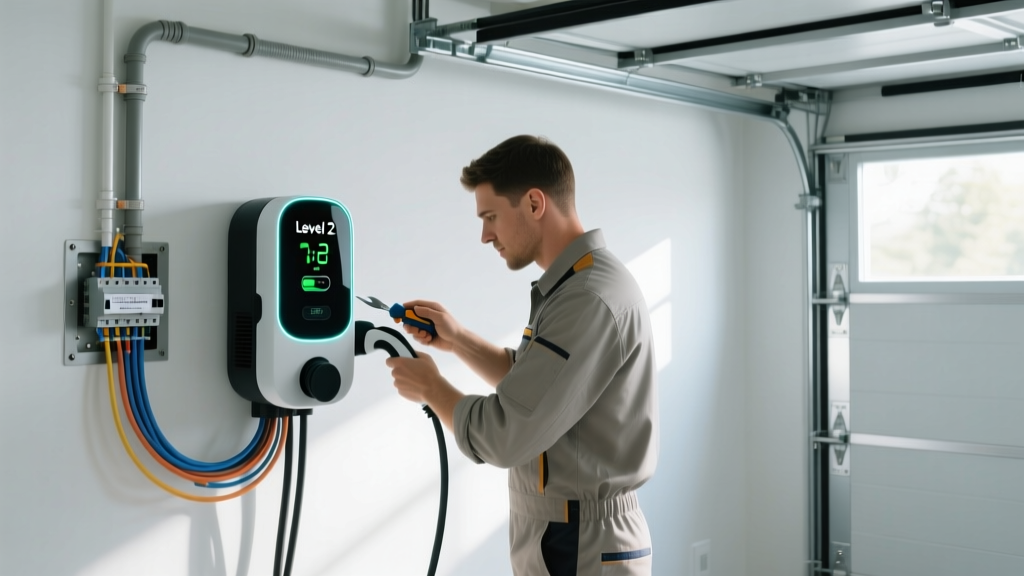
- Installation day: Typical installs take 2–6 hours. The electrician will run the circuit, mount the charger, connect wiring, and test.
- Inspection: The city/county inspector visits (usually within 1–2 weeks) to verify the installation meets NEC and local amendments. Don't use the charger until it passes inspection — your permit requires this.
- Configure and schedule: Connect your charger to Wi-Fi, set charging schedules to align with off-peak TOU rates, and test a full charge cycle.
Frequently Asked Questions
Can I install a home EV charger myself?
Technically, a homeowner can pull an electrical permit and do their own work in many jurisdictions. However, 240V circuits carry serious shock and fire risk if wired incorrectly, and a mistake can void your homeowner's insurance. We strongly recommend hiring a licensed electrician. The labor cost ($300–$1,500) is a small fraction of the risk.
Do I need a smart charger, or is a "dumb" charger fine?
A non-smart (dumb) charger like the Grizzl-E Basic works perfectly for charging — it delivers power when plugged in. Smart features (Wi-Fi scheduling, energy tracking, load management) are conveniences, not necessities. However, smart scheduling is the easiest way to ensure you charge during off-peak TOU hours, which can save $200–$400/year. For the $50–$100 price premium, a smart charger pays for itself quickly.
Will charging at home degrade my EV battery?
Level 2 home charging is actually the gentlest way to charge an EV battery. Degradation is primarily driven by heat and high C-rates (charge speed relative to battery capacity). A 48A Level 2 charge on a 75 kWh battery is roughly 0.15C — extremely mild. By contrast, DC fast charging at 150 kW is roughly 2C, generating significantly more heat. Data from Recurrent Auto shows that EVs charged primarily on Level 2 retain 90–95% of original capacity after 5 years and 100,000 miles. Set your charge limit to 80% for daily use (unless you have an LFP battery, which manufacturers like Tesla recommend charging to 100% weekly) and you'll maximize longevity.
My garage has no 240V outlet. What are my options?
You have three paths: (1) Have an electrician install a dedicated 240V circuit with a hardwired charger — this is the standard approach. (2) If you have a dryer outlet (NEMA 10-30 or 14-30) near your parking spot, you can use a portable EV charger with the correct plug adapter (e.g., the Tesla Mobile Connector with a 10-30 adapter) at up to 24A/5.8 kW. (3) Use the Level 1 cord that came with your EV on a standard 120V outlet — this adds only 3–5 miles per hour and is only practical for PHEVs or very low daily mileage.
Can I charge two EVs on one circuit?
Yes, with load-sharing chargers. The Tesla Wall Connector supports Power Sharing, where two or more units on a single 60A circuit dynamically split available power. When one car is nearly full, the other gets more current. ChargePoint and Emporia also offer dual-charger load management. Without load sharing, you'd need two separate dedicated circuits — which may require a panel upgrade.
What's the difference between a 32A and 48A charger?
A 32A charger (on a 40A circuit) delivers 7.7 kW and adds ~28 miles of range per hour. A 48A charger (on a 60A circuit) delivers 11.5 kW and adds ~42 miles per hour. For a 75 kWh battery, 32A charges 10–80% in about 6.9 hours vs. 4.6 hours for 48A. If you drive less than 50 miles per day, a 32A charger is more than adequate and uses thinner, less expensive wire. For high-mileage drivers or large-battery vehicles (100+ kWh), 48A ensures you're always topped up by morning.