Why Installing a Home EV Charger Changes Everything
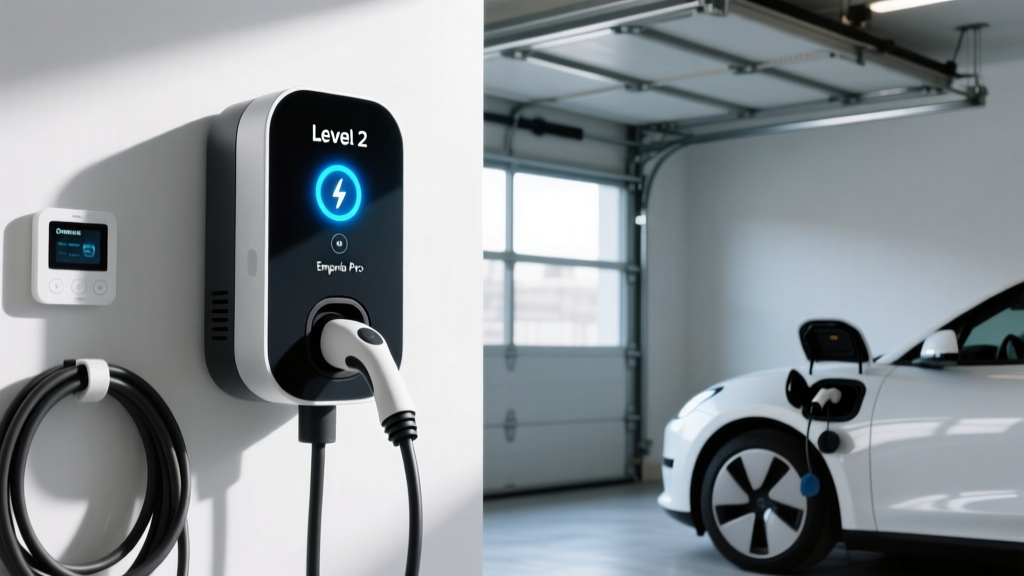
Over 80% of EV charging happens at home. A Level 2 home charger replenishes 25–45 miles of range per hour of charging, meaning a full overnight session easily covers most drivers' weekly mileage. The question isn't whether to install one — it's how much it will cost, what your electrical panel can handle, and which hardware fits your vehicle's connector.
This guide walks through every cost, electrical requirement, and equipment decision you'll face when you install EV charging at home, with exact numbers from real-world installations and current 2026 equipment pricing.
Charging Levels Explained: Speed in kW and Miles Per Hour
Before sizing equipment, understand the three charging tiers. The critical distinction: kW (kilowatts) measures power — the rate at which energy flows. kWh (kilowatt-hours) measures energy — the total capacity of your battery. Think of kW as water flow rate and kWh as the size of the tank.
| Level | Voltage | Power (kW) | Miles of Range Added/Hour | Best For |
|---|---|---|---|---|
| Level 1 | 120V (standard outlet) | 1.0–1.4 kW | 3–5 miles | Low-mileage drivers, PHEVs |
| Level 2 | 240V (dryer-style outlet) | 3.3–19.2 kW | 12–65 miles | Daily home charging, BEVs |
| DC Fast Charge | 200–800V DC | 50–350+ kW | 150–1,000+ miles (equivalent) | Road trips, rapid top-ups |
Real-world Level 2 context: A 48-amp hardwired charger delivering 11.5 kW will add roughly 35–42 miles per hour to an EV averaging 3.5–4.0 miles/kWh. A 70 kWh battery (like the Ford Mustang Mach-E Extended Range) charging from 10% to 80% at this rate takes approximately 4.5–5 hours. The same session on a 32-amp (7.7 kW) unit takes closer to 7 hours.
DC fast charging is not a daily solution — it stresses the battery if used exclusively and costs 2–4× more per kWh than home charging. Plan your install around Level 2 as your primary source.
How Much Does It Cost to Install a Home EV Charger?
Total installation costs vary enormously based on your home's electrical infrastructure. Here's a realistic breakdown for a 48-amp hardwired Level 2 charger (11.5 kW output on a 60-amp dedicated circuit):
| Cost Component | Typical Range | Notes |
|---|---|---|
| Level 2 Charger (Equipment) | $350–$750 | Smart Wi-Fi chargers; basic units from $250 |
| Electrician Labor | $400–$1,500 | Depends on run length, wall type, conduit |
| Electrical Permit | $50–$300 | Varies by municipality; some bundle with inspection |
| Panel Upgrade (if needed) | $1,500–$4,000 | Upgrading from 100A to 200A service panel |
| Conduit, Wiring, Disconnect | $100–$400 | 6 AWG copper for 48A circuits; longer runs cost more |
| Total (no panel upgrade) | $900–$2,950 | Most homes with 200A panels fall here |
| Total (with panel upgrade) | $2,400–$6,950 | Older homes with 100A service |
Key insight: Homes built after 2000 typically have 200-amp panels with spare breaker slots — install costs cluster around $1,200–$2,000 total. Pre-1980s homes often have 100-amp or even 60-amp service. Adding a 60-amp EV circuit to an already-loaded 100A panel requires a service upgrade, which is the single biggest cost driver.
Some utilities offer rebates of $250–$1,000 for Level 2 installation, and the federal Residential Clean Energy Credit (IRS §25D) covers 30% of equipment and installation costs up to $1,000 through 2032 for qualified home charging equipment. Check your utility's EV program before scheduling work.
Electrical Requirements: What Your Panel Needs
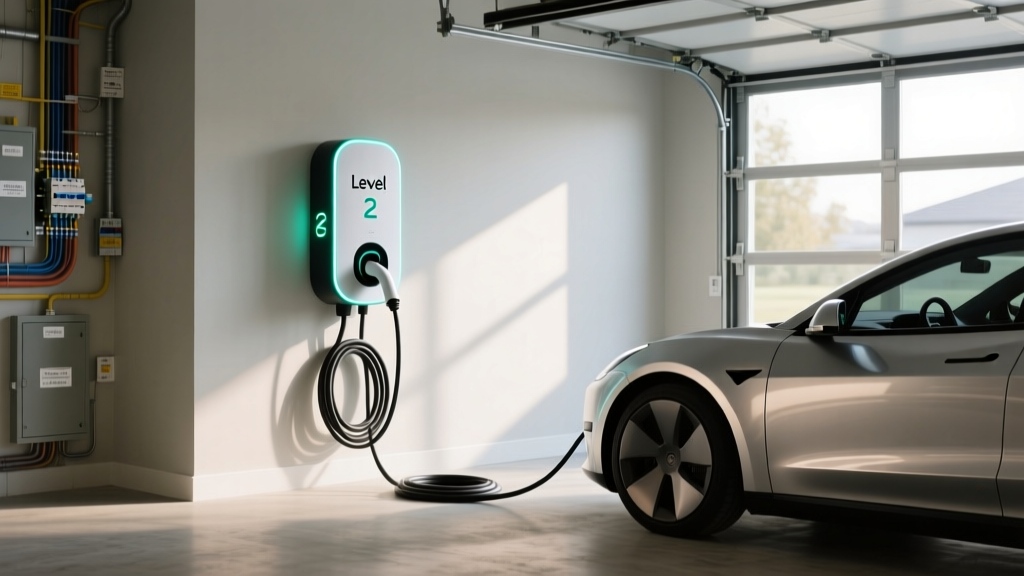
A 48-amp continuous-load Level 2 charger requires a 60-amp dedicated circuit (the National Electrical Code requires circuits rated at 125% of continuous load: 48A × 1.25 = 60A). Here's what your electrician will evaluate:
Panel Capacity
Your electrician will perform a load calculation per NEC Article 220. A typical 200A panel with electric range, dryer, and central A/C may have 40–80 amps of headroom. If the calculated load exceeds 80% of panel rating with the EV circuit added, you need a panel upgrade or a smart load-management device.
Smart Load Management (Panel-Upgrade Alternative)
Devices like the Emporia Smart Load Management or the Wall Connector's built-in load-sharing can throttle charging speed when household demand spikes, allowing a 48A charger on a panel that wouldn't otherwise support it. This can save $2,000–$4,000 versus a full panel upgrade.
Wiring and Conduit
- Wire gauge: 6 AWG copper (THHN in conduit) for 48A/60A circuits; 4 AWG for runs over 100 feet to limit voltage drop
- Conduit: EMT (metal) or PVC per local code; outdoor runs typically require rigid or liquid-tight
- Disconnect: Some jurisdictions require a separate disconnect switch within sight of the charger
Safety and Code Requirements
- Dedicated circuit: Your EV charger must not share a breaker with other loads
- GFCI protection: NEC 2023/2026 requires GFCI for 240V receptacles in garages; hardwired units may be exempt in some jurisdictions — confirm with your inspector
- Outdoor rating: If installing outside, the charger must carry a NEMA 4 or NEMA 4X weather rating
- Cable management: Wall-mounted holster and cable organizer prevent trip hazards and connector damage
Which Connector Is Compatible With My EV?
The connector landscape consolidated significantly by 2026. Here's the current state:
| Connector | Brands Using It (2026 Models) | Home Charger Availability |
|---|---|---|
| NACS (Tesla/J3400) | Tesla (all), Ford, GM, Rivian, Volvo, Polestar, Hyundai/Kia (2025+), Honda, BMW, Mercedes, Nissan (Ariana) | Widely available — Tesla Wall Connector, Emporia, Autel, ChargePoint Home Flex (with NACS) |
| CCS1 (Combo) | Legacy models (2024 and earlier VW ID.4, older BMW i4, some Stellantis EVs) | ChargePoint Home Flex, JuiceBox, Grizzl-E |
| CHAdeMO | Nissan Leaf (legacy — discontinued 2025 in US) | Limited home options; most CHAdeMO owners use adapters |
Adapter reality for 2026: Ford, GM, Rivian, and other NACS-transition brands include or sell NACS adapters for CCS1-port vehicles from prior model years. If you own a 2022–2024 CCS1-equipped EV, a NACS-to-CCS adapter ($100–$250) lets you charge at Tesla Superchargers. For home charging, the connector on your wall unit simply needs to match your car's inlet — buy the native connector to avoid daily adapter fumbling.
Recommendation: If your current or next EV uses NACS, buy a NACS-terminated charger. If you're between vehicles or own two EVs with different connectors, a charger with a J1772 plug plus a J1772-to-NACS adapter covers both (most NACS vehicles ship with this adapter).
Recommended Level 2 Chargers: Equipment Compared
These are the units we recommend based on reliability, power output, smart features, and value — all current for 2026:
| Charger | Max Output | Connector | Cable Length | Smart Features | Price (MSRP) |
|---|---|---|---|---|---|
| Tesla Wall Connector (Gen 4) | 11.5 kW (48A) | NACS | 24 ft | Wi-Fi, OTA updates, load sharing, power metering | $475 |
| ChargePoint Home Flex | 12.0 kW (50A) | NACS or J1772 (configurable) | 23 ft | Wi-Fi, app scheduling, Alexa, load management | $649 |
| Emporia Vue Level 2 | 11.5 kW (48A) | NACS or J1772 | 24 ft | Wi-Fi, energy monitoring, solar integration, load management | $399 |
| Grizzl-E Smart | 10.0 kW (40A) | J1772 (NACS adapter available) | 24 ft | Wi-Fi, OCPP, extreme-cold rated (-40°C) | $549 |
| Autel MaxiCharger Home | 11.5 kW (48A) | NACS | 25 ft | Wi-Fi, RFID, app control, load balancing | $499 |
Editor's pick for most buyers: The Tesla Wall Connector at $475 offers the best combination of price, power, cable length, and reliability for NACS-equipped vehicles. For J1772/CCS owners or households with mixed connectors, the ChargePoint Home Flex's configurable plug is the most versatile.
Hardwired vs. plug-in (NEMA 14-50): Hardwiring delivers the full 48A and avoids the GFCI breaker requirement for 240V receptacles in many jurisdictions. A NEMA 14-50 outlet limits you to 40A (9.6 kW) continuous but provides portability — you can take the charger when you move. Discuss both options with your electrician based on your local code.
How Much Does Charging Cost Per Mile vs. Gas?
Electricity rates and gas prices vary by region, but here's a representative cost comparison using an EV averaging 3.5 miles/kWh (like a 2026 Tesla Model Y or Hyundai Ioniq 5) versus a gas car averaging 28 MPG:
| Scenario | Rate | Cost Per Mile (EV) | Cost Per Mile (Gas, 28 MPG @ $3.40/gal) |
|---|---|---|---|
| Home Off-Peak (Time-of-Use) | $0.09/kWh | $0.026 | $0.121 |
| Home Standard Rate | $0.15/kWh | $0.043 | $0.121 |
| Public Level 2 (network) | $0.30/kWh | $0.086 | $0.121 |
| DC Fast Charging (peak) | $0.48/kWh | $0.137 | $0.121 |
The takeaway: Home charging at off-peak rates costs roughly one-fifth of gasoline per mile. Even at standard residential rates, you save 60–65% per mile. However, exclusive reliance on DC fast charging can push your per-mile cost above gasoline — this is why home charging is the economic foundation of EV ownership.
According to fueleconomy.gov, the national average electricity cost for EV driving is approximately $0.04–$0.05 per mile when primarily charging at home, compared to $0.11–$0.14 per mile for a 27 MPG gasoline vehicle at current fuel prices.
Charging Time Examples for Common Battery Sizes
Here's how long a 10–80% charge takes at various Level 2 power levels:
- 60 kWh battery (e.g., Chevy Equinox EV): 7.7 kW charger = ~5.5 hrs | 11.5 kW charger = ~3.6 hrs
- 80 kWh battery (e.g., Tesla Model Y LR): 7.7 kW charger = ~7.3 hrs | 11.5 kW charger = ~4.9 hrs
- 100 kWh battery (e.g., Ford F-150 Lightning Ext. Range): 7.7 kW charger = ~9.1 hrs | 11.5 kW charger = ~6.1 hrs
All of these fit comfortably within an overnight window (10 PM–6 AM) at 11.5 kW, which is why a 48A hardwired install is the sweet spot for battery-electric vehicles.
Frequently Asked Questions
Can I install an EV charger myself?
Hardwired 240V installations require a licensed electrician in virtually all US jurisdictions — unpermitted electrical work voids homeowner's insurance coverage for related claims and can fail at home inspection when you sell. If you're experienced with electrical work, you can run conduit and wire to save on labor, but the final connection and permit sign-off should involve a licensed professional. Plug-in units on an existing NEMA 14-50 outlet are the only DIY-friendly option, and even the outlet installation requires a permit in most areas.
Do I need a 200-amp electrical panel?
Not necessarily, but it helps. A 200A panel with moderate existing loads typically supports a 60A EV circuit without upgrade. A 100A panel with electric heating, range, and dryer almost certainly requires an upgrade or a smart load-management device. Your electrician's NEC Article 220 load calculation is the definitive answer — don't guess based on panel sticker rating alone.
Should I get a hardwired or plug-in (NEMA 14-50) charger?
Hardwired delivers 20% more power (48A vs. 40A on a 50A outlet), avoids GFCI nuisance trips that plague some 14-50 installations under NEC 2023+, and is generally more reliable. Plug-in gives you portability and the ability to use the outlet for other purposes (welder, RV). If you own your home and plan to stay, hardwire. If you rent or move frequently, plug-in.
Does home charging degrade my EV battery faster?
No — Level 2 home charging is actually gentler on battery chemistry than DC fast charging. The moderate charge rate generates less heat, and lithium-ion batteries (both NMC and LFP) experience less degradation at slower charge speeds. According to data aggregated by Recurrent Auto, EVs primarily charged at Level 2 show minimal capacity loss over 100,000+ miles, typically retaining 90–95% of original capacity.
Is the federal tax credit available for home charger installation?
Yes, under the Residential Clean Energy Credit (IRS §25D), you can claim 30% of the cost of home EV charging equipment and installation, up to a maximum credit of $1,000. This is separate from the §30D vehicle purchase credit. The equipment must be installed at your primary US residence. Consult a tax professional to confirm eligibility and proper filing.
What if my HOA restricts EV charger installation?
Many states (including California, Colorado, Florida, Texas, and others) have "right to charge" laws that prevent HOAs from unreasonably restricting EV charger installation. Your HOA can impose reasonable aesthetic and safety requirements (e.g., charger placement not visible from the street, using a licensed electrician) but generally cannot prohibit installation outright. Check your state's specific statute.