If you've just ordered an electric vehicle — or are seriously shopping for one — the single most impactful ownership decision you'll make is setting up Level 2 charging at home. Public DC fast chargers are essential for road trips, but 80–90% of all EV charging happens where you park overnight. A properly installed home charger adds 25–45 miles of range per hour, costs a fraction of public charging, and eliminates the "range anxiety" that still keeps many buyers on the fence.
This guide walks through exactly how to install an EV charger at home: the electrical requirements, realistic cost breakdowns (including the panel upgrade scenario nobody talks about), equipment recommendations with real specs, connector compatibility, and the per-mile cost math versus gasoline. All figures reflect 2026 pricing and the current federal tax landscape.
Understanding EV Charging Levels: Speeds That Actually Matter
Before hiring an electrician, you need to understand what each charging level delivers — and why Level 2 is the home-installation sweet spot. The critical distinction: kW (kilowatts) measures power — the rate at which energy flows into your battery. kWh (kilowatt-hours) measures energy — the total capacity of your battery, like gallons in a fuel tank. A 48-amp Level 2 charger delivering 11.5 kW fills a 75 kWh battery in roughly 6.5 hours from empty. Confusing these two units is the most common mistake in EV charging research.
| Level | Voltage | Max Power (kW) | Miles of Range Added Per Hour | Typical Use Case |
|---|---|---|---|---|
| Level 1 | 120V (standard outlet) | 1.4–1.9 kW | 3–5 miles | Emergency/trickle; PHEVs with small batteries |
| Level 2 | 240V (dedicated circuit) | 7.2–19.2 kW | 20–65 miles | Home overnight charging; workplace; public destinations |
| DC Fast | 400–800V DC | 50–350+ kW | 150–1,200 miles/hr (peak) | Road trips; 10–80% in 18–35 min depending on vehicle |
The miles-per-hour figures assume an average efficiency of 3–4 miles per kWh, which covers most EVs from the EPA's efficiency database. A heavy, less-efficient truck like the Rivian R1T might see 20% fewer miles per hour, while a sleek Hyundai Ioniq 6 could see 10–15% more.
Electrical Requirements: What Your Home Needs for a Level 2 Charger
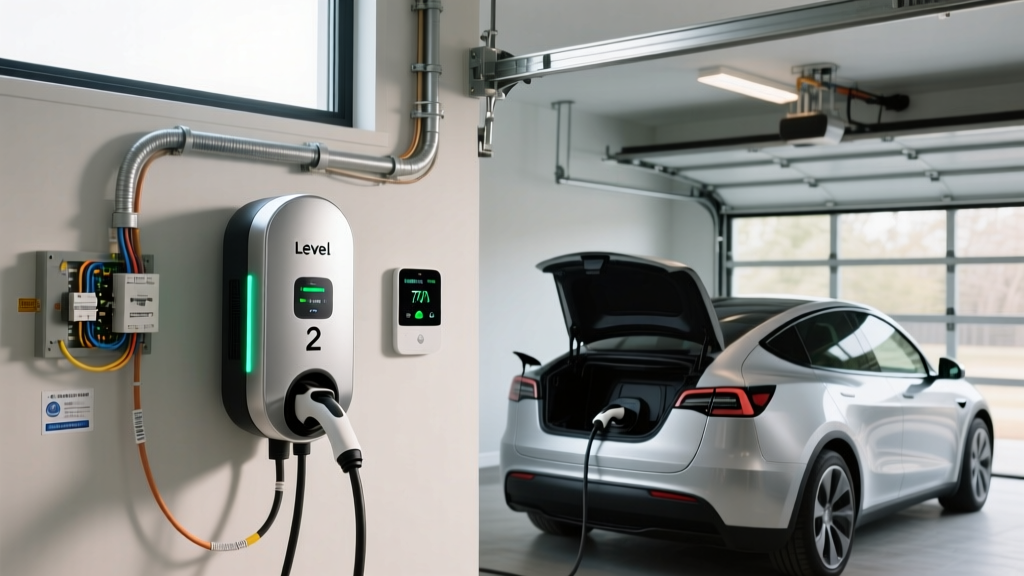
A Level 2 home charger requires a 240-volt dedicated circuit — the same type of circuit that powers your electric dryer or oven. Here's what that means in practice:
Circuit amperage and charger output: Most residential Level 2 chargers draw between 32 and 48 amps. Electrical code (NEC Article 625) requires the circuit breaker to be rated at 125% of the continuous load. So a 48-amp charger needs a 60-amp breaker. A 32-amp charger needs a 40-amp breaker. The wire gauge must match: typically 6 AWG copper for a 60-amp circuit, 8 AWG for a 40-amp circuit.
Panel capacity check: Your home's main electrical panel has a total capacity — usually 100, 150, or 200 amps. An electrician will perform a load calculation (NEC Article 220) to determine whether your panel can handle an additional 48–60 amp continuous draw. If you're already running electric heat, an electric water heater, and a dryer on a 100-amp panel, a panel upgrade is likely required.
Hardwired vs. plug-in (NEMA 14-50): You have two installation options. A hardwired charger connects directly to your panel's wiring — no outlet, slightly cheaper installation, and often eligible for higher amperage. A plug-in charger uses a NEMA 14-50 receptacle (the same as an electric range), which lets you take the charger with you if you move but limits you to 40 amps of continuous draw (50-amp breaker). For most homeowners planning to stay put, hardwired is the better choice for reliability and maximum charging speed.
Do You Need a Panel Upgrade?
This is the cost variable that catches homeowners off guard. If your home has a 200-amp panel with available headroom, adding a 60-amp EV circuit is straightforward. But many homes built before 2000 have 100-amp or 150-amp panels that are already near capacity. A panel upgrade to 200 amps typically costs $1,500–$4,000 depending on your utility's requirements, whether a new meter base is needed, and local labor rates. In some cases, a "smart" panel or load-management device (like the Span Drive or EMPoria Energy load manager) can avoid a full upgrade by dynamically reducing EV charging when other appliances cycle on — saving $1,000–$2,500.
How Much Does It Cost to Install an EV Charger at Home?
Total installation cost depends on four variables: the charger unit, electrical labor, materials (wire, conduit, breaker), and whether your panel can handle the load. Here's a realistic breakdown based on 2026 national averages:
| Component | Simple Install (Panel Adjacent) | Standard Install (50–80 ft run) | Complex Install (Panel Upgrade Needed) |
|---|---|---|---|
| Level 2 charger unit (48A) | $400–$700 | $400–$700 | $400–$700 |
| Electrician labor | $300–$600 | $600–$1,500 | $1,200–$2,500 |
| Materials (wire, conduit, breaker) | $100–$250 | $250–$600 | $400–$900 |
| Permit and inspection | $50–$150 | $50–$200 | $100–$300 |
| Panel upgrade (if needed) | — | — | $1,500–$4,000 |
| Total | $850–$1,700 | $1,300–$3,000 | $3,600–$8,400 |
Federal incentive note: The Alternative Fuel Vehicle Refueling Property Credit (IRS Form 8911) offers up to 30% of the cost of home EV charging equipment and installation, capped at $1,000. This credit has specific census-tract eligibility requirements — it applies only in non-urban or low-income areas. Check the IRS guidance or consult a tax professional before assuming eligibility. Some utilities also offer rebates of $250–$500 for Level 2 equipment; check your local provider.
Choosing the Right Home EV Charger: Equipment Picks
Not all Level 2 chargers are equal. The key specs that matter: max amperage (which determines your charge speed), cable length (you want at least 18 feet; 25 is ideal), connector type (matching your vehicle), smart features (Wi-Fi scheduling for off-peak electricity rates), and NEMA rating (NEMA 4 for outdoor installation).
Emporia Level 2 EV Charger
Power: 48 amps (11.5 kW) on a 60-amp circuit | Connector: J1772 (NACS adapter available) | Cable: 24 ft | Smart features: Wi-Fi scheduling, solar integration, energy monitoring via app | Price: ~$400 | Best for: Budget-conscious buyers who want smart scheduling and real-time energy tracking. Excellent value. Hardwired installation required for full 48A.
ChargePoint Home Flex (2nd Gen)
Power: Up to 50 amps (12 kW) configurable | Connector: J1772 or NACS (select at purchase) | Cable: 23 ft | Smart features: Wi-Fi, Alexa integration, scheduled charging, detailed session history | Price: ~$550–$650 | Best for: Flexibility. Adjustable amperage lets you match your circuit — set to 32A on a 40-amp circuit or 50A on a 60-amp circuit. Available in both NACS and J1772.
Tesla Wall Connector
Power: 48 amps (11.5 kW) on a 60-amp circuit | Connector: NACS (Tesla native) | Cable: 24 ft | Smart features: Wi-Fi updates, power sharing (link multiple units on one circuit), access control | Price: ~$475 | Best for: Tesla owners. Sleek design, reliable hardware, and power-sharing lets you install two connectors on a single 60-amp circuit (useful for two-EV garages). Non-Tesla EVs need a NACS-to-J1772 adapter for charging.
Grizzl-E Smart
Power: 40 amps (9.6 kW) on a 50-amp circuit | Connector: J1772 (NACS adapter available) | Cable: 24 ft | Smart features: Wi-Fi, OCPP compatibility, load balancing | Price: ~$450 | Best for: Cold-climate durability. Built in Canada, rated to -40°C/-40°F, with a rugged aluminum case. Slightly lower amperage than competitors but extremely reliable in harsh winters.
Connector Compatibility: Will the Plug Fit Your EV?
The North American charging connector landscape has consolidated significantly since 2023, when Ford and GM announced adoption of the Tesla-designed NACS (North American Charging Standard). By the 2026 model year, NACS is the dominant connector for new EVs. Here's where each brand stands:
| Connector | Brands Using It (Native) | Adapter Required? |
|---|---|---|
| NACS (Tesla standard) | Tesla (all), Ford (2025+), GM (2025+), Rivian (2025+), Volvo/Polestar (2025+), Hyundai/Kia (2026+), BMW (2026+) | None for native vehicles. Older CCS vehicles need a NACS-to-CCS adapter (~$150–$250). |
| CCS1 (legacy standard) | Remaining Stellantis models, some 2024–2025 carryover vehicles, Volkswagen ID.4 (2024 and earlier) | CCS-to-NACS adapter needed to access Tesla Superchargers |
| CHAdeMO | Nissan Leaf (legacy only — discontinued in most markets) | CHAdeMO-to-NACS adapters exist but are rare and expensive (~$300+) |
What this means for your charger purchase: If you're buying a 2025 or newer EV from Tesla, Ford, GM, Rivian, Hyundai, or Kia, you want a charger with a NACS connector. If you own an older CCS-equipped EV (2024 model year or earlier), buy a J1772 charger and use the adapter that came with your vehicle or purchase a CCS-to-J1772 adapter. The ChargePoint Home Flex is available in both NACS and J1772 configurations, which is why it's a versatile pick.
Charging Time Examples: What to Expect With Common Battery Sizes
Here's how long a full Level 2 session takes for popular 2026 EVs charging at home on a 48-amp (11.5 kW) circuit. These times assume a 10–80% charge, which is the recommended daily charging window for NMC (nickel-manganese-cobalt) battery chemistry to maximize longevity. LFP (lithium iron phosphate) batteries can be charged to 100% regularly without degradation concerns.
| Vehicle | Battery (kWh usable) | Chemistry | 10–80% Time (hrs) | EPA Range |
|---|---|---|---|---|
| Tesla Model 3 Long Range | 75 kWh | NMC | ~4.6 hours | 363 mi |
| Hyundai Ioniq 5 (Long Range) | 77.4 kWh | NMC | ~4.7 hours | 318 mi |
| Ford F-150 Lightning (Extended) | 131 kWh | NMC | ~8.0 hours | 320 mi |
| Chevrolet Equinox EV | 85 kWh | NMC | ~5.2 hours | 319 mi |
| Tesla Model Y (LFP Standard) | 60 kWh | LFP | ~5.2 hours (to 100%) | 280 mi (est.) |
Even the largest battery — the F-150 Lightning Extended Range at 131 kWh — reaches 80% in about 8 hours on a 48-amp Level 2 charger. That's comfortably within an overnight window. For most EVs with 75–85 kWh batteries, a full overnight charge from 20% to 80% takes 4–5 hours.
Cost to Charge: Home Electricity vs. Public Stations vs. Gasoline
The economic case for home charging is overwhelming — but the gap between home and public charging costs is larger than most new EV owners expect. Here's the real math:
| Scenario | Rate | Cost Per kWh | Cost Per Mile (at 3.5 mi/kWh) |
|---|---|---|---|
| Home, off-peak utility rate (national avg.) | $0.12–$0.16/kWh | $0.14 avg. | $0.04 |
| Home, standard rate (no time-of-use plan) | $0.15–$0.22/kWh | $0.18 avg. | $0.051 |
| Public Level 2 (ChargePoint, EVgo, etc.) | $0.25–$0.49/kWh | $0.35 avg. | $0.10 |
| DC Fast Charging (Electrify America, Tesla Supercharger) | $0.35–$0.55/kWh | $0.45 avg. | $0.13 |
| Gasoline (28 MPG combined, $3.40/gal) | $3.40/gal | n/a | $0.12 |
At home off-peak rates, an EV costs roughly $0.04 per mile to fuel — about one-third the cost of a 28 MPG gasoline car at $3.40/gallon. Even at standard residential rates with no time-of-use optimization, home charging is roughly half the cost of gasoline per mile. But relying exclusively on DC fast charging at $0.45/kWh actually costs more than gasoline. This is why home charging is not optional for EV economics — it's the entire value proposition.
Time-of-use tip: Most utilities offer off-peak rates between 10 PM and 6 AM. Every smart charger listed above lets you schedule charging to these windows automatically. If your utility charges $0.22/kWh during peak hours but $0.09/kWh overnight, scheduling saves you $0.13/kWh — roughly $500–$800 per year for an average driver covering 12,000 miles.
Safety, Permits, and Code Requirements
A Level 2 EV charger is a continuous high-draw electrical load that runs for hours — often while you sleep. Proper installation isn't optional; it's a safety and insurance requirement.
Permits are mandatory. Nearly every jurisdiction in the U.S. requires an electrical permit for a new 240V circuit. The permit fee is typically $50–$200, and the work must pass inspection by your local authority having jurisdiction (AHJ). Skipping the permit risks voiding your homeowner's insurance in the event of an electrical fire.
GFCI protection: NEC 2020 and later requires GFCI (Ground Fault Circuit Interrupter) protection for EV charging circuits. Hardwired chargers often have GFCI built into the unit. For NEMA 14-50 receptacle installations, your electrician must install a GFCI breaker — these cost $50–$120 more than standard breakers. Some EV owners report nuisance trips with certain GFCI breakers and charger combinations; your electrician should select a compatible pairing.
Outdoor installation: If your charger is mounted outdoors (on a garage exterior wall or carport), it must carry a NEMA 4 rating (weather-resistant against rain and splashing). All chargers recommended above meet this standard. Ensure the cable can retract or be hung on a hook to prevent ground contact and tripping hazards.
Dedicated circuit: Your EV charger must be on a dedicated circuit — not shared with any other appliance. This is non-negotiable per NEC Article 625. A shared circuit risks overloading and breaker trips.
Frequently Asked Questions
Can I install an EV charger myself?
If you're hardwiring, absolutely not — this requires a licensed electrician for code compliance, permit, and insurance. If you're installing a NEMA 14-50 outlet, a qualified electrician should still handle it; improper 240V wiring is a serious fire hazard. The only true DIY scenario is plugging a portable Level 1 charger into an existing 120V outlet, which adds just 3–5 miles of range per hour.
Will charging my EV at home increase my electric bill significantly?
Driving 12,000 miles per year at 3.5 miles/kWh requires about 3,430 kWh annually. At the national average residential rate of $0.16/kWh, that's roughly $549 per year — or $46/month — in additional electricity cost. Compare that to $1,457 per year in gasoline at 28 MPG and $3.40/gallon. Your total utility bill goes up, but your total fuel cost drops by roughly 60%.
Do I need a smart charger, or is a basic unit fine?
A basic "dumb" charger works perfectly for charging — it sends power to your car when plugged in. But a smart charger with Wi-Fi and scheduling pays for itself if your utility has time-of-use rates. Scheduling your charge to off-peak hours can save $300–$800 per year. Smart chargers also provide energy monitoring, session history, and remote control — useful for troubleshooting and tracking costs.
My garage is far from the electrical panel. Is that a problem?
Not a deal-breaker, but it adds cost. Wire runs over 50 feet require thicker-gauge wire (to reduce voltage drop), more conduit, and additional labor. A 100-foot run of 6 AWG copper through conduit can add $400–$800 to the installation compared to a 20-foot run. Get a quote that specifies the run length so you can compare fairly.
Should I charge to 100% every night?
For NMC batteries (most long-range EVs), the recommended daily limit is 80%. Charging to 100% occasionally for road trips is fine, but daily 100% charges accelerate degradation. Set your vehicle's charge limit to 80% for routine use. LFP batteries (found in some Tesla Model 3/Y Standard Range variants and select other models) can and should be charged to 100% regularly — LFP chemistry benefits from full-charge calibration. Check your vehicle's manual for the manufacturer's recommendation.
What about the federal tax credit for home chargers?
The Alternative Fuel Vehicle Refueling Property Credit covers 30% of equipment and installation costs, up to $1,000. However, it's restricted to equipment installed in eligible census tracts (generally non-urban or low-income areas). Many suburban and urban homeowners do not qualify. Use the IRS eligibility tool or consult a tax professional to confirm before claiming. This credit is separate from the §30D vehicle purchase credit.