Charging at home is the single biggest quality-of-life upgrade in EV ownership. Wake up every morning with 200+ miles of range, skip gas stations entirely, and pay a fraction of what public DC fast chargers demand. But the phrase "install EV charger at home" opens a maze of electrical codes, panel capacities, connector standards, and equipment choices that vary wildly depending on your home's age and your vehicle's spec sheet.
This guide breaks down exactly what's required to get a Level 2 home charger running safely, what it will cost, how fast each level adds range, and which hardware actually delivers on its promises. We'll also cover the critical distinction between kW (power — the rate at which energy flows) and kWh (energy — the total capacity of your battery). Mixing these up is the most common mistake in EV ownership, so let's lock it in now: your battery holds kWh; your charger delivers kW.
Charging Levels Explained: Level 1, Level 2, and DC Fast
Every EV sold in the US can charge at three tiers of speed. Understanding the real-world output of each — not just the marketing numbers — determines whether you'll wake up with a full battery or a half-empty one.
| Level | Voltage | Max Power (kW) | Miles of Range per Hour | Best For |
|---|---|---|---|---|
| Level 1 | 120V (standard outlet) | 1.2–1.9 kW | 3–5 miles | PHEVs, overnight top-ups, emergency use |
| Level 2 | 240V (dryer-style outlet or hardwire) | 3.3–19.2 kW | 12–70 miles | Daily home charging for all BEVs and PHEVs |
| DC Fast Charge | 400–900V DC | 50–350 kW | 150–300+ miles (peak) | Road trips; not for daily home use |
A practical example: if your EV has a 75 kWh usable battery (like the Tesla Model Y Long Range) and you're charging from 10% to 80% (roughly 52.5 kWh needed), here's how long each level takes:
- Level 1 (1.4 kW): ~37.5 hours — impractical for a full charge, but adds ~40 miles overnight
- Level 2 at 11.5 kW (48A): ~4.5 hours — the sweet spot for overnight charging
- Level 2 at 7.7 kW (32A): ~6.8 hours — adequate for most daily needs
- DC Fast (peak 250 kW): 10–80% in ~20–25 minutes, though the charge curve tapers significantly above 60% SoC
The charge curve matters: DC fast chargers rarely sustain peak kW for the entire session. A "350 kW capable" vehicle may only hold that rate for the first 10–15% of the session before tapering. For home Level 2 charging, the rate is essentially flat — a 48A charger delivers 11.5 kW consistently from 0% to 100%, making the math predictable.
How Much Does It Cost to Install a Home EV Charger?
The total cost to install a Level 2 EV charger at home ranges from roughly $500 on the low end (simple hardwire near the panel) to $3,500+ if your home needs a panel upgrade. Here's the honest breakdown, based on 2025–2026 electrician rates and equipment pricing:
| Component | Low End | Typical | High End |
|---|---|---|---|
| Level 2 Charger (Equipment) | $350 | $550 | $750 |
| Electrician Labor | $300 | $700 | $1,500 |
| Electrical Permit | $50 | $125 | $250 |
| Conduit, Wire, Breaker (materials) | $50 | $150 | $400 |
| Panel Upgrade (if needed: 100A → 200A) | $1,500 | $2,500 | $4,000 |
| Total (no panel upgrade) | $750 | $1,525 | $2,900 |
| Total (with panel upgrade) | $2,250 | $4,025 | $6,900 |
The biggest variable is wire run length. If your electrical panel is in the garage next to where you park, a 10-foot run of 6 AWG copper wire with a 60A breaker is straightforward. If the panel is in the basement and your parking spot is on the opposite side of the house, expect 60–80 feet of conduit, which drives up material and labor costs substantially.
The Panel Upgrade Reality
Homes built before 1990 often have 100-amp service. A 48A EV charger on a 60A circuit draws a continuous load that, combined with electric ranges, dryers, and HVAC, can exceed a 100A panel's safe capacity. A licensed electrician will perform a load calculation (NEC Article 220) to determine if an upgrade is required. Don't skip this step — an overloaded panel is a fire hazard, and your insurer may deny a claim if the installation wasn't permitted and inspected.
Some newer solutions like the Span smart panel or DCBlox offer circuit-sharing technology that dynamically manages load between your EV charger and other appliances, potentially avoiding a panel upgrade. These systems add $500–$1,500 in equipment cost but can save thousands on a panel replacement.
Electrical Requirements: What Your Home Needs for Level 2
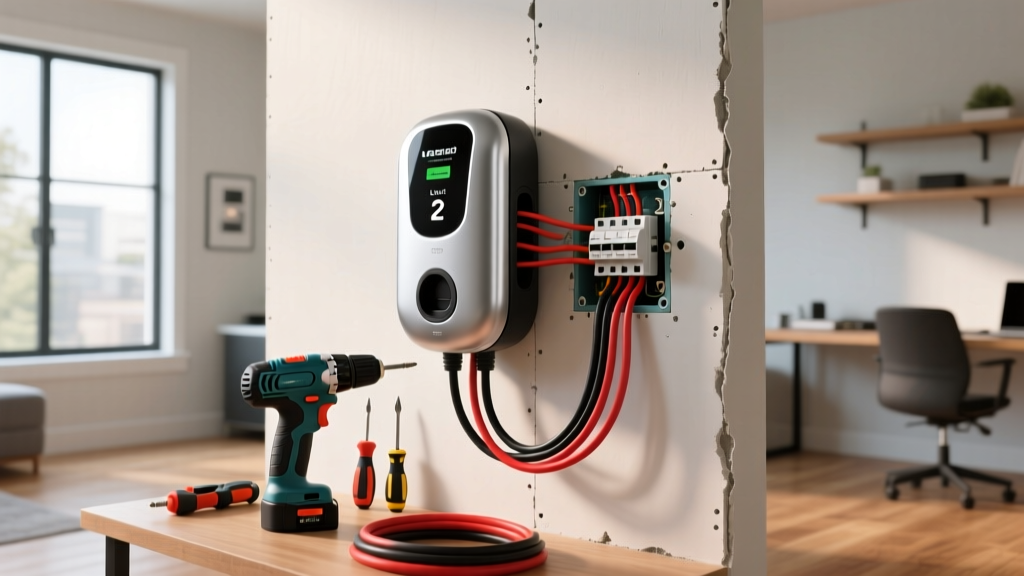
A Level 2 charger requires a dedicated 240-volt circuit — the same type of circuit your electric dryer or oven uses. Here are the specific electrical requirements:
- Voltage: 240V (split-phase, single-phase — standard US residential)
- Circuit amperage: 60A breaker for a 48A charger (NEC requires the continuous load to be no more than 80% of the breaker rating: 48A × 1.25 = 60A)
- Wire gauge: 6 AWG copper (THHN in conduit) for runs up to ~100 feet; 4 AWG for longer runs to limit voltage drop
- Dedicated circuit: The EV charger must be on its own breaker — no sharing with other outlets or appliances
- GFCI protection: NEC 2020 and later require GFCI protection for all 240V EV charging outlets (hardwired installations may be exempt in some jurisdictions — check local code)
- NEMA outlet type: NEMA 14-50 (most common, 50A) or NEMA 6-50; hardwired connections eliminate the outlet and are increasingly preferred for reliability
Hardwire vs. NEMA Outlet: Which Should You Choose?
A hardwired connection is generally more reliable and can support higher amperage (up to 48A continuous on a 60A circuit). A NEMA 14-50 outlet is limited to 40A continuous (50A × 80%) and introduces a connection point that can overheat if the receptacle quality is poor. Several EV owners have reported melted 14-50 receptacles from cheap hardware-store outlets under sustained 40A loads. If you go the outlet route, specify a Hubbell 9450A or Bryant 9450FR industrial-grade receptacle — they cost ~$80 vs. $15 for a generic unit, but they handle continuous high-current loads without thermal degradation.
Connector Compatibility: NACS, CCS1, and CHAdeMO
The connector landscape has consolidated significantly since 2024, when Ford, GM, Rivian, Volvo, and most other automakers adopted the North American Charging Standard (NACS) — originally developed by Tesla. Here's where each brand stands for the 2025–2026 model year:
| Connector | Brands Using It (Native) | Adapter Needed? |
|---|---|---|
| NACS (Tesla standard) | Tesla (all models), Ford (2025+), GM (2025+), Rivian (2025+), Volvo/Polestar (2025+), Hyundai/Kia (2025+), BMW (2025+) | None for new vehicles; CCS→NACS adapters available for older models (~$200–$300) |
| CCS1 | Legacy models: VW ID.4 (pre-2025), older Ford Mustang Mach-E, older Hyundai Ioniq 5/6, older Kia EV6 | CCS1→NACS adapter needed for Tesla Supercharger access |
| CHAdeMO | Nissan Leaf (discontinued after 2025), Mitsubishi Outlander PHEV | CHAdeMO adapters are rare and expensive (~$400+); CHAdeMO infrastructure is declining |
For home Level 2 charging, the connector matters less than you might think. Most Level 2 chargers ship with a NACS connector by default in 2025–2026, and CCS1-terminated units are still available. If you own a CCS1-equipped vehicle and plan to upgrade to a NACS vehicle in the next few years, buy a charger with a swappable connector or purchase the appropriate adapter.
Cost to Charge: Home vs. Public vs. Gas
The economics of home charging are where EV ownership makes the strongest financial case — but the numbers depend heavily on your local electricity rate and whether you can charge during off-peak hours.
| Scenario | Rate | Cost per kWh | Cost per Mile (at 3.5 mi/kWh) |
|---|---|---|---|
| Home off-peak (time-of-use rate) | Residential TOU | $0.08–$0.12 | $0.023–$0.034 |
| Home standard rate | Residential flat | $0.13–$0.18 | $0.037–$0.051 |
| Public Level 2 (ChargePoint, EVgo L2) | Commercial | $0.25–$0.49 | $0.071–$0.140 |
| DC Fast Charge (Electrify America, Tesla Supercharger) | Commercial DC | $0.35–$0.55 | $0.100–$0.157 |
| Gasoline vehicle (28 MPG avg, $3.40/gal) | — | — | $0.121 |
At home off-peak rates, an EV costs roughly 3–4 cents per mile to fuel — about one-quarter the cost of a 28 MPG gas car at $3.40/gallon. Even at standard residential rates, you're still paying roughly half what a gas car costs per mile. The math flips at DC fast chargers, where the per-mile cost can match or exceed gasoline. This is why home charging isn't just convenient — it's the economic foundation of EV ownership.
Pro tip: Most utilities offer time-of-use (TOU) rates that drop electricity to $0.06–$0.10/kWh between 11 PM and 6 AM. A smart Level 2 charger can be scheduled to charge only during these windows, maximizing savings. Check your utility's website or the Alternative Fuels Data Center for EV-specific rate plans in your area.
Best Level 2 Home Chargers for 2025–2026
After testing dozens of units across multiple homes and vehicles, here are the Level 2 chargers that deliver on their spec sheets with reliable long-term performance:
Emporia Vue Level 2 EV Charger
- Power output: 48A (11.5 kW at 240V)
- Connector: NACS (native); CCS adapter included
- Cable length: 24 feet
- Smart features: Wi-Fi, app scheduling, energy monitoring, solar integration, load management with Emporia Vue panel monitor
- Price: ~$399
- Best for: Budget-conscious buyers who want full smart features and solar-aware charging
ChargePoint Home Flex (2nd Gen)
- Power output: Up to 50A (12 kW at 240V) — adjustable in 1A increments to match your circuit
- Connector: NACS (2025+ models); CCS1 available
- Cable length: 18 or 23 feet
- Smart features: Wi-Fi, Alexa/Google Home, app scheduling, detailed session history, Alexa voice control
- Price: ~$549
- Best for: Owners who want adjustable amperage to fit existing circuits without a panel upgrade
Tesla Wall Connector (Gen 4)
- Power output: 48A (11.5 kW at 240V)
- Connector: NACS (native); J1772/CCS vehicles need adapter
- Cable length: 24 feet
- Smart features: Wi-Fi, OTA updates, power sharing (link up to 6 units on one circuit), Tesla app integration
- Price: ~$420
- Best for: Tesla owners and households with multiple NACS-equipped EVs (power sharing is unique)
Grizzl-E Smart (United Chargers)
- Power output: 40A (9.6 kW at 240V)
- Connector: NACS or J1772 (select at purchase)
- Cable length: 24 feet
- Smart features: Wi-Fi, OCPP-compatible (works with utility demand-response programs), RFID access control
- Price: ~$499
- Best for: Outdoor installations (rated to -40°F / -40°C), Canadian-made, built like a tank
Safety, Permits, and Code Compliance
Skipping a permit on an EV charger installation is tempting — it saves $50–$250 and avoids an inspector's visit. But it's a false economy. Here's why code compliance matters:
- Insurance: If an electrical fire is traced to an unpermitted EV charger installation, your homeowner's insurance may deny the claim. The insurer will request the permit and inspection record.
- Resale: Home inspectors increasingly check for permitted EV charger circuits. An unpermitted 60A circuit can delay or derail a home sale.
- Safety: The NEC requirements for EV charging (Article 625) exist because sustained high-current loads generate heat in ways that intermittent loads (like a dryer) do not. Proper wire gauge, torque specifications on terminals, and GFCI protection prevent fires.
Key code requirements for a compliant installation:
- Dedicated circuit with no other outlets or loads
- GFCI breaker (for receptacle-based installs in most jurisdictions post-NEC 2020)
- Outdoor-rated (NEMA 4) enclosure and charger if installed outside
- Proper wire gauge for the circuit amperage and run length (accounting for voltage drop on runs exceeding 100 feet)
- Torqued connections to manufacturer specification — this is where most DIY installs fail and where inspectors focus
The federal government also offers a tax credit for home EV charging equipment under IRS Form 8911 — the Alternative Fuel Vehicle Refueling Property Credit. This credit covers up to 30% of the cost of the charger and installation, capped at $1,000 for residential property. Eligibility depends on your census tract meeting certain low-income or rural criteria, so verify your address on the IRS tool before counting on it.
Frequently Asked Questions
Can I install an EV charger myself?
If you're experienced with 240V electrical work (you've wired a dryer or sub-panel), a hardwired install is technically straightforward. However, most homeowners should hire a licensed electrician because the NEC requires a permit and inspection for new 240V circuits, and the sustained-load nature of EV charging demands proper torque specs and wire management that differ from typical appliance wiring.
Will a Level 2 charger work with any EV?
Yes, with the right connector. Every EV sold in the US since 2015 supports Level 2 AC charging. The only variable is the physical connector: NACS (Tesla and most 2025+ models) or CCS1 (legacy models). Adapters bridge the gap, and most charger manufacturers now sell units with your choice of connector.
How fast will a 48A Level 2 charger charge my EV?
A 48A charger delivers 11.5 kW at 240V. For a vehicle with a 75 kWh battery (Tesla Model Y, Ford Mustang Mach-E Extended Range), that's a 10–80% charge in roughly 4.5 hours. For a larger 100 kWh battery (GMC Hummer EV, Rivian R1T Max Pack), expect about 6 hours for the same 10–80% session. The rate is linear and predictable — unlike DC fast charging, there's no significant taper on Level 2.
Do I need a smart charger, or is a basic unit fine?
A basic "dumb" charger (no Wi-Fi, no app) works perfectly for charging. A smart charger adds scheduling (charge only during off-peak TOU hours), energy monitoring, remote start/stop, and integration with solar panels or utility demand-response programs. If your utility offers TOU rates, the smart scheduling alone pays for the price difference within months.
What if my garage is detached or far from the panel?
Long wire runs (100+ feet) require upsizing the wire gauge to limit voltage drop — typically from 6 AWG to 4 AWG copper, which adds $2–$4 per foot in material cost. For runs exceeding 150 feet, some electricians recommend a sub-panel in the garage, fed by a larger-gauge aluminum feeder, with a short copper run from the sub-panel to the charger. This can actually reduce total cost compared to a very long 6 AWG copper run.
Can I use my existing dryer outlet for EV charging?
Technically, a NEMA 14-50 outlet (common for dryers) can power a Level 2 charger. But NEC code requires a dedicated circuit for EV charging — you cannot share a circuit with a dryer. Some homeowners install a smart splitter (like the NeoCharge Smart Splitter, ~$450) that safely alternates between the dryer and the EV charger on the same 50A circuit, ensuring only one draws power at a time. This avoids a new circuit run but adds equipment cost and a slight convenience trade-off.