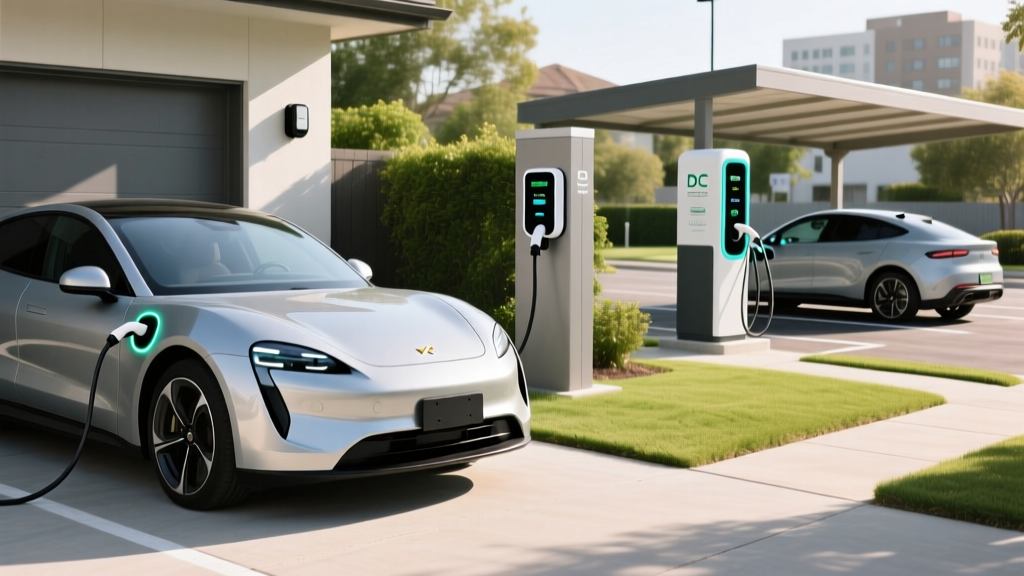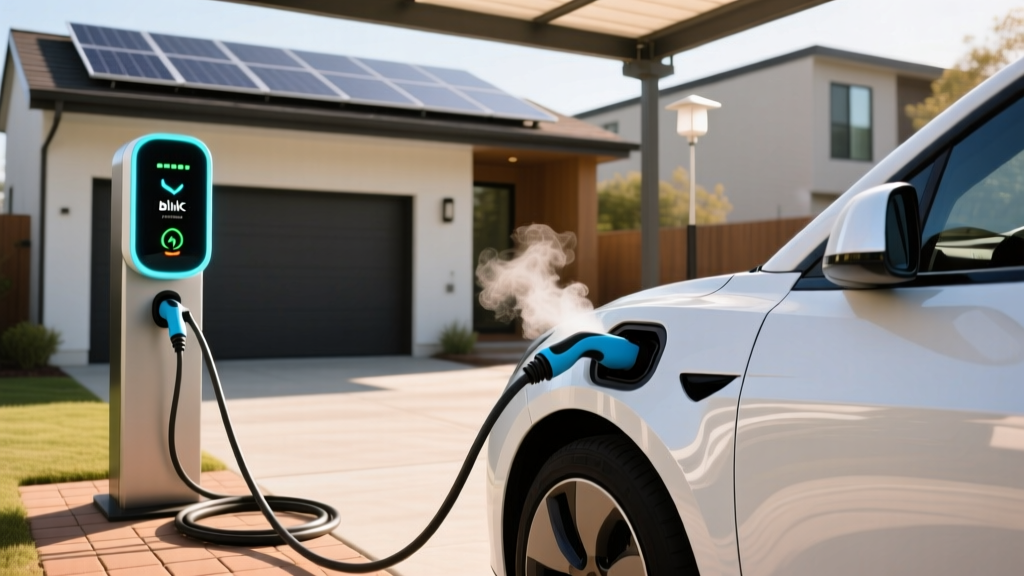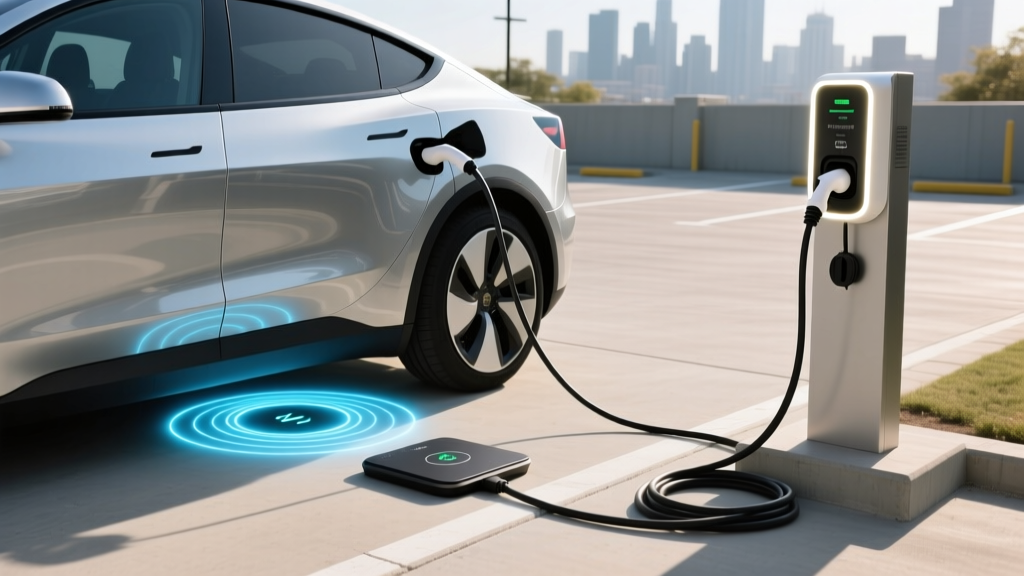
If you've ever set a phone on a charging pad and walked away, you've used inductive charging. Now imagine doing the same with your electric vehicle: pull into the garage, step out, and the car begins charging with no cable to plug in. Wireless EV charging has moved from concept to commercial availability, with systems like WiTricity and Plugless Power reaching consumers and OEMs like BMW and Mercedes-Benz offering or testing integrated receiver pads. But how does an inductive charger actually work at the power levels needed to fill a 75–100 kWh EV battery, and is it worth the premium over a conventional plug-in Level 2 station?
This guide breaks down the physics of inductive power transfer, compares it head-to-head with wired Level 2 charging, and walks through the real-world costs, speeds, and installation requirements you need to know before investing in either approach.
The Physics: How Does an Inductive Charger Work?
Inductive charging relies on electromagnetic induction — the same principle behind transformers and electric motors. Here's the sequence:
- Transmitter coil (ground pad): A flat coil embedded in a pad on your garage floor or driveway is connected to a 240V AC power source. Alternating current flows through the coil, generating an oscillating magnetic field.
- Receiver coil (vehicle pad): A matching coil mounted under the EV sits within a few inches of the transmitter. The magnetic field passing through this coil induces an alternating current in it.
- Rectification and regulation: Onboard electronics convert the induced AC into DC and regulate voltage to charge the traction battery, just as a wired charger's onboard converter does.
- Communication handshake: A low-power signal between the pads confirms alignment, negotiates power levels, and monitors foreign-object detection (FOD) — ensuring no metal debris or living objects sit between the coils.
The key specification is the air gap — the distance between transmitter and receiver coils. Most consumer EV systems operate at 4–8 inches (100–200 mm). Efficiency drops as the gap widens; modern resonant inductive systems (which tune both coils to the same resonant frequency, typically 85 kHz per the SAE J2954 standard) achieve 90–93% end-to-end efficiency at optimal alignment. That compares to roughly 95–97% for a hardwired Level 2 plug-in charger.
Charging Levels and Speeds: Inductive vs. Plug-In Compared
Before comparing wireless to wired, let's establish what each charging level actually delivers. Remember: kW (kilowatts) measures power — the rate of energy flow. kWh (kilowatt-hours) measures energy — the total amount stored in your battery. A 7.7 kW charger adds 7.7 kWh of energy per hour (minus efficiency losses).
| Level | Power (kW) | Miles of Range/Hour | 10–80% Time (75 kWh Battery) | Typical Use |
|---|---|---|---|---|
| Level 1 (120V) | 1.0–1.4 kW | 3–5 mi/hr | 38–53 hours | Emergency / overnight top-up |
| Level 2 Plug-In (240V) | 7.7–19.2 kW | 25–75 mi/hr | 4.5–6.5 hours (at 7.7 kW) | Primary home / workplace charging |
| Level 2 Inductive (240V) | 3.6–11 kW | 12–40 mi/hr | 5–8 hours (at 7.7 kW equivalent) | Hands-free home / fleet charging |
| DC Fast Charging | 50–350 kW | 150–1,000+ mi/hr | 18–45 minutes | Road trips / rapid top-ups |
Current consumer inductive systems max out at 11 kW (WiTricity's Halo system, used in aftermarket kits). Most production installations deliver 3.6–7.7 kW. That's sufficient for overnight charging of virtually any EV — a 75 kWh battery at 7.7 kW reaches 80% in roughly 6 hours — but it won't match the fastest plug-in Level 2 units that push 11.5–19.2 kW.
For context, DC fast charging operates in an entirely different league. A 350 kW DCFC station can push a compatible EV from 10–80% in 18–25 minutes. Inductive charging is strictly a Level 2 replacement, not a DCFC substitute.
How Much Does It Cost to Install a Home EV Charger?
Whether you go wireless or wired, the electrical infrastructure is largely the same: both require a dedicated 240V circuit from your panel. Here's the full cost breakdown for a typical home installation.
| Component | Wired Level 2 | Inductive (Wireless) |
|---|---|---|
| Charger equipment | $350–$750 | $2,500–$4,500 |
| Vehicle receiver pad (if not OEM-integrated) | N/A | $1,500–$3,000 |
| Electrician labor (run 240V/40–50A circuit) | $500–$2,000 | $500–$2,000 |
| Permit and inspection | $50–$250 | $50–$250 |
| Panel upgrade (100A → 200A, if needed) | $1,500–$3,500 | $1,500–$3,500 |
| Total (no panel upgrade) | $900–$3,000 | $4,550–$9,750 |
| Total (with panel upgrade) | $2,400–$6,500 | $6,050–$13,250 |
The panel upgrade is the wildcard that catches many homeowners off guard. If your home has a 100-amp service panel — common in houses built before 2000 — adding a 40A or 50A dedicated EV circuit may exceed your panel's capacity, especially if you're also running electric heat, a dryer, and an oven. A licensed electrician will perform a load calculation per NEC Article 220 to determine if an upgrade is required. Don't skip this step.
On the federal side, the IRS Residential Clean Energy Credit (IRC §25D) covers 30% of the cost of EV charging equipment and installation, up to $1,000 per year for the equipment portion, through 2032. This applies to both wired and inductive chargers installed at your primary residence. Check with a tax professional for eligibility specifics.
Which Connector or Charger Is Compatible with My EV?
This is where inductive charging faces its biggest practical limitation: you need a receiver pad on the vehicle. Unlike plug-in charging, where a universal connector handles the connection, wireless charging requires hardware on both sides.
| Connector / System | Type | Compatible Vehicles | Adapter Needed? |
|---|---|---|---|
| NACS (J3400) | Wired (AC + DC) | Tesla (all), Ford, GM, Rivian, Volvo, Polestar, others adopting through 2025–2026 | CCS→NACS adapter for older non-Tesla EVs at Superchargers |
| CCS1 (Combo) | Wired (AC + DC) | Hyundai, Kia, VW, BMW, Mercedes, most legacy non-Tesla EVs | NACS→CCS adapter for Tesla Superchargers |
| CHAdeMO | Wired (DC only) | Nissan Leaf, Mitsubishi Outlander PHEV (legacy) | Limited adapter options; network declining |
| J1772 | Wired (AC only) | All EVs (NACS vehicles via adapter) | NACS vehicles need J1772→NACS adapter |
| SAE J2954 Inductive | Wireless | Aftermarket kits (Plugless); BMW 530e (pilot); select fleet vehicles | Vehicle must have or be retrofitted with receiver pad |
As of 2026, no mass-market EV sold in the U.S. ships with an integrated inductive receiver pad as standard equipment. The WiTricity Halo system is available as an aftermarket kit for select vehicles, and Plugless Power (Evatran) has offered retrofit kits for models like the Nissan Leaf and Chevrolet Volt in the past. BMW tested a wireless charging pad for the 530e iPerformance in limited markets. If your EV doesn't have a factory receiver, you're looking at a retrofit — which adds cost and requires underbody modification.
Equipment Recommendations: Top Chargers for Home Use
Whether you choose wired or wireless, here are the top-performing home charging solutions available in 2026, with exact specifications.
ChargePoint Home Flex (Wired)
- Power output: Up to 12 kW (50A) on a 60A circuit, or 9.6 kW (40A) on a 50A circuit
- Connector: NACS (J3400) native; J1772 version also available
- Cable length: 23 feet
- Smart features: Wi-Fi, scheduling, Alexa/Google integration, energy tracking, load sharing
- Price: $549–$599
- Best for: Most EV owners wanting reliable, fast Level 2 charging
Tesla Wall Connector (Wired)
- Power output: Up to 11.5 kW (48A) on a 60A circuit
- Connector: NACS native; includes J1772 adapter in box
- Cable length: 24 feet
- Smart features: Wi-Fi, over-the-air updates, power sharing between multiple units, access control
- Price: $425
- Best for: Tesla owners and NACS-equipped EVs on a budget
WiTricity Halo (Inductive)
- Power output: Up to 11 kW (ground pad transmitter)
- Connector: Wireless — no physical connector; SAE J2954 compliant
- Cable length: N/A; ground pad connects to 240V junction box
- Smart features: Alignment assist via app, foreign object detection, auto-start on park
- Price: ~$3,000–$4,500 (ground pad + control unit); vehicle receiver sold separately
- Best for: Fleet operators, garage-parkers who want zero-effort plug-in, accessibility needs
Emporia Vue EV Charger (Wired)
- Power output: Up to 11.5 kW (48A)
- Connector: J1772 (NACS adapter included)
- Cable length: 24 feet
- Smart features: Integration with Emporia home energy monitor, solar-aware scheduling, circuit-level load management
- Price: $399
- Best for: Solar owners wanting integrated energy management
How Much Does Charging Cost Per Mile vs. Gas?
The economics of EV charging depend heavily on where and when you charge. Here's a realistic cost-per-mile comparison using a 2026 mid-size EV (averaging 3.0 miles/kWh or 112 MPGe) versus a comparable gas car at 28 MPG combined.
| Scenario | Rate ($/kWh) | Cost/Mile | Annual Cost (12,000 mi) |
|---|---|---|---|
| Home, off-peak (utility time-of-use) | $0.09–$0.13 | $0.03–$0.04 | $360–$480 |
| Home, standard residential rate | $0.14–$0.18 | $0.05–$0.06 | $600–$720 |
| Home, inductive (93% efficiency penalty) | $0.14–$0.18 (effective $0.15–$0.19) | $0.05–$0.065 | $640–$780 |
| Public Level 2 (ChargePoint, EVgo) | $0.25–$0.49 | $0.08–$0.16 | $960–$1,920 |
| DC Fast Charging (Electrify America, Tesla) | $0.35–$0.58 | $0.12–$0.19 | $1,440–$2,280 |
| Gasoline (28 MPG, $3.40/gal) | — | $0.12 | $1,440 |
The takeaway: home charging is dramatically cheaper than gas, saving $700–$1,100 per year. Public DC fast charging, however, can equal or exceed gasoline costs per mile. Inductive charging adds a modest 5–8% efficiency penalty — roughly $40–$60 extra per year compared to wired home charging. That's the "convenience tax" for going wireless.
Safety, Electrical Code, and Installation Requirements
Both wired and inductive chargers must comply with the National Electrical Code (NEC Article 625) and local building codes. Here are the non-negotiable requirements:
- Dedicated circuit: Your EV charger must be on its own breaker — no sharing with other appliances. A 40A charger requires a 50A breaker (NEC requires circuits to be rated at 125% of continuous load).
- GFCI protection: The 2020 NEC and later require GFCI (Ground Fault Circuit Interrupter) protection for all EV charging outlets. Hardwired units typically have GFCI built into the charger itself.
- Outdoor rating: If your charger is installed outside (driveway or exterior wall), it must carry a NEMA 4 or NEMA 4X rating for weather resistance. All major wired chargers meet this; for inductive ground pads, the transmitter is sealed and rated for outdoor embedment or surface mounting.
- Wire gauge: A 50A circuit requires 6 AWG copper wire; a 60A circuit requires 4 AWG. Your electrician will size this based on run length and local code.
- Permit and inspection: Virtually all jurisdictions require an electrical permit for EV charger installation. The inspection verifies proper grounding, breaker sizing, and GFCI compliance. Budget $50–$250 for the permit fee.
Is Inductive Charging Worth It for Your EV?
For most private EV owners in 2026, wired Level 2 charging remains the practical choice. A high-quality plug-in station like the ChargePoint Home Flex or Tesla Wall Connector delivers faster charging, lower cost, and universal compatibility for under $600 in equipment. The installation is straightforward, and you can move the charger to your next home.
Inductive charging makes sense in specific scenarios:
- Fleet and ride-hailing operations where drivers cycle in and out of charging spots dozens of times per day — eliminating plug/unplug wear and driver effort
- Accessibility needs — drivers with mobility limitations who cannot manage heavy charging cables
- Premium garage setups where a clean, cable-free floor is a priority and cost is secondary
- Future autonomous vehicle applications — self-parking EVs that align themselves over a pad without human intervention
Until OEMs begin integrating receiver pads as standard equipment — something the SAE J2954 standard is designed to enable — inductive charging will remain a niche, premium option. But the technology works, it's safe, and it's only getting more efficient.
Frequently Asked Questions
How much does it cost to install a home EV charger?
A wired Level 2 home charger costs $900–$3,000 fully installed (equipment, electrician labor, and permit), assuming no panel upgrade is needed. If your home requires a 100A-to-200A panel upgrade, add $1,500–$3,500. An inductive (wireless) system costs $4,550–$9,750 before a panel upgrade, due to the higher cost of transmitter and receiver pads.
How fast will each charging level add range?
Level 1 (120V) adds 3–5 miles of range per hour. Level 2 wired (240V, 7.7–12 kW) adds 25–45 miles per hour. Level 2 inductive (3.6–11 kW) adds 12–40 miles per hour depending on power level. DC fast charging (50–350 kW) can add 150–1,000+ miles per hour at peak rate, though the charge curve tapers significantly above 80% state of charge.
Which connector or charger is compatible with my EV?
For wired charging: if your EV is a Tesla or a 2025+ model from Ford, GM, Rivian, Volvo, or Polestar, you likely have the NACS (J3400) connector. Most other EVs use CCS1. All EVs can use J1772 for Level 2 with an adapter if needed. CHAdeMO is legacy (Nissan Leaf). For inductive charging, your vehicle must have or be retrofitted with a receiver pad — no universal connector standard applies.
How much does charging cost per mile vs. gas?
Home charging at off-peak rates costs $0.03–$0.04 per mile — roughly one-quarter the cost of gasoline at $0.12/mile (28 MPG, $3.40/gallon). Standard residential rates bring EV cost to $0.05–$0.06/mile. Public DC fast charging at $0.35–$0.58/kWh costs $0.12–$0.19/mile, which can equal or exceed gasoline. Inductive charging adds a ~5–8% efficiency penalty over wired Level 2.
What electrical upgrades might I need?
The most common upgrade is a panel capacity increase from 100A to 200A, needed when your existing panel can't support an additional 40–50A continuous load. Other potential upgrades include running new conduit from the panel to the garage, upgrading wire to proper gauge (6 AWG or 4 AWG copper), adding a GFCI breaker, and obtaining a local electrical permit. Homes built after 2010 with 200A service typically need only the dedicated circuit run.
Is wireless EV charging safe in rain or snow?
Yes. Inductive ground pads are sealed to NEMA 4X or IP68 standards and designed for outdoor installation. The SAE J2954 standard includes foreign object detection (FOD) that shuts down power transfer if metal debris, animals, or other objects are detected between the pads. There are no exposed electrical contacts, which actually makes inductive charging safer than plug-in connectors in wet conditions.
Does inductive charging degrade my EV battery faster?
No. The charging method (inductive vs. wired) does not affect battery degradation. What matters is the charge rate (kW), state-of-charge range, and battery temperature — all of which are managed by the vehicle's battery management system (BMS) identically regardless of how the DC current arrives. Level 2 inductive charging at 7.7–11 kW is well within safe charge rates for modern NMC and LFP batteries.